



Top view of surfer with board walking along beach with waves and golden sand

Australia and New Zealand Foreign Direct Investment Attractiveness Survey 2026

Australia and New Zealand are among the world’s most admired investment destinations. But the qualities investors admire about our countries aren’t necessarily those that determine where capital flows.


In brief:

  • Investors value the quality of life, political stability and sustainability credentials on both sides of the Tasman.
  • But other factors – workforce capability, labour costs, level of R&D, and innovation and tax competitiveness – guide investment decisions.
  • Our nations’ future competitiveness will depend on converting reputation into execution.

For decades, Australia and New Zealand have sold a simple story to the world: we are prosperous, safe, and stable places to invest. That story has served us well.

Strong institutions, trusted legal systems, transparent markets and high living standards helped attract global capital. But in a more geopolitically fragile, fragmented and technology-intensive global economy, capital is becoming more selective.

Beyond quality of life, safety, diversity and culture, investors are focused on the ability to turn ideas into commercial outcomes, mobilise talent, deliver projects and scale growth.

Investors are hunting for economies that can deploy infrastructure quickly, build workforce capability rapidly and commercialise innovation effectively.

The reputation reality check

The EY Australia and New Zealand Foreign Direct Investment Attractiveness Survey reveals a growing tension at the heart of the Trans-Tasman investment proposition.


On one hand, both countries continue to attract significant international investment. From 2015 to 2025, more than 4,600 foreign direct investment projects worth almost US$400 billion were announced across both Australia and New Zealand, supporting nearly 400,000 jobs.


These investments have helped deliver infrastructure, transfer expertise, accelerate innovation, strengthen business ecosystems, develop skills and support the high-growth sectors that will shape future prosperity. Importantly, they have helped fund the services that our citizens expect.


Yet the survey also reveals a disconnect between the qualities investors admire most about Australia and New Zealand and the factors that are increasingly shaping investment decisions.

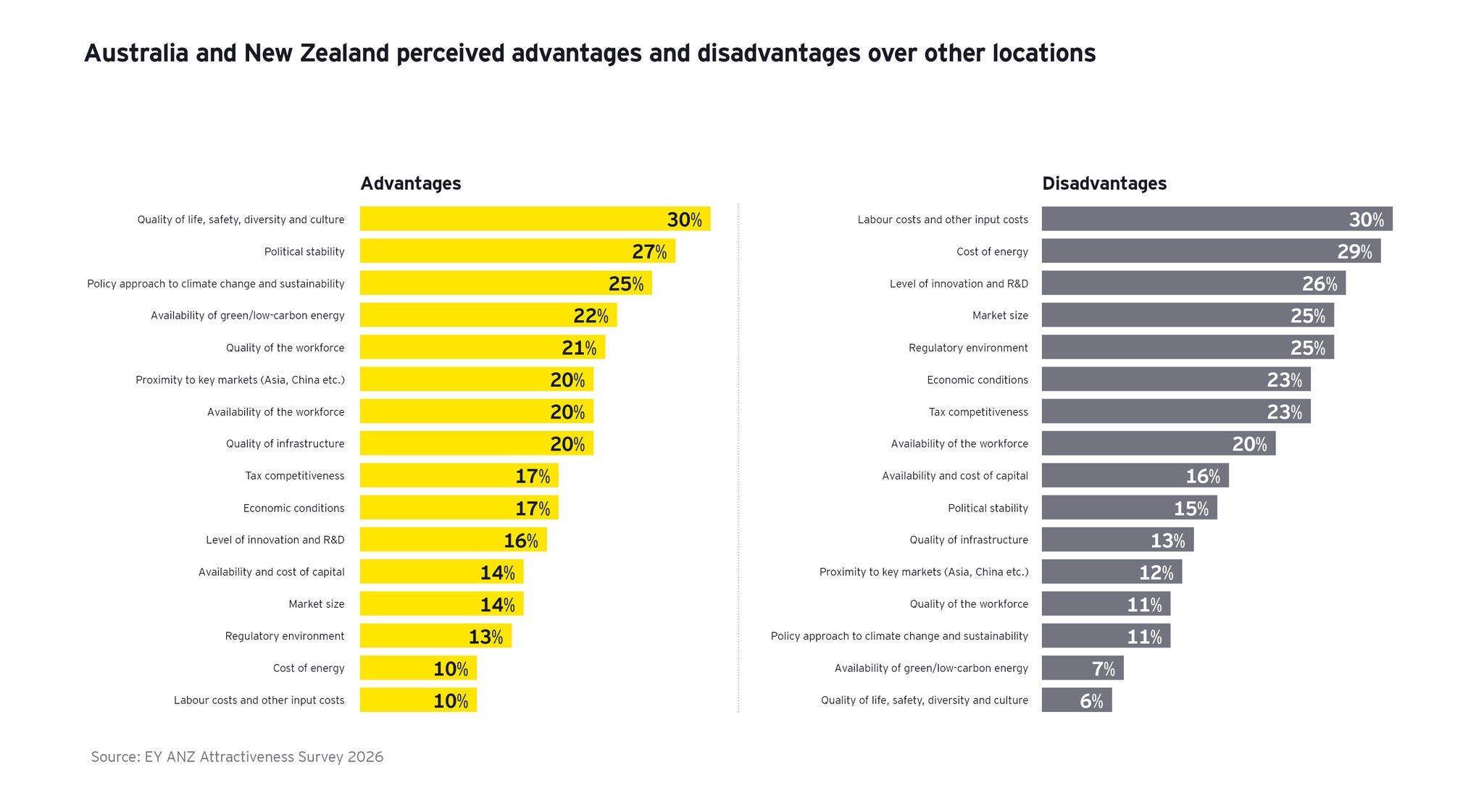
Advantages and disadvantages chart

Our survey captured the views of 300 international business decision-makers across a range of industries, markets and organisation sizes.

Australia ranked fifth and New Zealand eleventh overall for foreign investment attractiveness, despite being assessed alongside larger regional blocs including Western Europe and the Gulf countries. Investors continue to value many of the attributes that have traditionally underpinned the region's appeal, including quality of life, political stability, and climate and sustainability settings.


These are not trivial strengths. Stability and predictability are highly valued against a backdrop of geopolitical uncertainty, supply chain disruption and economic volatility.


But the qualities investors most admire about Australia and New Zealand are not necessarily the qualities they prioritise when allocating capital.


When assessing investment destinations, investors place greatest weight on workforce capability, labour and input costs, innovation capacity, market scale and tax competitiveness. These are also the areas where Australia and New Zealand face some of their strongest competitive pressures.


What investors value is changing

Around the world, governments are competing to attract investment linked to artificial intelligence, advanced manufacturing, digital infrastructure, clean energy and critical minerals.


As a result, investors are placing greater emphasis on factors such as labour availability and quality, labour and input costs, R&D intensity, market size and tax competitiveness.


Top five global investment priorities

30%
30%
availability and quality of the workforce
29%
29%
labour costs and other input costs
26%
26%
level of R&D and innovation
21%
21%
Market size
21%
21%
tax competitiveness

Friction points

Regulatory complexity emerged as one of the clearest friction points. Only 16% of respondents viewed Australia's approvals processes for foreign investment as “not at all restrictive”. In New Zealand, the figure was 5%.

While both countries have introduced reforms to improve investment pathways, the findings suggest investors continue to perceive approval processes as complex and difficult to navigate.

This matters because capital is mobile. Investors are not simply comparing tax rates or labour costs. They are comparing the ease with which opportunities can be converted into value. Markets that can provide talent, infrastructure, policy certainty and efficient project delivery are increasingly gaining an edge.

Australia and New Zealand have been prosperous, safe and stable places to invest, but must do more to continue to attract capital. Investors increasingly prioritise countries that are agile, build capability and adapt to change.

Australia and New Zealand have strong foundations as investment destinations, but investors are prioritising countries that are agile, focused on building capability and adapting to change.

Three priority areas for future competitiveness

The report identifies three strategic priorities for governments and policymakers to consider.

1. Innovation, AI and the digital economy

Almost half (46%) of investors said improving technology infrastructure should be the top priority for Australia and New Zealand to strengthen attractiveness for AI investment and innovation.

In response, the report suggests pre-zoned, investment-ready data centre precincts are one of the highest-leverage economic opportunities available to both countries, supported by abundant renewable energy resources, available land and strong international connectivity.

2. Workforce, mobility and productivity

Three in 10 investors who redirected capital away from Australia and New Zealand cited better access to technology or skilled labour elsewhere as a contributing factor. The report explains the role of targeted migration settings, fast-track arrangements for specialised talent and stronger workforce development pathways in addressing these challenges.

3. Tax competitiveness and investment certainty

Investors consistently identified tax certainty and predictability as important elements of an attractive investment environment. In fact, 19% of those surveyed said a lack of stable, predictable and competitive tax settings are a leading risk to the future attractiveness of Australia and New Zealand.

The report suggests that tax settings should be considered as part of a broader competitiveness agenda encompassing investment certainty, regulatory efficiency and business confidence.

Summary

Future competitiveness will depend on how effectively Australia and New Zealand translate strengths into capability, productivity and growth. The collective challenge is to create the conditions that allow investment to succeed once it arrives.

About this article

Authors

Related articles

Five forces shaping foreign direct investment in Europe

Repositioning Europe for the next wave of global investment around five forces that will shape the region’s attractiveness and competitiveness. Learn more.