






Indian customer support agent wearing headset working on computer late at night in modern dark office setting

Is SOC maturity your hidden resilience gap?


Why banks and insurers must modernize SOC operations to stay resilient against cyber threats and rising regulation.


In brief

  • Cyberattacks are inevitable, making SOC maturity essential for operational resilience, rapid response and regulatory compliance. 
  • Traditional SOCs struggle with threats of mass exploitation, rising alert volumes and costly 24/7 monitoring requirements. 
  • Next-generation SOCs use automation and risk-driven operations to improve resilience, scalability and response effectiveness.

Cyberattacks have become an unavoidable cost of doing business for banks and insurance companies as evidenced by the risk monitor that FINMA1 publishes annually. As cybercrime becomes increasingly industrialized and AI accelerates the speed and scale of attacks, the question is no longer whether an institution will be targeted, but how effectively it can detect, contain and recover from a compromise.

FINMA Risk Monitor 2024
30%
30%
Year-on-year increase in reports of successful or partially successful attacks in the banking and insurance sector.

This shift in perspective has significant implications for operational resilience. While organizations have traditionally emphasized prevention through perimeter defenses, awareness programs and reactive controls, the evolving threat landscape has increasingly challenged this approach.


As a result, resilience now depends not only on preventing attacks but also on detecting and responding to them quickly. This requires a shift from signature- and rule-based methods to analytics- and behavior-driven capabilities, elevating the security operations center (SOC) from a monitoring function to a key enabler of resilience.


SOC maturity has become critical to operational resilience

The modern SOC sits at the intersection of cybersecurity, operational continuity and regulatory compliance. Its effectiveness directly shapes how quickly an organization can detect malicious activity, assess the severity of an incident and coordinate containment measures before disruption spreads across critical business processes.


Why detection and response matter more than prevention

Given the increasing inevitability of successful attacks, cybersecurity effectiveness is defined less by prevention alone and more by the speed and quality of detection and response. Moreover, considering its central role in an organization’s defense capabilities, the SOC can no longer be viewed purely through a technology lens. Its operational effectiveness now influences executive decision-making, crisis management, customer trust and supervisory confidence.


Yet despite the growing importance of SOC capabilities, many financial institutions still have security operations environments in place that are not designed for the realities of the modern threat landscape.


The critical gap between perceived and actual maturity

One of the more concerning trends observed across the industry is the disconnect between how organizations perceive the maturity of their SOC and how those capabilities perform under real operational pressure.


Many institutions – almost 70% according to the SANS SOC Survey 20252 – continue to rely heavily on manual processes for the critical operational activity of metric reporting. This practice is characteristic of traditional SOC operating models that were designed for lower volumes of alerts and slower-moving threat environments.


While these models may still create the appearance of operational control during routine conditions, they often struggle when faced with large-scale or fast-moving attack scenarios.


How organizations routinely overestimate SOC readiness

At the same time, organizations frequently overestimate their own maturity across key operational domains. Our experience conducting SOC maturity assessments in the European market using the Security Operations Center Capability Maturity Model (SOC-CMM), which is grounded in international standards, confirms this pattern. Internal assessments may conclude that incident response processes are well defined, monitoring coverage is sufficient or automation capabilities are adequately developed. However, independent evaluations often reveal significant gaps between documented procedures and actual operational execution.


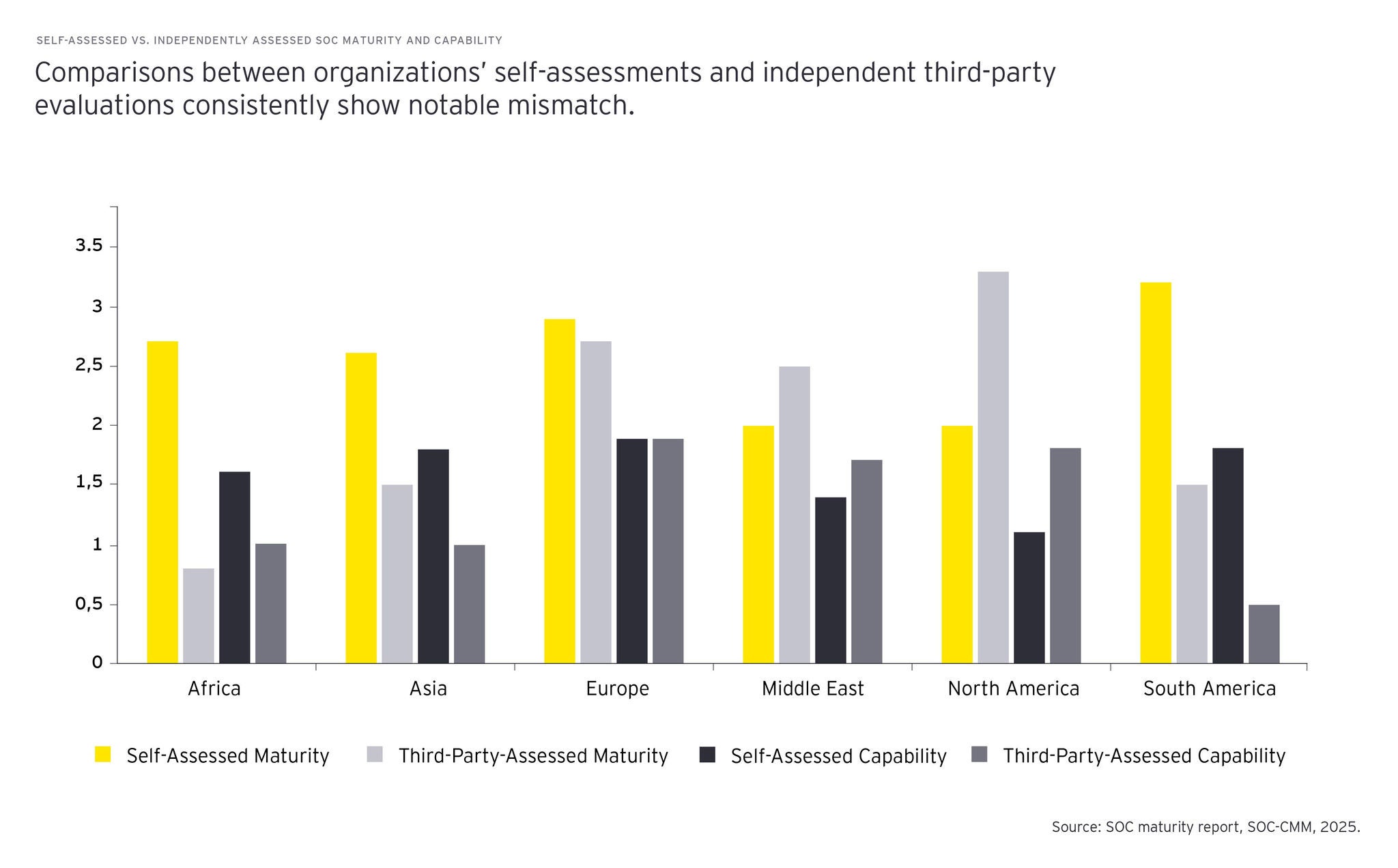
In its SOC maturity report 20253, the SOC-CMM foundation found that there is a mismatch across regions between organizations’ own rating of both their SOC maturity and operational capabilities compared with independent third-party assessments.

ey.com-graphic-template 11_chart

The gap is particularly pronounced in Africa and South America but can be observed across all major markets. In most regions including in Europe, organizations tend to rate their SOC capabilities higher than third-party assessments, whereas financial institutions in the Middle East and North America tend to underestimate their SOC maturity. This highlights the importance of objective benchmarking and independent validation when assessing SOC readiness and defining transformation priorities.

Why robust SOC readiness matters

Such maturity estimation errors create a critical form of organizational blind spot. When leadership assumes that the SOC is operating at a different level of maturity than it actually is, investment priorities may become distorted. Critical weaknesses remain unresolved while resources are allocated toward lower-impact initiatives. Operational shortcomings may only become visible once a major cyber incident occurs, at which point remediation options become significantly more limited and costly. In many cases, institutions discover too late that their SOC lacks the scalability, automation and coordination mechanisms required to respond effectively under sustained pressure.

Regulatory expectations are raising the stakes

The growing regulatory focus on operational resilience has intensified the pressure on banks and insurance companies to strengthen their SOC maturity.

Supervisory authorities increasingly expect organizations to demonstrate not only that they maintain cybersecurity controls, but also that they can detect, manage and report material cyber incidents within highly compressed timeframes.

In Switzerland, for example, financial institutions are expected to report material cyber incidents within 24 hours of detection as part of broader operational resilience requirements4. For severe incidents, this expectation applies irrespective of business hours, while lower-severity incidents are generally subject to reporting timelines aligned with official banking business days.

While FINMA does not explicitly mandate continuous 24/7 SOC monitoring, its expectation that institutions detect cyberattacks as quickly as possible makes continuous monitoring and response capabilities increasingly difficult to avoid.

Institutions face rising compliance costs

Rising regulatory scrutiny introduces substantial operational and financial challenges. Traditional SOC models are resource-intensive by design. Maintaining continuous coverage frequently requires globally distributed analyst teams operating across multiple time zones. In our experience, organizations operating a 3x8 shift model with limited shift overlaps typically require at least 5.5 to 6 full-time employees (FTEs) for each continuously staffed role to ensure uninterrupted coverage. However, this figure can vary significantly depending on the operating model and the organization’s level of investment in staffing.

For institutions relying heavily on manual processes, these staffing demands quickly become difficult to scale. Potential cybersecurity talent shortages could further intensify the problem, while the complexity of modern attacks in any case increases the level of expertise required from operational teams.

The corresponding tension between rising regulatory expectations and the limited scalability of traditional SOC operating models is driving the need for a fundamentally different approach to security operations.

Why next-generation SOCs are becoming a necessity

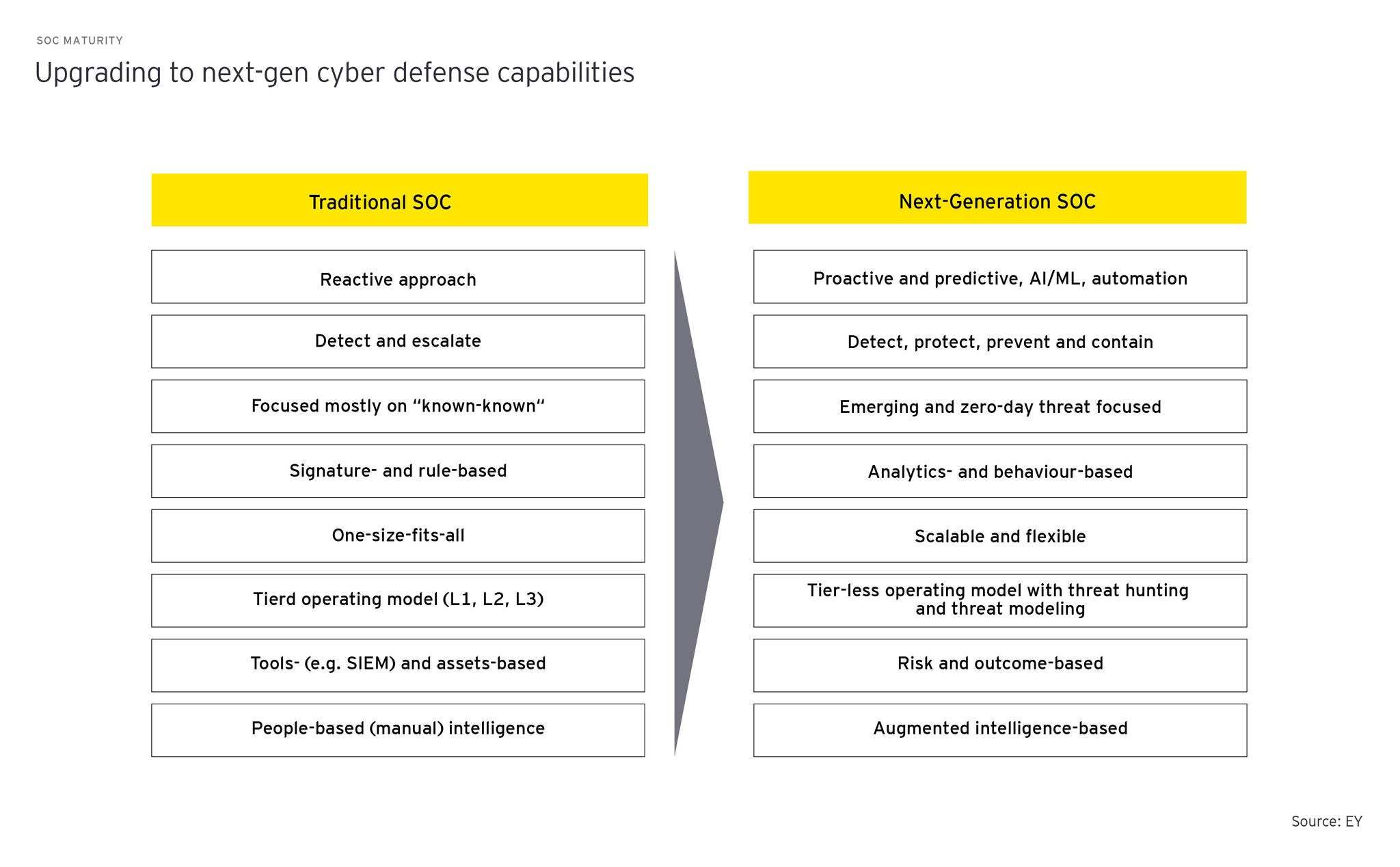
The next-generation SOC is not simply a traditional SOC with additional tools layered on top. It represents a broader operational transformation centered around automation, intelligence-driven processes and tighter integration with enterprise risk management.

The core objective is to shift security operations from reactive firefighting toward proactive and scalable resilience.

ey.com-graphic-template 11
The next-generation SOC is not simply a traditional SOC with additional tools layered on top.

Automation and proactivity as a remedy

Next-generation SOC models seek to address these limitations by embedding automation and AI-enabled decision support directly into operational workflows. Increasingly, this includes the use of AI-enabled investigation capabilities that help automate triage, analysis and response activities within the existing security stack while maintaining appropriate human oversight.

Routine investigation and response activities, which often consume significant analyst capacity, can be orchestrated automatically. Threat intelligence can enrich alerts in real time. Automated playbooks can initiate predefined containment actions before human intervention becomes necessary.

Combined with machine learning models that prioritize incidents based on behavioral anomalies and business context, implementing organizations should be able to improve detection and response times, increase consistency in incident handling and reduce reliance on scarce specialist resources.

Furthermore, as regulatory expectations rise and attackers increasingly leverage automation themselves, these capabilities help organizations strengthen resilience while easing the operational burden of maintaining around-the-clock monitoring and response functions.

Risk- and outcome-driven approach

This applies equally to internally operated SOCs and outsourced service models, as institutions ultimately remain responsible for governance, incident response coordination and regulatory reporting obligations.

Mature SOCs have completed a shift from a tools- and assets-based concept to risk- and outcome-based strategies. They increasingly integrate cyber incident handling into broader operational resilience processes, ensuring that decision-making responsibilities are clearly defined and escalation paths are unambiguous.

This integration enables management teams to make faster and more informed decisions during crises. It also strengthens organizational coordination across legal, compliance, communications and business continuity functions.

Technology alone does not define a next-generation SOC – equally important is the alignment between security operations, enterprise risk management and executive governance structures.

Assessing SOC maturity

Despite broad agreement on the direction of travel, many organizations struggle with a fundamental question: what exactly do they need to do to tighten their digital operational resilience and where should they invest first?

SOC maturity is now a business issue

The evolution of the threat landscape has fundamentally changed the role of security operations within financial institutions.

SOC maturity is no longer a narrow technical consideration delegated exclusively to cybersecurity teams. It has become a core determinant of operational resilience, regulatory readiness and organizational stability.

Institutions that continue to rely on heavily manual and reactive operating models face mounting operational strain. Alert volumes will continue to grow. Regulatory expectations will continue to tighten. Attackers will continue to accelerate the speed and scale of exploitation through automation and AI-driven techniques.

In that environment, organizations that fail to modernize their SOC capabilities risk becoming increasingly reactive, increasingly costly to operate and increasingly vulnerable to disruption.

That said, the path forward requires a realistic and pragmatic approach. Organizations must be willing to challenge internal assumptions about their current capabilities and confront operational weaknesses before attackers expose them under crisis conditions. They must recognize that resilience cannot be achieved through isolated technology investments alone. It requires coordinated transformation across processes, governance, automation and management structures.

As cyber threats become faster, more automated and increasingly difficult to contain, the gap between perceived and actual SOC readiness will continue to widen. Financial institutions that act now to objectively assess and modernize their security operations capabilities will be far better positioned to absorb disruption, maintain supervisory confidence and compete in an environment where operational resilience is becoming a defining business differentiator.

Summary

Cyberattacks have become a constant operational reality for banks and insurers, making security operations center (SOC) maturity a critical driver of resilience, compliance and business continuity. Traditional, reactive SOC models struggle to keep pace with increasingly sophisticated and automated threats while regulatory expectations continue to rise. Many organizations overestimate their readiness, creating critical gaps between perceived and actual capabilities. Next-generation SOCs address these challenges through automation, intelligence-driven detection and tighter integration with enterprise risk management. Independent SOC maturity assessments provide the objective insight needed to prioritize investments, optimize operations and strengthen organizational resilience in an environment of continuous cyber pressure.

Acknowledgement

Special thanks to Benjamin Derler and Marc Schenk for their valuable contribution to this article. 


FAQs

Related articles

How cyber incident simulations enhance cross-team collaboration

Explore the benefits of running cyber incident simulations to improve cybersecurity and collaboration throughout your organization.

Navigating cyber risks in AI: safeguarding financial services

Deep-dive into critical vulnerabilities that Swiss financial services organizations deploying AI in cloud environments can be exposed to.

How could your security operations center (SOC) reach its true potential?

You may not have control over when security incidents occur, but an effective and mature SOC can stop threats before actual damage occurs.


Explore how EY can help you

Secure creators can innovate and adopt emerging technology without compromising cybersecurity. Explore our service offering.

Indian customer support agent wearing headset working on computer late at night in modern dark office setting

About this article

Request for proposal (RFP) - exclusively for Switzerland

|

Submit your request now!