Businesswoman working on project on digital tablet in office

Global IPO highlights in Q3 2026 and insights for future IPO candidates


Explore Q3 2026 IPO activities and why post-IPO leadership motivation matters for value creation.


In brief

  • Global IPOs -2% YoY to 367, proceeds increased by 79% YoY to $93.3 billion, led by the $26.5 billion SK Hynix IPO.
  • Q1–Q3 2026: Significant increases in IPO deals and proceeds in Europe and Asia.
  • IPO success does not guarantee sustained leadership commitment. Organizations must create a compelling next chapter beyond the IPO.
  • Rewards remain important, but sustained motivation requires purpose, ownership, growth opportunities and strategic influence.

The latest IPO Barometer revealed a more constructive picture for the global IPO market in the third quarter of 2026. While overall activity remained below the previous year’s level, proceeds increased significantly. The number of IPOs declined by about 2% year-on-year to 367 (Q3 2025: 374), reflecting continued market selectivity. Despite fewer listings, proceeds increased by 79.3% to $93.3 billion (Q3 2025: $52.0 billion), indicating that investors remained willing to commit substantial capital to attractive and well-positioned issuers.

Regional highlights

  • China, including Hong Kong, remained the most active market with 79 IPOs (Q3 2025: 58), representing a 36.2% increase in activity. Proceeds more than doubled, rising by 134% to $43.1 billion (Q3 2025: $18.4 billion), supported by several large semiconductor and technology listings.
  • The United States recorded 24 IPOs (Q3 2025: 65), down 63.1% year-on-year. Despite the lower number of listings, proceeds more than doubled, rising by 121.9% to $35 billion (Q3 2025: $15.8 billion), driven primarily by the US-listed SK Hynix transaction.
  • Europe recorded 45 IPOs (Q3 2025: 24), an increase of 87.5%. However, proceeds declined by 19.7% to $2.9 billion (Q3 2025: $3.7 billion).

Sector performance

In the third quarter of 2026, the technology sector dominated, accounting for approximately 67% of global placement volume. Activity was supported by strong investor demand for semiconductor, data infrastructure and software-related businesses, with SK Hynix, CXMT Corp and Zhongji Innolight among the quarter’s largest transactions. Across the first nine months of 2026, the sector picture was more diversified, with advanced manufacturing accounting for approximately 41% of global placement volume and technology accounting for around 32%. Investor interest remained focused on businesses linked to critical infrastructure and energy, artificial intelligence, robotics and defense.

Switzerland still waiting for a broader recovery

Following three new listings in the second quarter, activity in the Swiss IPO market remained selective in Q3 2026. Infracore, a Swiss real estate company specializing in hospital and healthcare infrastructure, completed its listing on SIX Swiss Exchange on 9 July and generated total proceeds of approximately CHF 238 million. Overall, the selective improvement observed in the second quarter continued but has not yet developed into a broader recovery of the Swiss IPO market.

How we read the market

The strong increase in global proceeds shows that investors remain prepared to deploy significant capital when issuers offer an attractive proposition and a strong market position. At the same time, the decline in the overall number of IPOs highlights that market access remains selective and that the positive development continues to be concentrated among larger transactions and businesses operating in highly sought-after sectors.

For Switzerland, the successful listing of Infracore demonstrates that well-positioned and appropriately prepared companies can access the capital markets even in the current environment. However, the market has not yet entered a broad-based recovery. Many potential issuers continue to monitor conditions and use the current period to strengthen their IPO readiness while waiting for a sufficiently attractive market window.

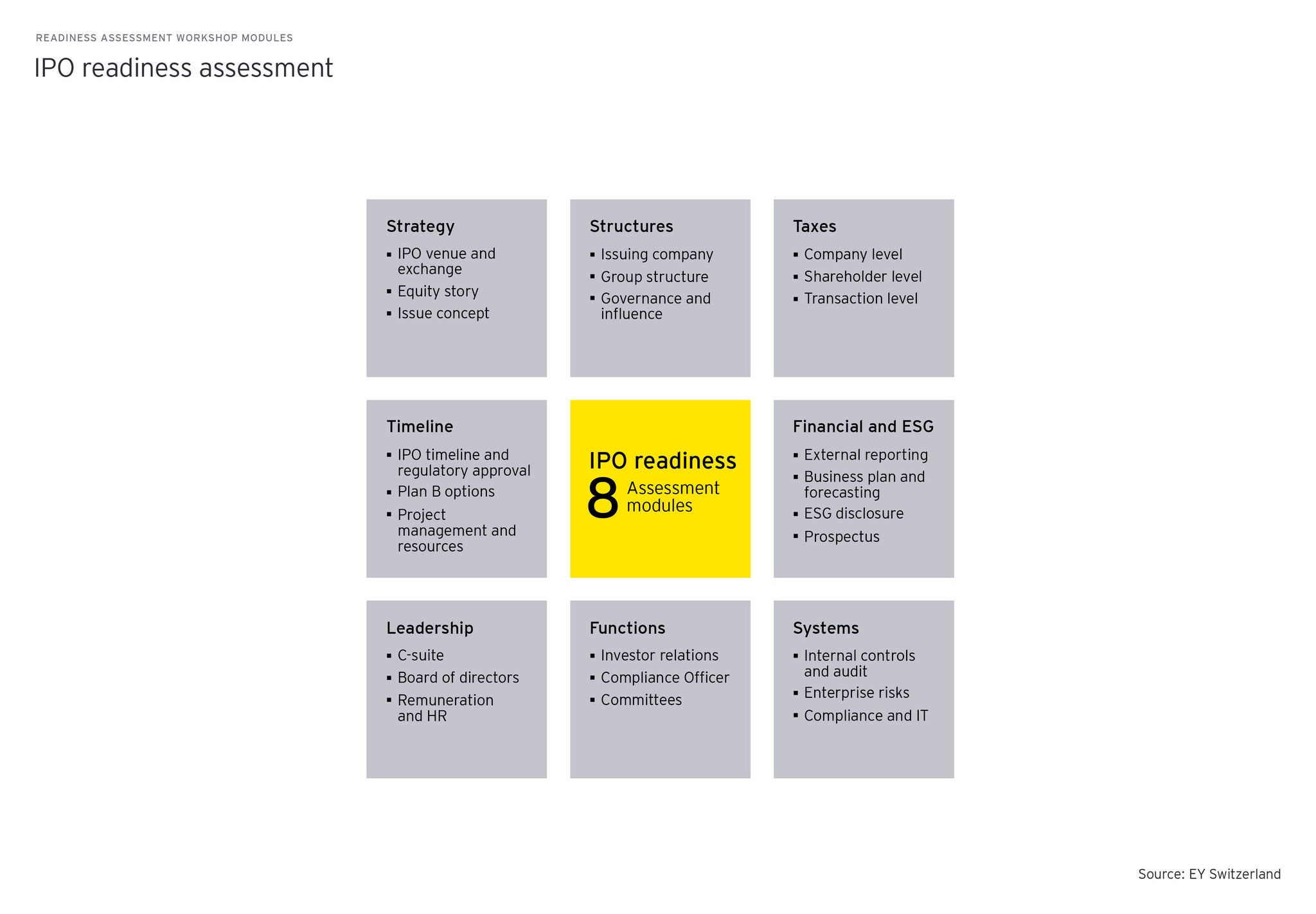
Going public is a significant milestone for any company, but it comes with a host of new responsibilities, particularly in terms of reporting requirements. Candidates need to ensure that they are well prepared and may benefit from external support in assessing readiness and developing a roadmap toward the target structure across eight key areas:


ey.com-graphic-template 112

Leadership motivation after an IPO

For many founders and leadership teams, an IPO is the defining milestone after years of growth, fundraising and sacrifice. Yet sustaining energy, commitment and performance after listing can prove harder than reaching it.

Before an IPO, leaders pursue a clear destination, a shared objective, a potential liquidity event and the opportunity to translate years of effort into a tangible outcome. After listing, that visible finish line disappears and gives way to recurring performance expectations, public scrutiny and accountability to a broader shareholder base. The challenge shifts from reaching the IPO to renewing leadership commitment once the milestone has been achieved.


How motivation shifts throughout the IPO journey

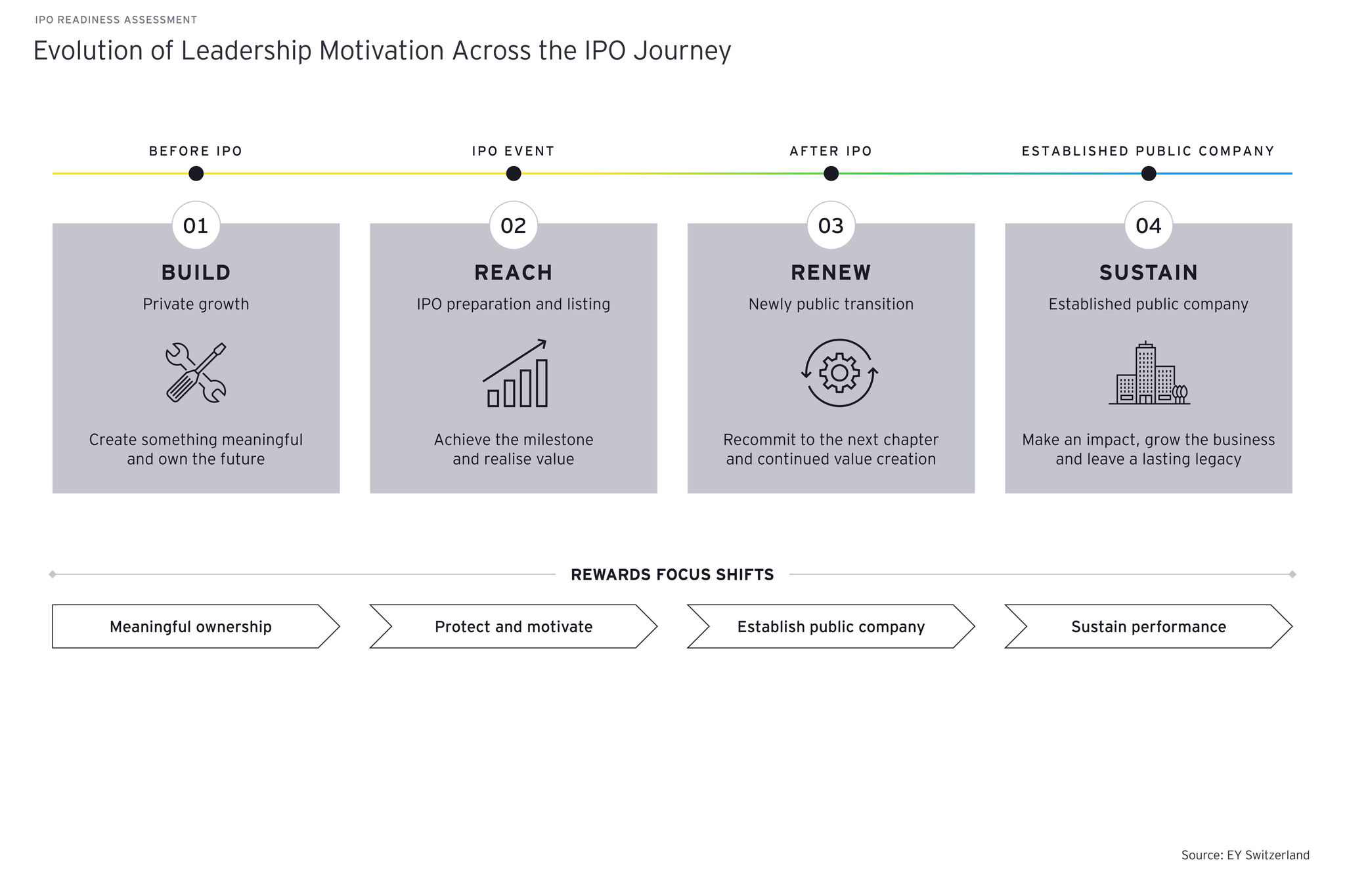
The graphic below illustrates a common transition. It does not suggest that every leader follows the same path. Rather, it highlights how the motivational drivers that support a company through growth and IPO stage must evolve as the organization matures. The key challenge is creating a new strategic horizon once the IPO milestone has been reached.

graphic-6

When the IPO is no longer the goal

Going public changes the leadership environment. The company must continue to grow and innovate, but within a more structured context defined by governance requirements, market expectations and greater transparency. Leaders face a wider group of stakeholders judging not only results, but also how those results are achieved.

At the same time, the milestone that united the organization has been achieved. Some executives may have realized significant wealth, while the intensity of the entrepreneurial journey can give way to the routines of life as a public company. These changes do not automatically reduce motivation, but they can expose a gap if the organization has not articulated well enough what comes next.

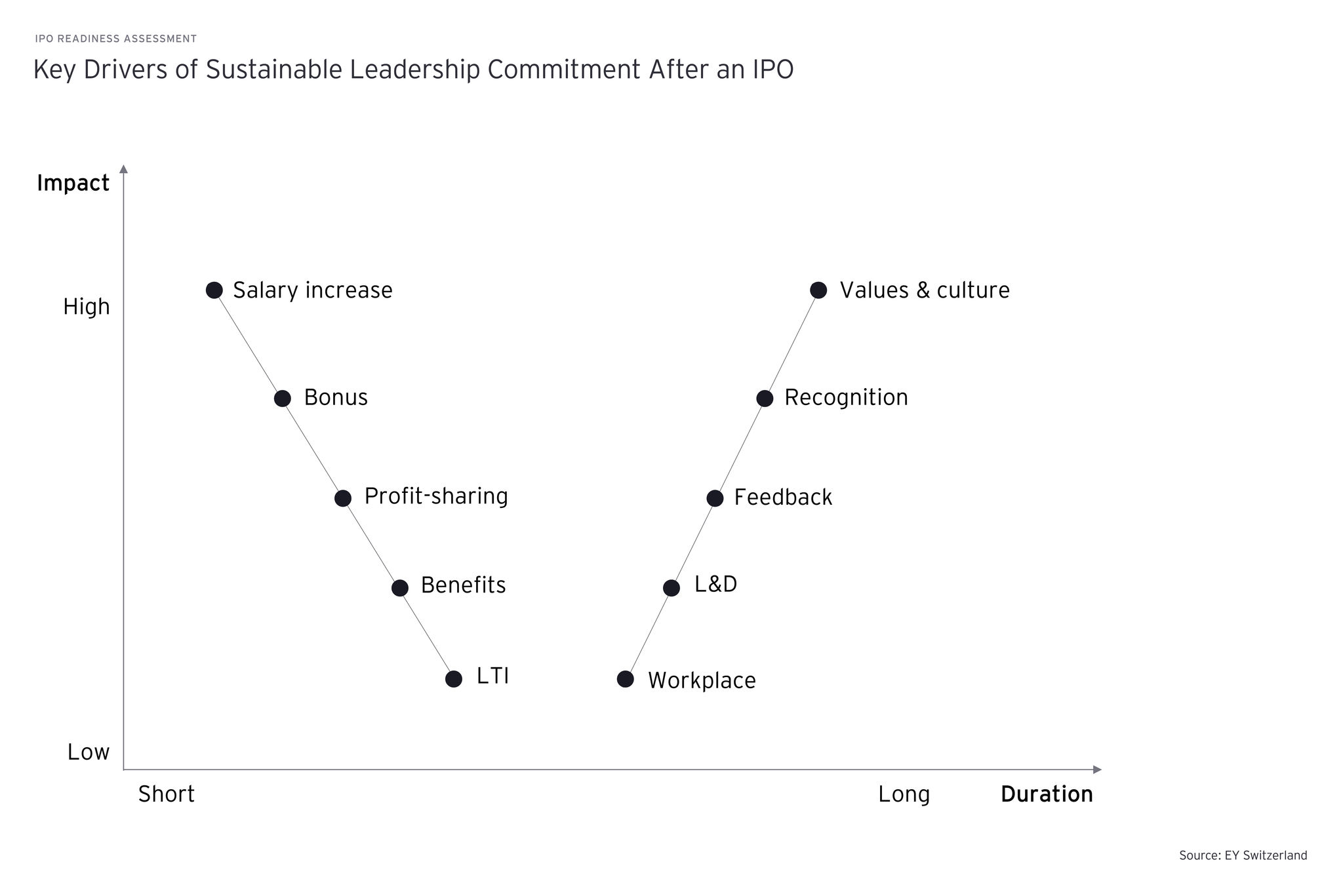
Executive retention and motivation are related, but they are not the same thing. Cash, deferred awards and additional equity may discourage departure, but they do not automatically create conviction, discretionary effort or commitment to the next transformation. A leader can remain economically aligned while becoming less engaged.

graphic-2

The above graphic illustrates why compensation alone is insufficient. Sustainable commitment can also depend on strategic influence, growth opportunities, recognition, trusted relationships and confidence in the post-IPO leadership environment. The mix differs by individual, making it essential for boards to understand what drives critical leaders rather than assume one lever will work for everyone.

Designing the leadership proposition after an IPO

The leadership proposition post-IPO should begin with defining the company’s next ambition and the leadership required to deliver it, not with the incentive plan. Four questions can help structure the discussion:

A new performance horizon

An IPO closes one chapter and removes the goal that organized it. Organizations that sustain leadership engagement beyond listing deliberately establish a new performance horizon, one that connects strategy, leadership, ownership and personal impact. For CEOs, boards and board renumeration or compensation committees, the implication is clear: executive motivation after an IPO cannot be sustained through compensation design alone. Rewards can strengthen commitment to the next goal, but they cannot create the ambition that drives it.


Summary

Global IPO activity remained selective in Q3 2026, with fewer listings but significantly higher proceeds. China and the EU recorded increased IPO activity and technology-dominated global issuance. Switzerland showed continued signs of recovery, although activity remained limited and a broader rebound has yet to materialize.

An IPO is a significant milestone, but it also removes the goal that helped organize the preceding phase of growth. As companies transition to public ownership, leaders face greater scrutiny, governance requirements and performance expectations. While compensation remains an important tool, additional equity alone may not sustain motivation once the IPO has been achieved. Organizations should therefore focus on building a broader leadership proposition for the post-IPO period. This should combine ownership, purpose, strategic influence, development opportunities and recognition. The most successful companies establish a new performance horizon that keeps critical leaders committed to creating lasting value.

Acknowledgement

We kindly thank Lukas Molkentin, Anya Martineau and Marja Coquoz for their valuable contribution to this article.


FAQs

Related articles

Global IPO highlights in Q2 2026 and insights for future IPO candidates

Explore Q2 2026 IPO activities and how to build a board ready for public life.

Global IPO highlights in Q1 2026 and insights for future IPO candidates

Explore Q1 2026 IPO activities as well as key process and control considerations.

Global IPO highlights in Q4 2025 and insights for future IPO candidates

Explore Q4 2025 IPO activity and learn about key Swiss tax considerations for going public.


Explore how EY can help you 

Supporting companies to go public and evaluate strategic transactions.

Suspension bridge over young Rhone River near Ernen, Valais, Switzerland, known as 'Goms Bridge', 2018

About this article

Authors

Request for proposal (RFP) - exclusively for Switzerland

|

Submit your request now!