Business analyst team checking in financial statement for audit internal control system. Accounting , Financial  Concept.

Global IPO highlights in Q1 2026 and insights for future IPO candidates


Explore Q1 2026 IPO activities as well as key process and control considerations.


In brief

  • Global IPOs -23% YoY to 230, proceeds +36% to $40.6 billion; China well above prior year, the US and Europe delivered mixed results in IPOs and volumes.
  • Aerospace and defense, infrastructure and artificial intelligence continue to shape IPO pipelines and are expected to be key drivers of activity in 2026.
  • Preparing for an IPO requires early and proactive strengthening of internal controls and processes to meet heightened public company reporting, audit and regulatory expectations.

Q1 2026 IPO Barometer

After a promising start to 2026, renewed geopolitical tensions and a sharp rise in global energy prices triggered a sharp slowdown in IPO activity worldwide. The number of initial public offerings fell by 23% year-on-year to 230 (2025: 300), marking the lowest level in six years. The last time global IPO volumes fell below this level was during the second quarter of the COVID‑19 crisis in 2020, with 195 IPOs.

Despite the sharp decline in listings, IPO proceeds increased by 36% to $40.6 billion ($29.9 billion). This resilience reflects investors’ continued preference for larger, well‑prepared issuers able to demonstrate critical scale, robust business models and a proven track record ahead of a listing. The number of IPOs raising more than $500 million rose from 14 to 22, while smaller transactions fell sharply: listings with proceeds below $100 million decreased from 237 to 146.

Regional highlights

  • China (including Hong Kong) recorded 68 IPOs (2025: 50) with total proceeds of $16.7 billion (2025: $6.0), representing a 181% increase in proceeds compared with the prior‑year period and the strongest growth among major markets.
  • United States: IPO activity declined sharply, with 27 listings down 55% (2025: 60) while issuance volume of $10.2 billion (2025: $9.0 billion) was 13% higher compared to prior-year period.
  • Europe: The number of IPOs fell by 18% to 28 (2025: 34). Nevertheless, supported by the Czech industrial and defense conglomerate CSG, the world’s largest IPO in the first quarter, total proceeds rose by 48% to $6.4 billion (2025: $4.4 billion).

Sector performance

In the first quarter of 2026, advanced manufacturing led global IPO activity, generating $11.3 billion in proceeds across 42 listings, reflecting continued investor interest in industrial scale and production capabilities. The technology sector followed second, with 38 IPOs raising $8.8 billion.

Switzerland: subdued start to the year

The Swiss IPO market remained subdued in the first quarter of 2026. Ongoing geopolitical uncertainty, elevated market volatility and a challenging financing environment led many potential issuers to adopt a wait‑and‑see approach and postpone listing plans.

At the same time, well‑prepared companies with a clear capital‑markets strategy and longer‑term funding needs continue to actively assess public‑market options, particularly in anticipation of a potential improvement in market conditions later in the year.

How we read the market

The escalation of the Middle East crisis has had a pronounced impact on global IPO markets, driving listings to a six‑year low amid rising energy prices, heightened volatility and renewed policy uncertainty. While overall activity declined, investor demand remained focused on established issuers with scale, resilient business models and proven earnings power.

Defense, aerospace and infrastructure companies benefited from the geopolitical backdrop, supporting targeted IPO activity despite weaker overall volumes. At the same time, artificial intelligence continued to underpin IPO pipelines, with investor focus shifting away from early‑stage vision stories toward scalable, commercially proven applications, particularly in infrastructure, data centers, semiconductors and industrial use cases.

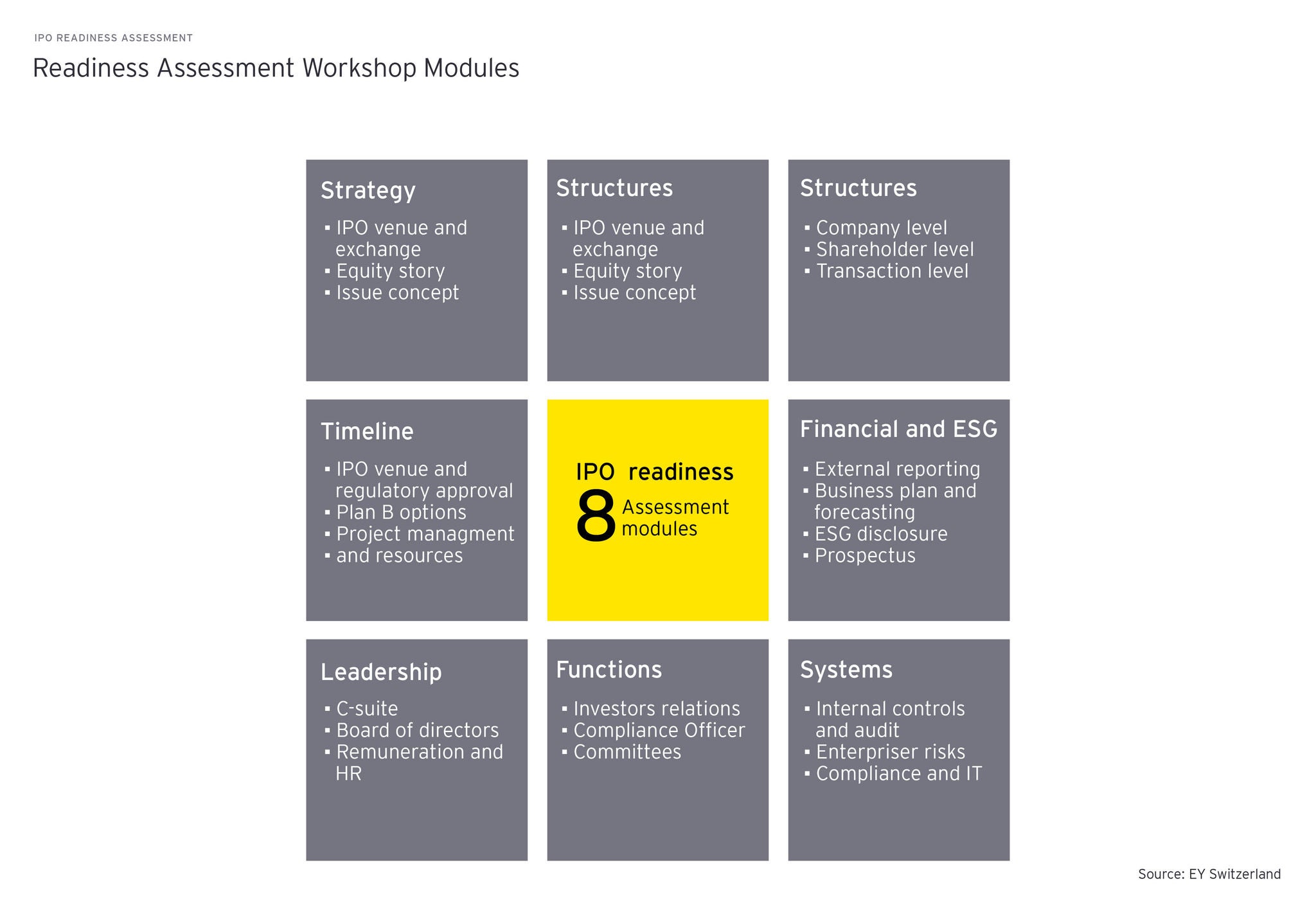
Going public is a significant milestone for any company, but it comes with a host of new responsibilities, particularly in terms of reporting requirements. Candidates need to ensure that they are well prepared and may benefit from external support in assessing readiness and developing a roadmap toward the target structure across eight key areas:


ey.com-graphic-template

Preparing for an IPO: Process & control Implications

An Initial Public Offering (IPO) transforms a company into a public registrant, subjecting it to significantly higher expectations for financial reporting integrity, internal controls maturity, governance discipline and audit evidence. Becoming “IPO ready” requires a structured, proactive approach to uplift processes, remediate control gaps and ensure compliance with public company reporting standards. This aspect of IPO readiness is frequently overlooked by companies and their executives in the whirlwind of preparing the business for the other aspects of the transaction.

Increased regulatory & reporting requirements

Once a company is public, it faces new and enhanced accounting, disclosure and governance obligations, including expanded footnote disclosures, quarterly and/or half-year reporting requirements and auditor involvement in reviewing financial statements. Public companies must meet strict requirements regarding disclosure controls and procedures and internal controls over financial reporting (ICFR). These obligations introduce new rigor, documentation standards and expectations for completeness and accuracy.

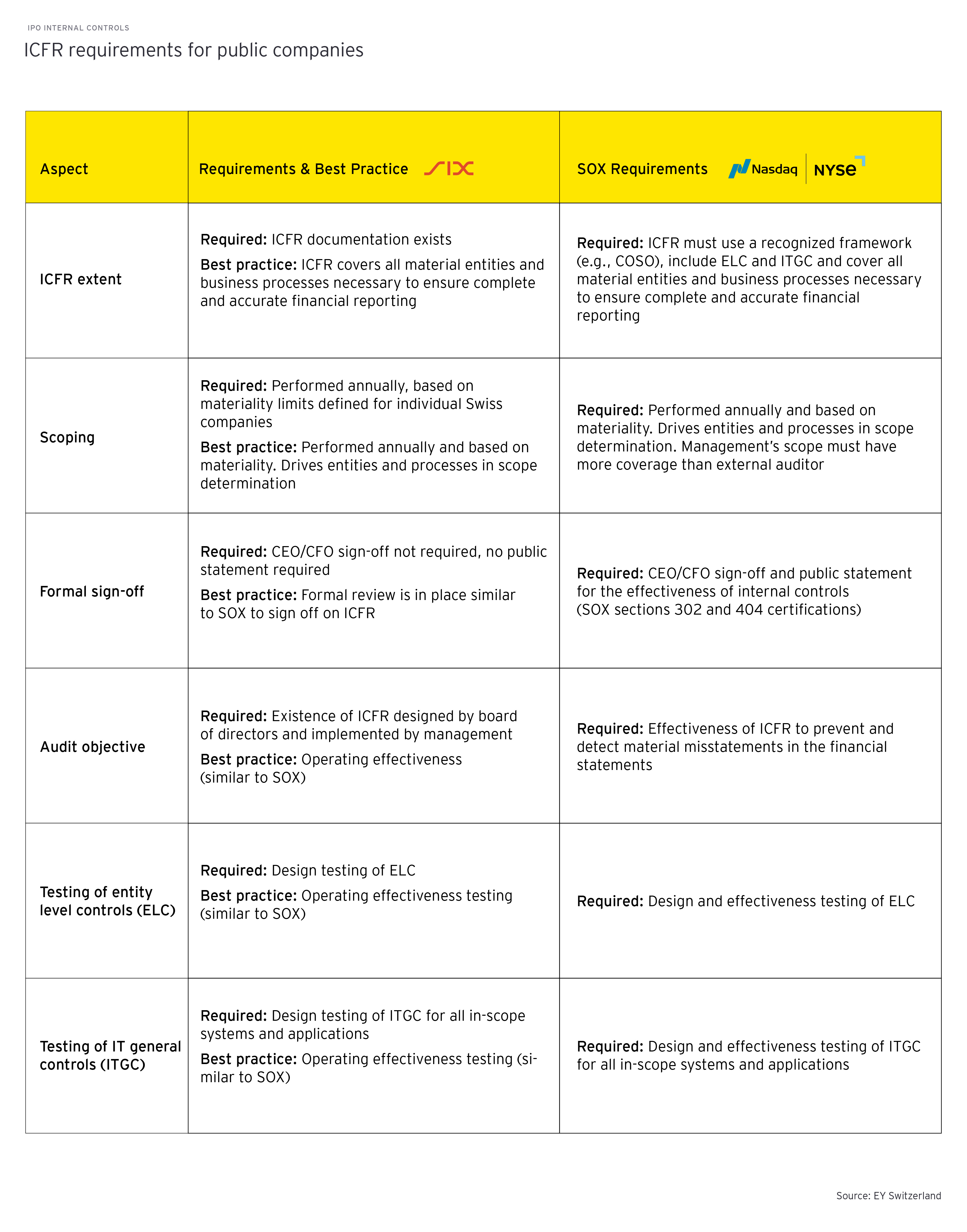
When companies become publicly listed, they need to adhere to enhanced ICFR requirements, including external auditor attestation. The extent of the requirements varies depending on where the company elects to list.

The table below lays out the ICFR requirements for public companies listed in Switzerland compared to the requirements for listing on common US exchanges:

ey.com-graphic-template 11

Early preparation for these elevated regulatory and reporting requirements is viewed as a leading practice as it signals strong governance and reduces the risk of deficiencies surfacing during the IPO execution window, which could impact potential new investors’ confidence in the newly public company.

Heightened auditor scrutiny & evidence expectations

External auditors apply public company audit standards, increasing scrutiny across processes, controls, estimates and supporting evidence. Post-IPO audits frequently require:

  • More robust control design documentation (e.g., Risk and Control Matrices (RACMs), flowcharts depending on elected listing jurisdiction)
  • Evidence of consistent control operation
  • Expanded testing support, including detailed samples, system logs and ITGC evidence
  • More rigorous review cycles during compressed IPO timelines

Public companies must also accommodate auditor reviews of filings, comfort letter procedures and responses to regulator questions. Any weaknesses lead to delays, increased cost or reputational impact.

Internal controls & process uplift requirements

A public-ready control environment must be formalized, repeatable, well documented and auditable. Key areas typically requiring uplift include:

  • Entity level controls (tone at the top, governance, accountability)
  • Process level controls across revenue, inventory, close & consolidation, procurement, payroll, treasury, among others
  • IT general controls (ITGC) including controls related to access, change management, IT operations
  • Financial statement disclosure controls ensuring timely, accurate filings
  • Documentation standards enabling external audit validation

Some of the most common areas companies need to address are headcount constraint challenges, segregation of duties controls and system limitations of legacy ERPs. High growth companies approaching IPO frequently exhibit gaps in control design, documentation and systems maturity — making uplift essential to achieve public company governance and to increase efficiency for the more frequent and faster reporting requirements.

Pre-IPO process & controls diagnostic (“Rapid Assessment”)

A pre-IPO rapid diagnostic supports companies in determining readiness, prioritizing gaps and establishing an execution roadmap. This assessment typically includes:

  • Evaluating current processes, risks and controls
  • Performing a preliminary materiality-based scoping analysis
  • Identifying gaps relative to public company standards and ICFR requirements
  • Conducting interviews and reviewing process documentation
  • Assessing systems, data governance, financial reporting quality and scalability
  • Benchmarking against leading practices
  • Defining remediation activities, timelines and resource needs

This approach aligns with the EY IPO readiness framework, which emphasizes early gap identification, cross-functional assessments and establishing an effective control foundation before filing.

Importance of early action & embedding compliance

Embedding ICFR early reduces the cost and disruption of late-stage remediation. By building scalable controls, companies can also realize the benefits of an effective and efficient control framework such as:

  • Reduce execution risk during the IPO process
  • Enhance audit outcomes
  • Improve operating efficiency in the close and reporting process
  • Strengthen investor confidence and governance credibility

Better informed decision-making for executives

ICFR readiness is not just a compliance exercise – it enables sustainable operational discipline and supports long-term success as a public company. If you are in the assessment stage of preparing for an IPO and want to talk to a team that works on IPO readiness assessments every day, feel free to reach out to EY, we look forward to hearing from you.


Summary

Global IPO activity weakened significantly in the first quarter of 2026, with deal numbers down sharply amid heightened geopolitical uncertainty, while proceeds proved more resilient as investors focused on larger, well‑positioned issuers. China rebounded strongly on deal value, Europe saw fewer but larger transactions supported by a mega‑IPO, and US activity declined markedly. Advanced manufacturing and technology led issuance while aerospace, defense, infrastructure and artificial intelligence continue to shape IPO pipelines. Switzerland experienced a quieter start to the year, with issuers prioritizing readiness and strategic flexibility ahead of potential market reopening.

Preparing for an IPO in this environment requires early and proactive strengthening of governance, processes and internal controls. Companies that invest ahead of time in robust reporting frameworks, ICFR maturity and regulatory readiness are better positioned to navigate volatile markets, meet public‑company expectations and execute a successful listing when market windows open.

Acknowledgement

We kindly thank Catherine Wälchli, Jack Stadelman and Anya Martineau for their valuable contribution to this article.


FAQs


Related articles

Global IPO highlights in Q4 2025 and insights for future IPO candidates

Explore Q4 2025 IPO activity and learn about key Swiss tax considerations for going public.

Global IPO highlights in Q3 2025 and insights for future IPO candidates

Read about IPO activities in Q3 2025 and find the right financial reporting standard for life as a public entity.

Global IPO highlights in Q2 2025 and insights for future IPO candidates

Explore the Q2 2025 global IPO market performance, ESG practices, key trends, and how companies can prepare for effective Sustainability Reporting


    Explore how EY can help you with IPO

    Supporting companies to go public and evaluate strategic transactions.

    Business analyst team checking in financial statement for audit internal control system.

    About this article

    Authors

    Request for proposal (RFP) - exclusively for Switzerland

    |

    Submit your request now!