






Closeup Benjamin Franklin face on USD banknote with stock market chart graph for currency exchange and global trade forex concept.

Global IPO highlights in Q4 2025 and insights for future IPO candidates

Explore Q4 2025 IPO activity and learn about key Swiss tax considerations for going public.


In brief

  • Global IPOs +2% to 1,259; proceeds +32% to $163.3b; Q4 deals -5% but value +15%. Asia/US up, Europe soft. Switzerland 3 IPOs with promising 2026 outlook.
  • Technology led by proceeds and count; mobility was #2 by proceeds, advanced manufacturing by deals; sponsor‑backed (PE/VC) issuers made up 36% of proceeds.
  • An IPO process is a transformative journey that requires heavy and early involvement from a tax perspective to ensure a successful outcome.

Q4 2025 IPO barometer

In our latest EY Switzerland IPO Barometer, we see a modest improvement in global listing activity for 2025. The total number of IPOs worldwide increase slightly by 2% to 1,259 (2024: 1,240) while issuance volume rose by 32% to $163.3 billion. In Q4 2025, 347 companies went public (-5% vs. the prior‑year quarter), yet proceeds increased by 15% to $51.7 billion, highlighting investors’ preference for larger, better‑prepared issuers.

Regional highlights

  • Asia (including Hong Kong) accelerated: 214 IPOs (2024: 179) and $53.7 billion in proceeds (2024: $20.9 billion). The largest global IPO of the year was Contemporary Amperex Technology Co Ltd (CATL) at about $5.3 billion in May.
  • United States remained a magnet for cross‑border listings: 220 IPOs (2024: 176) and $40.2 billion in proceeds (2024: $33.0 billion). More than 60% of US IPOs came from non‑US issuers.
  • Europe posted 100 IPOs (2024: 131) with $17.1 billion in proceeds (2024: $19.3 billion). Even in a softer environment, several large listings stood out – notably Verisure in Q4, raising just under $4.2 billion, Europe’s largest IPO in 2025.

Sector performance

We continue to see the technology sector leading by proceeds (over $34 billion) and by count (202 IPOs), reflecting investor focus on scale, profitable growth paths and platform durability. Mobility ranked second by proceeds (~$19.0 billion), while advanced manufacturing was second by number of deals (185). Sponsors remained active: PE‑ and VC‑backed issuers accounted for 11% of IPOs and 36% of global placement volume.


Switzerland in 2025: quiet Q4, but a solid year

Switzerland recorded three classic IPOs on SIX (prior year: two) and several notable transactions across the year:

  • SMG Swiss Marketplace Group listed on SIX on 19 September 2025, raising approximately CHF 903 million – one of Europe’s largest IPOs in 2025 and among the top 10 globally in Q3.
  • Aebi Schmidt Group began trading as AEBI on NASDAQ in July 2025 following shareholder approval of its merger with Shyft Group.
  • Amrize (a Holcim spin‑off) completed a dual listing on SIX and the NYSE on 23 June 2025.
  • Bioversys AG went public on 7 February 2025 with proceeds of roughly CHF 80 million.


Although Q4 brought no new Swiss listings, issuer readiness and investor selectivity supported high‑quality outcomes when windows opened.


How we read the market

Across regions, differences in macro dynamics and policy backdrops shaped liquidity and valuation outcomes. The US benefited from deregulation tailwinds, rate‑cut expectations and strong cross‑border demand. China and Hong Kong rebounded on catch‑up effects and supportive measures. Europe faced structural and geopolitical headwinds, even as the pipeline remained well filled.


Outlook for 2026

With the tariff settlement with the United States and persistently low interest rates, Switzerland offers an attractive environment for new listings in 2026. Our guidance to prospective issuers remains consistent:

  • Anchor the equity story in clear, defensible growth drivers and disciplined capital allocation.
  • Demonstrate robust governance and disclosure that meet the expectations of selective global investors.
  • Prepare early and calibrate timing to volatility and liquidity windows across listing venues.


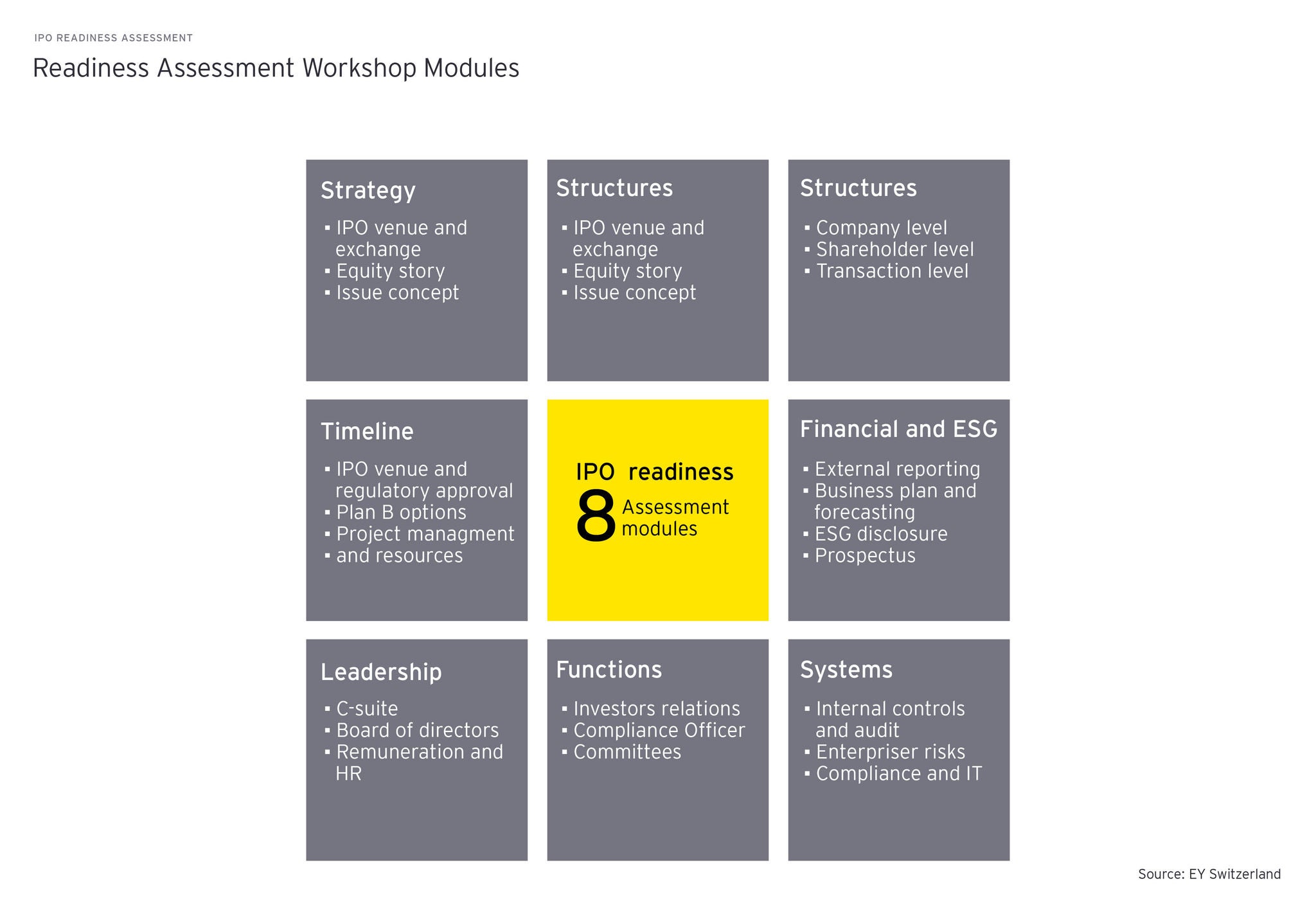
Going public is a significant milestone for any company, but it comes with a host of new responsibilities, particularly in terms of reporting requirements. Candidates need to ensure that they are well prepared and may benefit from external support in assessing readiness and developing a roadmap toward the target structure across eight key areas.

ey.com-graphic-template

The transition from a private to a public company through an IPO is a pivotal moment for any organization. Besides various strategic, operational, legal, regulatory as well as financial aspects which need to be considered, several tax-related challenges and opportunities should be addressed and examined when contemplating an IPO.

Swiss tax considerations surrounding IPOs

Private to public IPO – tax objectives

IPOs of the last few years can broadly be divided into three categories: (i) carve-outs of businesses from already listed companies, (ii) listings of companies held by corporate investors and (iii) exit strategies for private equity held assets.

Although the specific tax considerations for all types of IPOs vary given the distinct initial circumstances, the main tax objectives include amongst others in particular:

  • creation and preservation of capital contribution reserves
  • preservation of tax attributes
  • minimization of transaction taxes
  • creation of structure for future tax-efficient profit repatriation
  • ensuring tax neutrality in pre-IPO reorganizations

Furthermore, qualitative goals focus on establishing a sustainable tax function and strategy and designing a flexible group structure for future transactions.

Structuring alternatives and future cash repatriation

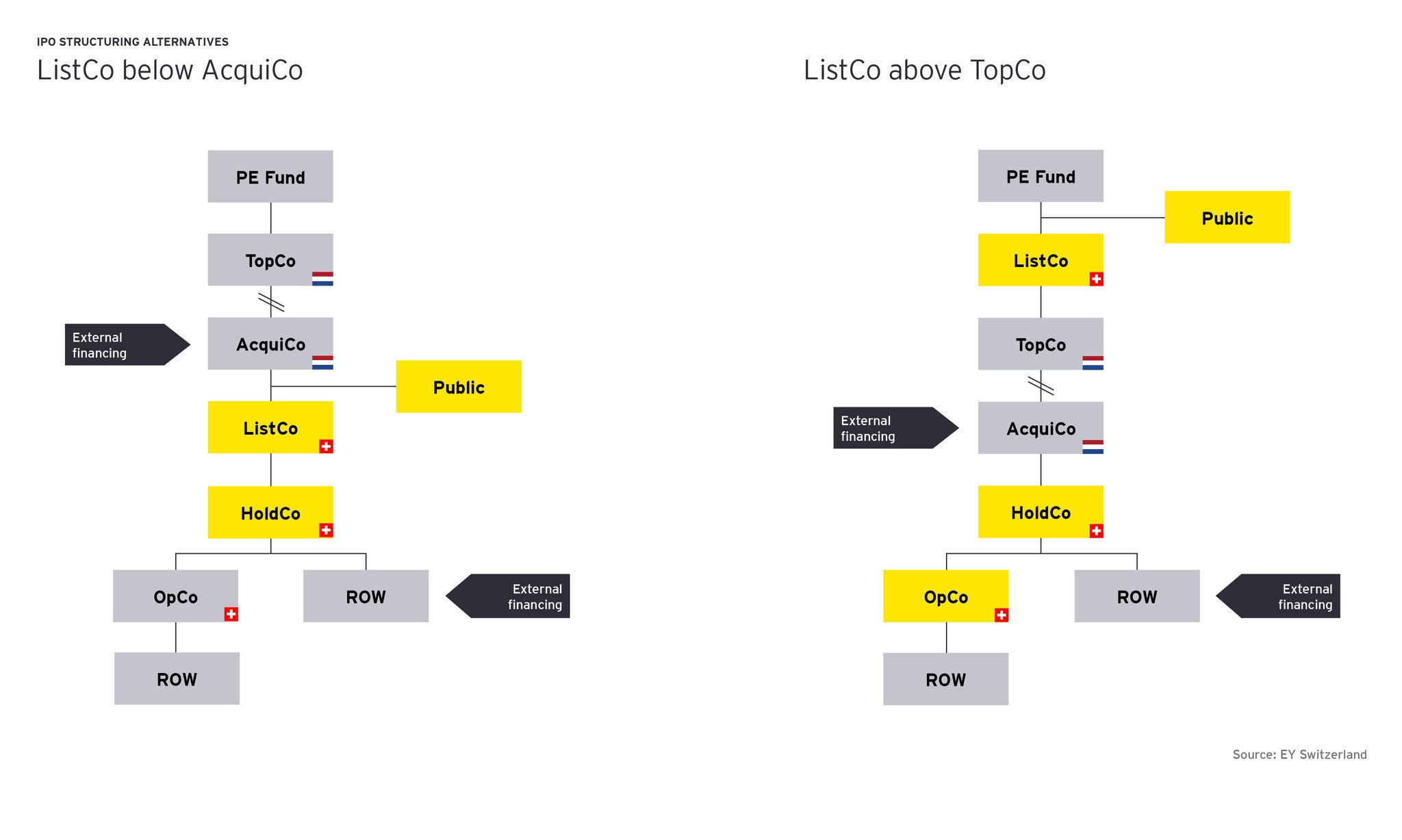
To illustrate some of the most relevant tax implications more concretely, the following discussion is based on a classic Luxembourg private equity structure owning a Swiss principal headed group with various foreign operating subsidiaries (please refer to illustration below).

Over the last few years, it has become customary to implement a newly established ListCo. Such a ListCo may either be interposed between the Swiss group’s parent company and its acquisition vehicle or at the top of the holding structure above the feeder vehicle of the different investors (i.e., TopCo). The reorganization steps to achieve such a structure can generally be carried out without adverse Swiss tax consequence provided the requirements for a tax-neutral reorganization scheme are met.

By establishing a new ListCo resident in Switzerland, current target group shareholders can contribute their shares in the target group into the ListCo at a value up to the target group’s total fair market value (in accordance with Swiss statutory accounting rules). Whether or not and to what extent such contributions can qualify as capital contribution reserves, which might be repaid to future shareholders after the IPO free of Swiss dividend withholding tax (WHT), depends on various factors. The creation of capital contribution reserves is a key element for future tax efficient repatriation. Aspects which need to be considered in the light of the Swiss Federal Tax Administration’s Swiss dividend anti-abuse rules (particularly the (extended) international transposition) are the treaty eligibility of the current shareholders, value proportion of the target group’s Swiss activities compared to its foreign operations, shareholding quota in the target company which shall be sold as part of a secondary offering etc. Furthermore, certain restrictions regarding the repayment of capital contribution reserves may apply to Swiss listed companies (i.e., the 50:50 rule). Eventually, a case-by-case assessment as well as an advance tax ruling confirmation from the SFTA are required.

Graphics of IPO structuring alternatives

Financing considerations

When planning an IPO, existing financing arrangements of a target group and/or its shareholders should be reviewed regarding potential change-of-control clauses, related potential refinancing needs as well as future structural considerations. In anticipation of certain Swiss target group entities acting as guarantor for such external financing, the Swiss 10/20 Non-Bank Rules as well as substance requirements for financing entities are critical. Meanwhile, various financing constellations are compatible with the 10/20 Non-Bank Rules and allow for flexible financing arrangements. In this context, it is essential to obtain a corresponding advance tax ruling at an early stage to confirm compliance with applicable law and practice.

Primary and secondary offering

For both the primary and secondary offering of a Swiss ListCo, different Swiss stamp duty consequences should be expected. The primary offering is generally subject to a 1% Swiss share issuance tax on the total amount raised (after certain minor deductions). In return, any contribution exceeding the nominal capital should typically qualify as capital contribution reserves, which can be repaid in the future without triggering Swiss dividend WHT. By contrast, the secondary offering is generally subject to a 0.3% Swiss securities transfer tax (if listing occurs at SIX).

Other aspects to be considered

In addition to the key objectives above, other tax considerations in the IPO process should include the impact of (i) the contemplated IPO on the OECD Pillar 2 position of the target group, (ii) the pre-existing Management Incentive Plan (MIP), (iii) the tax compliance requirements as well as (iv) impacts on general tax strategy and tax function.


Summary

Global IPO activity increased in 2025, with higher volumes. Regional divergence persisted: Asia and the US strengthened while Europe lagged. Technology led issuance and sponsor-backed listings remained influential. Switzerland delivered transactions and entered 2026 positioned for momentum.

Embarking on an IPO in Switzerland is a complex undertaking that requires meticulous planning. From a tax perspective, critical priorities include pre‑IPO reorganizations, strategies for future cash repatriation, potential adjustments to the group’s financing structure and a range of other tax aspects. Addressing these elements proactively with the relevant stakeholders and tax authorities is essential to ensure a smooth transition to the public markets and a successful IPO.

Acknowledgement

We kindly thank Kilian Bürgi, Ken Brandstetter and Anya Martineau for their valuable contribution to this article.


FAQs

Related articles

Global IPO highlights in Q3 2025 and insights for future IPO candidates

Read about IPO activities in Q3 2025 and find the right financial reporting standard for life as a public entity.

Global IPO highlights in Q2 2025 and insights for future IPO candidates

Explore the Q2 2025 global IPO market performance, ESG practices, key trends, and how companies can prepare for effective Sustainability Reporting

Global IPO highlights in Q1 2025 and insights for future IPO candidates

Discover in our global IPO market insights how frontrunners are securing IPO strategy and IPO process success by going public in best-fit capital markets


    Explore how EY can help you with IPO

    Supporting companies to go public and evaluate strategic transactions.

    Benjamin Franklin face on USD banknote with stock market chart graph

    About this article

    Authors

    Request for proposal (RFP) - exclusively for Switzerland

    |

    Submit your request now!