






White senior male CEO seriously works in boardroom, signs business contract documents from female secretary, corporate financial report, and investment project, and executive leadership president.

Global IPO highlights in Q2 2026 and insights for future IPO candidates


Explore Q2 2026 IPO activities and how to build a board ready for public life. 


In brief

  • Global IPOs -21% YoY to 195, while proceeds reached a record $136.0 billion, driven by the $86.2 billion SpaceX IPO.
  • Switzerland recorded 3 IPOs but remains in the early stages of recovery.
  • Strong IPO governance requires an independent board, effective oversight and a culture of accountability — starting 6–12 months before listing.

The latest IPO Barometer revealed a mixed picture for the global IPO market in the second quarter of 2026. While overall activity slowed, proceeds reached a record high. The number of IPOs declined by 21% year-on-year to 195 (2025: 246), reflecting continued market selectivity amid geopolitical uncertainty. Despite fewer listings, proceeds surged to $136.0 billion (2025: $32.1 billion), marking the strongest quarter of the past decade. 

The sharp increase in proceeds was driven by a small number of exceptionally large transactions. The ten largest IPOs accounted for $109.3 billion, or around 80% of global proceeds. SpaceX alone raised $86.2 billion, making it the largest IPO of all time, followed by Cerebras Systems Inc ($6.4 billion) and Victory Giant Technology (HuiZhou) Co Ltd ($3.0 billion).

SpaceX IPO
$86.2bn
$86.2bn
The largest IPO of all time

Regional highlights

  • China (including Hong Kong) remained resilient with 61 IPOs (2025: 55), representing an 11% increase in activity. However, proceeds declined by 12% to $13.3 billion (2025: $15.2 billion).
  • United States recorded 39 IPOs (2025: 51), down 24% year-on-year, while issuance volume surged to $115.6 billion (2025: $8.1 billion), largely driven by the record-breaking SpaceX IPO.
  • Europe remained stable with 16 IPOs (2025: 17), while proceeds increased by 40% to $2.2 billion (2025: $1.6 billion).

Sector performance

In the second quarter of 2026, advanced manufacturing dominated IPO proceeds, raising $97.7 billion across 39 listings, largely driven by SpaceX, and the technology sector followed with $15.1 billion raised across 36 IPOs. Overall, investor demand remained concentrated in sectors with scalable growth models, resilient revenue prospects and clear links to long-term structural trends. Companies relying solely on broad AI positioning or high-level growth narratives faced a more challenging environment, as investors increasingly focused on profitability, execution capability and sustainable margins.

Switzerland still waiting for a broader recovery

The Swiss IPO market gained momentum in the second quarter of the year, welcoming three new listings: Centiel, DSM-Firmenich and Matador Secondary Private Equity AG. In addition, Infracore announced its intention to pursue a future IPO on SIX in June. While these developments point to a gradual improvement in market sentiment, many potential issuers remain focused on IPO readiness and are waiting for a more favorable market window before proceeding with a transaction.

How we read the market

Our view of the market remains cautiously constructive. Global mega-deals have captured significant investor attention and may help support risk appetite, improve liquidity and strengthen valuation levels for growth companies. However, these landmark transactions do not automatically translate into stronger IPO activity in Europe or Switzerland.

Instead, positive international market momentum should be viewed as a supporting factor rather than a primary driver. A sustained period of successful global IPOs can help restore confidence, reduce volatility and encourage investors to re-engage with new offerings. Ultimately, however, Swiss companies will need to differentiate themselves through strong fundamentals, a compelling equity story and a well-prepared investment case.

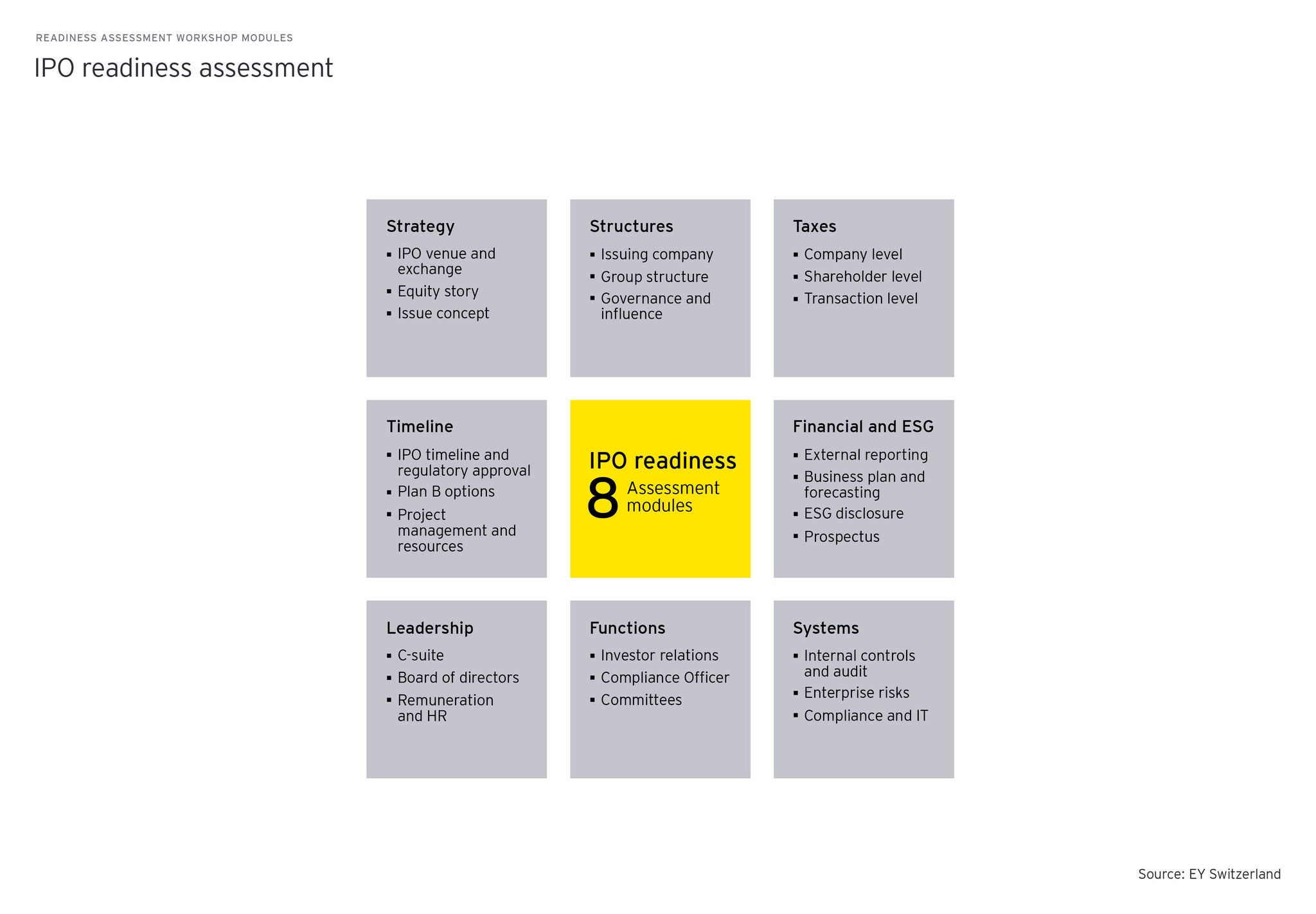
Going public is a significant milestone for any company, but it comes with a host of new responsibilities, particularly in terms of reporting requirements. Candidates need to ensure that they are well prepared and may benefit from external support in assessing readiness and developing a roadmap toward the target structure across eight key areas:

ipo

IPO governance readiness: building the board for public life

Going public is one of the most transformative events in a company’s lifecycle. But beneath the excitement of the roadshow lies a complex infrastructure that the market demands before it will trust a company with its capital. At the centre of that infrastructure is corporate governance.

Being governance ready is meaningfully different from being operationally ready. A company can have a promising equity story, strong revenue growth, a compelling product and an experienced management team and still fall short of the governance standard. Investors and regulators are asking a different question: not only whether the company can grow, but whether it can be trusted to govern itself responsibly in the public interest. Companies that treat governance as a last-minute compliance exercise risk delayed listings, depressed valuations and post-IPO crises that could have been prevented. Those that invest in governance early arrive at the public markets with the credibility and operational maturity institutional investors require.

How to build a strong pre-IPO corporate governance framework 

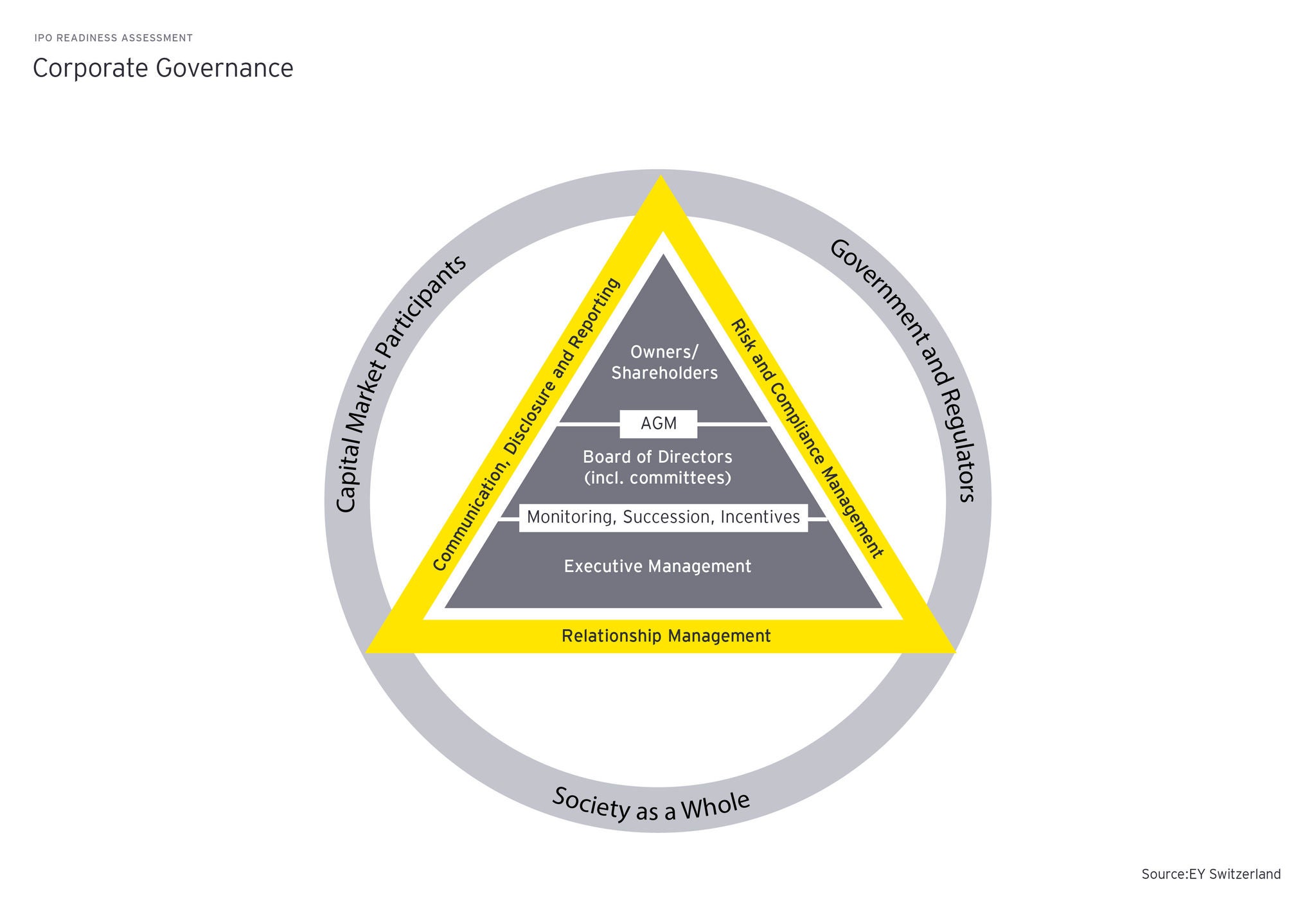
Corporate governance is the mechanisms, processes and relations by which a company is directed and controlled. In the IPO context, this governance framework spans board composition, executive accountability, internal controls, audit integrity, risk oversight and disclosure practices. Being governance-ready means these systems are not simply in place but they also operate effectively and interact with each other in practice.

ey.com-graphic-template

The board: your governance foundation

Nothing signals public governance maturity more clearly than the board composition strategy. The board of directors should be sized to meet the needs of the individual company – small enough for efficient decision-making yet large enough to bring together a diverse range of skills, experience and sector knowledge and perspectives needed to the oversee the company effectively. Additionally, most listing destinations require a majority of independent directors. Under the Swiss Code of Best Practice for Corporate Governance issued by Economiesuisse, independence means that directors hold no executive role within the company, have no prior audit relationship and maintain no material business ties that could impair their objective judgment.


Recruiting the right directors takes time. Identifying candidates, conducting due diligence and completing onboarding rarely happens in under six months. Companies that begin this process late often find themselves listing with placeholder directors which is a concern that sophisticated investors will spot immediately when reviewing the prospectus. As a starting point, a useful exercise for companies is to establish a skills matrix that maps current directors against what the board will require post-IPO.


Board committees

Under Swiss law, only the establishment of a compensation committee is mandatory for listed companies. However, in practice, companies preparing for an IPO typically establish additional board committees to align with market expectations, strengthen board oversight and demonstrate governance maturity to investors. The following three committees are commonly regarded as the backbone of a listed company’s governance framework:

Beyond the three core committees, boards may also establish additional committees covering areas such as sustainability, digitalisation/technology, innovation, risk and investments or corporate governance itself. That said, in smaller organisations or where there is a concentrated shareholder structure, certain responsibilities may instead be retained at full board level or assigned to individual board members. In all cases, it is essential that responsibilities are clearly defined and effectively exercised. For listed companies, the “comply or explain” principle applies, requiring transparent disclosure of governance structures and any deviations from established best practices.


Effective risk management is equally foundational. The board should conduct formal risk assessments at least annually, covering strategic, operational, legal, financial and reputational risks, and use findings to refine internal controls.


Culture as a governance imperative

Governance ultimately flows from culture. A company can maintain technically compliant board structures and still experience governance failures if the underlying culture tolerates shortcuts or discourages dissent.


Before going public, management should honestly assess whether employees feel safe raising concerns, whether governance compliance is genuinely valued throughout the organisation. A functioning ethics hotline, whistleblower protections and a properly embedded code of conduct are baseline requirements, not optional enhancements. Several of the most damaging post-IPO governance failures in recent years were rooted in cultural deficiencies that proper pre-IPO diligence would have identified.


Start earlier than feels necessary

Begin IPO governance readiness work 6 to 12 months before the anticipated listing date. This allows time to recruit directors without pressure, to build internal controls methodically and to resolve governance gaps before the filing process begins. Companies that compress this timeline are forced into rushed decisions and, in some cases, discover material issues too late to address before the roadshow.


The public markets function as a system of accountability that holds companies to a higher governance standard than most private organizations are accustomed to. Companies that arrive at the IPO genuinely governance-ready do not simply satisfy investor scrutiny. They establish the credibility and institutional trust that support long-term value creation as a public company.

Summary

While global IPO activity declined in Q2 2026, proceeds reached a record high as investors concentrated capital in a handful of large transactions. Advanced manufacturing and technology continued to lead the market, with investors remaining highly selective and favouring companies with strong fundamentals and compelling growth stories. In Switzerland, IPO activity showed early signs of recovery, although a broader market reopening has yet to materialise. In this environment, governance readiness is increasingly important. Early preparation helps companies build investor confidence, strengthen credibility and establish the governance foundations needed to meet public market expectations and support long-term value creation.

Acknowledgement

We kindly thank Anya Martineau for her valuable contribution to this article.


FAQs

Related articles

Global IPO highlights in Q1 2026 and insights for future IPO candidates

Explore Q1 2026 IPO activities as well as key process and control considerations.

Global IPO highlights in Q4 2025 and insights for future IPO candidates

Explore Q4 2025 IPO activity and learn about key Swiss tax considerations for going public.

Global IPO highlights in Q3 2025 and insights for future IPO candidates

Read about IPO activities in Q3 2025 and find the right financial reporting standard for life as a public entity.


Explore how EY can help you with IPO

Supporting companies to go public and evaluate strategic transactions.

White senior male CEO seriously works in boardroom, signs business contract documents from female secretary

About this article

Authors

Request for proposal (RFP) - exclusively for Switzerland

|

Submit your request now!