Two warehouse workers in orange safety vests and hard hats reviewing a document between shelves stacked with boxes.

Is your operating model ready for the new EU customs rules?


Discover how the EU customs reform is redefining who can import into Europe.


In brief

  • From 21 September 2027, the new Union Customs Code introduces revised rules for importers and exporters, including EU establishment requirements for importers and greater accountability for customs and regulatory compliance.
  • The choice of who acts as importer into the EU may affect customs valuation, VAT, transfer pricing, contractual arrangements and supply chain design.
  • As several of the reform's key simplifications are designed around EU-established operators, Swiss groups should evaluate their future importer model early and determine which entity is best placed to assume customs responsibilities within the EU.
  • Data consistency and automation are becoming the foundation of customs operations and compliance within the EU.
  • Swiss businesses should act now to map import flows, assess options and design an EU importer model that supports their wider strategy.

The European Union has adopted a major reform of its customs framework, introducing a new importer concept and placing greater emphasis on the responsibilities of the parties involved in bringing goods into the EU.

For Swiss companies selling into Europe, the reform goes far beyond customs compliance. It requires businesses to reassess who acts as importer into the EU and how customs responsibilities are allocated across the group. The future importer model may have implications not only for customs compliance, but also for customs valuation, VAT, transfer pricing, contractual arrangements and broader supply chain design. Companies that start this assessment early will have greater flexibility in shaping a future-proof operating model, while those that wait may find themselves making decisions under increasing time pressure.

The reform has now been formally adopted. The Council has given its final approval to an ambitious overhaul of the EU customs framework, described as the most comprehensive reform of its kind in decades. Regulation (EU) 2026/2108, establishing the Union Customs Code and the European Union Customs Authority, was adopted on 16 September 2026, published in the Official Journal on 19 September 2026 and entered into force on 20 September 2026. While the Regulation generally applies from 21 September 2027, a number of provisions will become applicable on different dates as part of a phased implementation. The new framework will replace the current Union Customs Code, which has applied since 2016. The new framework is designed to modernize customs, facilitate global trade, respond to the rapid growth of e-commerce, improve the collection of customs duties and strengthen controls over non-compliant, dangerous or unsafe goods.

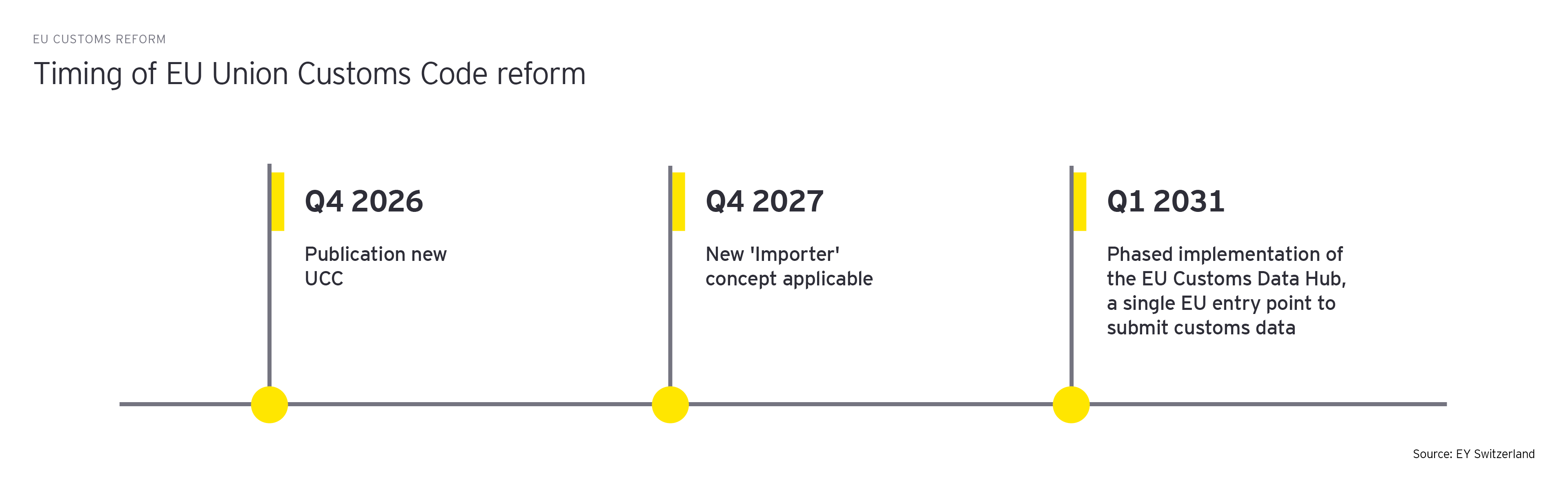
Timing of EU Union Customs Code reform

At the heart of this transformation is a new concept of “importer” that will apply as of September 2027. The importer must be established in the EU and will be responsible for ensuring compliance not only with customs requirements but also with other legislation applied by the customs authorities such as product safety, product liability and sustainability legislation.

For multinational businesses, this is a structural change. Existing customs operating models may need to be reassessed to determine which entity should assume the role of importer under the new framework, while arrangements involving indirect representation could become less attractive due to the potential liability implications for customs representatives.

For many Swiss groups, the assessment will typically focus on three key questions: Which EU entity should act as importer? How can existing service providers or EU subsidiaries support the chosen operating model? And is the underlying data sufficiently robust to support the new compliance and reporting requirements? Companies should also consider the time required to assess, design and implement any necessary changes. This article explains why the change is a sensible one, what it asks from businesses and where to start.

The message for Swiss business leaders is clear: early action provides greater flexibility while reducing implementation risks and potential supply chain disruption.

A customs reform designed for a different trading environment

Why is the EU reforming its customs system now?

The scale of the reform reflects the scale of the challenge facing the EU customs union. For decades, the customs union has operated through national customs administrations working together across national borders. Today, however, the system is managing a dramatically different trading environment. According to the European Commission, the EU customs union oversees trade worth more than €4.3 trillion, representing around 14% of global trade. In 2025 alone, customs authorities managed around 6 billion e-commerce parcels alongside more than 1.5 billion items in traditional trade.1 That growth, particularly in e-commerce, is changing the nature of customs risk.

The shortcomings of the current framework help explain the rationale behind the reform. Today, customs across the EU is administered by 27 national customs authorities and relies on more than 100 separate IT systems. Despite a common customs framework, businesses operating across multiple Member States often face inconsistent practices, duplicated compliance efforts and increased administrative complexity. The EU Customs Data Hub and the new EU Customs Authority aim to reduce this friction through greater consistency and improved data sharing.

EU trade
€4.3 trillion
€4.3 trillion
Combined value of trade managed by EU customs offices in 2025...
...equivalent to
14%
14%
of global trade.

What is changing in the EU customs system?

The reform responds by introducing new tools, new institutional structures and new responsibilities. Among its most visible innovations is the EU Customs Authority, a decentralized EU agency intended to coordinate governance across the customs union which will be based in Lille and begin operations in 2027. The authority will analyze continuously updated import and export data through a new EU Customs Data Hub, helping customs authorities identify higher-risk cargo and coordinate controls and crisis management.

For companies, this signals a broader shift: customs is becoming increasingly data-driven, coordinated and integrated at the EU level.

The new importer concept needs to be understood against that backdrop. It is not simply a new definition inserted into an otherwise familiar customs system. It forms part of a much wider redesign of how the EU identifies responsibility, assesses risk and manages the movement of goods.

The importer is becoming a strategic role

Who can act as importer under the new EU customs rules?

Under the new framework, the importer must be established in the EU and must ensure compliance with customs requirements and other legislation applied by the customs authorities. This change puts the legal entity acting as importer in a much more consequential position. In plain terms, the importer is the company that is legally answerable toward the customs authorities for customs-related obligations, including the accuracy of customs data, the payment of duties and compliance with other regulatory requirements applied by customs authorities where relevant to the imported goods. Under the new Code, this company has to be established in the EU. It does not directly mean that such company must be the legal and commercial owner of the subject goods. The concept of importer may differ from a customs, VAT or regulatory perspective. This aspect must be examined in the context of business and tax operating models.

Why does the choice of importer matter?

Consider a multinational business headquartered outside the EU. Its current model may involve a non-EU principal owning the goods, a centralized supply chain managing inventory and a customs broker acting as indirect representative. Such an arrangement may have developed incrementally over many years and may currently work well from an operational and commercial perspective. The reform creates a reason to examine that structure from first principles.

If the current non-EU entity cannot perform the importer role under the new framework, the business will need to determine which EU entity can assume the responsibility or whether the operating model itself needs to change. And if indirect representation results in additional liability exposure for customs representatives, the commercial attractiveness of that option could diminish significantly.

Indirect representation, i.e., a customs representative acting in its own name on behalf of another person, remains possible under the new framework. However, businesses should assess carefully whether this model remains appropriate in light of the respective roles, responsibilities and liability implications for all parties involved.

This is why the question should not be delegated solely to the customs department. The choice of importer can affect legal responsibilities, tax positions, intercompany arrangements, contracts and physical supply chain flows.

The entity selected must be capable not only of performing the customs role but also of managing the associated responsibilities within the broader business model.

This concept is not entirely new. The requirement for exporters to be established in the EU has been in place for many years. One of the effects of the reform is that establishment in the Union becomes a common feature of both the importer and exporter concepts. While importers and exporters remain distinct roles with different obligations, businesses now have a stronger incentive to review these roles together as part of a broader assessment of their EU operating model.

E-commerce is accelerating the shift in responsibility

The reform’s treatment of e-commerce illustrates the EU’s broader move toward placing greater responsibility on commercial actors that control the transaction.

Who will be responsible for importing goods sold through e-commerce?

The updated framework clarifies that non-EU e-commerce platforms will be considered the importer of goods sold into the EU. Rather than leaving customs formalities and duty payments to the final EU consumer, platforms will be responsible for handling those obligations.

This is particularly significant given the sheer volume of parcels entering the EU through e-commerce. The Commission reports that more than 90% of e-commerce parcels arriving in the EU in 2025 came from China.

The reform also introduces a new penalty framework for e-commerce operators that fail to meet their customs obligations, including obligations relating to EU standards and appropriate duty payment. In the most serious cases, penalties can reach 6% of a company’s annual import value of goods in the preceding year, alongside the possibility of losing certain customs privileges or facing restrictions on access to online platforms.

Two important cost changes are already in effect: the duty exemption for consignments below € 150 has been removed as of 1 July 2026 and a temporary €3 customs duty per item now applies to qualifying low-value consignments until 1 July 2028.

How does the customs reform distinguish B2B and B2C imports?

For Swiss businesses operating across both B2B and B2C channels, it is important not to treat these developments as one uniform importer requirement. The UCC reform distinguishes between different importer-related concepts. For B2B import flows, the general “importer” concept is the key area of attention, while B2C distance sales and platform-based e-commerce imports are addressed through the separate “deemed importer” concept.

Consequently, Swiss businesses need to map their actual trade models before determining which elements of the reform apply to them.

The reform reaches beyond customs

The implications of the new importer definition extend well beyond the border.

What other business functions are affected by the new importer requirements?

Companies will need to rethink their legal entity footprint in the EU. Some may face a reallocation of risks and responsibilities as well as a potential misalignment between customs, VAT and transfer pricing. Moreover, organizations have to consider potential exposure to compliance risks, penalties and delays as well as the risk of disruption to import flows. This makes the reform a cross-functional issue.

Suppose an organization decides that an existing EU subsidiary should become its importer. That decision could alter the subsidiary’s functional profile and risk allocation. The organization may then need to consider whether its intercompany agreements and transfer pricing arrangements still reflect the functions and risks being undertaken. VAT consequences may also need to be assessed, while legal teams may need to revisit contractual responsibilities.

Supply chain teams face a similar practical question: can the new structure support the physical movement of goods without introducing unnecessary complexity or delays?

These questions should be considered together. A solution that addresses customs compliance but creates significant tax, legal or operational problems is unlikely to be sustainable.

The Customs Data Hub points to a more connected future

The reform provides an indication of where customs administration is heading. The new EU Customs Data Hub is intended to become a single platform through which importers and exporters interact with customs in the EU. The EU Customs Authority will use the data to support risk analysis and identify cargo that should be prioritized for inspection.

The transition to the new customs framework will take place gradually. Under the current timeline, use of the EU Customs Data Hub will become mandatory for e-commerce operators from 1 July 2028 and for all traders from 1 March 2034.

What does the Customs Data Hub mean for Swiss businesses?

For Swiss companies, the significance goes beyond the individual dates. We are seeing a move toward greater visibility of trade data, greater consistency in risk assessment and stronger use of technology across the customs union.

That creates both an obligation and an opportunity. Businesses will need reliable information about their products, transactions and supply chains. At the same time, companies that can provide comprehensive and accurate information may be better positioned to benefit from the reform.

2034 sounds comfortably distant, but the underlying work, such as getting product classifications, origin and valuation data consistent across systems, typically takes years rather than months. The voluntary window as of 2031 is an opportunity to test on your own terms rather than against a deadline.


We are seeing a move toward greater visibility of trade data, greater consistency in risk assessment and stronger use of technology across the customs union.

Compliance could become a competitive advantage

One of the most interesting elements of the new framework is the creation of a “trust and check” trader category for the most transparent and reliable businesses.

How can customs compliance become a competitive advantage?

Companies meeting stringent criteria and providing comprehensive information on the movement and compliance of their goods will be eligible for simplified customs procedures. The most reliable traders could ultimately release goods into EU circulation without active customs intervention. This introduces an important strategic dimension to the reform.

There is an important condition attached: trust and check status is open only to businesses established in the EU with a track record of regular customs activity and systems capable of sharing data with customs.

Customs compliance has traditionally been viewed primarily through the lens of avoiding penalties, delays and disruption. The emerging model suggests a different possibility: high-quality compliance and data can become an operational advantage.

That makes the decision about the importer even more important. The entity responsible for imports will need the systems, data, processes and governance necessary to support a modern customs environment.

Companies should therefore consider not only who can legally act as importer but also which operating model will allow them to become a reliable, data-enabled participant in the future customs system.

Data consistency and automation are becoming the foundation of customs compliance.

The clock is already running

The implementation timeline reinforces the need to begin now. The new importer concept is expected to apply as of September 2027. The EU Customs Authority is expected to begin operations in 2027. The new framework also introduces an EU-wide handling fee on small parcels as of 1 November 2026, with the level of that fee to be set by the Commission. The Council has also highlighted the separate removal of the historical customs duty exemption for imports valued below € 150.

Although important implementation details remain to be specified, the publication of the Regulation provides businesses with greater certainty regarding the overall direction and timeline of the reform. For businesses, these changes are arriving as a package rather than as isolated regulatory events.

How can Swiss organizations address the regulatory change with confidence?

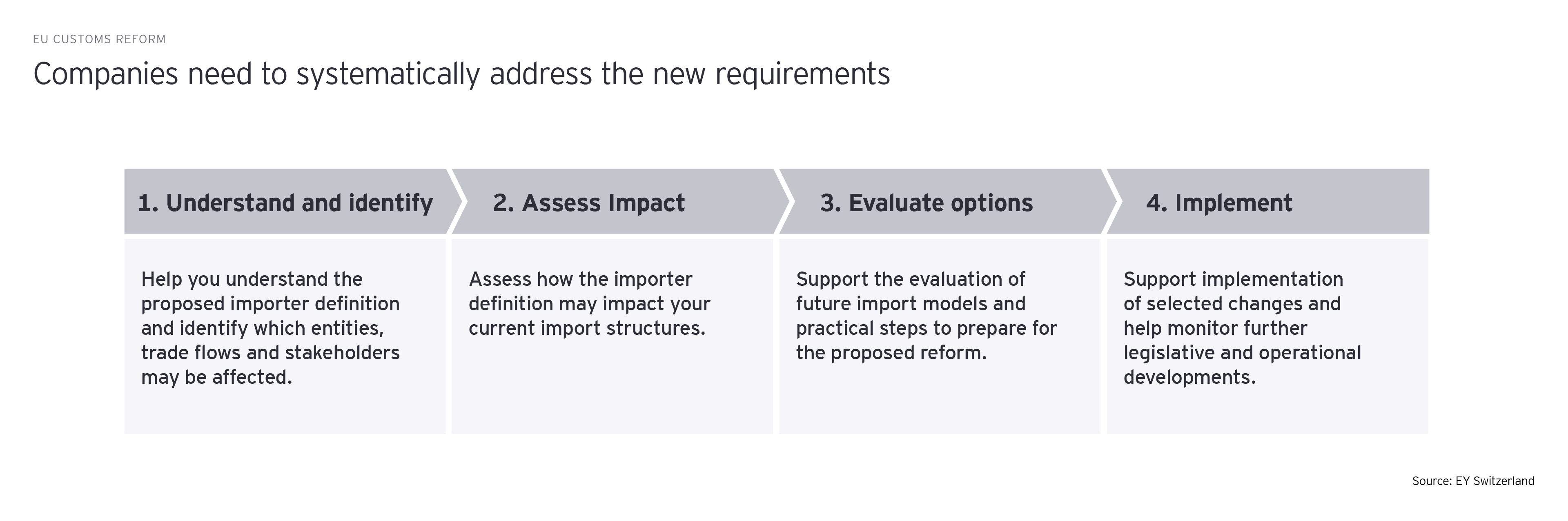
A systematic approach to addressing the new importer requirements encompasses four practical steps: understand, assess, evaluate and implement.

Companies need to systematically address the new requirements

The first step is to understand what is changing and to identify affected entities, trade flows and stakeholders. Businesses should determine whether they currently rely on a non-EU entity as importer of record, use customs brokers as indirect representatives or operate through principal, toller, contract manufacturer or limited-risk distributor structures, all common features of Swiss principal models. They should also examine supply chains in which ownership is centralized outside the EU.

The second step is to assess the consequences. This means looking at customs, VAT, transfer pricing, legal and supply chain considerations rather than evaluating the importer requirement in isolation.

Only then should the organization evaluate its options and move toward implementation.

A new operating model for the EU

The EU Customs Reform creates a moment for businesses to reconsider assumptions that may have been embedded in their European operating models for years.

The immediate question is who will qualify as importer as of September 2027. The more important question is what role that entity should play within the company’s broader European structure.

How should Swiss organizations design their EU operating model?

For some organizations, the answer may be to strengthen an existing EU entity. For others, it may involve restructuring responsibilities, changing contractual arrangements or redesigning import flows. The appropriate solution will depend on each company’s legal entity footprint, trade flows, commercial model and allocation of functions and risks. What is becoming clear is that the status quo should not be assumed.

The EU is building a customs system that is more centralized, more data-driven and more focused on accountability. E-commerce platforms are being given greater responsibility for imports. A new EU Customs Authority will coordinate risk and governance. The Customs Data Hub will progressively transform how trade information is managed. And trusted traders will have an opportunity to benefit from simplified processes.

Against that backdrop, the new importer definition is more than a compliance deadline. It is a signal that businesses need to decide deliberately how they want to participate in the next generation of EU customs.

The time to start is now. Map your EU import flows, identify where the current model depends on non-EU entities or indirect representation and bring customs, VAT, transfer pricing, legal and supply chain leaders into the same conversation. Then use the period before September 2027 not simply to close a compliance gap but to design an importer structure that supports your wider European strategy.

The companies that act early will have the greatest freedom to choose their model rather than inherit one under deadline pressure. As the EU customs system becomes more integrated and data-driven, that preparation could turn regulatory readiness into a genuine operational advantage.

Starting these discussions now allows businesses to assess whether their current customs and operating model remains fit for purpose. Taking action ahead of the relevant application dates provides greater flexibility to evaluate and implement any necessary adjustments. This gives businesses more time to align their organization, processes and systems with the requirements of the future customs framework.

The companies that act early will have the greatest freedom to choose their model rather than inherit one under deadline pressure. As the EU customs system becomes more integrated and data-driven, that preparation could turn regulatory readiness into a genuine operational advantage.


Start those conversations in 2026 and the reform becomes something more useful than a compliance exercise. It is an opportunity to tidy up the EU structure that has probably grown organically for years and to do it on your own timetable.


Summary

The EU customs reform is now law, and it changes how goods enter and leave the European Union. As of September 2027, the new importer concept will require the importer to be established in the EU and responsible for customs and related regulatory compliance. This is similar to the current definition of an exporter. The changes have significant implications for multinational operating models, indirect representation, VAT, transfer pricing, legal structures and supply chains. E-commerce platforms will face additional responsibilities while the EU Customs Data Hub and “trust and check” trader status will make customs increasingly data-driven. The reform also offers something in return, i.e., clearer rules, one EU-wide framework and simplified procedures for transparent traders. The practical ask is to map EU flows in both directions, decide which EU entity takes the role and align contracts and data behind that decision.

Acknowledgement

We kindly thank Deniz R Tuncel for his valuable contribution to this article.


FAQs

Related articles


Explore how EY can help you with Global trade operations

Backed by our deep technical knowledge, global scale, and leading EY Trade Connect technology platform, EY offers a flexible way to view trade operations with clarity and act with precision, while managing costs and mitigating risks.

Two warehouse workers in orange safety vests and hard hats reviewing a document between shelves stacked with boxes.

About this article

Authors

Request for proposal (RFP) - exclusively for Switzerland

|

Submit your request now!