Which companies are eligible?
Only operators of installations that are required to participate in the Swiss ETS under Article 16 of the CO₂ Act can apply. Operators that have opted out of mandatory participation and operators that participate voluntarily are not eligible for funding.[1]
Where a company intends to seek support for several independent measures, each measure requires a separate application. Applications submitted after project implementation has started are rejected, subject to a narrowly framed possibility for the Swiss Federal Office for the Environment (FOEN) to authorize an earlier start in justified cases.[1]
Which projects appear most relevant and competitive?
Projects appear most relevant when they combine substantial, measurable emissions reductions with a credible implementation plan and a clear need for financial support. The published rules are technology-neutral in their main test, which allows companies to begin with the full decarbonization CAPEX pipeline rather than a narrow list of preferred technologies.[1]
The guidance nevertheless identifies clear boundaries. Switching from one fossil fuel to another, replacing equipment with technology that is not state of the art, certain district-heating and reserve-power measures, and carbon capture and utilization in which the captured CO₂ is later re-emitted are among the measures that do not qualify as making a substantial contribution. Research, development, education and information measures are also excluded.[1]
What is required to win funding?
A competitive application must turn “substantial contribution” into a coherent, quantified and verifiable case. FOEN requires a plausible explanation of how the measure materially decarbonizes the ETS installation and evidence that it does not fall into an excluded category. The guidance does not set a single universal percentage threshold for substantial contribution, so the strength of the case depends on the project’s narrative and its position against the published assessment criteria.[1]
How is a substantial contribution assessed?
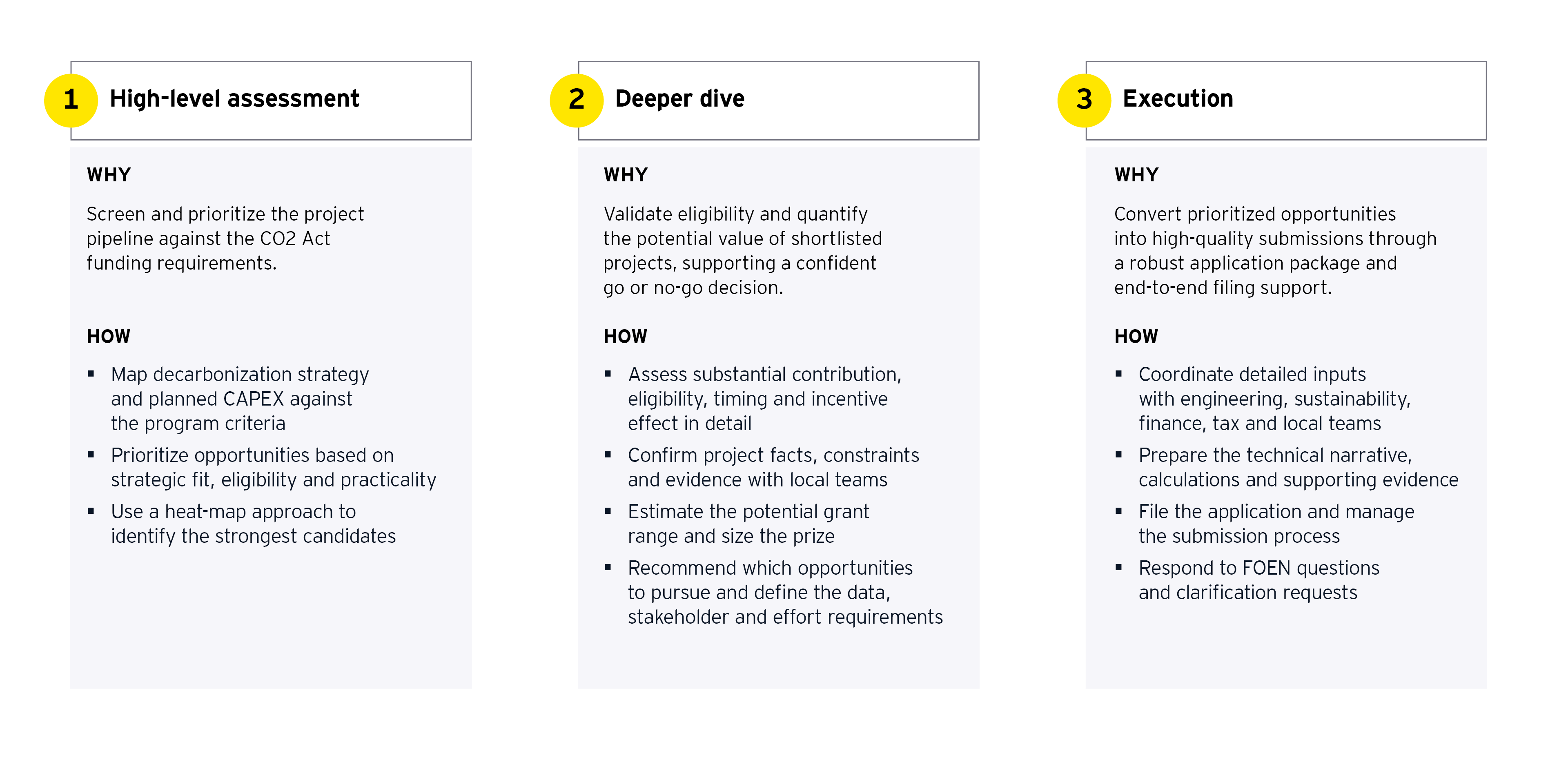
The program combines an eligibility gateway with comparative prioritization. First, the project must make a substantial contribution at the installation level. A strong application requires credible and quantified evidence on emissions reductions, business case, allowable costs and implementation.
If applications exceed the available annual resources, eligible applications are ranked. Half of the weighted score concerns the requested grant amount in CHF per ton of expected emissions reduction or negative emissions. Further criteria consider the percentage reduction in site emissions, carbon leakage exposure and the change in wider environmental impacts.[1]