



EY refers to the global organization, and may refer to one or more, of the member firms of Ernst & Young Global Limited, each of which is a separate legal entity. Ernst & Young Global Limited, a UK company limited by guarantee, does not provide services to clients.
Recent Searches

Based on the draft legislation submitted for public consultation, wealth tax is expected to introduce a new annual obligation from 15 December 2026 for high-net-worth individuals and wealth management structures. Except in cases where Hungarian tax residency or wealth management taxpayer status ceases, the first tax liability is expected to arise based on the assets held on 31 December 2026. The deadline for filing the tax return and paying the tax would be 31 August 2027.
A distinctive feature of the new tax is that it is not limited to specified assets but is based on the taxpayer’s overall wealth position. In practice, before the tax can be determined, this requires a comprehensive assessment of the taxpayer’s assets, an analysis of ownership and wealth management structures, the determination of the statutory value of individual assets, and the preparation of documentation supporting asset values, liabilities and deductions.
In this article, we outline the key points to know about wealth tax.
Who is subject to wealth tax?
Generally, wealth tax applies to the net wealth of individuals and wealth management structures exceeding HUF 1 billion.
- For Hungarian tax resident individuals, the tax liability is applicable to their entire domestic and foreign wealth.
- For non-resident individuals, the tax applies to real estate located in Hungary, property rights related to such real estate, ownership interests in companies established under Hungarian law, and ownership interests in companies holding real estate in Hungary.
- Wealth management structures are treated as separate taxpayers. These include, among others, trust arrangements, private foundations, and foreign structures with the same or a similar purpose. The entire domestic and foreign wealth of a resident wealth management taxpayer is taxable, while a non-resident wealth management taxpayer is liable to tax on specified Hungarian assets.
Special rules apply to determining tax residency. For Hungarian tax residency, the draft legislation builds on the rules of the Personal Income Tax Act and contains specific provisions for Hungarian citizens, including dual nationals. However, a Hungarian citizen who, on the last day of the tax year, has been habitually residing abroad for at least ten years will not be regarded as a Hungarian tax resident. This rule may be overridden by international treaties, but Hungarian citizens relocating to countries such as the United States, the United Kingdom or Portugal should nevertheless take this limitation into account.
A person who is not a Hungarian citizen and works in Hungary under a secondment, assignment or temporary agency arrangement by a foreign employer not registered under Hungarian law is exempted from the wealth tax obligation for a maximum period of five years. Under the current draft, the five-year period starts from the date the legislation enters into force, i.e. 15 December.
What is included in wealth?
The scope of taxable assets is comprehensive. In addition to real estate, it includes cash and bank deposits, securities and other investments, ownership interests in companies, receivables, crypto-assets, insurance policies with surrender value, investment-grade precious metals, property rights and high-value movable assets.
As a general rule, taxpayers do not need to take into account items intended for personal use, as well as furnishings and equipment customarily required for the normal use of real estate. Exceptions include works of art, collections and jewelry with an individual value exceeding HUF 3 million, as well as vehicles with an individual value exceeding HUF 10 million. However, the full value of movable assets connected with business or agricultural activities, or accounted for as expenses, forms part of the tax base.
Properly substantiated liabilities that actually exist may reduce the tax base. Hungarian tax resident taxpayers can take into account liabilities arising on grounds specified by law and supported by appropriate documentation. The rules are stricter for non-resident taxpayers: only liabilities directly related to the acquisition, establishment, maintenance or value-enhancing investment of taxable Hungarian assets are deductible.
The division of family wealth also matters
In the case of jointly owned assets, the asset is generally taken into account in proportion to ownership interest. In the case of marital joint property, the marital property agreement and any agreement between the spouses take precedence. For certain assets registered in the name of one spouse, the spouses may choose either to allocate the asset entirely to one spouse or to divide it on a 50-50 basis. This requires matching declarations from both spouses. Other jointly owned assets are generally allocated equally between the spouses’ tax bases.
The assets of a minor child, with the exception of inherited assets, assets acquired from the child’s own earnings, and assets replacing these, must be included in the tax base of the parent exercising parental custody. Where parental custody is shared, these assets are divided equally between the parents. The above exceptions form part of the minor’s own tax base.
How much is the tax?
The portion of net wealth exceeding the HUF 1 billion threshold constitutes the tax base. The annual tax rate is:
- 1% on the portion of the tax base not exceeding HUF 100 billion;
- 1.5% on the portion exceeding HUF 100 billion.
The tax payable may be reduced by, among other things, local taxes paid on taxable real estate, vehicle tax paid on taxable vehicles and similar foreign taxes.
The tax payable may also be reduced by 50% of the actual invoiced fees paid for independent expert, valuation or business valuation services that are mandatorily required under the legislation to determine the value of an asset, up to a maximum of HUF 2 million per year.
No tax is payable on foreign assets that are taxable in another state under an applicable tax treaty and exempt from tax in Hungary. Where the treaty permits, taxpayers can take the value of the exempt foreign assets into account to determine the tax rate applicable to their remaining wealth.
Taxpayers may indicate in their tax return that 5% of the wealth tax paid should be allocated to the National Cooperation Fund.
The key question: what is wealth worth?
Valuation is one of the most important aspects of applying wealth tax in practice. The proposed legislation sets out detailed valuation methods for individual asset categories. Where no specific rule applies to an asset, taxpayers must use the asset’s fair market value as of the last day of the tax year.
The value of a bank account or many exchange-traded assets can be determined relatively easily. By contrast, valuing an ownership interest in a family business, foreign real estate, a high-value movable asset or a complex wealth management structure may require considerably more data and professional judgement.
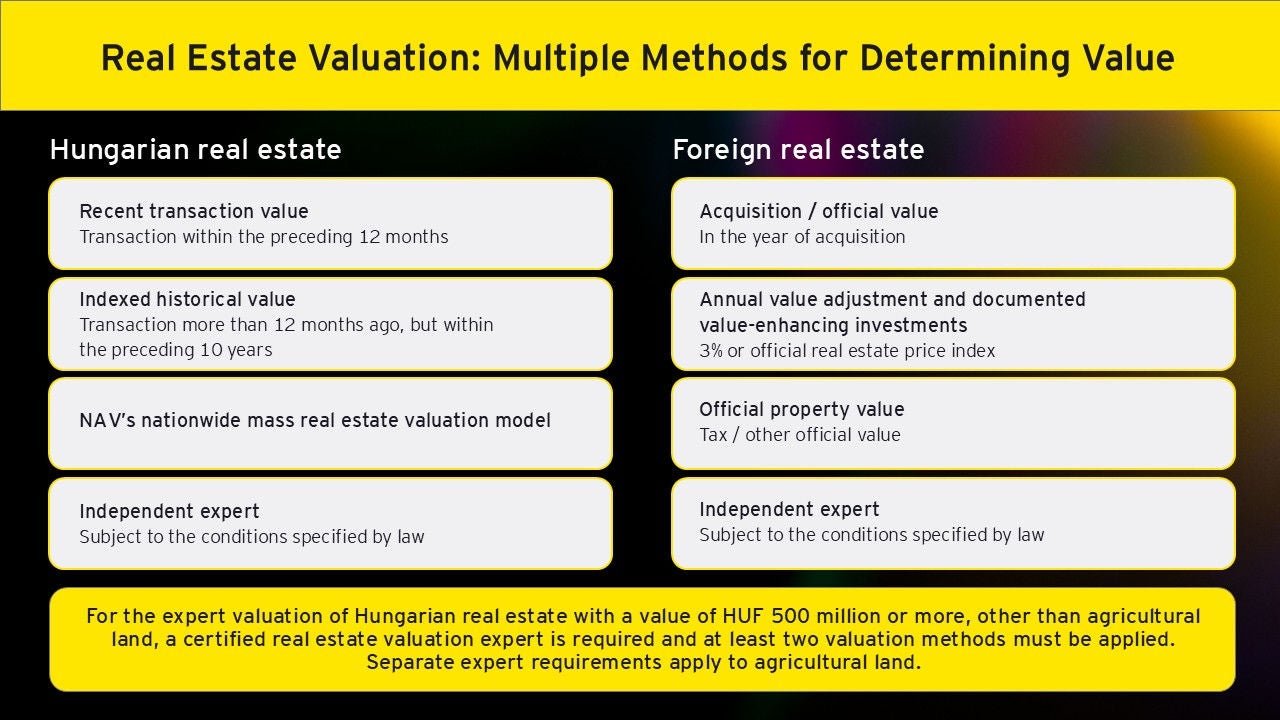
For Hungarian real estate, taxpayers must first consider the transaction value recorded during the preceding 12 months. If no such value exists, they may use a transaction value from up to ten years earlier, adjusted through appropriate indexation. For residential property and agricultural land, the legislation relies on specifically defined official price indicators. For other types of real estate, taxpayers may apply a price index determined on the basis of data from the Hungarian Central Statistical Office and applicable to the relevant property type. If the value cannot be determined using these methods, taxpayers may use the value generated by the Hungarian tax authority’s nationwide mass real estate valuation model or, where the statutory conditions are met, they can obtain an independent expert valuation.
For foreign real estate, the transaction price or official value at the time of acquisition must be used in the year of acquisition. In subsequent years, taxpayers may choose to adjust the previous year’s value either by 3% annually or according to changes in an officially published foreign real estate price index applicable to the relevant property type. If these methods are not applicable, taxpayers may use a foreign tax valuation or another official property value. As a last resort, they may obtain an independent expert valuation.
For movable assets, fair market value is the starting point. Taxpayers should first consider the consideration paid in an arm’s-length acquisition within the preceding 12 months. If this value is unavailable, they may use documented sale prices, auction prices or offer prices for comparable movable assets, followed by an insurance value that reflects current market value. Alternatively, taxpayers may also rely on an independent expert valuation.
Ownership interests in companies: both equity and income-generating capacity matter
Ownership interests listed on a stock exchange or regularly traded outside a regulated market must, as a general rule, be valued on the basis of their market price.
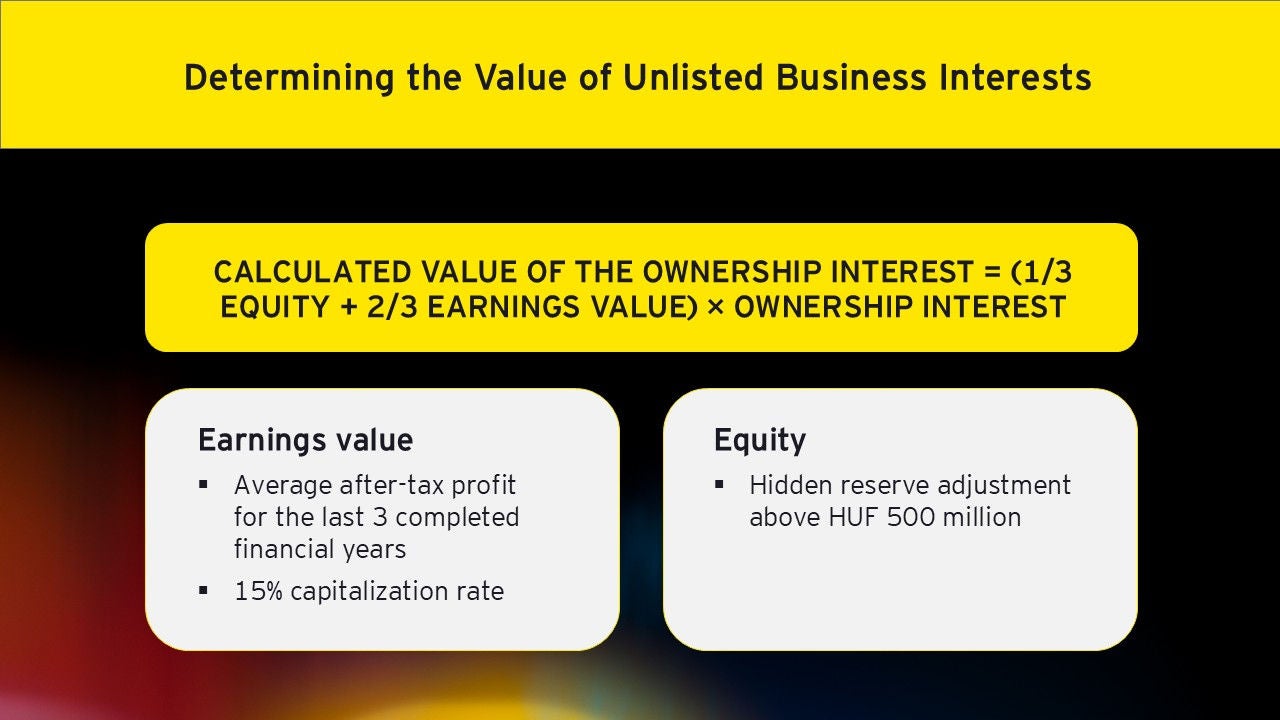
For unlisted ownership interests that are not regularly traded, the value is generally determined as the weighted average of one-third of the company’s equity value and two-thirds of its earnings value, reflecting its income-generating capacity, adjusted for the relevant ownership interest.
The earnings value is calculated on the basis of the average after-tax profit for the last three completed financial years and, for Hungarian companies, a capitalization rate of 15%. In other words, the earnings value is the amount 15% of which equals the average after-tax profit for the last three completed financial years.
If a company’s equity does not exceed HUF 500 million according to the company’s financial statements for the last closed financial year, the equity value is determined using the latest financial statements. Above HUF 500 million, equity must be adjusted for specified hidden reserves relating to real estate, ownership interests and securities. (For these purposes, a hidden reserve is the difference between an asset’s carrying amount and market value, approved by an independent auditor and reduced by the profit tax expected to arise on a future disposal of the asset. The draft legislation also allows taxpayers to use the value determined under the wealth tax rules instead of market value.)
Hungarian companies with equity exceeding HUF 500 million must provide the individuals exercising ownership rights and the Hungarian tax authority with the auditor-reviewed information required to determine hidden reserves within 30 days of the approval of their financial statements. Where a business valuation is carried out, the Hungarian company must provide the valuer with the information required for the valuation within 30 days of the request.
Under the draft legislation, taxpayers may reduce the value of a minority ownership interest determined under the above method by 25%, or by 30% if the minority interest is less than 33%.
Where the necessary financial statement data are only partially available or unavailable, or the available data are not suitable for determining the value of the ownership interest because of the company’s operating circumstances or specific rights and obligations attached to the interest, company value determined by an independent business valuer may be used.
Special valuation rules apply to holding companies, newly established companies, minority interests and other specific cases.
Property rights and options
The proposed legislation contains detailed provisions on property rights such as usufruct rights, rights of use, land-use rights, vehicle operator rights and building rights. As a general rule, taxpayers must value these rights according to the rules of the Hungarian Duties Act, while building rights are valued at fair market value.
Options and similar rights are valued under a multi-stage system. Taxpayers must first use market value. If market value is unavailable, they may rely on a value determined by a financial institution, a comparable transaction or an independent expert valuation.
For tax base purposes, the higher of the option’s fair market value and its intrinsic value determined under the legislation must be taken into account. The rules also address liabilities deductible by parties subject to obligations under options and exclude certain options that depend on personal performance or are already reflected in the value of another asset. The objective is for the tax base to reflect the genuine economic value of these rights.
Taxation of wealth management structures
Assets managed under trust arrangements, private foundations and structures established under foreign law with the same or a similar purpose qualify as separate wealth management taxpayers. The taxation of these assets is separate from the taxation of the settlor’s, trustee’s, founder’s, contributor’s and beneficiary’s own assets.
A wealth management taxpayer is considered resident in Hungary if the structure was established under Hungarian law or, in the case of a foreign structure, if its place of effective management is in Hungary. When determining the place of effective management, the key consideration is where the material strategic, managerial and economic decisions concerning the overall operation of the wealth management taxpayer are actually made. The place where decisions are formally approved, documented or implemented is not decisive in itself.
The tax liability of a Hungarian resident wealth management taxpayer extends to its entire domestic and foreign wealth. A non-resident wealth management taxpayer is liable to tax on real estate located in Hungary, property rights related to such real estate, ownership interests in Hungarian companies and ownership interests in companies holding real estate in Hungary. If a wealth management taxpayer ceases to qualify as Hungarian resident during the year, its tax liability will be determined on the basis of its wealth position on the day preceding the loss of its Hungarian resident status.
Particular attention should be paid to wealth management taxpayers considered related parties under the draft legislation.
Related wealth management taxpayers may apply the HUF 1 billion threshold only once collectively in each tax year. A related-party relationship can arise, among other cases, where the structures have the same settlor, the settlors are family members or the settlors qualify as associated enterprises. The threshold may be allocated among related taxpayers, but this requires declarations with identical content. In the absence of such declarations, the draft legislation provides that the threshold will be allocated according to the order in which the wealth management taxpayers were established.
In the cases specified by law, wealth management taxpayers must register with the Hungarian tax authority within 30 days and, as part of the registration, provide the information necessary for, among other purposes, identification, determination of tax residency, representation and the identification of settlors.
For international structures, particular attention should be paid to entities regarded as tax transparent. Where a partnership or similar arrangement is tax transparent under the applicable law, the assets held by it are not taken into account at the level of the entity itself but directly at the level of its members or other participants.
The tax base of a wealth management taxpayer must be determined asset by asset in accordance with the valuation methods set out in the draft legislation.
Once the rules are understood, preparing an asset inventory is the first real task
The first step in preparing for the new rules is to determine precisely which assets fall within the scope of the tax. This requires an assessment of tax residency, direct and indirect ownership arrangements, foreign assets, the division of marital and family wealth, as well as trusts, foundations and other international structures.
The next step is to prepare a comprehensive asset inventory. Each asset must be identified and matched with the appropriate valuation rule. Deductible liabilities and required data disclosures must also be identified, along with assets for which an expert valuation or business valuation may be necessary.
Given the nature of the task, tax, valuation, accounting, international tax and legal considerations are closely interconnected in the process.
How to report wealth tax?
Wealth tax should be assessed, reported and paid through self-assessment by 31 August of the year following the relevant tax year. Taxpayers are only required to file a tax return if wealth tax is payable for the relevant year. Tax return filing and the related administrative procedures must be completed electronically, and taxpayers will have to retain the documentation supporting valuations, liabilities and tax-reducing items.
If payment of the tax in a single amount would impose a disproportionately heavy burden given the taxpayer’s liquidity position, the Hungarian tax authority may, upon request, allow deferred payment or payment in instalments for up to 12 months or, in exceptional cases, up to 24 months.
Importantly, the legislation also contains a general anti-avoidance rule. Any valuation method or legal transaction intended to circumvent the valuation or tax base determination rules will not constitute a proper exercise of rights. Changes to the structure of wealth can therefore be safely undertaken only where they are supported by genuine economic reasons or other substantively demonstrable reasons independent of the tax liability.
What should taxpayers focus on now?
The first valuation date is 31 December 2026. Taxpayers should therefore act now to determine whether the relevant individual or wealth management structure falls within the scope of the tax, prepare an asset inventory, clarify the treatment of family and wealth management structures, identify problematic assets or assets requiring a separate valuation, request the necessary information from companies, collect supporting documentation and calculate the expected tax liability in advance.
Wealth tax is therefore not simply a new type of tax. For individuals and wealth management structures with complex asset holdings, it represents a tax, valuation and documentation project. The quality of that project will largely depend on how systematically the overall wealth position is mapped, information is collected and valuations are performed from the very first year.
How can EY support your preparations?
EY’s wealth tax services address the entire process in an integrated manner. Support ranges from interpreting the new rules and preparing the asset inventory to valuing complex assets, assessing the tax liability, reviewing and appropriately structuring wealth from a legal perspective, and preparing the tax return and supporting documentation.
For financial assets, this includes reviewing and valuing retirement savings, long-term investments, investment funds, crypto-assets and other financial instruments. For real estate, the focus is on the relevant data, value and ownership structure of domestic and foreign residential, commercial and investment properties. For business interests, determining the appropriate company data, hidden reserves, earnings value and ownership interest may require specialized expertise.
Managing complex wealth structures requires coordinated input from several professional areas. In addition to domestic and international tax, valuation and structuring expertise, effective project management of the overall process is essential: the required data, valuations, expert work, declarations and documentation need to be managed in an integrated process.
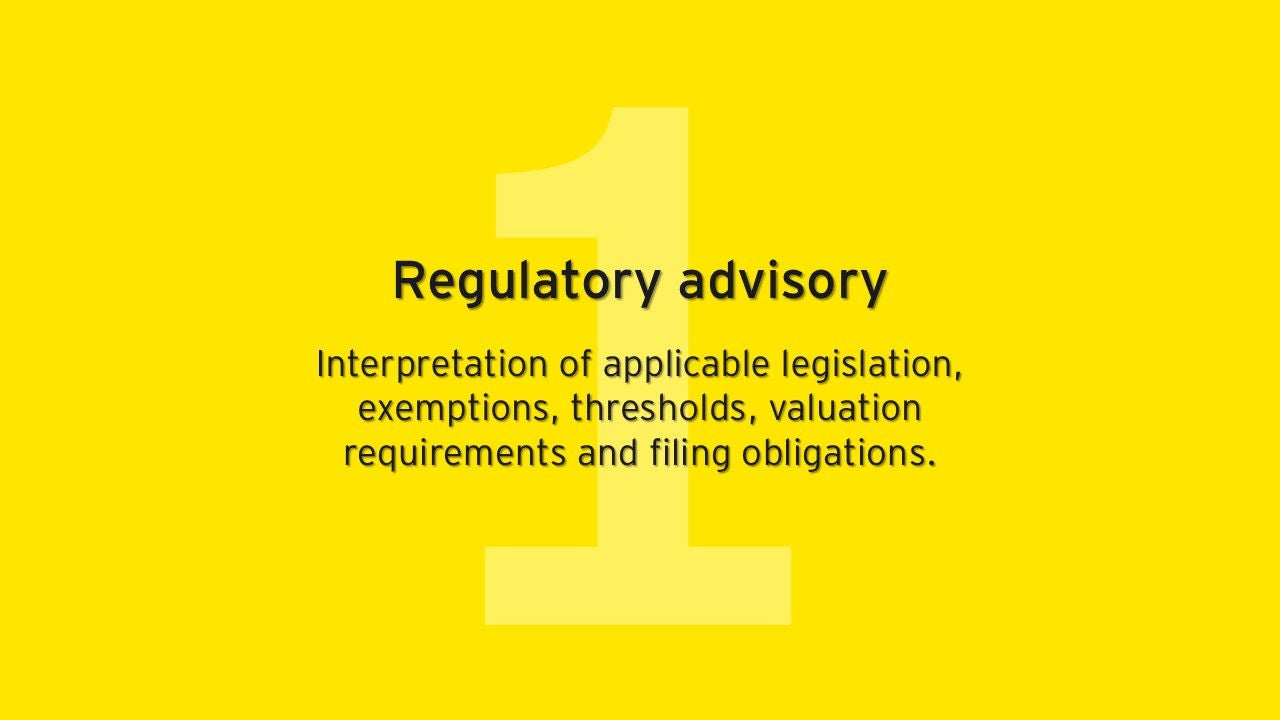
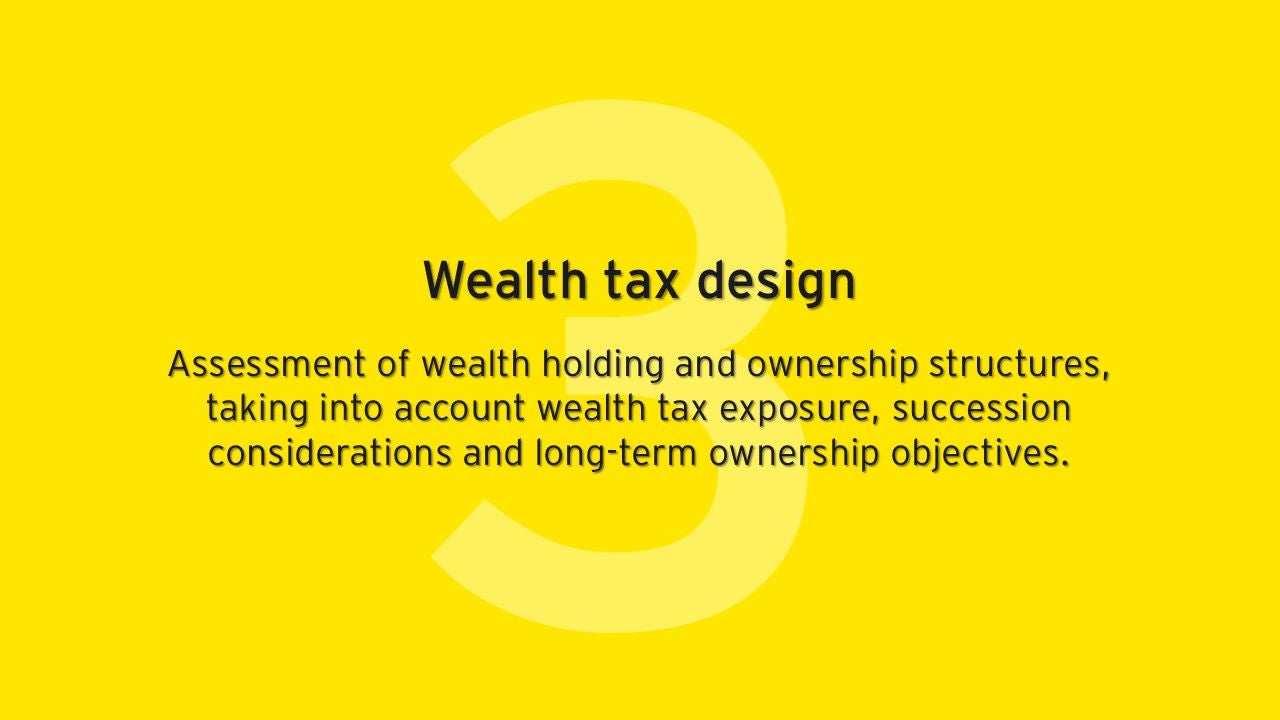
Our wealth tax support is built around four key pillars:


What EY
can do
for you
Direct to your inbox
Stay up to date with our Editor's picks newsletter.