


EY refers to the global organization, and may refer to one or more, of the member firms of Ernst & Young Global Limited, each of which is a separate legal entity. Ernst & Young Global Limited, a UK company limited by guarantee, does not provide services to clients.
Recent Searches

Business impact of AI: Organizations that use Artificial Intelligence in the right way increase profits and reduce costs.
Artificial intelligence (AI) has come to stay. More and more people – whether in their private lives, their work routines, or both areas – are utilizing the opportunities presented by this new technology. The European AI Barometer 2025 shows, how their perspective on AI applications has changed over the past 12 months, how satisfied they are with the application of technology in their everyday work and where they still see challenges.
In brief
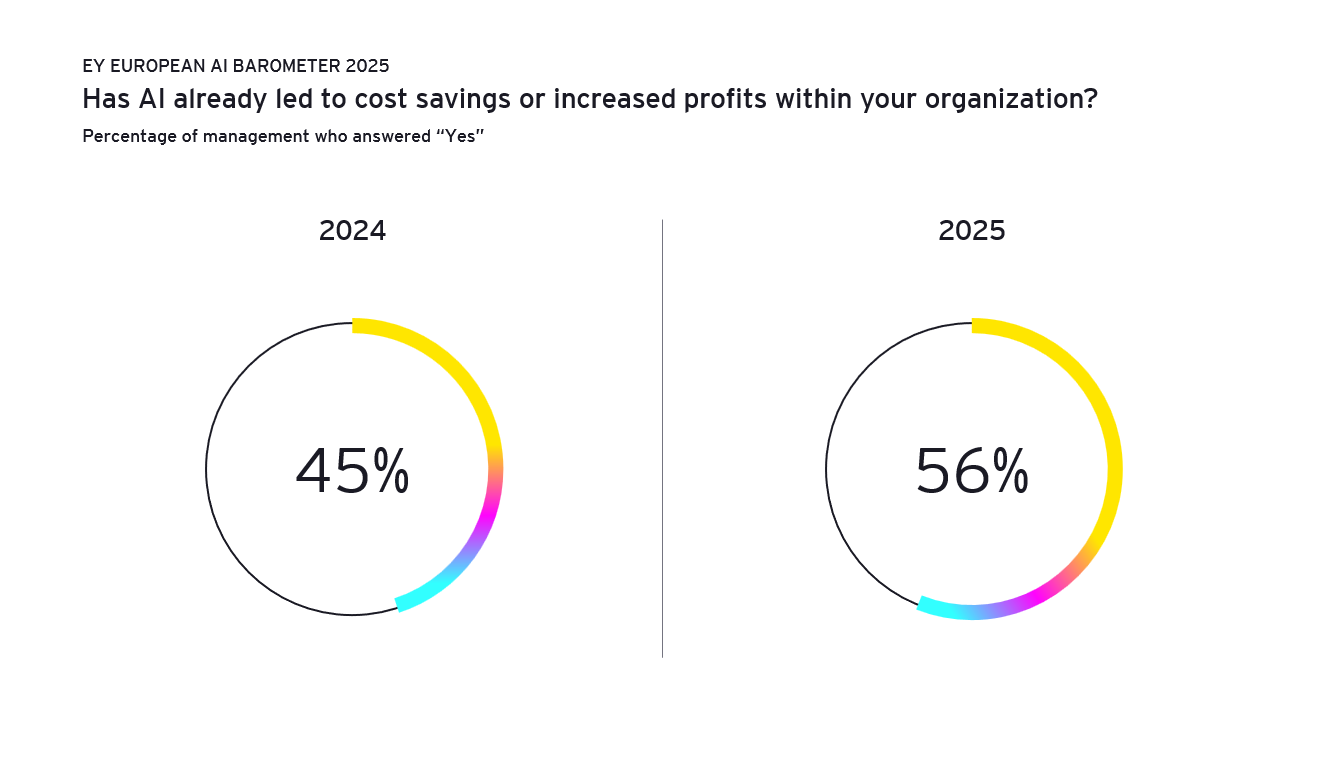
- More than half of the organizations (56%) have already been able to save costs or increase profits through AI – an increase of 11 percentage points and on average the effects are €6.24 million
- Four out of ten see a productivity increase thanks to AI — Management more often than employees
- Six out of ten respondents (61%) assume that the EU AI Act will have a positive influence on their own organization
- Only one in two (52%) believes that their employer has a clear ethical framework for deploying AI technologies
EY European AI Barometer 2025
Download the full report to gain insights into perceptions of AI’s impact.
Please fill in your information to gain access to our report.
AI is delivering tangible financial benefits. A majority of respondents (56%) say their organization has either increased profits or reduced costs through AI adoption, an 11-percentage-point rise from the previous year’s 45%. Only 16% say AI has not yet led to cost savings or profit increases, while 29% believe it is too early to assess. In terms of scale, over a one-third of respondents of the European AI Barometer 2025 report positive financial effects from AI initiatives of between €5 million and €15 million, further underscoring the transformative potential of AI when implemented effectively. On average, the use of the technology brings firms additional profits or savings of €6.24 million.
In certain sectors, such as advanced manufacturing (78%), sports (74%) and agriculture and agroindustry (73%), the financial gains from AI are evident. In contrast, government and public sector (35%), professional services (41%) and health (48%) report a significantly lower impact. Regionally, Spain (70%), Belgium (60%) and Germany (59%) lead in observing AI’s positive effects on financial performance, while Portugal (42%) and Austria (48%) trail behind (Figure 20). This growing body of evidence shows that AI is a powerful tool for enhancing productivity and financial outcomes, but its success depends on measuring impact, addressing workforce concerns and aligning strategic initiatives to drive sustained value creation.
Impact on workforce productivity
From the workforce’s perspective, AI is already making an impact on productivity. A total of 44% of respondents report improved productivity due to AI, while 8% have noticed a decline, 24% see no change, and 26% do not use AI tools. Men (48%) report higher productivity gains than women (39%), and management (56%) report significantly greater improvements than non-executive employees (35%). The positive effects are particularly pronounced in technology, media and telecommunications (60%), and advanced manufacturing (59%), reflecting the comparatively higher levels of AI adoption in these industries. Regionally, Belgium (52%) leads in reporting productivity increases, while Austria (34%) significantly lags behind.
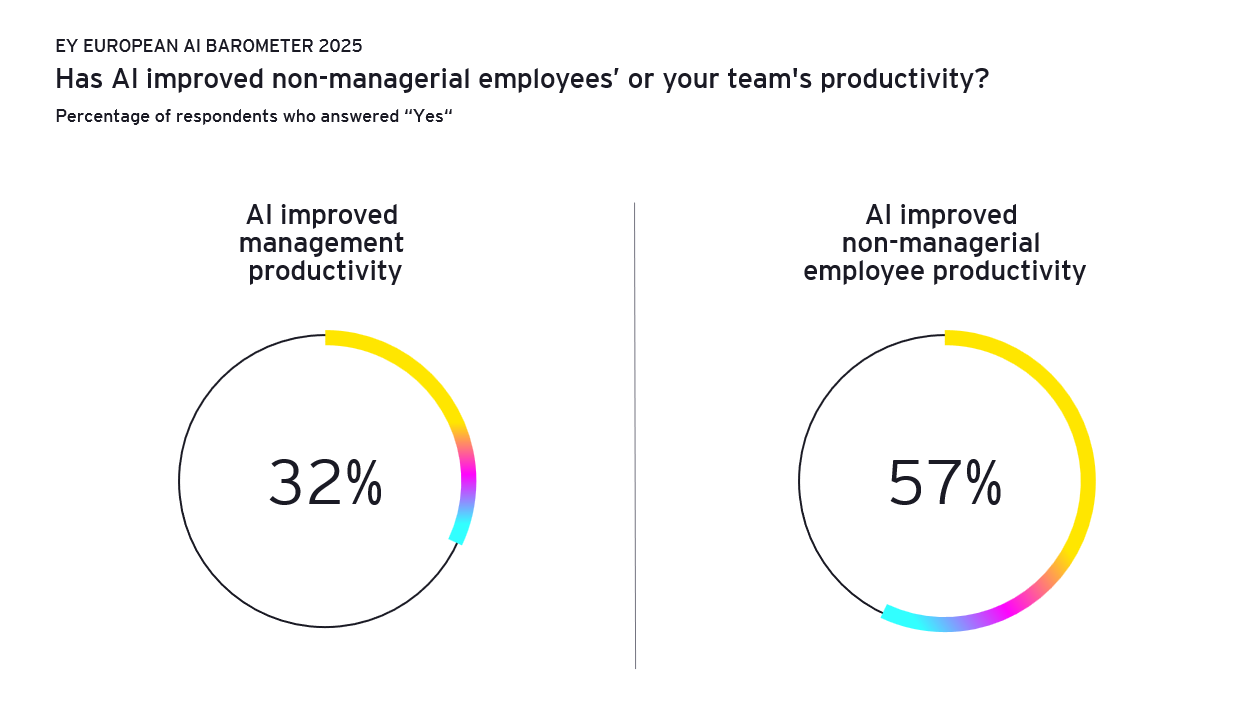
Interestingly, perceptions of AI’s impact on productivity reveal a notable divide. While 57% of management believe AI has enhanced the productivity of their teams, only 35% of non-executive employees agree, and of those only 9% see a significant improvement in their productivity. On the other hand, although 56% of management report productivity improvements in their own work, only 32% of non-executive employees believe their management’s productivity has increased. This disconnect underscores the need for organizations to adopt precise methods to measure the true benefits and costs of AI integration in live operations. Considering the stakes, this is not an area where intuition or subjective judgment should guide decision-making.
Monitoring and reporting are key
To effectively monitor and quantify AI’s impact, businesses must modernize their corporate monitoring and reporting systems. Accurate measurement requires implementing advanced metrics and dashboards capable of tracking productivity gains, cost savings and other key performance indicators in real time. These systems should integrate seamlessly into existing management, control and risk frameworks, ensuring a consistent and holistic view of AI's contributions. Beyond measuring productivity, updated systems should also capture the broader financial and operational impacts of AI, such as changes in workflow efficiency, employee satisfaction and customer outcomes. For example, correlating AI-driven productivity gains with specific investments in technology or training can help pinpoint areas of high ROI and inform future decision-making. Additionally, incorporating predictive analytics into monitoring systems can provide valuable insights into how AI adoption might influence long-term performance trends.
By upgrading their monitoring and reporting systems, businesses can go beyond anecdotal evidence to gain a clear, data-driven understanding of AI’s true impact. This not only supports better strategic decisions but also helps bridge the perception gap between management and non-executive employees, fostering greater transparency and building confidence in the organization’s AI initiatives. Leading organizations are already making quantum leaps in AI-driven operational excellence, driven by AI literacy initiatives, business process innovation and refined monitoring and management systems. These trailblazers demonstrate how mindful AI integration can transform challenges into opportunities for growth and resilience. Are you also ready to use the incredible possibilities of AI in the right way for exactly your company or your employer?
Select a country and visit the local website for insights and AI expert contacts.
Summary
The adoption of Artificial Intelligence is yielding significant financial benefits, with the majority of organizations reporting increased profits or reduced costs. Sectors like advanced manufacturing see notable gains, while the public sector and healthcare lag behind. Additionally, almost half of the employees report productivity improvements due to AI, particularly among management. To effectively measure AI's impact, businesses must modernize their monitoring systems to capture real-time data on productivity and performance indicators, fostering better strategic decisions and bridging the perception gap between management and employees.
EY European AI Barometer 2024
Discover our first edition and see how employee views on AI have evolved.