















Profitable Growth and Cost Optimisation

Growth alone is no longer a safeguard for business success. Rising costs and business complexity are challenging the wisdom of traditional strategies. The answer isn’t to keep expanding your business exponentially. It is smart, strategic cost optimisation. 


Complexity costs. Simplicity pays.

For years, businesses have chased the promise of growth through acquisitions, diversification and scaling, only to find themselves weighed down by inefficient operations, ballooning costs and confused customers.

The result? Overcomplicated operations that drain resources without delivering hoped-for returns.

Here’s what many organisations are grappling with:

  • Rising inflation, interest rates and consumer pressure squeezing margins
  • Complex, underperforming portfolios that add to overheads
  • The need to cut costs without stifling innovation
  • A lack of clarity on how to streamline operations while staying competitive
  • Failure to allocate expenditure or adjust business models in response to evolving trends or competitive threats.

The key challenge for business leaders today is to transform their approach to cost efficiency. This is the way to build a resilient, sustainable foundation for the future.

The cost transformation mindset

The solution isn’t simply to slash budgets. It's about rethinking how businesses operate. Cost transformation aligns a company’s cost structure with what truly drives value – empowering leaders to eliminate inefficiencies, simplify operations and reinvest in what matters most.

Simplifying and streamlining operations can free up resources for high-value innovation, investment and sustainable growth. 

The EY approach to cost optimisation

EY teams collaborate with our clients to uncover hidden inefficiencies and guide them through a tailored transformation that delivers measurable, sustainable results. Here's how:

Simplification: We work together to address non-essential complexity and refocus resources on core strengths. By eliminating distractions, businesses can operate with greater agility and allocate resources where they matter most.

Efficiency levers: Using AI and data-driven insights, we help clients to identify key levers that immediately improve performance, whether that’s reducing waste or implementing automation.

AI and automation: We help businesses integrate AI-driven capabilities that automate repetitive tasks, freeing up talent for higher-value work while eliminating errors and inefficiencies.

Business restructuring: Sometimes, the most effective strategy means rethinking an organisation’s structure. By optimising team structures and consolidating management layers, companies can achieve smarter, more cost-effective operations.

Targeted cost management: Through rigorous assessment and continuous performance evaluation, cost structures can adapt to market realities and business needs.
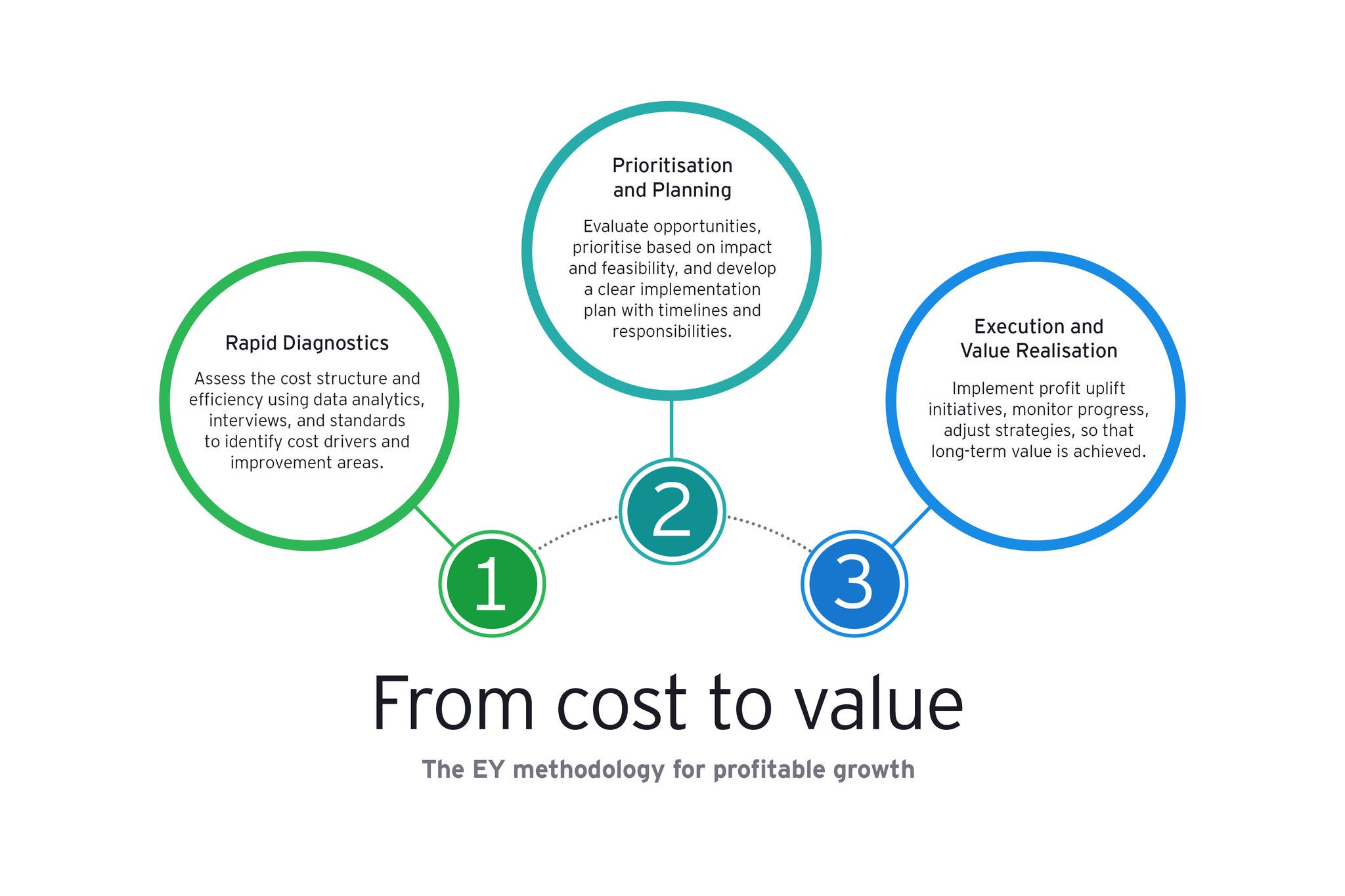
infographic


Frequently Asked Questions


Our teams have deep experience in supporting organisations on their profitable growth journey. Below are some of the most effective areas where we have seen real results in the Consumer Products industry.

Why choose EY?

EY teams offer more than just cost-cutting measures. We partner with clients to transform their entire business models, unlocking long-term value and sustainable profitability. Our deep knowledge, ecosystem of partners and tailored solutions can support real, measurable returns that drive ROI while positioning your business for long-term success.

People walking on wodden path

Client Stories

How a beverage giant achieved $125m in annual gains

The better the question (the problem):

A leading multinational beverage company sought to simplify operations and reduce costs. The challenge? Implement an enterprise-wide transformation that empowered in-market teams whilst ensuring long-term, sustainable gains.
 

The better the answer (how we helped):

Working closely with the client, we developed a new operating model, refined sales and marketing processes, and enhanced digital, data, and technology capabilities. Our teams supported the entire journey—from strategy and detailed design to implementation—empowering in-market teams, simplifying operations, and ensuring measurable, lasting value.
 

The better the world works (result/impact):

Streamlined operations, empowered teams, and a $125m annual profit improvement. This engagement ensured the client didn’t just identify savings—they achieved them, positioning the business for sustainable, long-term success.

People at warehouse

How a global, diversified miner sustainably reduced operating costs 

The better the question (The problem):

A global, diversified mining company was experiencing upward pressure on their cost base. Previous attempts at managing costs were not sustainable. Even after repeated cost outs, costs continued to grow, creating a “cost-out cycle”. The issue? Previous efforts delivered short-term benefits but failed to identify deeper organisational inefficiencies as the root cause of inflated operating costs.


The better the answer (How EY teams helped):

Knowing that cost optimisation is a continuous effort which requires structures, tools and processes, the EY team worked closely with the client to:

  • Embed cost management processes and routines to improve planning, approvals and reviews
  • Improve cost data to help enable actionable insights and better decision-making
  • Increase commercial / finance team effectiveness by defining roles and responsibilities and uplifting people’s capability through structured training

The better the world works (The impact):

Investment in the development of internal cost management capabilities created a platform for continuous cost improvement, facilitating the client to escape the “cost-out cycle” and sustain reduced operating costs and improved profitability.

How a software company saved $32m in 4 months

The better the question (the problem):

An Australian business management software company faced a tough challenge. With a refinancing deadline looming and a 2025 transformation agenda on the horizon, this software company needed to cut costs, modernise its technology, and align operations to unlock greater strategic value. Time was short, and stakes were high.


The better the answer (how we helped):

Over four months, EY teams engaged with the client to streamline operations, eliminate technological debt, and sharpen their focus on cost efficiency. Working closely with the client’s leadership, our teams provided practical tools, clear communication, and data-driven insights to drive meaningful change.


The better the world works (result/impact):

This company cut costs by $32.4 million AUD in just three fourmonths—62% above target. They also mapped out a technology overhaul projected to deliver $37.1 million AUD in benefits over three years. As 2025 refinancing approaches, the client is better prepared than ever to secure favourable terms and long-term growth.

1426602691

How a beverage giant achieved 35x ROI through cost transformation

The better the question (the problem):

A leading global beverage manufacturer needed to improve profitability amid stagnant revenue growth. The challenge? Execute a multi-year cost transformation to streamline operations and boost financial performance.


The better the answer (how we helped):

EY teams engaged with the client to:

  • Simplify their SKU portfolio, removing 75% of negative profit SKUs and reducing complexity by 35%.
  • Conduct a cost-to-serve analysis to improve customer profitability and cut distribution costs.
  • Review end-to-end supply chain processes to enhance efficiency and free up production capacity.

The better the world works (result/impact):

The program delivered a 35x ROI, freeing over 2,000 production hours, cutting logistics costs by 10%, and achieving a 5% uplift in gross profit—ensuring long-term, sustainable gains.

558949355

Achieving benefits of $5-$7m by identifying 20 actionable initiatives 

The better the question (the problem):

A large New Zealand insurance company faced challenges in its customer engagement centre operations. Despite revisiting its operating model and restructuring its operations, the company struggled with growth and operational efficiency, resulting in a savings gap of $10m. The company sought to reduce incoming call demand and increase the efficiency and effectiveness of its operations.


The better the answer (how we helped):

Working closely with the client, we conducted a six-week diagnostic assessment using our channel optimisation methodology. This involved developing a performance baseline, conducting direct observations through call listening, and analysing supplied data to establish key hypotheses for improvement. We identified high-impact improvement opportunities, estimated expected benefits, and outlined a high-level roadmap. The initiatives were scoped and categorised into strategic, priority, and quick wins to provide a clear pathway forward for implementation. 


The better the world works (result/impact):

Overall, 20 actionable initiatives were identified with an estimated benefit of $5m-$7m for the examined centre and potential benefit range of $8m-$13m when extrapolated across the wider  operations and brands.

Opportunity areas included:

  • Reducing incoming call workload (with opportunities to eliminate up to 16% of customer contact demand by addressing upstream process failures and shifting up to 29% of 'avoidable value' calls to existing self-service functionality)
  • Improving self-service functionality
  • Enhancing consultant performance management and reporting
  • Optimising forecasting and scheduling
  • Aligning telephony, resource and learning strategies

This engagement didn’t just identify savings; it upskilled the client’s team and provided them with actionable steps to implement these initiatives and achieve the savings, positioning the business for sustainable, long-term success.

Saving $70m in 6 months and an additional $130m+ in next financial year

The better the question (the problem):

A large public sector organisation faced significant challenges. With escalating costs, a need for service improvements, and increasing complexities in meeting regulatory requirements, the organisation needed to optimise costs and enhance capabilities. The stakes were high, and the timeline was tight.


The better the answer (how we helped):

Over six months, EY teams engaged with the client through three phases of work to identify and confirm benefits across the organisation. Key focus areas included sourcing approaches, negotiation tactics, and continuous improvement.


 Our teams mobilised governance and program management protocols, developed a Group Spend Cube, performed a baseline capability assessment, and explored initiatives through workshops with client stakeholders. We prioritised initiatives based on expected benefits and ease of implementation and executed them using agreed tools and procedures.


The better the world works (result/impact):

This organisation achieved multi-million dollar savings across key areas, accelerating and doubling current year expectations to $70m+ while setting up for an additional $130m+ in the next financial year. The organisation identified supplier synergies and categories ideal for consolidation, using accessible spend analytics, benefits tracking, and dashboard tools. The complementary client teaming transferred knowledge, good practices, and pace, setting the government body up for success following the close of the engagement.

Embracing operational excellence and achieving  ~$2.6m in savings

The better the question (the problem):

A leading multinational company faced challenges to reduce costs and improve service delivery in its back-office function.

The challenge? Transform shared services operations to become a provider of high-quality services delivered effectively and efficiently, maximising value for its shareholders. This would require navigating high levels of process variation, inefficient process handoffs, and high rework due to poor input quality.


The better the answer (how we helped):

Working closely with the company, we partnered on a data-driven approach to improve visibility of current operations and identify opportunities for increasing productivity. Our efforts focused on simplifying and standardising processes, reducing effort per task, and eliminating non-value-add activity. We supported the implementation of these opportunities and realising them through a process led future state organisation design. We also upskilled leadership on lean process improvement principles and active management.


The better the world works (result/impact):

The engagement led to significant capacity opportunities and process improvement initiatives, resulting in substantial annual gains:

  • Order to Cash: Identified 18 FTE capacity (46% improvement) 
  • Source to Pay: Identified 10.4 FTE capacity (20% improvement) 
  • Hire to Retire: Identified 8.5 FTE capacity (20% improvement) 

Key themes for improvement included right-sizing teams, consolidating transactional activities, standardising processes, improving input quality, establishing process-based queues, leveraging existing system functionality and reducing manual data entry.

The future organisation design improved process flows across teams, reduced handoffs, and duplication, and realised the capacity created through process improvements. Ninety staff and leadership were upskilled on principles of lean process improvement and active management to sustain the change and continue operational excellence focus.   

This engagement ensured the company didn’t just identify savings—they realised them, embedding a continuous improvement mindset that would continue to improve operations and service quality.

People at warehouse

$18m increase in Net Operating Profit before Tax

The better the question (the problem):

A leading food and beverage manufacturer sought to explore potential opportunities within their business aimed at enhancing Net Operating Profit before Tax (NOPBT). While prior product price increases had positively impacted the NOPBT, there remained significant opportunities for cost optimisation and revenue enhancement that could further improve profitability.


The better the answer (how we helped):

Working closely with the client, we undertook a comprehensive review of the current business model, identifying pain points and strengths through the lenses of revenue and market, cost optimisation, and product profitability.

We developed and tested improvement opportunities, with each opportunity  sized for its impact on NOPBT, implementation, and change requirements, and consolidated into a strategic 5-year plan to realise the improvements. The project involved creating a "business on a page" model overview, a 5-year strategic plan, and a product profitability and contribution dashboard.


The better the world works (result/impact):

The engagement led to a $18m increase in NOPBT, $10m of which would be realised within  a 2-year timeframe year (2025). This was achieved through initiatives across:

  • Revenue and Market: Enhanced revenue through market analysis and strategic pricing adjustments
  • Cost Optimisation: Reduced costs by streamlining operations and eliminating inefficiencies
  • Product Profitability: Enhanced product profitability through detailed analysis and optimisation of product lines


The future organisation design provided a holistic view of profitability, the factors influencing it, and potential improvement opportunities.


This engagement equipped the client leadership with a comprehensive strategic plan and tools to monitor and drive performance improvements, positioning the client to not only realise short- term savings but to also sustain and continue to drive improvements beyond the engagement timeline.  


Our latest thinking

Should your business shrink to grow?

Explore how simplifying your business can unlock greater profitability amidst rising costs and consumer pressures. Learn strategies for sustainable growth.

Six strategic levers to optimize long-term cost transformation

Achieving long-term, sustainable progress in cost transformation requires a strategic approach applying six potential levers.

How a prudent cost reduction strategy proved integral to a bank’s growth opportunity

We helped a leading global retail bank design a cost transformation strategy that delivered results.

Taking a strategic view to transform costs for a global asset manager

Using a strategic approach to cost transformation can create significant and sustainable benefits. Learn more.

    Are you ready to shrink your business to help it grow?
    Get in touch to learn more.