



EY refers to the global organization, and may refer to one or more, of the member firms of Ernst & Young Limited, each of which is a separate legal entity. Ernst & Young Limited is a Swiss company with registered seats in Switzerland providing services to clients in Switzerland.
Recent Searches

Data shows that the biggest risks in a family business exit often emerge before the buyer arrives – and persist long after the deal closes.
In brief
- Exit readiness starts years before a deal, with ownership structures, governance, tax and legal considerations shaping future options.
- Integrated modelling helps families understand after-tax proceeds, shareholder differences and the implications of earn-outs or continued involvement.
- After closing, governance evolves with the asset base, preserving continuity as the family moves from business ownership to wealth stewardship.
A successful business sale is often judged by the valuation achieved or the efficiency with which the transaction closes. In practice, however, experienced advisers know that neither factor determines whether an ownership transition ultimately succeeds.
For entrepreneurial families, the transaction is only one milestone in a much longer journey. Years before an offer is received, decisions about governance, ownership, tax and legal structures shape the options that will later be available. Long after closing, those same foundations determine how effectively the family preserves its wealth, exercises ownership and prepares the next generation.
The Family Barometer 2026 confirms this perspective. While many ultra-high-net-worth families expect to consider an ownership transition within the coming years, only a small proportion describe themselves as fully prepared. The findings also show that emotional attachment and family misalignment remain more significant obstacles than technical issues alone. Readiness, therefore, is not simply a matter of transaction preparation. It is the product of sustained business exit planning across the family, its ownership structures and the business itself.
Readiness is built long before the transaction
In advisory practice, one misconception appears repeatedly: families often assume they should begin preparing once they have identified a prospective buyer. In reality, many of the most important decisions become increasingly difficult once negotiations have begun.
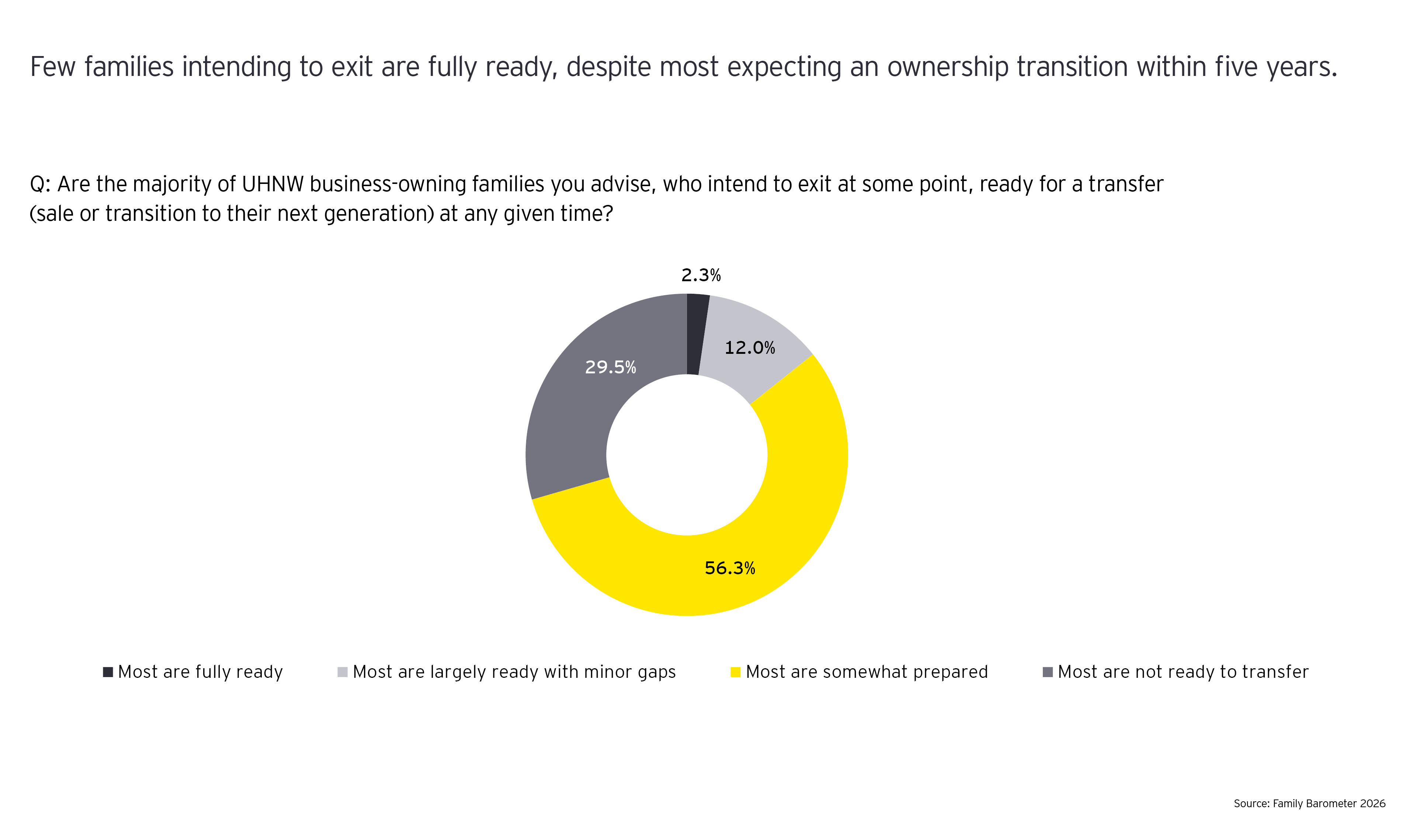
What should families do before an exit is on the table?
Ownership structures that have evolved over decades frequently reflect operational needs rather than transaction readiness. Holding companies may contain investment properties, surplus liquidity, intellectual property or minority investments that made perfect commercial sense during the life of the business but complicate a future sale. Equally, shareholder arrangements, succession structures or financing arrangements that have never presented operational difficulties may become material during due diligence.
Addressing these issues is rarely as simple as transferring assets shortly before signing. Depending on the circumstances, restructuring may trigger latent tax consequences, require corporate approvals or be affected by statutory blocking periods and other legal constraints. Once a transaction is underway, commercial timelines rarely allow sufficient flexibility to redesign long-established ownership arrangements.
The objective of an early structural review is therefore not to prepare for an imminent sale, but to preserve strategic optionality. A family that has already reviewed its ownership structure can respond to opportunities as they arise, rather than allowing historic structures to dictate future commercial decisions.
The objective of an early structural review is therefore not to prepare for an imminent sale, but to preserve strategic optionality.
Thomas Fisler
Partner, Head Private Client Tax Services | EY Switzerland
Governance creates commercial flexibility
Technical readiness is only one dimension of exit preparedness. Equally important is the ability of the family to reach timely decisions when opportunities arise.
How can family governance improve exit readiness?
Sophisticated entrepreneurial families rarely rely on a single governance system. Instead, they distinguish between three complementary but separate frameworks.
Family governance establishes the family’s purpose, values and decision-making processes, often involving family members irrespective of whether they hold operational responsibilities. Ownership governance governs the stewardship of family capital, shareholder rights and succession across generations. Business governance focuses on the management and oversight of the operating enterprise through boards, executive management and advisory bodies.
Although these systems are closely connected, they fulfil different purposes and involve different participants.
This distinction becomes particularly valuable when a company transition is being considered. Families that have already agreed how decisions are made, what they want to achieve collectively and how ownership should evolve are generally better positioned to evaluate commercial offers objectively. Questions of valuation, timing or transaction structure can be assessed against an established framework of family objectives rather than negotiated under the pressure of a live transaction.
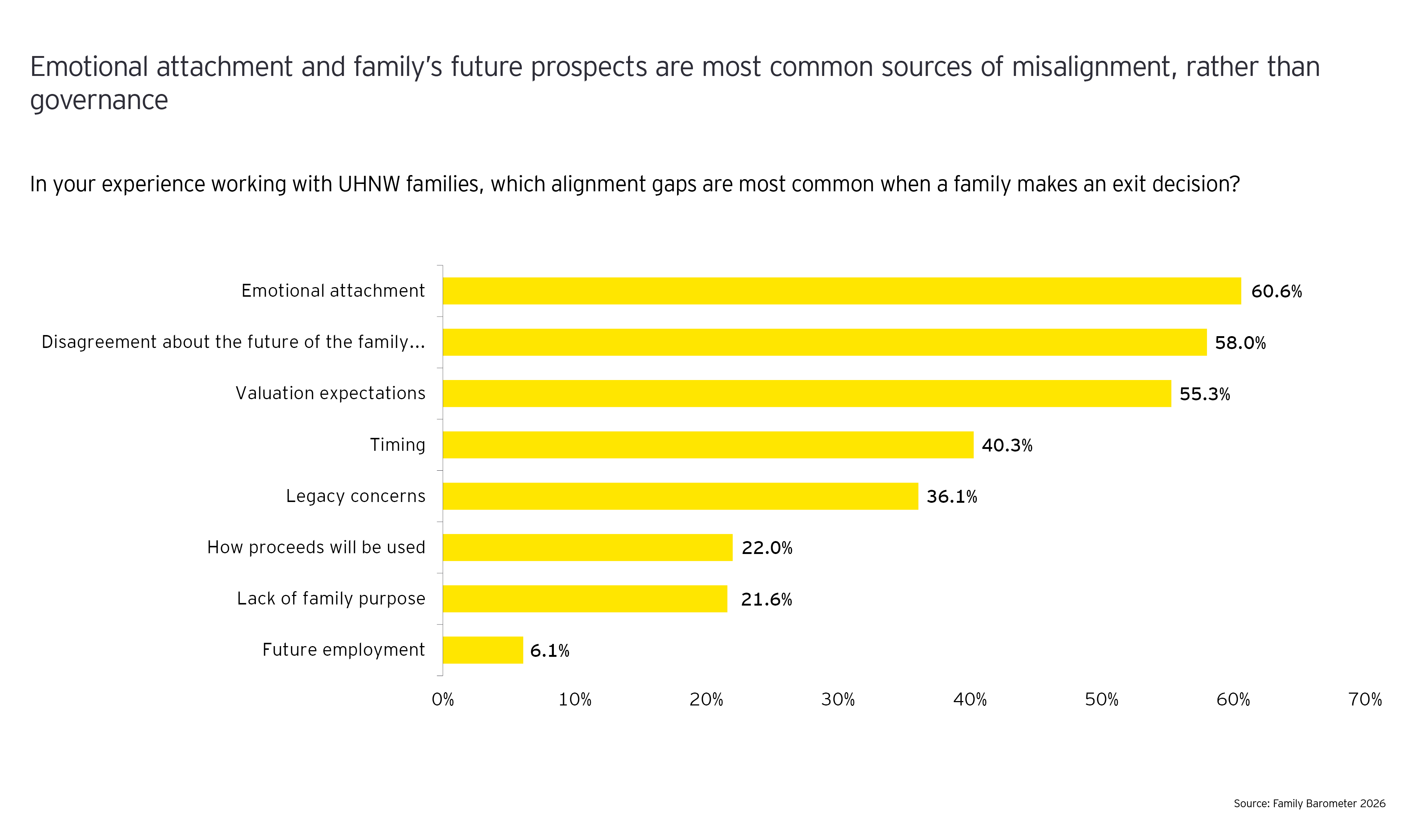
The Family Barometer supports this observation. It shows that family misalignment remains one of the principal barriers to exit readiness, while external professional advisers are consistently identified as an important contributor to family alignment. Rather than creating governance during a transaction, experienced advisers help families strengthen governance that already exists and ensure it supports future ownership decisions.
Looking beyond the headline valuation
When a letter of intent is received, discussions naturally focus on enterprise value. Yet from the family’s perspective, the headline valuation is only the beginning of the analysis. One of the first exercises in an integrated transaction is to model what ultimately reaches each shareholder.
How can families determine what they will actually receive from a sale?
The choice between a share sale and an asset transaction, the treatment of pre-closing distributions, carve-outs of non-core assets, rollover investments, seller financing arrangements and earn-out mechanisms can all influence the after-tax outcome. Those differences may become even more pronounced where shareholders hold their interests through different entities or reside in different jurisdictions.
Accordingly, the technically preferable transaction structure is seldom determined by tax considerations in isolation. Instead, advisers evaluate commercial objectives, legal implications, governance considerations and after-tax outcomes simultaneously. Scenario modelling allows families to compare realistic alternatives before commercial positions become fixed. It also helps align expectations among shareholders by replacing assumptions with transparent analysis of likely outcomes.
The headline valuation is only the beginning of the analysis.
Thomas Fisler
Partner, Head Private Client Tax Services | EY Switzerland
When sellers remain involved
Business sales do not always mark a complete departure. Founders frequently remain involved as directors, advisers or senior executives during a transition period. Earn-out arrangements may reward future performance. Buyers may request non-compete obligations or invite former owners to reinvest alongside them. While these arrangements often make commercial sense, they also require careful legal and tax analysis.
What are the tax and legal risks when a seller stays involved?
From a Swiss perspective, it is important to distinguish clearly between consideration paid for the sale of shares and payments relating to future services, employment, advisory activities or restrictive covenants. Different elements of the overall consideration may attract different tax treatment, social security implications or legal consequences.
Addressing these questions during the negotiation phase reduces uncertainty for both parties and helps ensure that the legal documentation accurately reflects the underlying commercial intentions.
Every shareholder has a different starting point
Another recurring advisory situation concerns shareholder mapping. From the outside, a family may appear to sell a single business. In reality, each shareholder may occupy a different legal and tax position.
Why can the same transaction produce different outcomes for shareholders?
Some family members may reside in Switzerland while others live abroad. Interests may be held directly, through holding companies or via existing succession structures. Different generations may also have different expectations regarding future ownership or inheritance. Without a coordinated review, a transaction that appears straightforward at group level may produce materially different outcomes than individual family members had anticipated.
Cross-border shareholder mapping, therefore, becomes an important element of transaction readiness. By identifying jurisdictional differences, succession considerations and ownership arrangements early, families can address potential issues before they affect negotiations or implementation.
The fundamental importance of this groundwork is reflected in the Family Barometer, which identifies intergenerational wealth transfer as one of the leading concerns for internationally active entrepreneurial families.
Certainty has value
Transactions inevitably involve judgement. Where the tax treatment of a restructuring, earn-out mechanism, management participation or ownership arrangement is commercially significant, uncertainty itself may become a source of execution risk.
When should families seek a Swiss tax ruling?
In Switzerland, early dialogue with the competent tax authorities can, where appropriate, provide valuable certainty through advance tax rulings before arrangements become legally binding.
While rulings are not necessary for every transaction, they can materially reduce execution risk in situations where tax treatment influences valuation, transaction structure or financing decisions.
The practical value lies less in achieving a particular outcome than in allowing all parties to negotiate on the basis of greater certainty.
Closing changes the asset base, not the governance philosophy
Perhaps the most persistent misconception surrounding business exits is that governance somehow begins once liquidity has been created. For well-prepared families, the opposite is true.
What changes after a family business is sold?
Family governance and ownership governance should already exist before the transaction. What changes after closing is not the governance philosophy but the assets to which it applies.
Before a sale, ownership governance focuses primarily on an operating business. Afterwards, it must address diversified financial assets, investment structures, business succession planning and long-term wealth stewardship.
The implementation therefore evolves rather than begins anew. Established governance principles may now be reflected in family investment companies, ownership arrangements, succession planning, investment policies or other wealth-holding structures. Tax and legal implementation gives practical effect to decisions that the family has already made regarding purpose, ownership and future generations.
The Family Barometer confirms that preserving joint family wealth becomes the leading priority following an exit. Families that have already established governance frameworks are better placed to adapt those arrangements to a different asset base without losing continuity in decision-making or ownership stewardship.
Preserving optionality throughout the ownership journey
Ownership transitions are rarely defined by a single transaction. They represent the culmination of decisions that often begin years earlier and continue long after closing.
Why should tax and legal planning start before an offer arrives?
The experience reflected in the Family Barometer confirms what advisory practice demonstrates every day: families that prepare early are better able to respond confidently when opportunities arise. They do not wait until an offer arrives to examine ownership structures, clarify governance or consider succession. Instead, they build these foundations over time, preserving the flexibility to make commercial decisions from a position of strength.
Integrated tax and legal advice plays a central role throughout that journey. Before an exit, it preserves optionality by reviewing ownership structures, governance and transaction readiness. During negotiations, it provides clarity through integrated legal, tax and commercial analysis. After closing, it translates the family’s established purpose and governance into ownership arrangements capable of supporting future generations.
The transaction itself is therefore neither the beginning nor the end of the advisory process. It is one important milestone in the long-term stewardship of family enterprise, family ownership and family wealth.
Summary
A successful family business exit is about more than achieving an attractive valuation. Tax, legal, ownership and governance decisions made years before a transaction can determine the options available when an offer arrives – and the outcomes for shareholders. Early structural reviews, integrated transaction modelling, clear governance and shareholder mapping can preserve flexibility and reduce execution risk. In Switzerland, advance tax rulings can provide certainty where tax treatment is commercially significant. After closing, governance does not start again: it evolves to steward a new asset base. For entrepreneurial families, the transaction is one milestone in a much longer journey of ownership, wealth and succession.
