a female vaulter jumping

How can Greece act now to create advantage from adversity?

Greece remains a resilient investment destination despite the challenging environment in Europe.


While in 2024 foreign direct investment (FDI) in Europe declined, and concerns are mounting due to geopolitical uncertainty and trade wars, investors maintain a positive outlook on Greece's attractiveness as an investment destination.

The seventh edition of the annual EY survey, Attractiveness Survey Greece 2025, includes valuable insights that shed light on the country’s comparative advantages, as well as on areas where we still lag behind competing countries, which are also vigorously fighting to attract investment


EY Attractiveness Survey
Greece 2025
 

Fill out the form to read the full survey in English.

Europe: Decline in FDI and emerging challenges

In 2024, investments in Europe fell by 5%, reaching their lowest levels since 2017. Among the investors who participated in the European survey, 37% stated that they had postponed, canceled, or scaled back their investment plans. Alongside the intensifying competition with the U.S. for capital attraction, tariff disputes have also emerged, with American FDI in Europe having declined by 24% over the past two years.

The picture in Greece 

In this unfavorable environment, the EY European Investment Monitor (EIM) database recorded 35 investment projects in Greece in 2024, compared to 50 in 2023. This marks the fourth-best performance in the 25-year period monitored by the database. In total, investments during the past five years represent 53% of all investments recorded by the survey since its launch in 2000.

This year’s survey also confirms the ongoing improvement of the qualitative composition of investments, with a shift in focus toward knowledge-intensive activities and high value-added sectors that can contribute to the transformation of the Greek economy. These sectors are expected to deliver greater long-term benefits, such as technology transfer and the creation of better-paid, highly skilled jobs. Notably, investments in the software and IT services sector account for 26% of the total, while 14% of FDI has been directed toward activities related to internet data centers.

Strong investment appetite

One out of two respondents (48%) stated that their company plans to establish or expand operations in Greece over the next year. This figure is slightly down from the historically high 51% recorded last year, reflecting the broader decline in investment intentions across Europe (59%, down from 72% in 2024).

These investment plans mainly focus on business support services, including call centers, shared services centers, and data centers (50%), followed by sales and marketing (48%), and research and development (37%). Among those planning to invest in the country, access to skills emerges as the primary reason for creating new or expanding existing operations (39%).

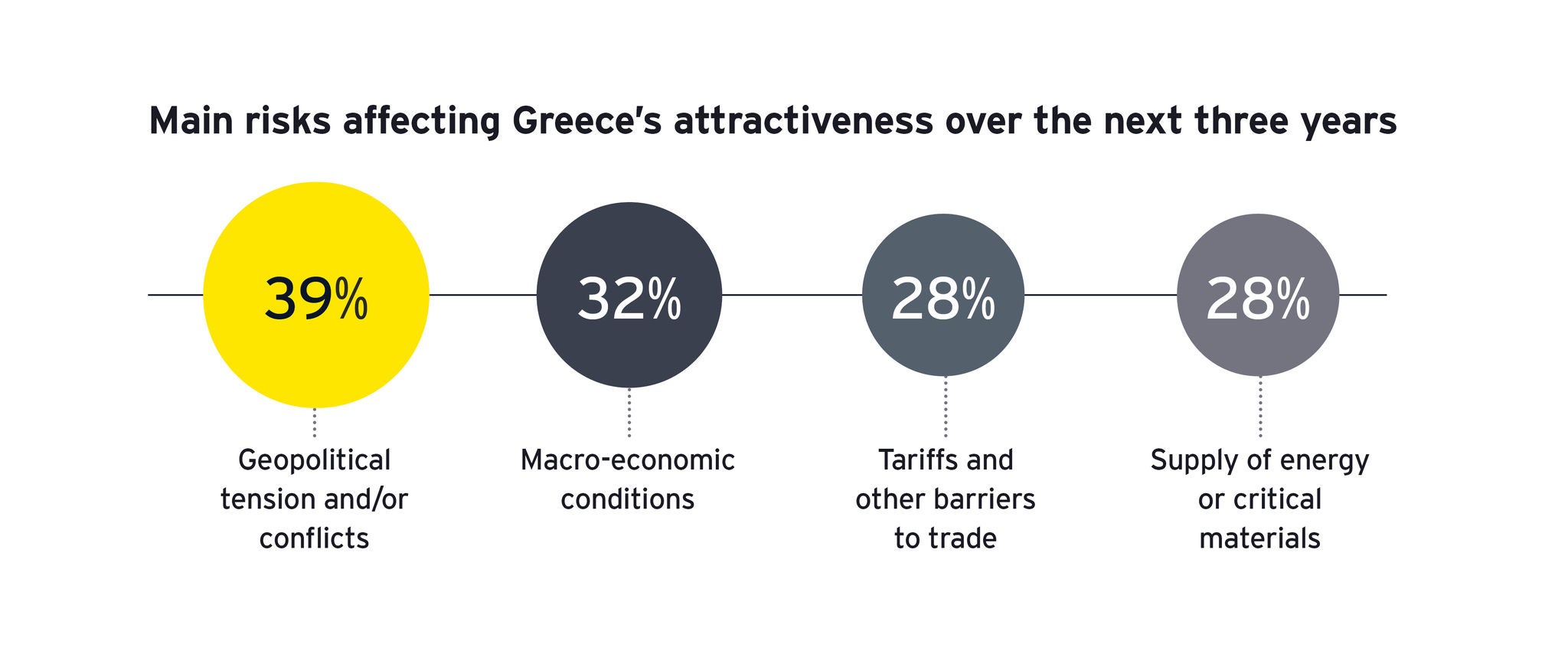
In today’s volatile environment, geopolitical tensions and conflicts have risen to the top of the list of perceived risks to the country’s attractiveness over the next three years - up from fifth place last year - with 39% of mentions. They are followed by macroeconomic conditions (32%), tariffs and other trade barriers (28%), and supply of energy or critical materials (28%).

Record-high confidence in Greece’s attractiveness policy

Survey participants increasingly associate Greece’s improving image with the policies being implemented. A total of 82% of respondents - up from 79% last year, and just 50% in the first year of the survey in 2019 - rated Greece’s attractiveness policy as effective in attracting international investors, including 22% who described it as very effective.

When it comes to attracting international investors,
consider Greece’s attractiveness policy as effective.

Greece’s performance in attracting talent (70% deem Greece’s performance is good overall) appears to be driving this positive sentiment. This is followed by its ability to attract companies (69%), innovative activities (66%), and capital (63%). On the other hand, policies aimed at attracting business headquarters (51%) and establishing global centers for competitiveness or world class clusters (50%) are seen as less effective. It is worth noting that in the first year of the survey, back in 2019, none of these indicators exceeded 50%.

Respondents also believe that the country’s approach in areas such as data and technology (65%), sustainability (64%), artificial intelligence (63%), innovation (58%), and regulation (56%) has positively impacted its attractiveness. However, investors remain more cautious about Greece’s approach to tax competitiveness (46%) and the labor market (40%).    

Positive perception for the country over the past year couples with optimism for the next three years

Three out of five participants (60%, compared to 62% last year) stated that over the past year, their perception of Greece has improved as a place where their business might establish or develop its activities. Specifically, among companies that currently do not have an investment presence in the country, the percentage has increased from 39% to 41%. At the same time, 63% (down from 69% last year) believe that the country’s attractiveness will further increase over the next three years. This percentage compares positively to the corresponding figure for the whole of Europe (61%) and other European countries surveyed.

Attractive destination for investments related to industrialization

Given the major challenge of reindustrializing the country, participants were asked how they evaluate Greece’s attractiveness as a destination for investments related to industrialization. While only 29% of those planning investments in the country over the next year said these involve manufacturing activities, overall, 76% of respondents consider Greece an attractive destination for industrialization-related investments, including 20% who find it very attractive, suggesting potentially untapped opportunities in this sector.

The most promising prospects for such investments are found in the energy sector, including renewables (45%), shipping, including marine and naval engineering (42%), and the pharmaceutical and biotechnology industry (37%).


Three key priorities for enhancing the country’s competitiveness

In order for Greece to maintain its competitive position in the global economy, respondents highlight three main priorities: supporting strategic industries, such as cleantech, artificial intelligence, defense, technology, and others (28%); developing education and skills and facilitating access to talent (26%); and reducing and simplifying taxation (25%).

Investors expect even more from Greece

In the past five years, Greece recorded more foreign direct investment than it had during the previous two decades combined. This performance is even more notable considering it occurred at a time when FDI in Europe declined by 16%, due to economic slowdown, the war in Ukraine, and intensifying competition with the U.S. In this challenging environment, the resilience of FDI in Greece and investors’ positive sentiment toward the country should not lead to complacency. On the contrary, Greece must remain committed to reforms that will further strengthen its long-term attractiveness. 

EY recommendations    

Since 2019, EY has been putting forward a series of recommendations through its annual surveys focusing on a range of areas; in some, progress is already evident, while in several others, these recommendations continue to hold great relevance. The proposals included in this year’s survey reflect the current challenges stemming from the evolving global landscape, as well as the technological developments impacting critical sectors of the economy. These recommendations are structured around eight key pillars:

  1. Developing targeted sectoral strategies
  2. Attracting artificial intelligence investments
  3. Addressing skills shortages
  4. Strengthening the industrial sector
  5. Establishing a competitive tax environment
  6. Branding and international promotion
  7. Improving quality of life
  8. Contributing to shaping critical European policies


EY Attractiveness Survey Greece 2025


Read more

Attractiveness surveys

EY Attractiveness surveys are widely recognized as a key source of insight into foreign direct investment (FDI).


    Summary 
     

    In a year where foreign direct investment across Europe is declining and concerns are intensifying due to geopolitical uncertainty and trade wars, investors appear to retain a positive outlook on Greece’s attractiveness. The major challenge for the country now is to more actively claim a larger share of what seems to be an increasingly limited investment flow into Europe.

    About this article