


EY refers to the global organisation, and may refer to one or more, of the member firms of Ernst & Young Global Limited, each of which is a separate legal entity. Ernst & Young Global Limited, a UK company limited by guarantee, does not provide services to clients.
Recent Searches

New Zealand consumers are coping with today’s energy bills, but not so confident about tomorrow’s.
In brief:
- 55% of New Zealand energy consumers are either experiencing energy poverty today or are concerned about paying future energy bills.
- Consumers want practical support, clearer information and fewer surprises, but only 36% believe providers are helping them manage costs effectively.
- Providers that reduce complexity, build trust and give consumers greater confidence and control will be better placed to improve energy wellbeing.
Despite living in a country blessed with abundant renewable energy resources, New Zealand consumers are surprisingly anxious about their energy future.
The EY Global Energy Research 2026 report reveals a striking paradox. Just 18% of New Zealand households are currently experiencing “energy poverty”, defined as spending more than 10% of household income on energy. That’s five points lower than the global average of 23%, and below comparable markets like Australia (22%), the United Kingdom (25%), the United States (26%) and Ireland (31%).
Yet the percentage of New Zealand consumers who fall into the “energy vulnerability” category tells a different story. According to an EY survey of nearly 17,200 energy consumers, more than 800 of those in New Zealand, 37% of Kiwi energy consumers are worried about paying future energy bills – a level of energy vulnerability that matches Ireland, where nearly a third of consumers are already experiencing significant hardship.
New Zealanders are not saying, “I'm struggling today”. But they are saying, “I'm not confident I’ll cope tomorrow.” More than four in five consumers (81%) want energy providers to take the lead in helping them manage their energy costs, yet only 36% believe providers are doing so.
What is energy wellbeing?
Energy wellbeing is not simply about whether consumers can pay their bills or are satisfied with their provider. It is an integrated experience that captures the extent to which consumers feel their energy needs are met reliably, affordably and securely, while also feeling confident, informed and fairly treated within the energy system.

1
Chapter 1
The confidence gap in New Zealand’s energy system
Consumers are coping today, but many are increasingly worried about tomorrow.
Globally, the energy system is transforming faster than the energy experience. As renewables uptake, demand growth and technological innovation create new complexities, customers are struggling to see the benefits.
Among the consumers we surveyed across 20 markets:
- 87% globally feel like they are spending more money on energy, rising to 92% in New Zealand
- 82% globally and 86% in New Zealand have experienced “bad news bills”
- 58% globally and 55% in New Zealand have changed discretionary spending behaviour to pay energy bills
- 79% globally and 78% in New Zealand say they are doing as much as they can to manage and reduce their energy costs.
New Zealanders are among the most economically resentful consumers. Compared with consumers globally, New Zealanders are far more likely to blame inflation (80% versus 69%), energy company profits (63% versus 48%) and infrastructure spending (49% versus 34%)
Energy providers aren’t meeting expectations
23%
23%
of energy users globally feel their provider creates value for consumers and their communities.
17%
17%
of energy users in New Zealand feel their provider creates value.
This is more than a customer experience issue. Resentful, frustrated or dissatisfied consumers are less likely to adopt new products, participate in flexibility programs or trust their provider. As energy systems become more complex and consumers are asked to play a more active role, wellbeing is becoming a prerequisite for participation.

2
Chapter 2
Consumers want more support, not more complexity
Predictability and confidence may matter as much as lower prices.
Restoring consumer confidence lies in system-wide change, from regulatory reform to new pricing models. But providers also need to directly address the impact of rising costs on consumers.
Traditional programs aimed at supporting customers in hardship tend to focus on income levels. But this may be a simplistic view. Our research found that even higher-income consumers are worried about being able to pay future energy bills.
What’s more important is the interaction of multiple factors that influence energy wellbeing, including predictability and lifestyle trade-offs. ‘Surprise’ bills hit consumers particularly hard because they disrupt household budgets, eroding confidence.
Context matters too. For example, vulnerability tends to grow with household size. The share of household income devoted to energy can be more important than the actual amount paid. Consumers in some regions with cheaper energy, such as the US, report higher vulnerability scores than those in countries with higher prices, such as Belgium and Germany.
How do providers respond?
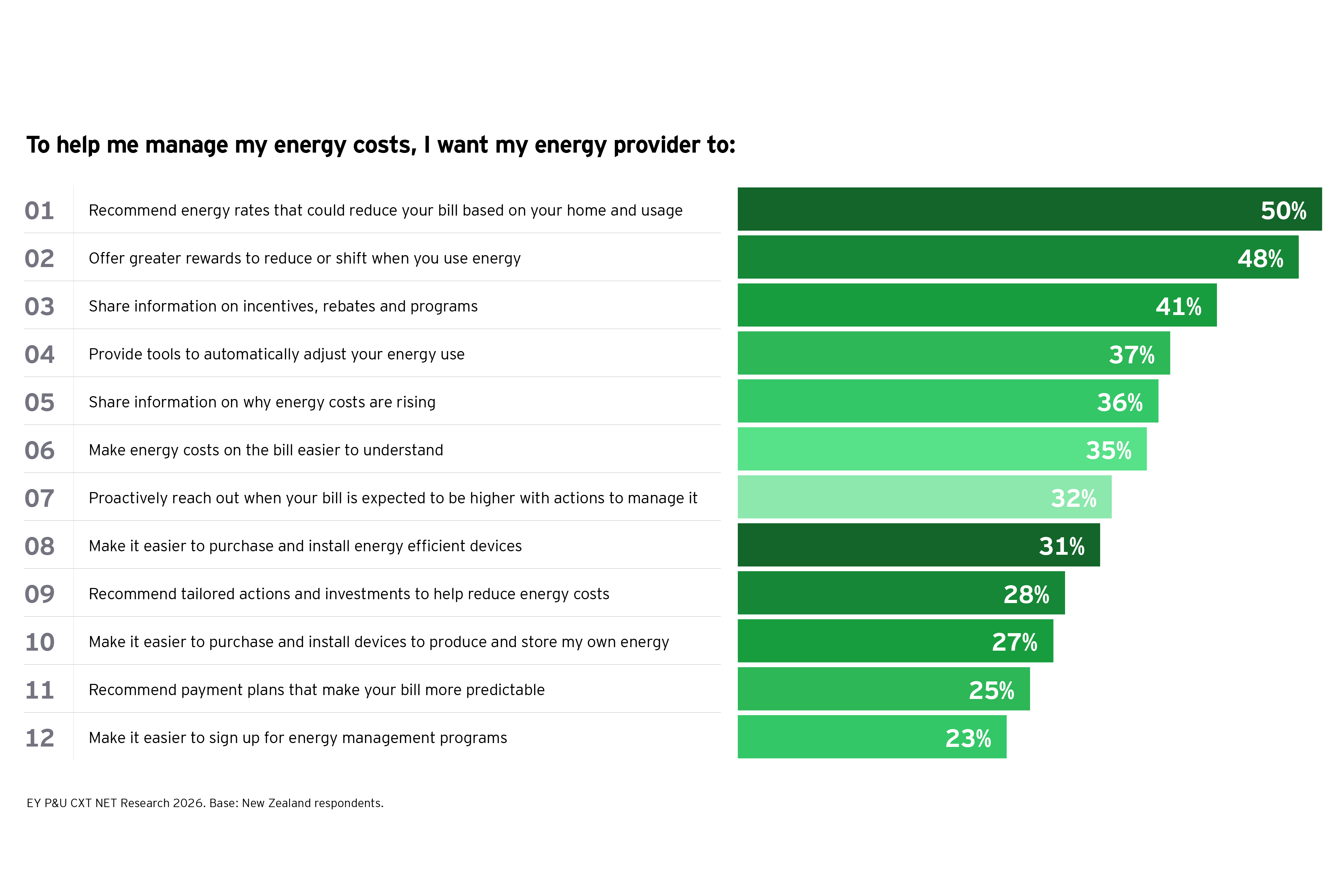
The answer is surprisingly practical. Consumers are not asking for more complexity. They want help reducing their bills, avoiding bill shock and making better decisions. Half want providers to recommend rates that could lower costs based on their home and usage, while almost as many want greater rewards for shifting energy use. More than a third want clearer explanations of rising costs and simpler bills.
Consumers want practical support that improves outcomes, not more information for information’s sake. They don’t want more dashboards, but they do want help making better decisions.

3
Chapter 3
Making AI work for consumers
AI won’t solve energy complexity if it adds more of it.
At first glance, New Zealand appears to lag some of its international peers in digital engagement.
While 51% of consumers already use AI for energy-related tasks, this trails markets such as the US (62%), the UK (61%) and Germany (60%). New Zealanders are also less likely to prefer digital-first interactions and less likely to plan to increase their use of AI in the future.
This aligns with the 2026 EY AI Sentiment Study, which found that concern about losing control is notably higher in New Zealand (68%) than other markets (59%).
For energy providers, the most interesting insight is not how much consumers use AI, but what they want it to do. In New Zealand, 61% of consumers would trust an AI agent to research energy providers and prices on their behalf. Consumers are starting with a low-stakes AI task: shopping around.
What consumers expect from digital-first experiences
57%
57%
Easy to use
47%
47%
Accurate and reliable
41%
41%
Clear information
Consumers are telling providers they want simpler bills, proactive alerts, tailored recommendations and confidence that they are on the right plan. They want providers to remove complexity rather than create more of it. Consumers are slowly coming around to the idea of using AI to achieve that – and the first energy relationship they automate may be the relationship with their provider.

4
Chapter 4
Three ways to elevate energy wellbeing
New Zealand consumers want less complexity, more confidence and greater control.
Consumers are demanding simplicity at a time where the energy system itself is becoming more complex around them.
Households will increasingly be asked to make decisions that once sat firmly within the energy sector. When should I charge my electric vehicle or run my dishwasher? Which tariff structure suits my household? How much control will I hand over to digital tools? New Zealand consumers are showing signs of anxiety, even before this complexity fully arrives.
For many providers, elevating energy wellbeing also competes with sustained pressure to do more with less. Our research points to action across three priority areas that can help providers improve consumer energy wellbeing while doing just that.
1. Agile operations
Agility – the ability to pivot at speed, innovate quickly and navigate sudden shocks – is critical to every business. For energy providers, agility is crucial to meeting changing customer needs and delivering experiences that build trust and satisfaction.
For many providers, traditional operating models stand in the way. Siloed workflows and processes fall short when new energy solutions — including electric vehicles, rooftop solar and energy management programs — span organisational lines.
Instead of having separate customer service teams, billing teams, operations teams and technical teams passing customers between departments, some providers are organising staff into multidisciplinary teams that can solve most customer problems from start to finish.
Actions for leaders:
|
Start it |
Shape it |
Scale it |
|---|---|---|
|
Centralise accountability for end-to-end journeys. Empower ownership to improve customer and employee experiences as interactions and offerings become more complex. |
Take a horizontal view of experiences across the organisation, breaking down operational silos that create unnecessary friction. |
Create a shared vision with employees around the future of talent development. Build career paths that support long-term skill evolution and rapid learning cycles with structured and self-directed opportunities. |
2. Digital innovation
For the first time in the six years of our study, most consumers globally prefer digital-first across all interactions with their energy provider, even during outages and emergencies.
But even as the structural shift to digital gathers pace, most consumers are frustrated by providers’ digital offerings. They want simple, intuitive channels, tailored insights and proactive support with the option to speak to a human.
The biggest opportunity lies in transforming the primary customer-provider interaction: billing and payments. Customers tell us they would like near real-time usage and costs, control over devices and automated energy management.
Leveraging rapid advancements in AI could help accelerate this innovation. But providers designing the AI experience will need to ensure interactions are intuitive and human, not intrusive or complex.
Actions for leaders:
|
Start it |
Shape it |
Scale it |
|---|---|---|
|
Revisit your digital and AI roadmap to focus on consumer and employee needs, including capabilities that empower consumers to manage their energy costs. |
Create a simplified, curated set of channels that deliver consistent omnichannel experiences designed for an AI-powered future. |
Build seamless pathways that combine digital self-serve and direct personal support. |
3. Energy empowerment
According to the International Energy Agency, flexibility can improve system efficiency by up to 30% while helping to reduce emissions. Even relatively simple measures, such as dynamic pricing, can help consumers lower their costs by 5% to 15%.1
New Zealand consumers appear open to participating in this future: 85% of respondents to our survey said they would sign up to at least one type of energy management program. But they want to stay in control.
More than half are interested in earning rewards for reducing energy use during periods of high demand, and almost half favour energy efficiency programs. Only 15% of consumers are interested in direct demand response, citing concerns about savings and data privacy, and 31% percent would not enroll any home devices in automated energy management programs, even if they saved them money.
New Zealand consumers are willing to participate, but on their terms. They want support, choice, incentives and savings, without sacrificing reliability, privacy or control.
Actions for leaders:
|
Start it |
Shape it |
Scale it |
|---|---|---|
|
Reimagine the holistic energy solution adoption journey from a consumer perspective. Take ownership by simplifying and reducing effort, even in areas that may be out of your control. |
Develop curated value propositions around flexibility tailored to appeal to unique groups of customers. Focus on what excites them and address key barriers. |
Create set-and-forget energy management experiences. Deliver peace of mind by design that builds in control, privacy and security. |
Summary
New Zealand consumers are not experiencing the same levels of energy hardship seen in some overseas markets, but many are increasingly anxious about future costs. EY research suggests that confidence, predictability and simplicity are becoming as important to consumers as affordability. Providers that reduce complexity, use AI to lower effort and create energy experiences that give consumers greater control can strengthen trust, participation and long-term system resilience.