[1] https://www.weforum.org/stories/2025/12/data-centres-and-ai-new-growth-engine/
[2] “More than 50% of Fraud Driven by AI and Hyper-Realistic Impersonations, but Banks also use Generative AI to Fight Back,” Feedzai, May 2025, https://www.feedzai.com/pressrelease/ai-fraud-trends-2025/.
[3] “Energy and AI,” International Energy Agency, April 2025, https://www.iea.org/reports/energy-and-ai/executive-summary.
[4] “Energy and AI,” International Energy Agency, April 2025, https://www.iea.org/reports/energy-and-ai/executive-summary.
[5] “AI in the Oil and Gas Industry,” Numails, January 2024, https://numalis.com/ai-in-the-oil-and-gas-industry/#2484ee09-745e-445a-b6d1-171b4d951601.
[6] “Digitization holds key to unlocking oil and gas industry's potential,” Offshore Magazine, October 2017, https://www.offshore-mag.com/business-briefs/article/16755967/digitization-holds-key-to-unlocking-oil-and-gas-industrys-potential.
[7] “AI in the Oil and Gas Industry,” Numails, January 2024, https://numalis.com/ai-in-the-oil-and-gas-industry/#de67ca5b-7a23-4ad9-bdf6-06804e8e0459.
[8] “AI in the Oil and Gas Industry,” Numails, January 2024, https://numalis.com/ai-in-the-oil-and-gas-industry/#a96876ef-f2b9-4015-b26d-d3153b7984b8.
[9] “Digital Twins & Predictive Maintenance in Midstream Pipelines,” Digital Oil & Gas Summit USA, July 2025, https://oilandgas-usa.com/digital-twins-predictive-maintenance-in-midstream-pipelines/.
[10] “How is AI improving oilfield logistics operations?,” Rigzone, September 2025, https://www.rigzone.com/insights/emerging-trends-and-technology-6/how-is-ai-improving-oilfield-logistics-operations-771.
[11] “How Audit Management Software Cuts Compliance Costs by 40%,” Aurora Financials, https://aurorafinancials.com/how-audit-management-software-cuts-compliance-costs-by-40/.
[12] “Compressed air in industry: how can digitalization help energy optimization?” Metron, https://www.metron.energy/blog/compressed-air-industry-energy-optimization/.
[13] “Ai In The Electric Utility Industry Statistics,” WifiTalents, February 2026, https://wifitalents.com/ai-in-the-electric-utility-industry-statistics/.
[14] “Ai In The Electric Utility Industry Statistics,” WifiTalents, February 2026, https://wifitalents.com/ai-in-the-electric-utility-industry-statistics/.
[15] “AI In The Utilities Industry Statistics,” WifiTalents, February 2026, https://wifitalents.com/ai-in-the-utilities-industry-statistics/.
[16] “Ai In The Electric Utility Industry Statistics,” WifiTalents, February 2026, https://wifitalents.com/ai-in-the-electric-utility-industry-statistics/.
[17] The largest US-based technology firms.
[18] EY Europe Central Energy Center’s analysis.
[19] “Data Center 2026 Outlook: Energy, Infrastructure, and Connectivity,” Morgan Lewis, December 2025, https://www.morganlewis.com/pubs/2025/12/data-center-2026-outlook-energy-infrastructure-and-connectivity.
[20] “Global Data Center Outlook 2026,” Fitch Ratings, December 2025, https://www.fitchratings.com/research/structured-finance/global-data-center-outlook-2026-16-12-2025?FR_Web-Validation=true&mkt_tok=NzMyLUNLSC03NjcAAAGfVsLPvXPRVV7rua07cO0llbR1VVeBGfsBs2vSPqyVTEsZCDSBtJqJaoQOP-w8gMMBuJhAW4rbMKciixJhsAE_IlCDkaKeGeSpNlGMAKuA_NU-7gNw-YU.
[21] “Data Center 2026 Outlook: Energy, Infrastructure, and Connectivity,” Morgan Lewis, December 2025, https://www.morganlewis.com/pubs/2025/12/data-center-2026-outlook-energy-infrastructure-and-connectivity.
[22] “Number of Data Centers by Country (November 2025),” Cargoson, January 2026, https://www.cargoson.com/en/blog/number-of-data-centers-by-country.
[23] “Energy and AI Observatory,” IEA, June 2025, https://www.iea.org/data-and-statistics/data-tools/energy-and-ai-observatory?tab=Energy+for+AI.
[24] “Energy and AI,” IEA, April 2025, https://iea.blob.core.windows.net/assets/b3a8b37f-32d1-4873-9eca-31cec5895264/EnergyandAI.pdf.
[25] “2024 United States Data Center Energy Usage Report,” Berkeley Lab, December 2024, https://eta-publications.lbl.gov/sites/default/files/2024-12/lbnl-2024-united-states-data-center-energy-usage-report.pdf.
[26] “Energy and AI Observatory,” IEA, June 2025, https://www.iea.org/data-and-statistics/data-tools/energy-and-ai-observatory?tab=Energy+for+AI.
[27] “Data Centres Metered Electricity Consumption 2024,” Central Statistics Office, June 2025, https://www.cso.ie/en/releasesandpublications/ep/p-dcmec/datacentresmeteredelectricityconsumption2024/keyfindings/.
[28] “Data centres accounted for more than fifth of Ireland’s electricity usage last year,” Irish Times, June 2025, https://www.irishtimes.com/environment/2025/06/10/data-centres-accounted-for-more-than-fifth-of-irelands-electricity-usage-last-year/.
[29] “Data centres consume 4.6 percent of the Netherlands’ electricity,” Statistics Netherlands, December 2025, https://www.cbs.nl/en-gb/news/2025/51/data-centres-consume-4-6-percent-of-the-netherlands-electricity.
[30] “Status and development of the German data centre landscape – Executive Summary,” The Federal Ministry for Economic Affairs and Climate Actions (BMWK), March 2025, https://www.bundeswirtschaftsministerium.de/Redaktion/EN/Publikationen/Digitale-Welt/status-and-development-of-the-german-data-centre-landscape-executive-summary.pdf?__blob=publicationFile&v=2.
[31] “La facture écologique des datacenters en France s’alourdit à mesure de leur développement,” Le Journal des Enterprises, July 2025, https://www.lejournaldesentreprises.com/article/la-facture-ecologique-des-datacenters-en-france-salourdit-mesure-de-leur-developpement-2123776.
[32] “Middle East tensions may disrupt AI chip production and data centers,” Cebernews, March 2026, https://cybernews.com/tech/middle-east-disrupt-ai-chip-production-data-centers/.
[33] “How the Iran war and rising energy prices are threatening semiconductor demand,” CNBC, March 2026, https://www.cnbc.com/2026/03/10/iran-war-semiconductor-memory-chip-impact.html?msockid=3a070caa3aa568712c4b1a1a3be4696b.
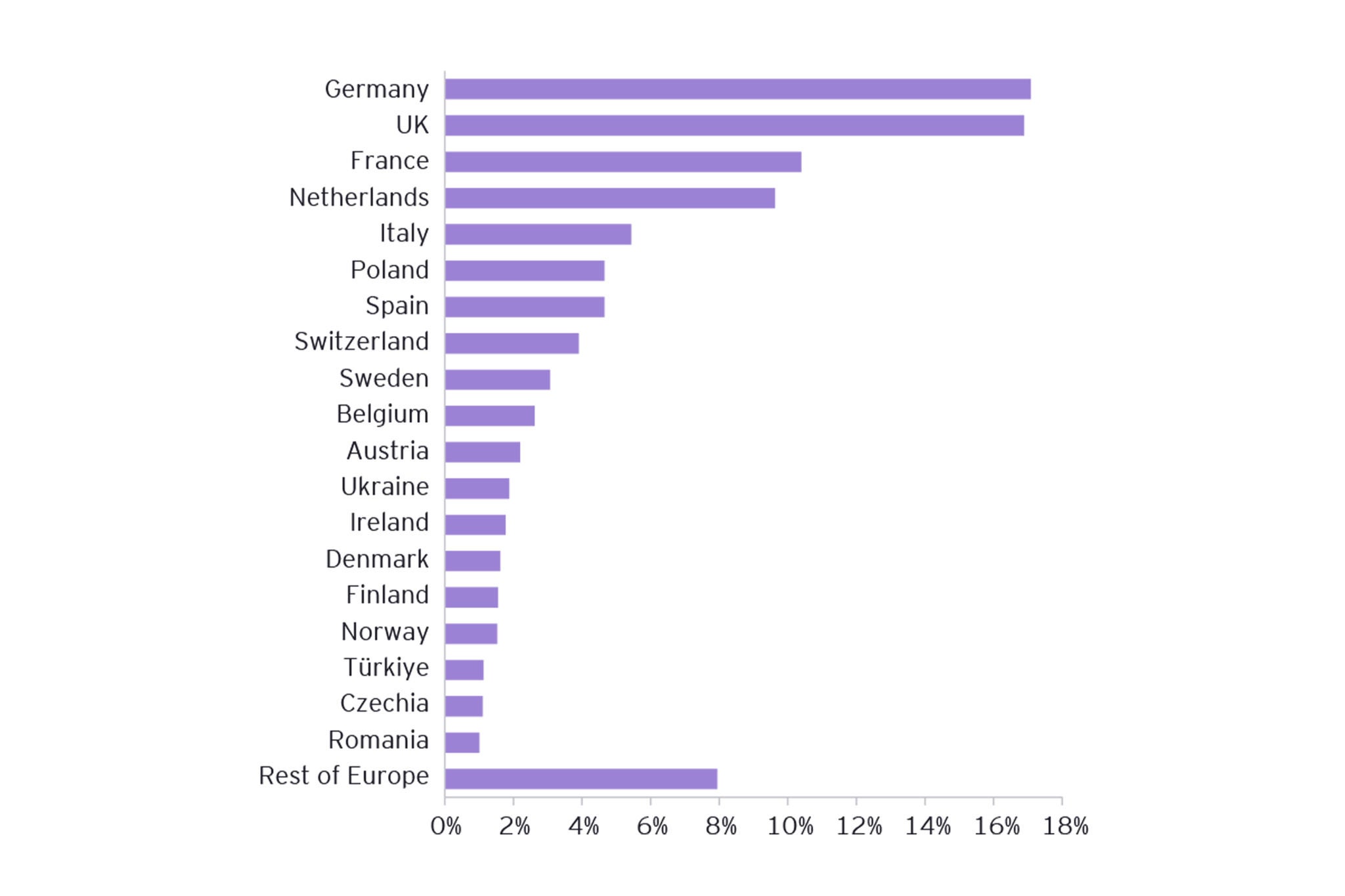
[34] “Number of Data Centers by Country (November 2025),” Cargoson, January 2026, https://www.cargoson.com/en/blog/number-of-data-centers-by-country.
[35] “Data centers in Europe,” Cloudscene, https://cloudscene.com/region/datacenters-in-europe
[36] “Europe's FLAP markets have 2,000MW of data center capacity,” DCD, August 2021, https://www.datacenterdynamics.com/en/news/europes-flap-markets-have-2000mw-of-data-center-capacity/.
[37] “2025 Data CenterSite Selection Dynamics in Europe,” Newmark, July 2025, https://nmrk.imgix.net/uploads/documents/2025-Data-Center-Site-Selection-Dynamic-Brief.pdf.
[38] “Nordics and southern Europe to see 110% data center demand growth by 2030 – report,” DCD, June 2025, https://www.datacenterdynamics.com/en/news/nordics-and-southern-europe-to-see-110-data-center-demand-growth-by-2030-report/.
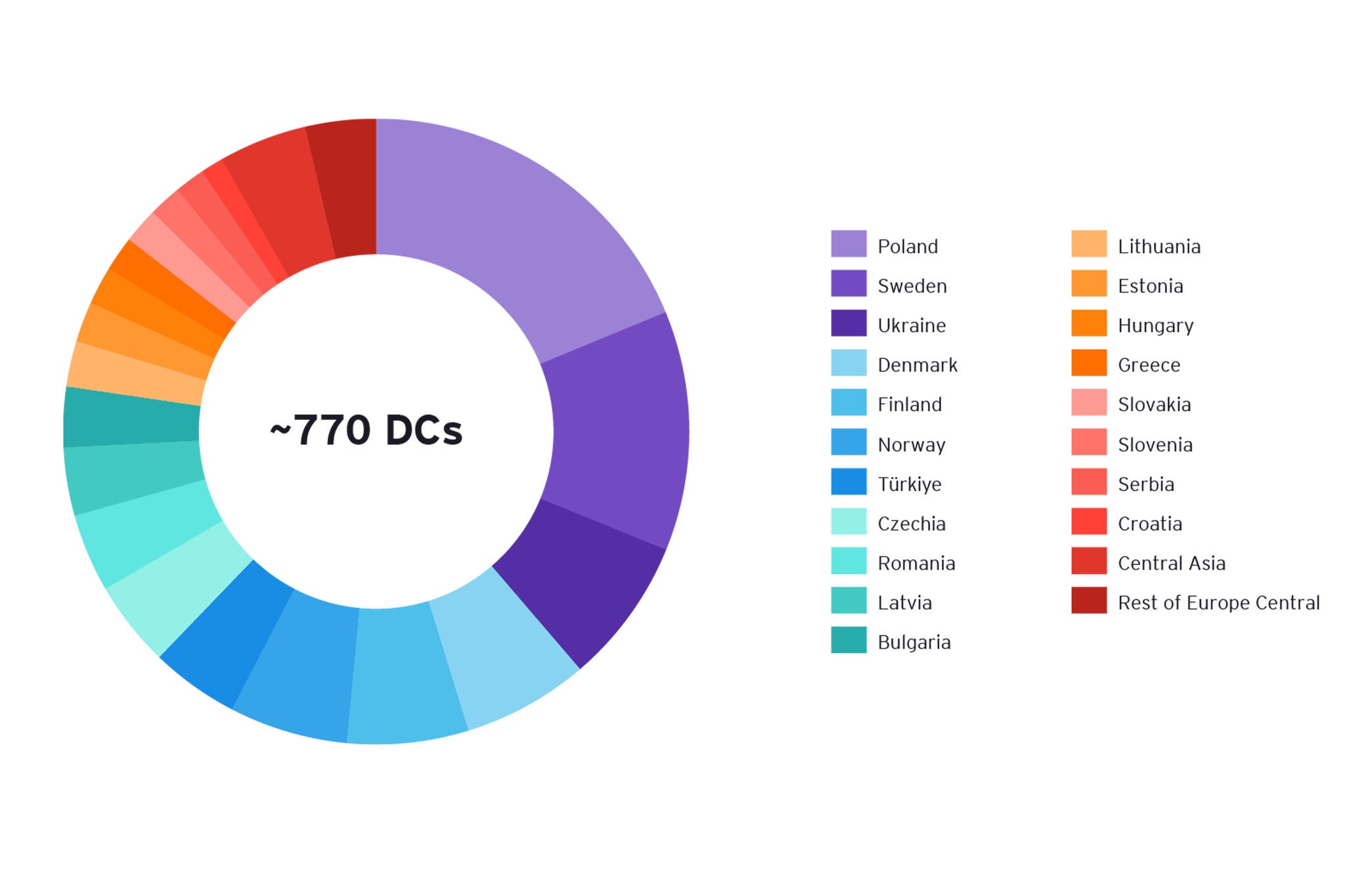
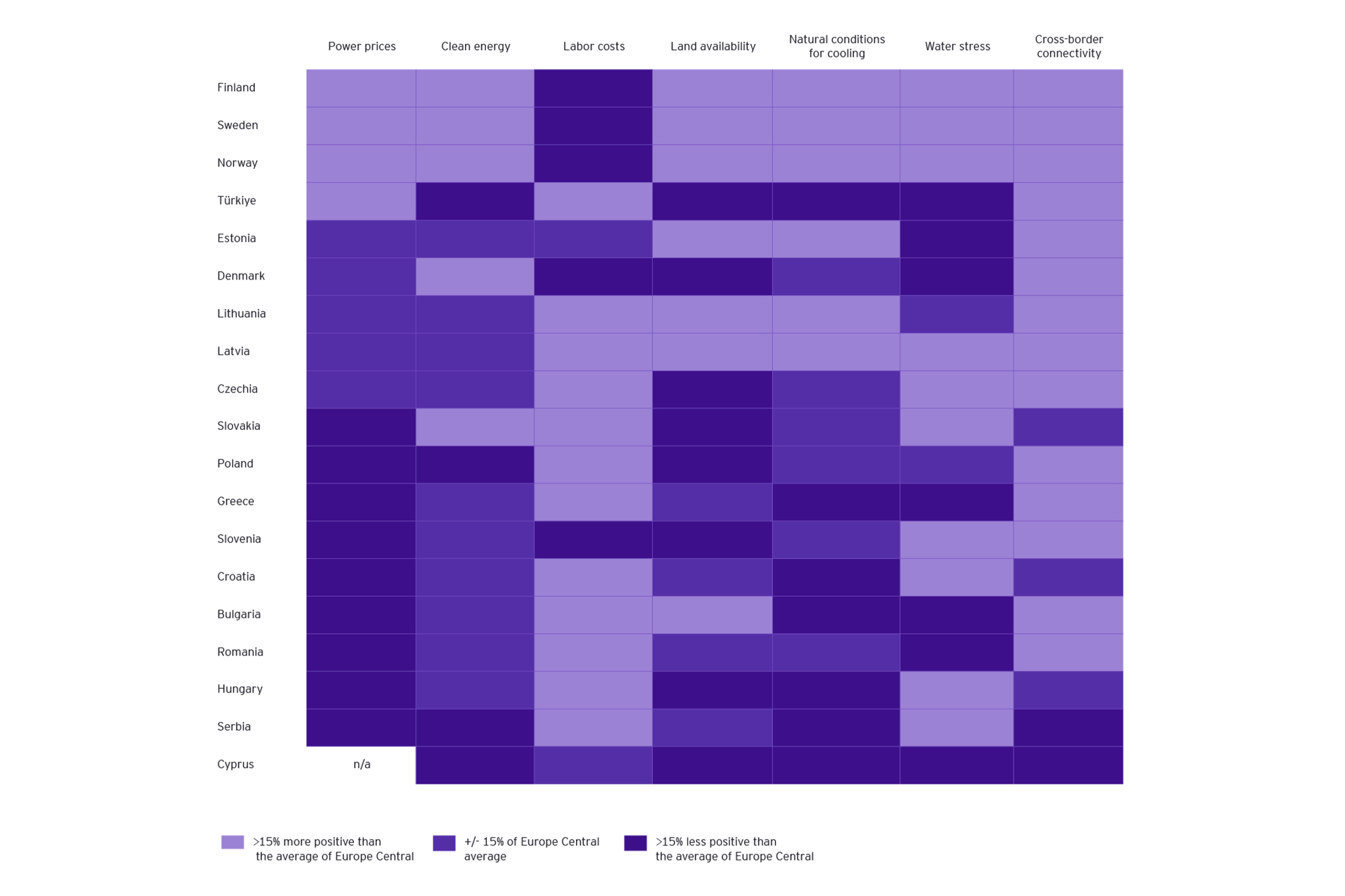
[39] EY’s Europe Central region includes 33 countries across several sub-regions. These include Denmark, Finland, Norway and Sweden in the Nordics; Poland, Estonia, Latvia, Lithuania and Ukraine in the North; Croatia, Czechia, Hungary, Serbia, Montenegro, Bosnia and Herzegovina, Slovakia and Slovenia in the Central; Albania, Bulgaria, Cyprus, Greece, Malta, North Macedonia, Romania and Moldova in the South; Türkiye; Armenia, Azerbaijan, Georgia, Kazakhstan, Kyrgyzstan, Tajikistan and Uzbekistan in the Caucasus and Central Asia.
[40] “Number of Data Centers by Country (November 2025),” Cargoson, January 2026, https://www.cargoson.com/en/blog/number-of-data-centers-by-country.
[41] “Monthly Electricity Data,” Ember, https://ember-energy.org/data/monthly-electricity-data/.
[42] “Data centres: Hungry for power,” ICIS, 2025, https://www.icis.com/explore/resources/data-centres-hungry-for-power/.