










EY-Parthenon CEO Survey

South Africa’s CEOs are sharpening the core to fund growth

South African CEOs are moving decisively from intention to action. With 90% expecting revenue growth over the next 12 months, leaders are strengthening their core businesses, investing in new capabilities and actively reshaping portfolios to create new routes to growth.


In brief

  • Ninety percent of South African respondents expect revenue growth during the next 12 months, up from the 60% that reported growth over the previous 12 months.
  • CEOs are pursuing growth on multiple fronts: improving the economics of the core business, using partnerships and minority investments to extend capabilities, and actively managing portfolios.
  • South African transaction intentions are particularly strong, with 63% expecting divestment or separation activity and 60% planning joint ventures over the next 12 months.
  • Execution will be decisive. Legacy technology, outdated operating models and regulatory complexity could constrain how quickly strategic intent becomes measurable value.

South African CEOs are not waiting for the environment to do the work. They are taking deliberate action to drive growth.

1

Chapter

Confidence is translating into action

The latest EY-Parthenon CEO Outlook Survey points to a clear shift in the South African growth agenda. While 60% of local respondents reported revenue growth over the previous 12 months, 90% expect growth during the next 12 months.

That confidence is not passive. CEOs are making deliberate choices about where to improve, invest, partner, acquire and divest. The result is a growth strategy that combines stronger execution inside the business with external moves to add capability, reach new markets and release capital from assets that no longer fit.

The central message is one of movement. South African leaders are not relying on a single growth lever. They are acting across the core business, external ecosystems and the portfolio at the same time.

2

Chapter

Strengthening the core to create room for growth

Growth starts with a stronger core business, not with growth activity in isolation.

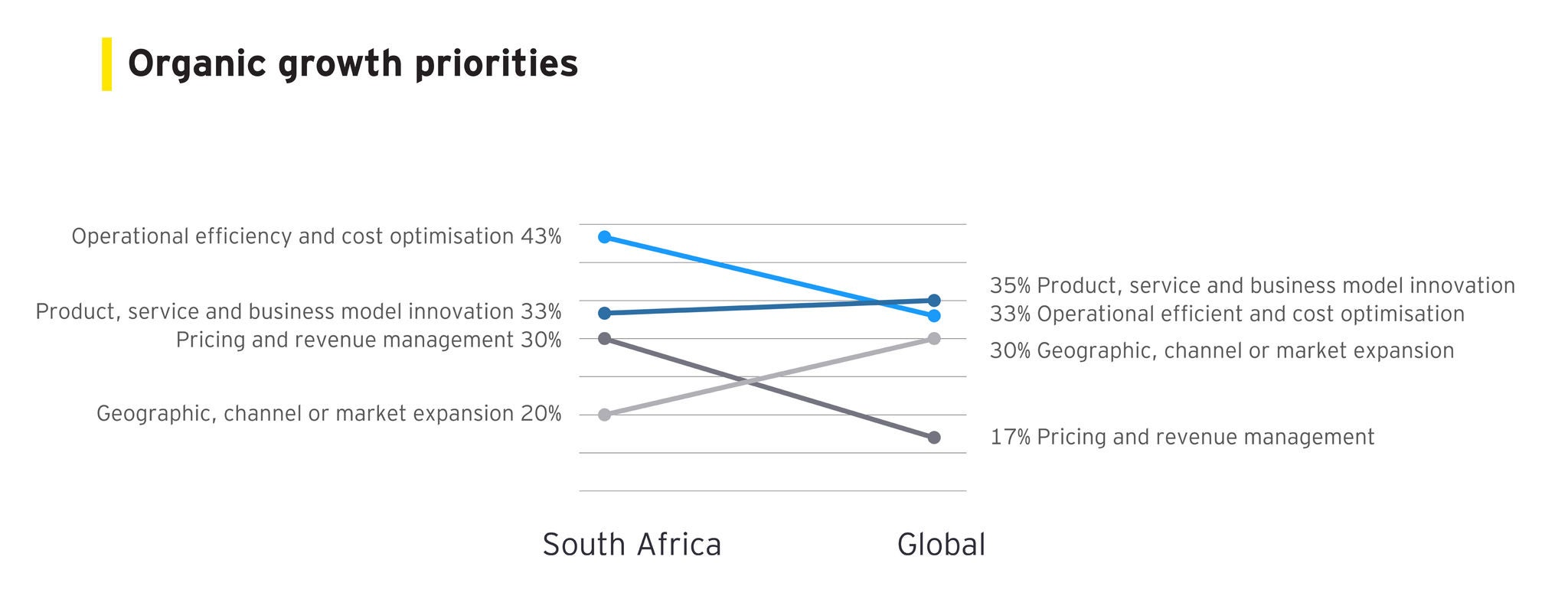
Operational efficiency and cost optimisation is the leading organic growth priority in South Africa, selected by 43% of respondents compared with 33% globally. Product, service and business-model innovation follows at 33%, while pricing and revenue management is cited by 30%, almost double the global result of 17%.

These priorities show that South African CEOs are focused on improving both the resilience and the economics of the existing business. Cost discipline remains important, but it sits alongside innovation and sharper revenue management. The objective is not simply to reduce cost; it is to create a stronger platform from which to grow.

Figure 1: Selected organic growth priorities: South Africa versus global Source: EY-Parthenon CEO Outlook Survey, September 2026.
3

Chapter

Extending capability through partnerships and investment

South African CEOs are using external ecosystems to move faster and broaden the capabilities available to the business.

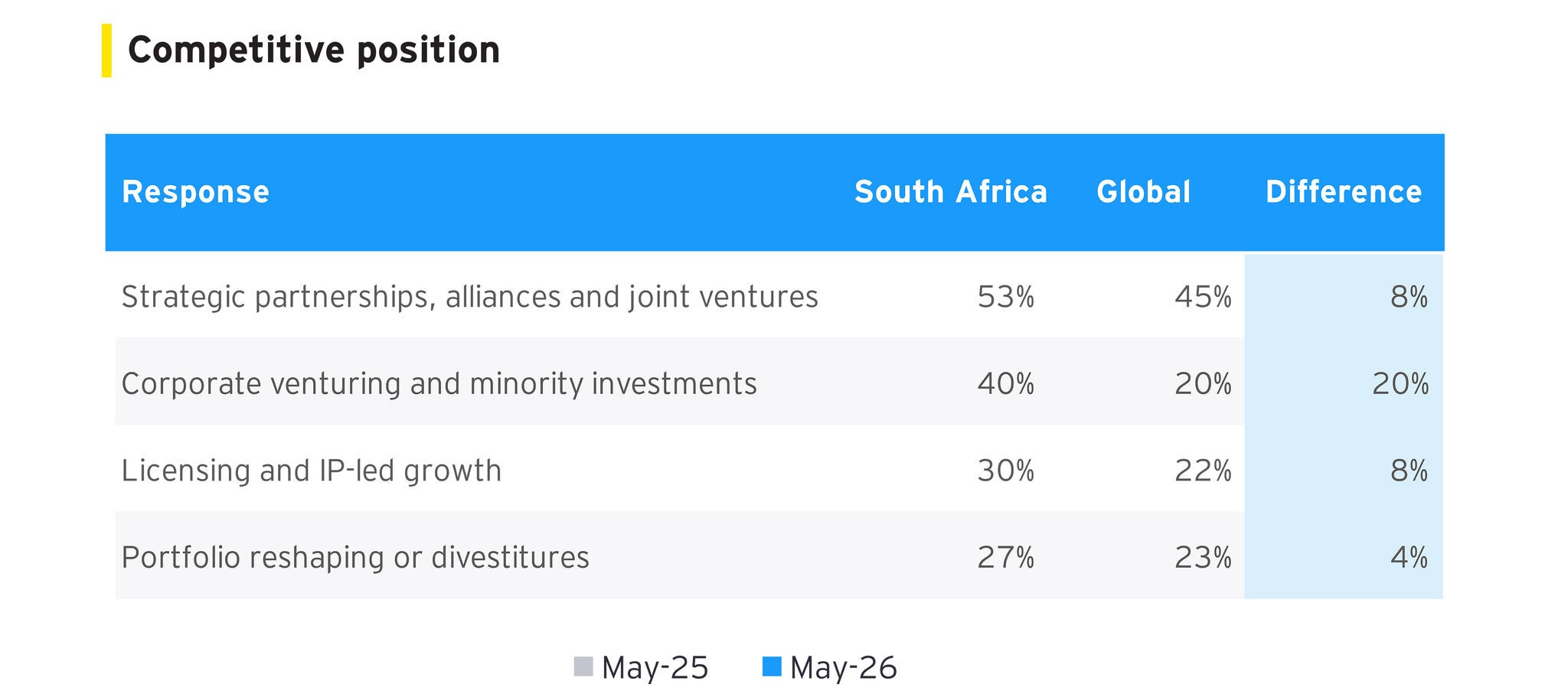
Strategic partnerships, alliances and joint ventures are the leading external growth priority, selected by 53% of South African respondents compared with 45% globally. Corporate venturing and minority investments are selected by 40%, double the global result of 20%. Licensing and intellectual-property-led growth is also more prominent locally, at 30% compared with 22% globally.

The pattern suggests a pragmatic approach to growth. CEOs are not choosing between building and buying. They are combining internal improvement with partnerships and targeted investments that can provide access to skills, technology, intellectual property and new routes to market.

This flexibility matters in an environment where speed, capital discipline and access to capability must be balanced. Partnerships and minority investments can complement the core business while allowing leaders to test new opportunities without relying only on large-scale acquisitions.

Figure 2: Selected inorganic growth priorities: South Africa versus global Source: EY-Parthenon CEO Outlook Survey, September 2026.
4

Chapter

Actively reshaping the portfolio

Growth and portfolio simplification are being pursued together.

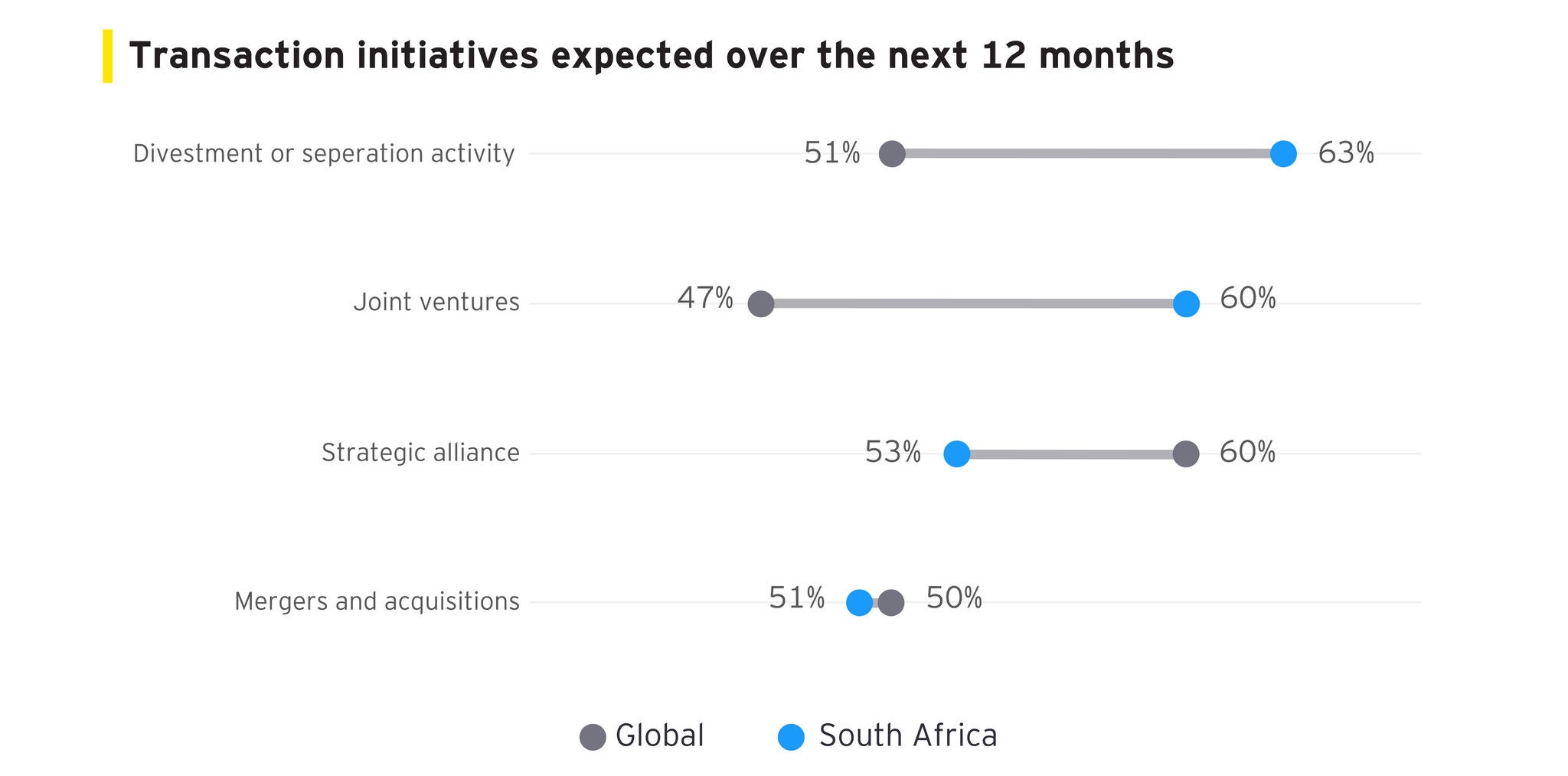
The transaction outlook reinforces the extent of planned action. Sixty-three percent of South African respondents expect to pursue a divestment or separation activity over the next 12 months, compared with 51% globally. Joint ventures are expected by 60%, above the global result of 47%, while strategic alliances and mergers and acquisitions remain prominent at 53% and 50%, respectively.

This is not simply a story of greater deal appetite. CEOs are combining acquisitions, alliances and joint ventures with the sale or separation of assets. Transactions are being used in both directions: to add capabilities and create new growth options, and to release capital or reduce complexity where parts of the portfolio no longer support the strategy.

Portfolio management is therefore becoming a more continuous strategic discipline. The question is not only what to acquire, but also what to retain, partner around, separate or exit so that capital and management attention remain aligned to the strongest opportunities.

Figure 3: Transaction initiatives expected over the next 12 months. Source: EY-Parthenon CEO Outlook Survey, September 2026.
5

Chapter

Execution will determine how much value is realised

The ambition is clear. The challenge is converting activity into measurable and sustained value.

Delivering on these intentions will not be straightforward. Regulatory, antitrust or competition barriers are the most frequently cited South African divestment challenge at 37%, compared with 21% globally. Balancing speed and cost with maximising value follows at 30%. Early preparation, a clear value story and disciplined management of separation complexity will influence whether portfolio activity achieves its strategic and financial objectives.

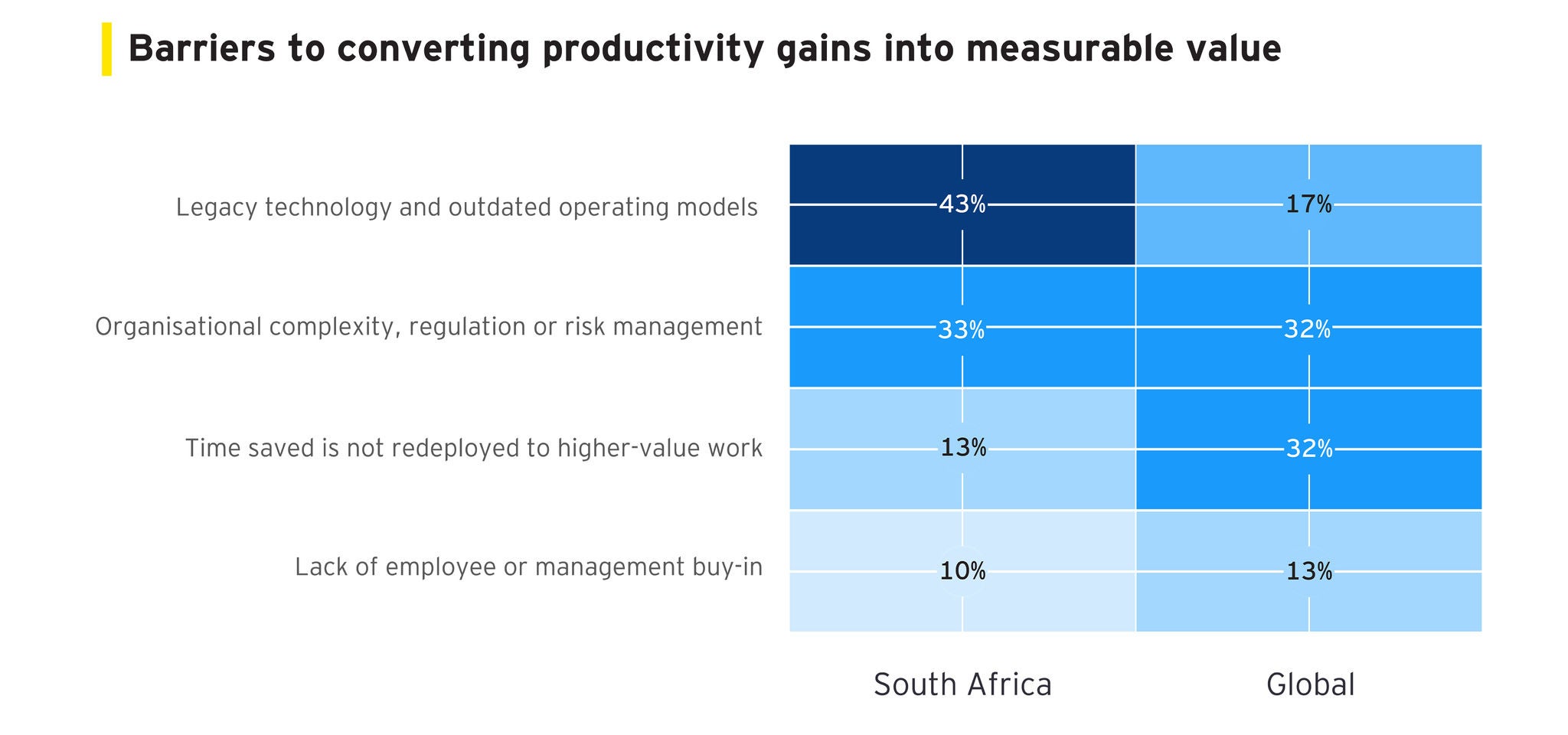
The operating environment inside organisations also matters. Forty-three percent of South African respondents identify legacy technology and outdated operating models as the biggest barrier to converting productivity gains into measurable value, compared with 17% globally. A further 33% point to organisational complexity, regulation or increased risk management.

This places execution at the centre of the growth story. CEOs may be moving with confidence, but growth will depend on whether systems, workflows, decision rights and operating models can support the pace and breadth of change being pursued.

Figure 4: Barriers to converting productivity gains into measurable value Source: EY-Parthenon CEO Outlook Survey, September 2026.
6

Chapter

Productivity supports the growth agenda

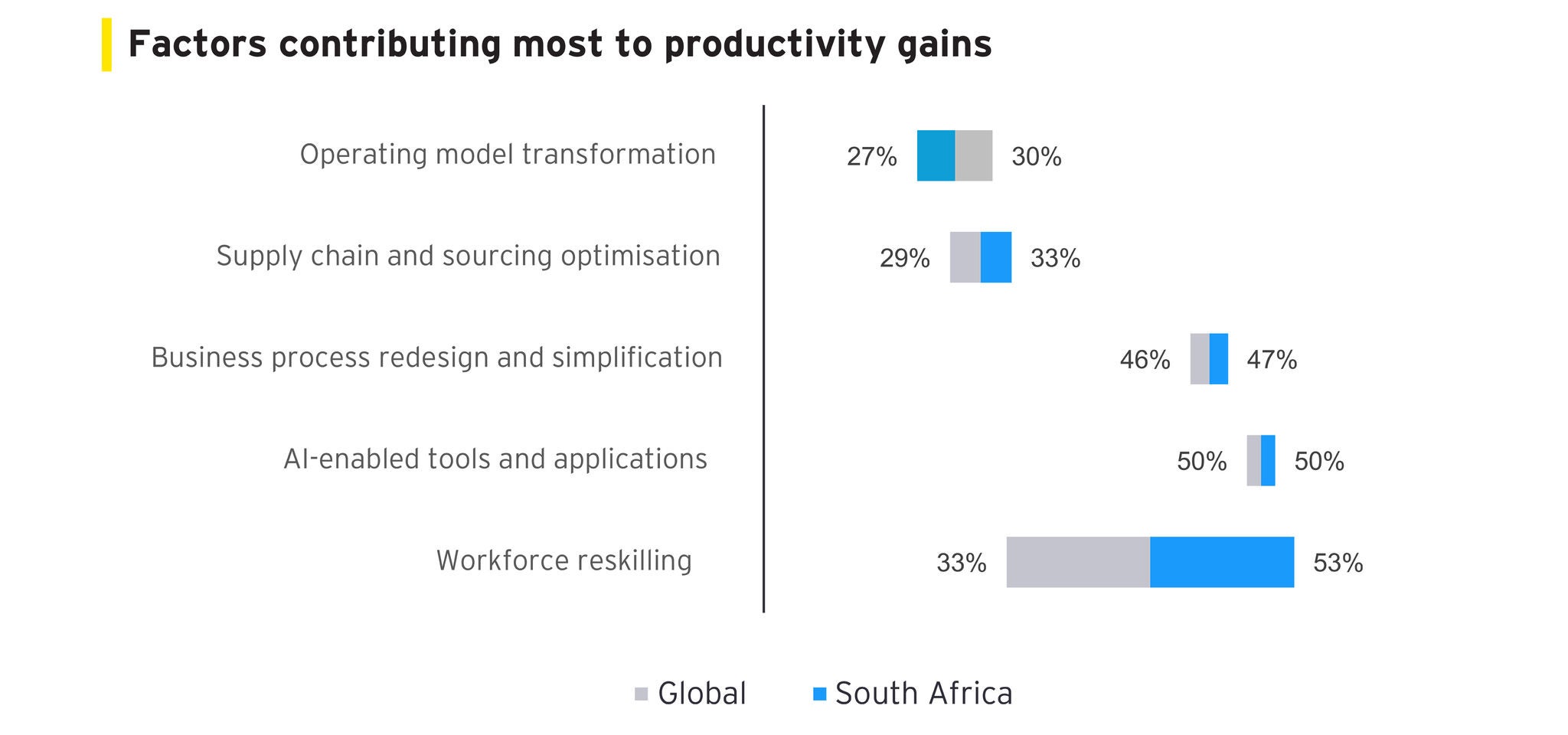
South African organisations are already reporting productivity gains from workforce reskilling, AI-enabled tools and process redesign. Reskilling is cited by 53% of local respondents, compared with 33% globally. AI-enabled tools are cited by 50%, in line with the global result, while business-process redesign and simplification is cited by 47%, broadly matching the global 46%.

These findings are best understood as supporting the broader growth agenda. The additional capacity created through skills, technology and process improvement becomes strategically important when it is redirected towards innovation, stronger customer propositions, improved execution and new sources of revenue.

Figure 5: Factors contributing most to productivity gains. Source: EY-Parthenon CEO Outlook Survey, September 2026.

AI is an enabler, not the headline

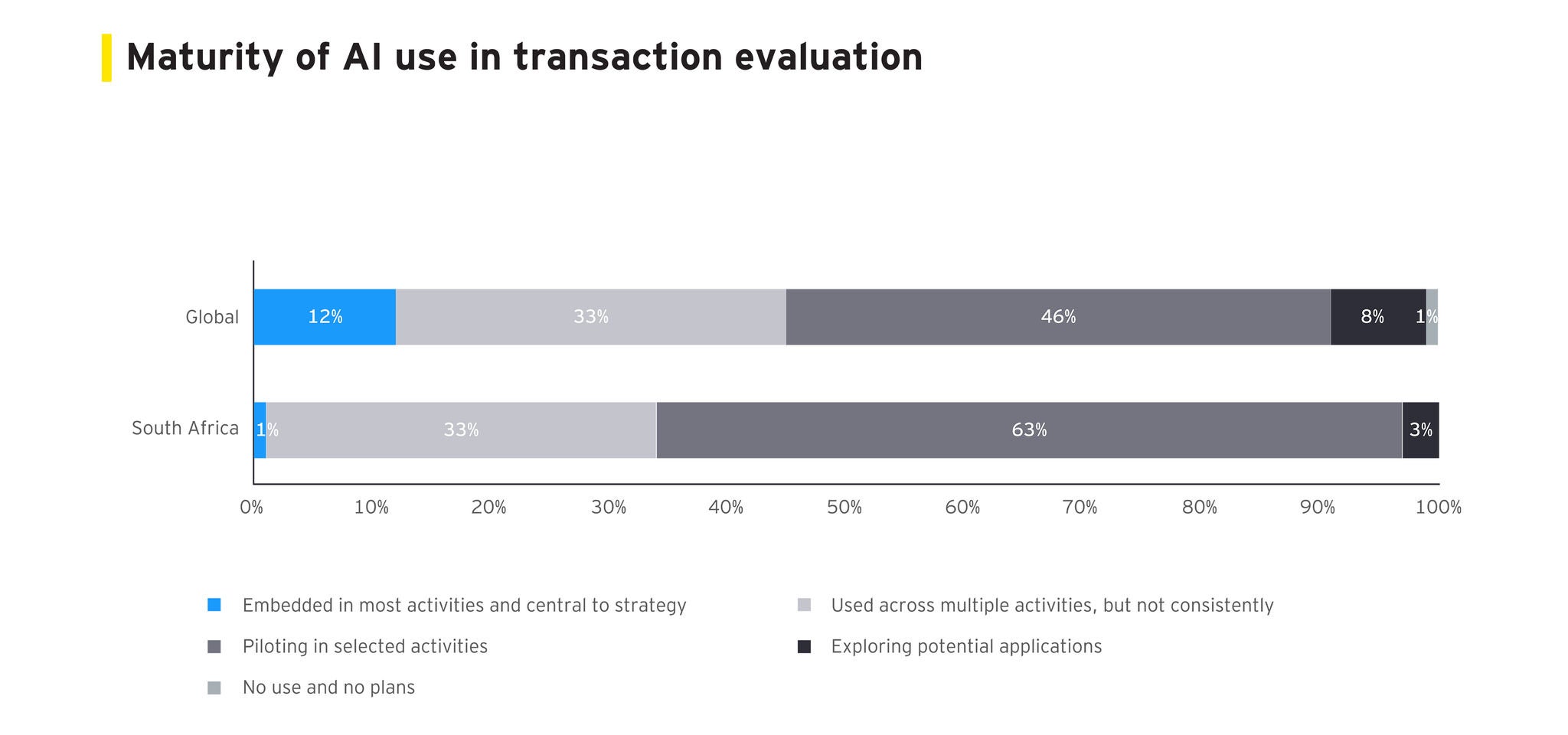
AI is already being used in South African transaction evaluation, but adoption remains concentrated in pilots and inconsistent use across multiple activities. Ninety-six percent of respondents are either piloting AI in selected activities or using it across multiple activities, compared with 54% globally. None report that AI is embedded across most transaction activities and central to transaction strategy, compared with 12% globally.

The strategic priority is therefore not AI adoption in isolation. It is using technology selectively and responsibly to improve the quality, speed and consistency of decisions that support growth and value creation.

Figure 6: Maturity of AI use in transaction evaluation. Source: EY-Parthenon CEO Outlook Survey, September 2026.

In summary

South Africa's CEOs are moving - strengthening the core, extending capability and reshaping portfolios to drive growth.

The findings present a clear picture of South African CEOs in action. Strong growth expectations are being matched by a broad set of deliberate moves: improving operational performance, sharpening pricing and innovation, building partnerships, making targeted investments, pursuing transactions and exiting or separating assets where appropriate.

Technology, workforce capability and process improvement support this agenda, but they are not the story on their own. The headline is that CEOs are taking decisions now to position their organisations for growth.

The next test is execution. Leaders will need to modernise operating models, navigate regulatory and separation complexity, measure returns clearly and ensure that capital and management capacity are directed towards the opportunities that can create lasting value.

Explore South Africa's editions of our CEO survey

What will it take to win in a more complex world?

South African CEOs in 2026 balance confidence with discipline, advancing growth and resilience while scaling AI and navigating geopolitical complexity.

How can CEOs deliver stability today while reimagining for a future in flux?

South Africa’s CEOs enter 2026 with renewed confidence, scaling AI, strengthening resilience and accelerating transformation across the business landscape.

How can South Africa’s CEOs turn stability into strategy for growth?

South African CEOs must move from survival tactics to strategic innovation for growth.

About this article