





EY refers to the global organisation, and may refer to one or more, of the member firms of Ernst & Young Global Limited, each of which is a separate legal entity. Ernst & Young Global Limited, a UK company limited by guarantee, does not provide services to clients.
Recent Searches

Kiwis want AI that protects, not predicts, finance leaders must spotlight real benefits to earn trust and drive adoption.
In brief:
- New Zealanders are open to AI in fraud prevention but remain sceptical of its broader financial applications.
- Transparency and plain-language communication are essential to building trust in AI-powered services.
- A fast-follower strategy allows NZ firms to learn from global leaders while tailoring AI to local expectations.
If you work in financial services, there’s one graph from the latest EY AI Sentiment Survey that should stop you in your tracks.
It shows that just 3–7% of New Zealanders have consciously used AI for any financial task in the past six months. That’s less than a third – and sometimes less than a quarter – of the global average.
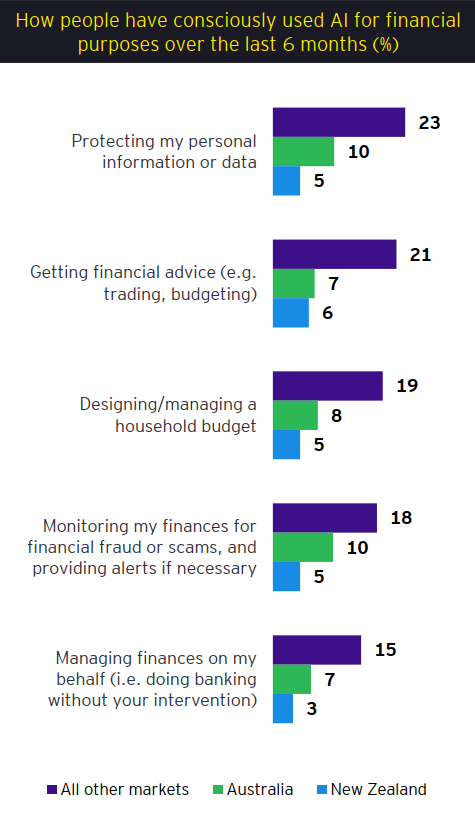
This graph reveals a trust and awareness gap too big to ignore.
People in Aotearoa are deeply wary of AI managing their money. Yet, according to our survey, nearly 60% say they want AI used more to protect them from fraud and financial threats. The message is clear: Kiwis trust AI when it acts as a shield, but not when it tries to steer.
This isn’t a rejection of AI. It’s a demand for transparency, boundaries and benefits that customers can see.
Fast followers can still lead
For New Zealand’s financial services sector, AI isn’t a race to be first. In fact, a fast-follower approach may be the best of both worlds – learning from global leaders while avoiding their early mistakes.
Being a fast follower isn’t passive. We still need to put the right foundations in place: robust data governance, clear AI use policies, and above all, transparent communication with customers.
In many cases, strategy is being led by offshore parent companies — often out of Australia. But if AI tools are going to work for New Zealanders, we need to be in the sandpit too. Testing, adapting, and building trust on local terms.
Share the good news stories
Right now, too many of the good news stories about AI are hidden, and that’s feeding into the trust deficit.
AI is already making a positive impact in New Zealand financial services, just quietly. It’s powering fraud detection systems. It’s helping insurers analyse decades of complex policy wording for inconsistencies. It’s supporting call centres in delivering better service.
But clearly the customer doesn’t know that, and that’s a missed opportunity. Trust is built when we explain not just what AI is doing, but why it benefits our customer.
If AI helps keep your account safe from fraud, say so. If it supports call centre staff in responding faster and more accurately, say so. Don’t bury it in the T&Cs (or even assume the T&Cs have been updated!). Surface it in plain English, at the right moment, in the right channel. “Our AI shield blocked a suspicious transaction attempt today.” This is the kind of message that builds confidence.
What financial services leaders can do now
- Be transparent. Trust starts with honesty. If AI is working in the background, say so.
- Anchor in protection. Customers already trust AI to help prevent fraud. Build from there.
- Don’t skip the basics. Strong governance, ethical boundaries and clear communication must come before scale.
- Invest in digital and data literacy. If your team isn’t using AI, they can’t innovate with it. Individual productivity is a precursor to institutional innovation.
- Show what’s in it for the customer. Every AI-driven insight should answer one question: How does this help me?
New Zealand’s “Number 8 wire” mindset isn’t about being first — it’s about making things work, reliably and well. That’s how the financial services sector can earn trust in AI – through practical, visible value delivered on our terms.
Summary
AI is already delivering value in New Zealand’s financial sector, from fraud detection to service enhancements, but most customers don’t know it. To build trust, financial institutions must make AI’s benefits visible, relatable, and grounded in protection. A fast-follower approach allows New Zealand to adopt proven strategies while tailoring them to local needs. By focusing on transparency, ethical governance, and customer-first messaging, financial leaders can shift the narrative from fear to confidence. Trust won’t come from technology alone, it will come from showing how AI works for people, not just systems. That’s how NZ finance can lead with impact.
This article is the eleventh in the new EY AI Sentiment Index series, explores how New Zealand’s financial sector must lead with transparency and customer-centric value to build trust in AI and unlock its full potential.

Related articles
Sprinting smart: How to strategise before the AI surge
AI adoption is a race. The starting pistol has been fired but many organisations are still standing in the blocks. Before business leaders take off at a sprint, there is one thing they must do first.
AI and Scope 3 emissions: turning compliance into opportunity
Learn how AI can help businesses tackle Scope 3 emissions while boosting efficiency.
Risk-aversion: The AI roadblock
Inaction on AI is risky. Learn how to leverage AI for growth and efficiency in your business. Learn more.