





A close-up image of a green spiral pattern resembling a Fibonacci sequence

From invisible to invaluable: Can AI turn Scope 3 emissions into competitive advantage?

Dealing with Scope 3 emissions is no longer optional – and using AI to track them shouldn’t be either.


In brief:

  • AI can help businesses to measure and manage Scope 3 emissions with unprecedented precision.
  • The catch? AI’s potential will only be realised if CEOs unite sustainability and technology teams under a shared vision.

A food manufacturer reformulated a lasagne recipe, using an AI-powered chatbot, to cut costs and Scope 3 emissions by 18% without compromising quality and taste.


An industrial tech company applied AI algorithms to reduce material waste and lower customers’ production costs.


And a consumer goods giant leveraged AI to engage 70% of its suppliers in tracking emissions, inspiring a new level of collaboration across the value chain.


These case studies, featured in the new report from the Climate Leaders Coalition, demonstrate how AI can tackle Scope 3 at its most complex.


The EY-Liberty Global Smarter networks, greener planet report, published in January 2025, shares other compelling case studies. Consider the AI-enhanced ‘call before you dig’ program that reduced unnecessary field dispatches by 30-35%. Or the AI-optimised data centre software that achieved 15% average savings in energy and equivalent to nearly AU$2 million a year.


These success stories also reveal a key insight: AI doesn’t just help with emissions tracking. Applied strategically and responsibly, AI can help organisations align their financial and environmental goals, control costs and enhance efficiency, spark innovation, and foster a new era of collaboration with supply chain partners.


From hidden footprint to open book

Scope 3 emissions are the hidden climate cost of business – embedded in product lifecycles, transport networks, waste disposal, and even how employees commute. Unlike Scope 1 and 2, which companies can directly control, Scope 3 emissions are inherited from every supplier, contractor and service provider along the value chain. The simplest way to think about it? Your Scope 3 emissions are someone else’s Scope 1 or 2.


Measuring emissions is the first step to managing them – but with Scope 3 that’s the hardest part. The Carbon Disclosure Project (CDP) estimates that supply chain emissions are, on average, 11.4 times larger than a company’s direct operational footprint. Yet, most businesses still struggle to track them.


That changed in 2025. From 1 January, Australia’s largest companies must start to disclose their Scope 3 emissions. Smaller businesses aren’t directly covered – yet. But by 2027, thousands of organisations, including not-for-profits, will be subject to the same rules. And even those outside the mandate won’t escape scrutiny. When large supply chain partners must report their Scope 3 emissions, they’ll be asking their suppliers to do the same.


It’s a daunting shift, but also a defining moment.

Leaders who step up to the Scope 3 emissions reporting challenge can turn a compliance headache into a competitive advantage – cutting costs, driving innovation and strengthening supplier relationships in the process.

The commander of emission control

The January 2025 EY-Parthenon CEO Outlook Survey of 1,200 global leaders reveals a range of transformation objectives that sit alongside sustainability targets. Improving customer and employee engagement, reducing costs, optimising operations, driving product and process innovation, all ranked higher.

CEO transformation priorities in 2025

Elevating the customer experience
Optimising operations
Enhancing product and process innovation
Achieving sustainability targets

However, AI and Scope 3: Precision on the path to net-zero emissions, prepared by EY teams together with select members of the Climate Leaders Coalition, reveals a compelling opportunity.


AI and data-driven insights not only tackle Scope 3 emissions but also align with the most pressing business priorities, helping companies achieve both environmental and operational goals simultaneously.


Precision on the path to net-zero emissions finds companies that leverage AI-driven analytics can:


  • Automate emissions tracking – AI can process vast amounts of data, mapping emissions across supply chains in real time to aid fast, informed decisions.
  • Improve data accuracy – Machine learning algorithms can fill gaps in third-party data, saving time and reducing reliance on rough estimates.
  • Optimise supply chain decisions – AI can model different scenarios, helping businesses choose lower-emission suppliers and improve logistics efficiency.
  • Engage suppliers at scale – AI-powered tools can help companies work with thousands of suppliers simultaneously, driving emissions reductions across the value chain.
AI transforms Scope 3 emissions from a data labyrinth into a clear roadmap. By bringing together sustainability expertise and AI-driven insights, businesses can make real, measurable progress on decarbonisation.

From isolation to integration

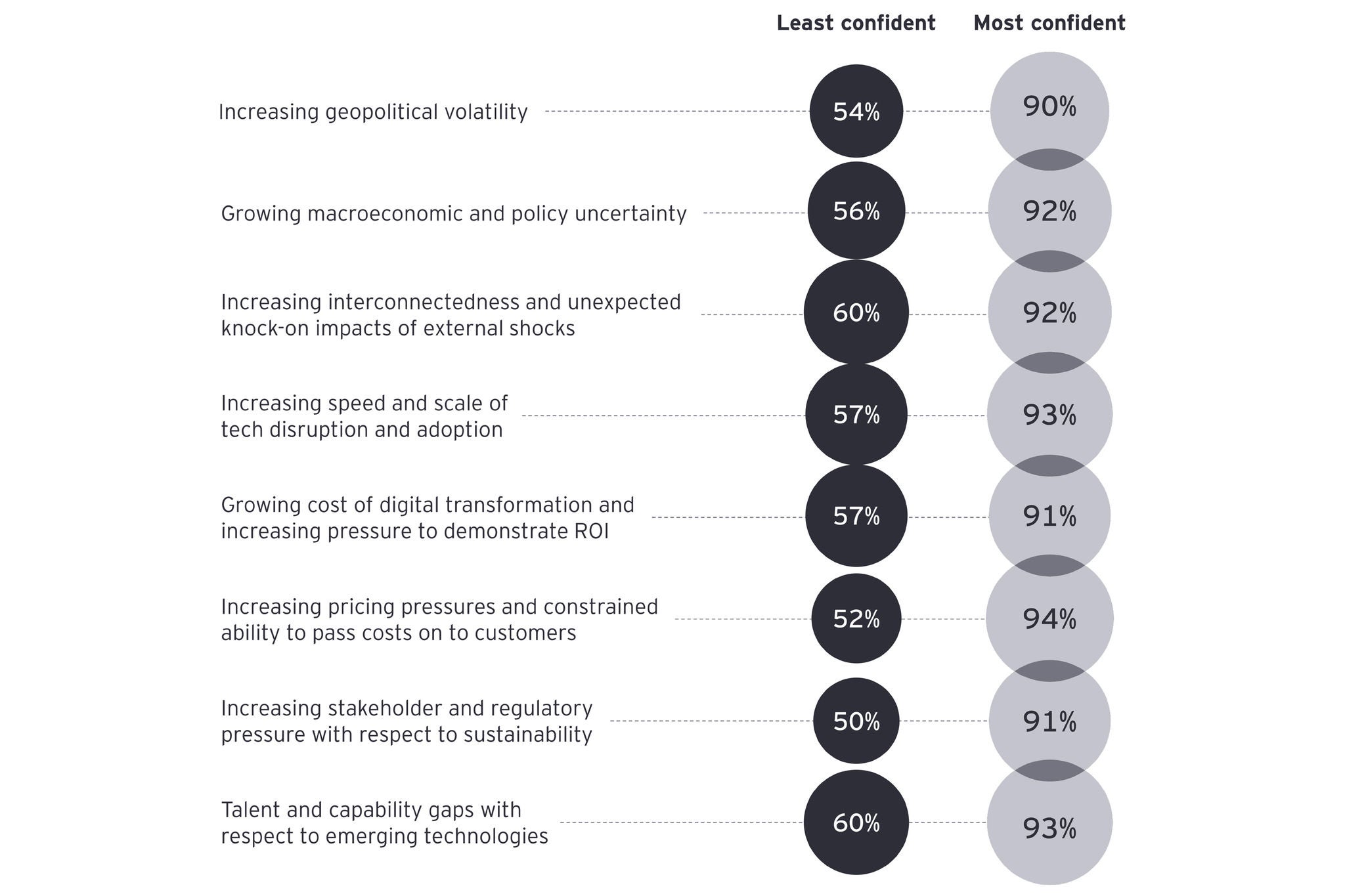
The EY-Parthenon CEO Outlook Survey found 93% of the most confident CEOs see AI and technological disruption as critical to future success – compared to just 57% of the least confident. The pattern is similar for sustainability: 91% of confident CEOs see rising stakeholder and regulatory pressure as a key driver of transformation, versus only 50% of their less assured peers.

This suggests that forward-looking CEOs are bringing technology and sustainability together to transform their businesses.

ey-ai-and-scope chart

However, one big barrier stands in their way: organisational silos. Sustainability teams and technology teams often operate in isolation, limiting their collective impact.

As Ann Sherry AO, Co-chair of the Climate Leaders Coalition, notes in the report: “AI is not just a tool for the IT department. Nor is emissions management the sole responsibility of sustainability teams. Achieving real progress will require both technical and sustainability to align under a shared vision.”

AI is a strategic asset that requires top-down guidance for full impact. To give AI the best chance of tackling Scope 3 at speed and scale, CEOs must drive an integrated approach across their organisation. The Climate Leaders Coalition report suggests four strategies to get started:

  1. Assess: Identify gaps in Scope 3 data and evaluate where AI offers the greatest value.
  2. Select: Choose AI tools that align with emissions categories and business needs.
  3. Implement: Aim for seamless integration between AI systems and existing data and reporting frameworks.
  4. Train and monitor: Equip teams with AI skills and continuously refine applications.

From compliance to authentic conversations and competitive advantage

Mandatory disclosures may be the trigger, but the true Scope 3 story is about transformation. AI offers CEOs the precision and speed needed to turn Scope 3 from an overwhelming challenge into a strategic advantage.

The latest EY AI Sentiment Index Survey, published in April 2025, finds that AI both excites and worries people. They want reassurance that AI is designed for everyone – built inclusively, serving the whole community, and securing long-term benefits for both people and the planet.

Summary

Leaders who use AI to step up to the Scope 3 challenge will not only meet compliance requirements but also reveal efficiency opportunities, strengthen partnerships, and start new, authentic conversations with customers, employees and suppliers. The question for CEOs is not how to act, but how fast they can bring their technology and sustainability teams together to seize this moment.

Related articles

Does today’s disruption provide the blueprint for tomorrow’s growth?

EY-Parthenon CEO Survey September 2025 reveals how leaders build confidence, resilience, and growth strategies amid disruption and transformation.

Mandatory Scope 3 Emissions Reporting

For many Australian organisations, the reporting of scope 3 emissions is about to move from being ‘on the radar’ to front of mind.

Australian AI Sentiment Report: Presenting the Australian nation’s view on AI

How are everyday Australians feeling about AI? And what does this mean for the organisations they rely on for everyday goods and services?

    About this article

    Authors

    Contributors

    Contact us