





EY refers to the global organisation, and may refer to one or more, of the member firms of Ernst & Young Global Limited, each of which is a separate legal entity. Ernst & Young Global Limited, a UK company limited by guarantee, does not provide services to clients.
Recent Searches

Kiwis trust AI when they see it working, retailers must spotlight its benefits to turn hidden tech into visible value.
In brief:
- New Zealanders are already using AI in retail but lack awareness, which limits trust and engagement.
- Transparency is key, retailers should highlight how AI improves service, safety, and convenience.
- Cultural values like practicality and self-reliance shape Kiwi skepticism, requiring tailored communication strategies.
New Zealanders say they don’t trust AI — but it’s already shaping how they shop. Can consumer-facing companies help a sceptical nation move forward?
There’s a curious contradiction in how New Zealand consumers perceive AI. Just 37% of Kiwis surveyed for the EY AI Sentiment Index say they’re comfortable with AI-powered product recommendations – far below the global average of 60%.
Yet, AI is already in their shopping basket. It’s just that customers don’t know it.
Seeing is believing
New Zealanders are ahead of the global average when it comes to using AI for customer support, with 33% accessing AI-powered help compared to 31% globally.
That suggests Kiwis are comfortable with AI when it’s transparent, visible and clearly working for them. They welcome AI that acts like a helpful assistant, not a hidden operator.
But that comfort has clear limits. Just 9% use AI to find discounts (compared to 21% globally), and only 8% trust it to recommend products. The numbers drop even further for automation. Just 3% use AI to auto-refill their shopping carts, well below the 12% global average.
If Kiwis can’t see how AI is helping them, they won’t trust it. The question for retailers isn’t “How do we use AI?”, but “How do we show customers it’s already working for them?”
Trust starts with transparency
New Zealand is the second most sceptical market of all those we surveyed and the least enthusiastic about the future of AI.
There are valid reasons for this. The tyranny of distance; the connected communities; a cultural resistance to flashy promises and a preference for the practical over the theoretical; a bit of tall poppy syndrome, perhaps?
And, of course, there’s the “Number 8 wire mentality” – the idea that we solve problems with whatever we’ve got on hand, not with shiny new tools. We all know the mindset: If I haven’t built it myself, how can I trust it?
These factors all feed into a deep scepticism around AI. But it would be a mistake to shrug and say, “So what?” Every New Zealand company has a responsibility to bring people along on this journey – because if we don’t, we’ll be left behind.
Artificial indifference: New Zealand’s cool response to AI
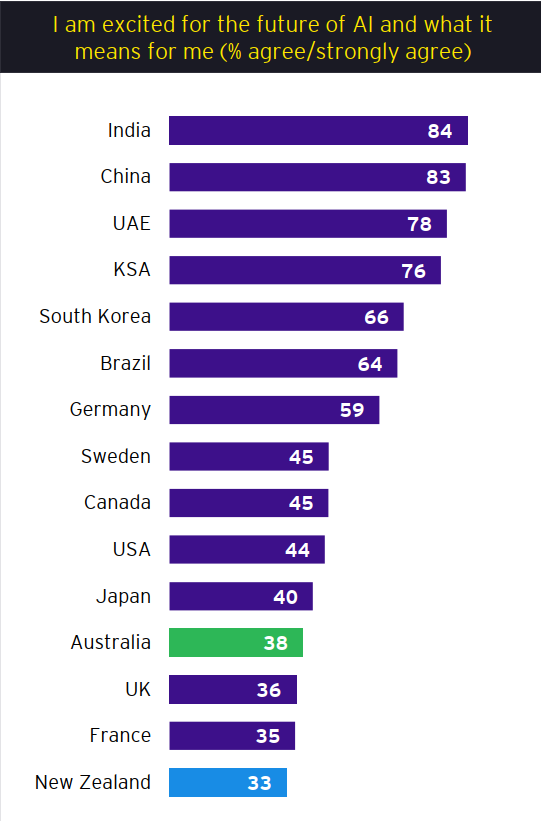
Source: EY AI Sentiment Index, January 2025.
Tech with a thank you
For consumer-facing companies, the first step is transparency. Don’t hide your use of AI. Highlight it. Tell your customers when they’re benefiting from it. Make it clear that fraud detection, personalised support and even stock management are enhanced by intelligent systems working behind the scenes.
But transparency is just the first step. From my years in marketing, I know saying ‘thank you’ is one of the most powerful message you can convey to your customers.
Say ‘thank you’ by letting your customers know how AI is making their experience better by keeping their data safe, helping them find what they need faster, or making their online orders more accurate.
When customers can see how AI is making their lives easier, it stops feeling like a hidden force and starts feeling like a helpful companion.
It’s not about making AI visible but about making its benefits unmistakable.
Summary
AI is already enhancing the retail experience in New Zealand, from fraud detection to faster service, but many customers remain unaware of its role. This lack of visibility fuels scepticism, despite widespread use. To build trust, retailers must make AI’s benefits unmistakable: show how it helps, where it’s used, and why it matters. Transparency, paired with culturally attuned messaging, can shift perceptions from suspicion to appreciation. By making AI feel like a helpful companion rather than a hidden force, businesses can foster confidence and loyalty, ensuring that New Zealand doesn’t just use AI, but embraces it.
This article is the ninth in the new EY AI Sentiment Index series, explores how New Zealand retailers can build AI trust by making its benefits visible, practical, and clearly aligned with customer needs. Next up, EY Regional Technology Consulting Leader, Oceania, Kurt Solarte, explores how empathy and transparency are essential for leaders to build trust in AI and guide teams through emotionally complex digital transformation.

Related articles
Sprinting smart: How to strategise before the AI surge
AI adoption is a race. The starting pistol has been fired but many organisations are still standing in the blocks. Before business leaders take off at a sprint, there is one thing they must do first.
AI and Scope 3 emissions: turning compliance into opportunity
Learn how AI can help businesses tackle Scope 3 emissions while boosting efficiency.
Risk-aversion: The AI roadblock
Inaction on AI is risky. Learn how to leverage AI for growth and efficiency in your business. Learn more.