






EY Megatrends

How the productivity reset will redefine value

AI and global shifts are redefining productivity, demanding new measures and smarter strategies.


In brief

  • AI and megatrends are transforming how organizations create value and measure success.
  • True productivity growth requires rethinking data, skills and operating models.
  • Leaders must balance innovation, governance and human-machine collaboration for lasting impact.

This article is part of the first set of insights in the new EY Megatrends series: Preparing for the human-machine hybrid era

The story of productivity has always been a story of what we measure, how we think, and how we manage. Productivity matters — rising productivity drives economic growth and raises standards of living, while boosting corporate profits and return on investment.

We are now on the cusp of a reshaping of productivity­ — what drives it, how it’s measured, and what the term even means. Artificial intelligence (AI) is in the spotlight as the main force driving this reshaping, but it is not the only force. It converges with regulatory and sovereignty shifts, geopolitics and supply chain rewiring, energy and compute constraints, capital and cost-of-risk pressures, demographic change and talent expectations, and the climate transition. Together they make productivity a dynamic system property rather than a standard factory setting.

In the coming years, productivity may no longer be captured solely by the traditional ratio of quantity of output to units of input. What has so far been a relentless race for increased quantity may flip on its head, as we enter an era in which machines can generate seemingly infinite quantities of content. The focus will instead shift to quality and creativity, driven by the increasingly critical capacity of organizations to convert information, insight and innovation into sustained economic value. The challenge will be how to quantify and incentivize gains that occur not on production lines, but within digital ecosystems, in the speed of decision-making, the adaptability of autonomous systems, and utilizing the creativity unlocked through human-machine collaboration.

Yet even as much changes, the essence of productivity will continue to be about using resources, whether human, material, financial or computational, to achieve higher quality, better and faster outcomes.

For business leaders, the implications are profound. In the age of AI, real productivity will come not from incremental automation, but from re-architecting how organizations operate, decide and learn.

Productivity will move from the traditional dimensions of how to do tasks faster and cheaper to one where work is better, smarter, resilient and more strategic.

For governments and policymakers, the rise of AI in business demands more than a rethink of productivity metrics — it calls for education systems that prioritize digital, analytical, and adaptive skills. Governments will also need to consider the impact of AI on their industrial strategies, sustainability agendas and the planning of labor and immigration policies to support a reshaped workforce.

The leaders of tomorrow, in both business and government, will be those who treat AI not merely as a technological revolution but as a human one. In some cases, AI will evolve from a tool to becoming a part of the workforce, redefining performance, purpose and progress for a new era. In this future, productivity will no longer be about doing more of the same but about imagining and delivering what was previously impossible.

While this has implications for leaders across business and governments, it has the greatest relevance for chief executive officers, chief financial officers, chief strategy officers, chief operating officers, and chief human resource officers — as well as for government officials and policymakers. This trend may also motivate companies to consider new roles, such as a chief productivity officer or even chief agentic officer.

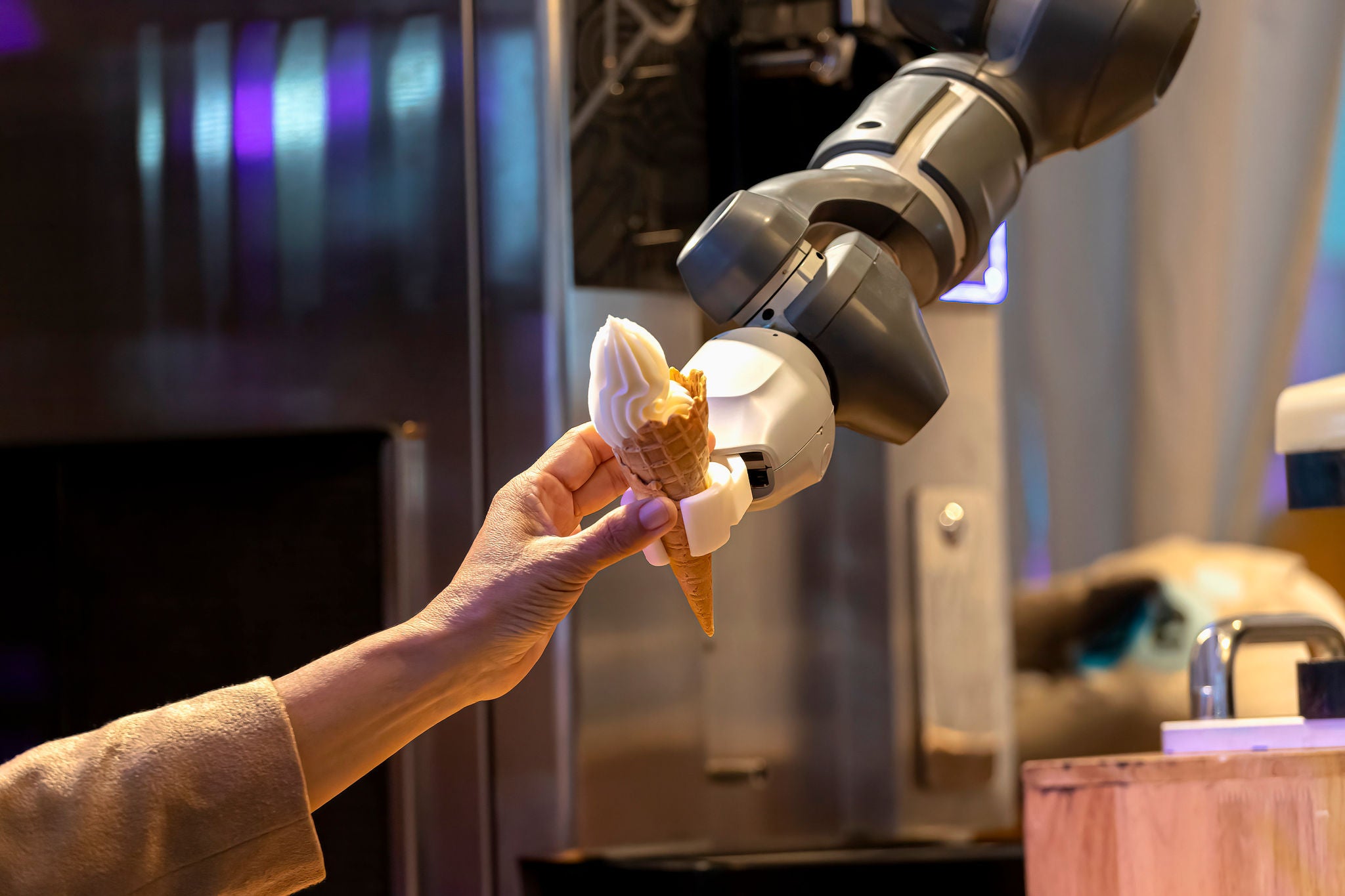
Robot Arm passing Ice Cream Cone to customer
1

Chapter 1

The history of measuring modern productivity, from steel to software

Measuring productivity is difficult – and increasingly complex.

Modern productivity debates trace back to early 20th-century ideas. Frederick Taylor’s “scientific management” revolutionized factory work through time-and-motion studies, defining productivity as measurable, mechanical efficiency. In steel plants, Taylor showed how reorganized workflows and rest schedules could raise tons produced per worker daily, purely a physical measure.

By the 1950s, Robert Solow expanded the concept with growth accounting, distinguishing gains from labor and capital from those driven by innovation and efficiency, what became “total factor productivity.”1

Yet as economies moved toward services and software, measurement grew harder. Counting goods is simple; valuing usability, search efficiency or public service quality is not. Free digital tools and nonmarket services defy price-based metrics, obscuring real progress. This evolution, from factory stopwatches to complex data systems, explains why technology’s impact often eludes statistics. As Solow noted, “You can see the computer age everywhere but in the productivity statistics.” Studies suggest early IT adoption even reduced productivity through interruptions and information overload.2

Greg Daco, Vice President, EY Parthenon, Strategy and Transactions, Ernst & Young LLP, says, “We’re witnessing the first real signs of an AI-driven productivity revolution — visible not yet in performance, but in investment. Firms are channeling capital into data infrastructure, software development, energy, and talent, laying the groundwork for future growth.

“AI could extend the economic expansion by two to four years over the next decade — but only if companies get the basics right: robust data, reliable infrastructure, abundant energy, and skilled people. The productivity gains will come to those who build strong foundations before chasing results.”

Gen AI real boost to global GDP by 2033:
baseline model
Gen AI real boost to global GDP by 2033:
optimistic model

 The shift from labor hours to valuing outcomes redefines productivity for the AI era. Traditionally, success was measured by output per hour, for example with legal professionals by briefs written and accounting professionals by financial statements audited, assuming time drove results. Today, with AI copilots and agents, time is abundant; human insight and accuracy are the new limits. Productivity now reflects the quality and impact of outcomes relative to the supervision required. A better formula is Productivity = (Accuracy × Relevance × Impact) / Human cognitive input. The less correction needed for valuable results, the higher the productivity.


 “True productivity now measures value created, not hours consumed,” notes Biren Agnihotri, Chief Technology Officer, Ernst & Young LLP.
 

The widespread adoption of AI will likely exacerbate this decades-old challenge, making it even more critical to measure how ideas, software and organization, not just hours and machines, drive growth.
 

Researchers and policymakers are rethinking productivity across several fronts:

  • Expanding productivity measures to recognize AI and robotics as active contributors to output, not just as background tools, to frame productivity as the value created per combined unit of human and agentic effort.3
  • Recording the value of data, algorithms and computing power as productive assets in new international government accounting standards.4
  • Using better price indices for AI services to avoid underestimating productivity gains (as can happen when rapidly improving AI learns faster or performs more complex tasks and these gains are not reflected in price and quality measures).5
True productivity now measures value created, not hours consumed.

Together, these changes point to a future where productivity reflects not just how efficiently people work, but how effectively humans and intelligent systems work together. Getting this measurement right will be essential for guiding investment, policy, and the fair sharing of benefits from the next wave of automation.

Aerial photo of illuminated highway in Lapland at night
2

Chapter 2

Understanding the potential of the AI productivity boost

Unlocking the AI productivity boost demands strategic shifts, trusted data, and outcome-focused execution.

AI itself has long been used in various forms, from rule-based systems to machine learning models. Just look at the use of AI in the work done by recent Nobel Prize winners, with both physics and chemistry awards going to scientists for work relying on AI-enabled research6. But the public release of a generative AI (GenAI) chatbot in November 2022 marked a transformative moment. Its ability to understand and generate human-like content — from articles and slide decks to images and videos — captured public and investor attention, sparking unprecedented enthusiasm and investment across industries.
 

Companies that once viewed AI as a niche tool began to see it as a strategic driver of productivity and innovation. The sudden accessibility and versatility of generative AI (GenAI) demonstrated how automation could extend beyond repetitive tasks to include creative work, knowledge work, communication, and decision support.
 

However, a definitive calculation of the economic benefits that may accrue from the use of AI is yet to become clear. There is growing consensus that there will be an uplift similar to the information and communication technology (ICT) boost in the 1990s.


IDC, a global provider of market intelligence and advisory services, forecast that “Business spending to adopt artificial intelligence (AI) … will have a cumulative global economic impact of US$19.9t through 2030 and drive 3.5% increase in global gross domestic product (GDP) in 2030.”7 Similar expectations were voiced by Microsoft CEO Satya Nadella, who said he expected AI investment to drive UK growth and productivity: “It may happen faster, so our hope is not 10 years but maybe five.”8

Many companies are already providing real evidence of deployment, but we are merely in the foothills of the potential benefit. The technology’s transformative power is widely acknowledged but its full productivity dividend remains largely theoretical. While the productivity dividend remains unrealized, it is top of mind for business leaders, as an analysis of mentions of AI and productivity in company announcements shows.


The next wave of productivity will come from agentic AI, systems that can autonomously manage complex workflows, make semi-intelligent decisions, and coordinate tasks across functions. These higher-order agents are still 18–36 months from widespread deployment, but they represent the first true step toward what EY describes as the “Superfluid Enterprise".
 

“Companies have moved beyond debating if AI can deliver value to confront the harder question of how to make it happen,” notes Brad Newman, Partner, EY Global Consulting Supply Chain and Operations Leader, Ernst & Young LLP. “In areas like supply chain and operations, the conversation has shifted from theoretical ‘lights out’ automation to the practical challenge of integration and execution.”
 

The result is a pervasive execution gap: a gulf between the technological potential being sold by vendors and the measurable outcomes that CEOs are willing to commit to publicly.
 

Achieving AI-driven transformation and the boost to productivity will demand a wholesale shift toward outcome-based operating models, where leaders manage by exception and orchestration rather than process adherence. Instead of making sure everyone rigidly follows a set of fixed rules or procedures, leaders should focus on stepping in only when something unusual happens, when results fall outside expectations, or when a problem needs their attention. Their time is better spent coordinating people, technology and processes to achieve desired outcomes, like a conductor guiding an orchestra, rather than micromanaging every step.

Companies have moved beyond debating if AI can deliver value to confront the harder question of how to make it happen.

Such a transformation of business architecture requires a multi-year commitment.

Michael Von der Geest, Partner, EY Global Customer Managed Services Leader, Ernst & Young LLP, puts this succinctly, “Most business leaders do not understand enough about AI to architect their business models, and most technologists don’t understand enough about how businesses operate to tell them how to do it.”

This mutual blind spot leaves organizations searching for evidence and case studies that do not yet exist. It’s a challenge of demonstrating tangible results, which slows investment.

There is already evidence of this technology creating significant gains.9


Most firms now accept that AI’s success in boosting productivity depends less on the sophistication of algorithms and more on the quality of the data that fuels them. Many are still struggling to clean, unify and structure data across complex, fragmented systems. Newman describes this as a universal problem, “Some are struggling with the data side of it — data quality is one issue, and then the question of whether they even have the data they need.” Firms are increasingly investing in “self-healing data” tools that use AI itself to detect inconsistencies, fill gaps, and generate missing data points, creating the foundation for trustworthy automation.


At the same time, the boundary between automation and AI is blurring. Companies are discovering that what they really need is not just process automation but decision intelligence, systems that augment human judgment with real-time analysis and adaptive logic. In complex supply chains, this means AI can go beyond simply executing tasks to continuously optimizing trade-offs across cost, risk and service levels.


This productivity leap is particularly visible in what is becoming known as “physical AI.” Companies are learning the potential for embedding intelligence directly into machines and robotics. In this new future, retrofitted cameras and edge-based algorithms enable robots to recognize and adapt to new parts in real time, no longer halting production for reprogramming. Factories are evolving into adaptive ecosystems, powered by digital twins and simulations that optimize sequencing, speed, and energy use before a single physical change occurs.


The results are not confined to the shop floor. Front-end operations are also undergoing transformation, with AI improving forecasting, inventory, and maintenance responsiveness. In sectors like heating, ventilation and air conditioning (HVAC), predictive systems now alert technicians to potential breakdowns before customers notice a problem, reducing downtime and turning traditional product sales into ongoing service models. This shift toward “servitization” represents a fundamental change: Customers are shifting from purchasing machines to investing in outcomes, monetized through continuous services rather than one-off purchases.


Schneider Electric exemplifies this transition, focusing on delivering “energy as a service.” Recurring service revenues and digital solutions now comprise more than 50% of Schneider’s business, enabling strong, resilient margins independent of hardware cycles.

Beyond operational efficiency and service sales, AI is accelerating innovation itself. In research and development, generative systems trained on decades of structured and unstructured data are uncovering new molecules, materials and applications at unprecedented speed. When combined with real-time market sentiment and competitive intelligence, companies can direct R&D investment more effectively, improving both the pace and success rate of product development.

However, this productivity revolution depends on strong governance and trust. As intelligent agents increasingly make decisions, monitor systems, and interact with one another, human oversight and robust assurance become essential. Risk management must expand beyond financial controls and compliance dimensions. It needs to be reinvented for a new way of operating in an AI-enabled future.10 Without proper guardrails, the same technology that many hope will boost productivity could amplify vulnerabilities, from cyber threats to systemic errors.

Ultimately, AI offers industrial companies not just the opportunity to improve speed, but to enhance the effectiveness of their operations: to integrate intelligence throughout their physical and digital operations, to turn data into decisions, and to reinvent how value itself is created. In the next three to five years, this fusion of physical and cognitive capability promises to define a new frontier of growth, where productivity is redefined not by output per worker, but by innovation per algorithm.

To unlock the full productivity potential of AI, companies must shift from experimentation to purpose-led AI adoption. The evidence from early adopters shows that AI can help achieve measurable performance gains, from predictive maintenance and quality control to logistics optimization and R&D acceleration.

However, the greatest challenge lies not in developing better algorithms, but in integrating AI into the fabric of business operations. Firms need to invest in the foundations of intelligent systems, high-quality, unified data, interoperable platforms, and adaptive governance frameworks that build trust and transparency. This means moving toward outcome-based operating models, shifting their performance and success metrics away from outcomes toward outputs and focusing more on the tangible results and value provided, and where leadership focuses on managing exceptions and orchestrating results rather than enforcing static processes.

The next wave of productivity will come from agentic AI systems capable of autonomously coordinating complex workflows and making decisions across functions, enabling the Superfluid Enterprise". Companies that reimagine their architectures around such continuous intelligence will improve efficiency and resilience.

As the line between physical and digital operations blurs, organizations must balance innovation with oversight, ensuring AI augments rather than replaces human judgment. Ultimately, sustained productivity growth will depend on leaders’ ability to combine technological ambition with strategic discipline, turning data into decisions, and intelligence into enduring competitive advantage.

young man standing between golden skyscrapers looking up into sky
3

Chapter 3

The productivity question for governments and society

AI offers leverage but demands smart policy, energy reform, and inclusive workforce strategies.

“If Europe cannot become more productive, we will be forced to choose. We will not be able to become, at once, a leader in new technologies, a beacon of climate responsibility and an independent player on the world stage. We will not be able to finance our social model. We will have to scale back some, if not all, of our ambitions.” This was the assessment by Mario Draghi in his review of competitiveness in the European Union (EU).11

But this concern is not limited to the EU. The UK has similar concerns, and China aims to increase productivity by implementing an innovation-driven development strategy to boost total factor productivity and power high-quality development.12 Many governments now frame AI adoption as a lever to raise trend productivity and secure “industrial sovereignty” in strategic technologies.

The energy system is a first-order constraint and opportunity. Training and deploying modern AI largely occurs in data centers, and the International Energy Agency warns that electricity demand from data centers and AI is set to rise substantially this decade, which has implications for grids, siting, and clean power build-out.13 At the same time, AI can optimize power systems, from forecasting renewables to orchestrating flexible demand, helping governments reconcile digital expansion with climate goals.

Labor markets will feel uneven effects. The International Monetary Fund (IMF) finds that advanced economies, more reliant on services and industries based on cognitive tasks, are exposed earlier to both productivity gains and dislocation risks. These distributional impacts vary by education, gender and age. Policymakers are urged to pair AI diffusion with agile safety nets and active labor market policies, so benefits are broadly shared. The Organization for Economic Co-operation and Development (OECD) similarly highlights that AI will transform work and that regional disparities could widen without targeted skills strategies.14

Education and training will determine whether AI complements workers or displaces them. UNESCO’s guidance calls for a human-centered approach that equips learners with digital, critical, and ethical competencies, and for systems that use AI to personalize learning while safeguarding equity. Governments adopting these frameworks can better align curricula, vocational training and lifelong learning with the evolving mix of tasks in AI-enabled workplaces.15

Fiscal and regulatory systems must also adapt. The IMF argues that AI may tilt the income mix toward capital and superstar firms, implying a need to reassess capital income taxation and strengthen redistribution while financing skills and inclusion. It urges “agile” fiscal policies that can scale support in both gradual and highly disruptive scenarios. Tax professionals themselves are already deploying AI for compliance, risk scoring and service delivery, but widespread use raises questions about governance, transparency and safeguards in public decision-making.16,17

For governments, the key action will be how they create an environment that enables companies to boost productivity. But there are potential negative effects of utilizing the new technologies. The optimal playbook combines pro-innovation regulation and investment to lift productivity with safeguards that protect rights, ensure energy-system compatibility with net-zero trajectories, and modernize tax and social policies for an AI-intensive economy.

An action plan for AI-era productivity

  • Rebuild around clean, connected data: Treat data as infrastructure. Invest in high-quality, interoperable data systems that enable AI to function effectively and responsibly.
  • Embed decision intelligence into workflows: Integrate AI into day-to-day operations — not as a bolt-on, but as a core capability that enhances decision-making speed, accuracy and consistency.
  • Measure outcomes, not just effort: Shift from tracking hours and inputs to measuring value through speed, quality, resilience and new revenue streams — especially service-based models.
  • Invest in agentic systems with strong governance: Use AI agents to coordinate complex, cross-functional tasks — but ensure robust oversight, accountability, and ethical safeguards are in place.
  • Digitize physical operations with AI and digital twins: Combine edge computing and simulation to optimize throughput, quality, and energy use in real time.
  • Align talent, tools, and trust: Build digital skills across all levels, re-platform around interoperable AI tools, and embed risk controls to ensure AI augments — not replaces — human judgment.
  • Adopt new productivity metrics: Develop indicators that reflect human-machine collaboration, the value of data and models, and the contribution of intelligent systems to output.

Questions for leaders
 

CEOs:
  • Which outcomes will define competitive advantage in three years, and how will AI measurably move those needles quarter by quarter?
  • What operating architecture, data, platforms and governance will let agentic systems safely run at scale across functions?
  • How will we shift from product sales to outcome-based services without eroding trust or margins?
CFOs:
  • How will we capitalize data, models and compute to reflect their asset value while updating ROI and total cost of ownership lenses for AI programs?
  • What controls ensure model risk, cyber and compliance exposures remain within appetite as automation expands?
  • Where can opex-to-capex rebalancing and servitization improve cash flow resilience?
Chief Strategy Officers (CSOs):
  • Which ecosystems, partners, open models and infrastructure, are essential to avoid lock-in and accelerate diffusion?
  • What scenarios (Growth, Transform, Constraint, Collapse) most threaten our model, and what hedges are in place?
  • How will we reskill the organization to exploit decision intelligence in every P&L?
For COOs:
  • How do we re-architect operations to measure and manage productivity across human, digital, and agentic systems?
  • How do we move from process-driven to outcome-based operating models that manage by exception rather than routine?
  • How can we build robust assurance frameworks that manage operational, ethical, and cybersecurity risks from autonomous systems?
For CHROs:
  • How do we rethink workforce metrics to reflect contributions from both people and AI, such as learning velocity, adaptability and creativity?
  • What new roles, skills, and leadership behaviors are needed in a world where humans manage adaptive, semi-autonomous systems instead of static teams?
  • How do we embed ethical, transparent and inclusive principles into AI deployment, workforce transformation and cultural change?
Government officials:
  • What mix of skills, computer, and clean energy policy will crowd-in private AI investment while meeting climate targets?
  • How should statistics and tax codes evolve to recognize data and algorithms as productive assets and to ensure broad-based gains?
  • Which guardrails best protect rights and competition without stalling diffusion?

Summary

In the AI era, productivity will hinge less on hours worked and more on how well organizations turn data, models, and judgment into outcomes. Success requires treating AI as a foundational shift—rebuilding around clean data, embedding intelligence into workflows, and measuring value by speed, quality, resilience, and new revenue. The agenda is to invest in trusted data, adopt interoperable tools, manage by outcomes, build skills and embed risk controls. If executed well, growth will come not just from faster work, but from improved services, more adaptive industries, and a fairer distribution of AI-driven gains.

Related articles

How superfluid enterprises reshape organizations for competitive edge

Superfluid enterprises use AI and automation to eliminate friction, boost agility and unlock new competitive advantages. Discover how.

How emerging technologies are enabling the human-machine hybrid economy

Discover how technology is changing work and leadership. Take action to succeed in the evolving human-machine economy.

What if disruption isn't the challenge, but the chance?

Transform your business and thrive in the NAVI world of nonlinear, accelerated, volatile and interconnected change. Discover how.

    About this article

    Authors