









Man with canoe on the lake

Navigating the EU Omnibus Simplification Package: CSRD


Read in Germanread in French

The EU Omnibus aims to simplify CSRD, reducing compliance burdens and promoting competitiveness among businesses.


In brief

  • This is the first of four topical articles (EUTRCS3D and CBAM) on regulation amendments
  • The CSRD aims to enhance transparency and accountability in corporate sustainability reporting, ensuring that companies disclose their ESG impacts.
  • Proposed changes include postponed reporting deadlines, revised thresholds for large companies, and reduced reporting requirements for smaller enterprises.
  • The directive encourages businesses to integrate sustainability into their operations and respond effectively to stakeholder expectations.

Recap of the legislation

The Corporate Sustainability Reporting Directive (CSRD) is a pivotal element of the European Green Deal, designed to enhance corporate responsibility and facilitate the transition to a sustainable and inclusive economy. Adopted in 2022, the CSRD significantly expands previous sustainability reporting requirements by broadening the range of companies obligated to disclose sustainability information. It also introduces the European Sustainability Reporting Standards (ESRS), which emphasize a double materiality approach. This approach requires companies to report not only on how sustainability issues impact their business but also on the effects of their operations on people and the environment, underpinned by quantitative data. The CSRD took effect in January 2024 for large European public-interest companies, with phased implementation for private companies and non-EU parent companies, including Swiss multinationals.

Proposed changes from the EU Omnibus Simplification Package

The release of the EU’s first Omnibus Simplification Package ( “Omnibus Proposal” or “Proposal”) on February 26, 2025, aims to streamline and simplify sustainability reporting requirements, as just introduced by CSRD.

The Proposal is using a staggered approach. The first step involves a “Stop-the-Clock” measure to postpone the effective dates of requirements under CSRD. In the second step, the European Commission seeks to amend the CSRD more substantively with a separate directive. This directive primarily focuses on simplification, aiming to reduce both the disclosures required and the number of companies subject to mandatory reporting obligations.

Below is a summary of the two directives introduced by the Omnibus Proposal.

“Stop-the-Clock” Directive

At this point, the Stop-the-Clock Directive is no longer a proposal and officially entered into force on April 17, 2025. For companies that have not yet begun reporting, this means that the application of CSRD is postponed by two years:

  • Wave 2 (large EU companies): will now report in 2028 in respect of the 2027 financial year (i.e., a 2-year delay from initial 2025 financial year).
  • Wave 3 (SMEs): will now report in 2029 in respect of the 2028 financial year (i.e., a 2-year delay from initial 2026 financial year).
  • No change for Wave 1 (NFRD companies) and Wave 4 (non-EU companies) due to report for 2024 and 2028 financial years, respectively.

EU Member States are required to transpose this directive into their national law by December 31, 2025.

Directive making substantive amendments to CSRD

While we expect the debate to continue still for several months, the following key amendments are currently being reviewed and discussed:  

  • Raising application thresholds: The threshold for large companies has been adjusted to more than 1,000 employees (up from 250 employees) on average, with either a turnover greater than EUR 50 million or a balance sheet greater than EUR 25 million. This applies to both listed and non-listed companies, while listed SMEs are removed from the scope.
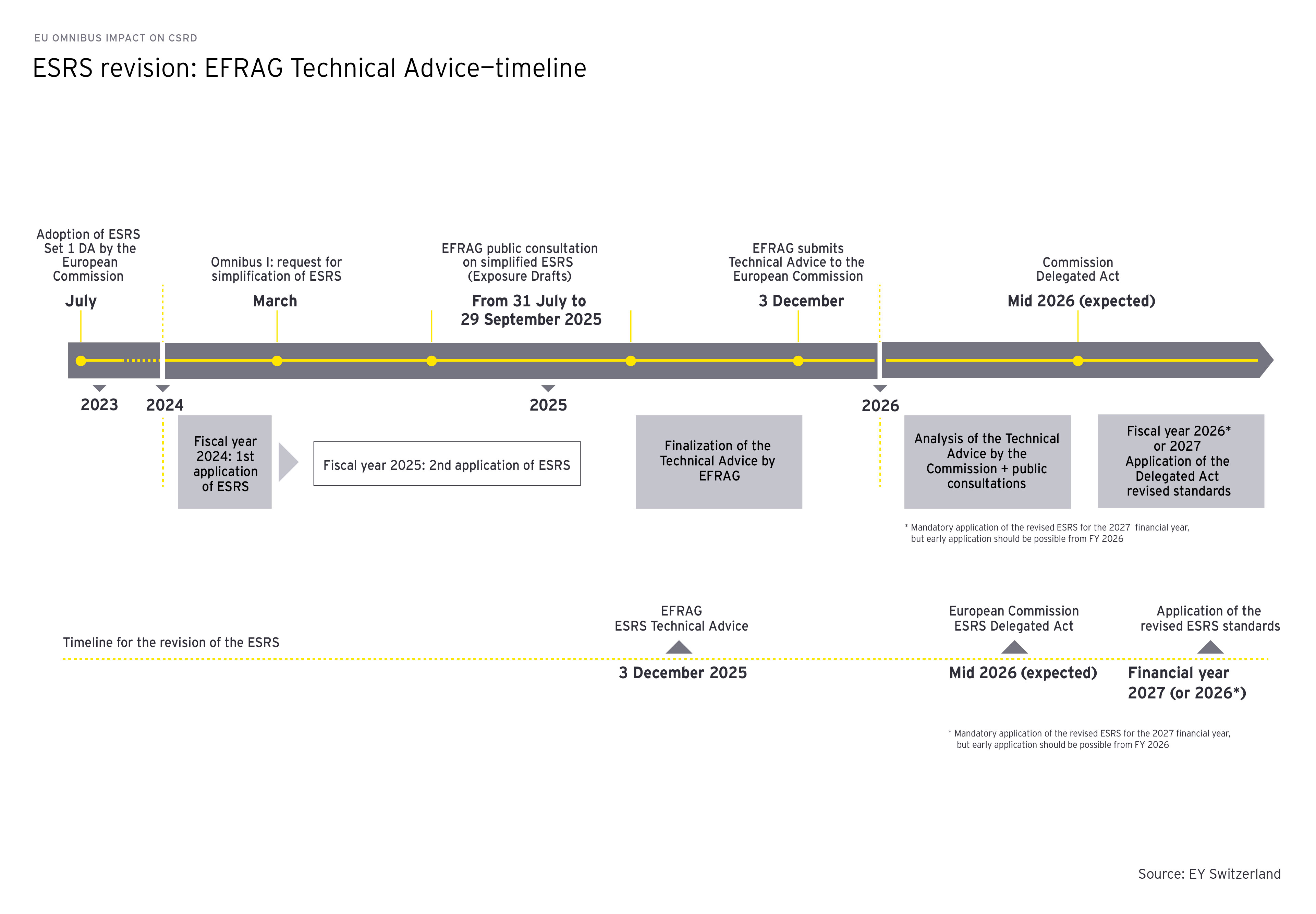
  • Revisions to the ESRS: The ESRS are currently undergoing revisions aimed at reducing and modifying datapoints, clarifying provisions, and enhancing consistency with other legislations. Public input was gathered in April as part of the consultation process, and EFRAG published a Progress Report on June 20, 2025, detailing the work completed on the project so far. The ESRS Exposure Drafts are expected to be published by the end of July 2025 for additional public feedback and review, with finalization anticipated in October 2025.
  • Value chain information: A new “value chain cap” has been introduced to limit the information that reporting entities can request from businesses in their value chain that fall outside the proposed revised scope of the CSRD.

What key aspects of legislation are not intended for change?

Despite the significant proposed amendments in the Proposal, several core elements of CSRD remain unchanged, preserving its emphasis on transparency and accountability in sustainability reporting:

  • Mandatory reporting requirements: The obligation for mandatory reporting will continue for the largest companies, both within the EU and from third countries, while encouraging voluntary reporting for those outside the scope.
  • Double materiality assessment: The concept of double materiality assessment remains intact, ensuring that both financial and impact materiality are considered in the reporting process.
  • Limited assurance: The necessity for limited assurance will persist, supporting the reliability and credibility of reported data.
  • Value chain reporting: Reporting must still encompass the entire value chain, although efforts are underway to clarify and refine the definition of “value chain” for reporting purposes.

What should companies do now?

In the aftermath of the Proposal, regulatory shifts have created both opportunities and uncertainties. The extension of timelines offers companies a chance to better prepare, align with new regulations and refine their sustainability practices. To assist companies in navigating next steps, we have outlined some “no-regret” and pragmatic actions to consider, drawing from our client discussions and broader market insights.


Monitor

  • Stay informed: Engage with industry peers and service providers to stay updated on evolving practices and monitor ongoing regulatory developments.
  • Review existing available information: Analyze Wave 1 CSRD reports to identify leading practices and opportunities for refinement.

Maintain

  • Strengthen governance and oversight: Use the additional time to enhance sustainability reporting operating models and oversight structures.
  • Ensure readiness: Complete / re-evaluate the double materiality assessment, which serves as the foundation of sustainability strategy and disclosures, to refine what is deemed truly material.

Prioritize

  • Focus on value-added activities: For example, focus on corporate and sustainability strategies and initiatives as well as on other investor and stakeholder requests.
  • Enhance data infrastructure and assurance readiness: Formalize processes, systems and controls to ensure high-quality data and readiness to undergo assurance.

How to navigate the EU Omnibus Simplification Package - Key implications for companies

Read more on how the European Commission's proposed amendments impact the Corporate Sustainability Reporting Directive (CSRD), the Corporate Sustainability Due Diligence Directive (CS3D), the EU Taxonomy Regulation (EUTR), and the Carbon Border Adjustment Mechanism (CBAM).

EY Webcast: Omnibus simplification package

In our webcast, you will learn how the European Union’s Omnibus Simplification Package aims to streamline sustainability reporting. This legislative initiative represents a significant milestone in the journey towards enhanced competitiveness. We will also present initial insights and recommendations that will help companies prepare for future challenges.

Summary

The EU Omnibus Simplification Package represents a significant step towards simplifying sustainability reporting and due diligence requirements. By providing businesses with more time to prepare, reducing the scope of reporting, and focusing on material activities, the Package aims to enhance competitiveness and support the transition to a sustainable and inclusive European economy. As the legislative process unfolds, businesses should stay informed and actively engage with stakeholders to navigate the challenges ahead and contribute to a more sustainable future.

Acknowledgment

We thank Grace Gilewicz for her valuable contributions to this article.

Related articles

The Impact of EU Omnibus on Regulation: Outlook

The EU Omnibus simplification Package is transforming compliance and sustainability reporting. Read more and explore its impact on your company.

Navigating the EU Omnibus Simplification Package - CBAM

Discover the changes to the CBAM regulation under the EU Omnibus Simplification Package and learn how companies can prepare for compliance.

Impact of Omnibus on the EU Taxonomy Regulation

Learn about the EU Omnibus Simplification Package and its impact on Taxonomy Regulation for better compliance and sustainability.

Navigating the EU Omnibus Simplification Package

Learn more about the EU Omnibus Simplification Package and its impacts for companies in Europe and Switzerland.

Understanding the EU Omnibus proposal: key insights and resources

Learn more about the recently announced EU Omnibus proposal.

CSRD technical resources

Our CSRD and ESRS technical resources provide guidance, tools, and insights for sustainability reporting standards.

EY Webcast: Omnibus simplification package – Way forward on Sustainability Reporting and Due Diligence

The Omnibus Simplification Package (“Omnibus”) is part of the European Commission's commitment to reduce wider sustainability reporting burdens.


    Explore Climate change & sustainability services

    Our multidisciplinary teams can help companies understand the risks and opportunities arising from climate change and sustainability issues.

    Brazil town from sky

    About this article

    Authors

    Request for proposal (RFP) - exclusively for Switzerland

    |

    Submit your request now!