Aerial view container cargo ship maritime freight shipping by container cargo ship, Global business import export commercial trade logistic container cargo ship freight shipping.

The EU–US framework deal – a wake-up call for Switzerland?


How Swiss businesses and policymakers should read the joint statement on an EU–US framework for reciprocal, fair and balanced trade.


In brief

  • Aside from addressing tariffs and non-tariff barriers, the EU–US framework deal seeks alignment on ESG requirements, redefining market access rules
  • Swiss businesses operating in the EU risk higher costs but may gain predictability if they adapt to new origin and sustainability criteria
  • For Swiss companies, ESG compliance is now integral to international trade strategy, while policymakers must secure recognition to stay competitive

In August 2025, the United States and the European Union issued a joint statement on a framework agreement on reciprocal, fair and balanced trade – a detailed commitment to reduce tariffs, dismantle non-tariff barriers and align on sustainability, industrial policy and strategic supply chains.

In November 2025, the United States followed up with the announcement of a major tariff cut on goods originating from Switzerland, reducing rates from 39% to 15%. The change is expected to take effect shortly, once customs systems are updated, with full implementation planned by early 2026. In return, Switzerland will open its market to more US agricultural imports and has committed to investing USD 200 billion in the United States by 2028, focusing on sectors such as pharmaceuticals and advanced manufacturing, an agreement designed to strengthen trade ties and boost exports on both sides.

These moves have caught the attention of more skeptical Swiss executives and policymakers. Many now see the US trade deals with the EU and Switzerland as a blueprint for how advanced economies are starting to link market access to sustainability performance, regulatory alignment and industrial security. For Swiss exporters, the message is clear: for economies with sufficient negotiating power, ESG compliance, supply chain transparency and adaptation to evolving green regulation worldwide are back on the negotiating table, potentially to the detriment of smaller economies.

The EU–US framework in brief

The joint statement covers multiple fronts, from tariffs and non-tariff barriers to trade to strategic economic cooperation. As such, it is more akin to an industrial policy pact than a conventional trade agreement.

Why Swiss businesses should care

The implications of the new US-EU joint statement for the Swiss export-oriented economy need to be carefully parsed, given the magnitude of the potential benefits for some businesses and disadvantages for others. On the one hand, the deal raises the risk for some Swiss exporters that supply chain interdependence will work against them. While the negotiated criteria in the agreement could actually help Swiss companies evaluate whether relocating parts of their production makes sense, stricter direct transportation rules are likely to be enforced. This could limit the ability of Swiss companies to store EU goods in Switzerland for re-export to the United States while still benefiting from preferential tariffs.

Currently, under non-preferential origin, it is relatively easy for Swiss companies to export EU goods from Switzerland. Going forward, to preserve tariff benefits, storage may only be possible under customs supervision in bonded warehouses, which would add costs and reduce flexibility. And while the recent US decision to apply the same tariff rate to Swiss and EU origin goods removes the duty gap, Swiss exporters will still need to meet non-preferential origin rules to qualify for the 15% tariff rate.

That said, the framework could bring tangible benefits compared to the current regime. The new rules of origin negotiated between the EU and the United States, even if imperfect from a Swiss perspective, may still offer greater recognition of Swiss inputs than the current US rules of origin. Crucially, they also provide legal certainty. Instead of grappling with ambiguous classifications and inconsistent application, producers would have a clear set of criteria to guide sourcing and production decisions. For Swiss exporting companies willing to adapt, the combination of more predictable treatment and the possibility of partial preferential access could ultimately strengthen their position in transatlantic trade.

As regards sustainability spillover, the deal shows that the EU is willing to carve out regulatory flexibilities for the United States in areas potentially critical to international trade such as the Carbon Border Adjustment Mechanism (CBAM), the Deforestation Regulation (EUDR) and the Corporate Sustainability Due Diligence Directive (CSDDD). After concluding trade negotiations with Indonesia, the world’s largest exporter of palm oil, the European Commission recently announced its intention to postpone implementation of the EUDR once more by another year, bowing to concerns of its trade partners, among them Brazil, Indonesia and the United States, who argue compliance with the rules would cause unjustified costs and hurt their exports to Europe. The EU has already classified the United States – along with all EU member states – as “low risk,” exempting them from stricter due diligence checks. These developments highlight the headwinds the EU faces in implementing its sustainability policy in practice and the need to weigh up policy measures against their international trade implications.

For Swiss companies, such policy shifts raise concerns as to whether they might face comparatively greater compliance burdens if they are held to stricter sustainability reporting, due diligence or origin verification standards than US or EU companies enjoy under the new arrangement. That said, existing CBAM exemptions between the EU and Switzerland already reduce one clear channel for asymmetric treatment, while EUDR and CSDDD outcomes will depend on technical implementing rules and political choices about whether to offer any simplifications through narrowly bilateral concessions or through broader, rule-based mechanisms – a process still ongoing.

As for Swiss companies that are not integrated in EU supply chains, many are concerned that US and EU companies will gain easier market access between the two economies as a result of lower tariffs, reduced non-tariff friction and mutual recognition of standards under the agreement. Some argue that Swiss companies not covered by a comparable bilateral deal may face relatively higher trade costs, complexity and delays in both the EU and US markets. Over time, that could erode margins or market share unless Switzerland negotiates equivalent or similar access arrangements.


The policy precedent – sustainability and trade

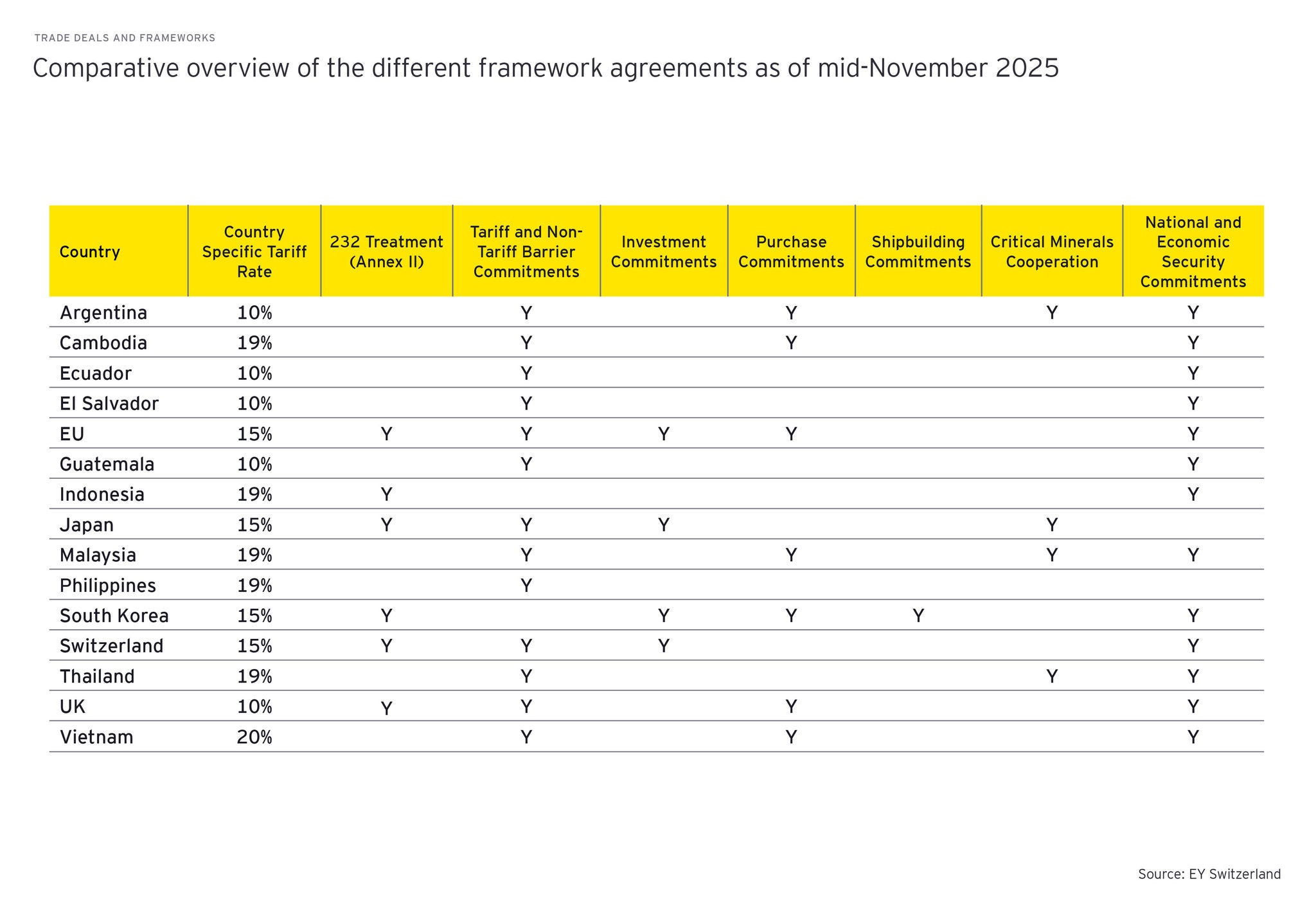
The joint statement underscores a growing trend, as market access increasingly gets tied to sustainability performance. This policy precedent mirrors other frameworks, from Indonesia-US sustainability-linked concessions (see below) to Switzerland’s own arrangement with India under the European Free Trade Association’s (EFTA) Trade and Economic Partnership Agreement (TEPA), under which New Delhi grants Bern better access to its market for 94.7% of current exports. Trade preferences on the negotiating table are no longer purely economic; they are conditioned on environmental, social and governance (ESG) commitments.

To understand the impact, the agreement must be read alongside the EU’s internal sustainability agenda. The EU’s Fit for 55 package requires a 55% emissions reduction by 2030, reshaping policies on energy, industry and transport. For exporters, this is not an abstract ambition – it flows directly into measures such as the Carbon Border Adjustment Mechanism (CBAM), which will apply to imports with high embedded emissions.

The European Green Deal adds another layer, integrating climate neutrality by 2050 into every economic sector. Exporters to the EU, including Swiss companies, will face tighter scrutiny of lifecycle performance, carbon intensity and environmental footprint.

At a more granular level, Extended Producer Responsibility (EPR) is expanding across new product groups, backed by eco-modulated fees and digital product passports. Swiss manufacturers selling into the EU will need to design for recyclability, track materials digitally and prove end-of-life management – even if their goods reach EU markets via intermediaries.

The EU–US framework fits a wider pattern. In the Indonesia–US deal, tariff concessions were tied to enforcing environmental laws, curbing illegal logging and fishing and strengthening labor rights but also to the lifting of export restrictions on critical minerals and exempting US exporters from “burdensome” certification and labelling requirements. Similarly, the EFTA–India TEPA included sustainable development provisions alongside tariff elimination. Both examples show that sustainability has become a core currency in international trade negotiations.

A pressing to-do list for Swiss businesses and policymakers

If EU–US cooperation sets a new benchmark, future competitiveness will depend not only on tariffs but also on how credibly companies can document their sustainability performance across the value chain. Leaders should assess their readiness for future trade policy in four areas: compliance with evolving green trade rules; supply chain vulnerabilities; operational adjustments in R&D, logistics and manufacturing; and financial planning to leverage grants or sustainable finance.

ey.com-graphic-template

Practical steps for Swiss businesses

  • Map regulatory exposure to CBAM, EUDR, EPR and rules of origin
  • Align product design with circular economy principles
  • Engage actively in standards dialogues to shape norms
  • Strengthen ESG data systems, ensuring traceability for carbon and material inputs
  • Build partnerships with EU companies to integrate into compliant supply chains

Policymakers, too, need to step up: they must engage Brussels early to negotiate equivalent recognition, reduce duplicative compliance costs for Swiss exporters and ensure that domestic regulations remain compatible with EU frameworks. Without such alignment, Switzerland risks being boxed out of preferential treatment despite maintaining high standards.

The new era of bilateral industry pacts

Trade negotiations are evolving beyond an exclusive focus on tariffs into comprehensive industry pacts where ESG has become a key currency. The EU–US framework illustrates how sustainability, supply chain security and industrial policy are now central to market access. Swiss companies must therefore prepare by embedding ESG compliance, strengthening data traceability and strategically integrating their organizations into aligned value chains – while policymakers work to secure recognition and equivalence. Only by adapting early can Swiss businesses and policymakers safeguard competitiveness in this new era of bilateral pacts on trade and industrial cooperation.

Sustainability requirements have become a core currency in international trade negotiations.

Summary

Aside from lowering tariffs and easing non-tariff barriers, the EU–US framework deal also focuses on sustainability requirements. For Swiss companies, the deal signals a watershed moment as ESG compliance and regulatory alignment become a core currency in global trade negotiations. Swiss businesses operating in the EU face both risks and opportunities: stricter origin rules may add costs, yet clearer criteria could improve predictability and partial access. The agreement underscores a new era in which sustainability requirements shape trade policy, pressing Swiss businesses to strengthen ESG traceability and creating an imperative for policymakers to safeguard competitiveness.


US customs tariffs: What Swiss companies need to know

Watch our webcast replay to learn how recent US customs tariff changes affect Swiss companies. EY specialists share updates, compliance insights, and planning strategies to help safeguard margins, strengthen supply chains, and remain competitive in the US market.


Related articles

Is the US tariff wall impenetrable for Swiss businesses?

US tariff hikes expose Swiss exporters to risks they can’t ignore – explore no-regret moves businesses can make now.

Navigating the EU Omnibus Simplification Package - CBAM

Discover the changes to the CBAM regulation under the EU Omnibus Simplification Package and learn how companies can prepare for compliance.


    Navigating uncertainties: how to turn uncertainties into future opportunities

    Although crisis and unwelcome change are never desirable, they can create space for new opportunities. When the answer is unknown and the situation painful or uncomfortable, there is a new stimulus for change and greater latitude for innovation and new problem-solving approaches.

    Brazil town from sky

    About this article

    Authors

    Request for proposal (RFP) - exclusively for Switzerland

    |

    Submit your request now!