





Action of safety officer is writing and check on checklist document during safety audit and inspection at drilling site operation. Industrial expertise occupation working scene.

Adapt, Transform, Thrive in the Testing, Inspection and Certification Industry

How TIC Players Can Navigate and Prosper in Fast-Paced, Challenging Times


In brief
  • The TIC sector will maintain its growth trajectory despite ongoing macroeconomic challenges.
  • M&A continues to be attractive and strategically important, with deal rationales slowly shifting to the expansion of service offerings.
  • Mastering AI is becoming one of the strategic imperatives for TIC players.

The Testing, Inspection, and Certification (TIC) industry faces an environment of rapid change and uncertainty. Despite its long-standing resilience against external shocks, driven by the need to uphold quality standards, TIC players must now recalibrate their strategies to navigate a volatile market environment to stay compliant with standards and regulations as well as ensure safety across various sectors. This includes addressing challenges such as price and salary volatility, technological advancements, and geopolitical shifts, which continue to shape organizational behavior. Relying solely on the sector's inherent resilience is less sufficient than it used to be; proactive adaptation is essential to sustain long-term performance and growth.

Economic Outlook and Challenges

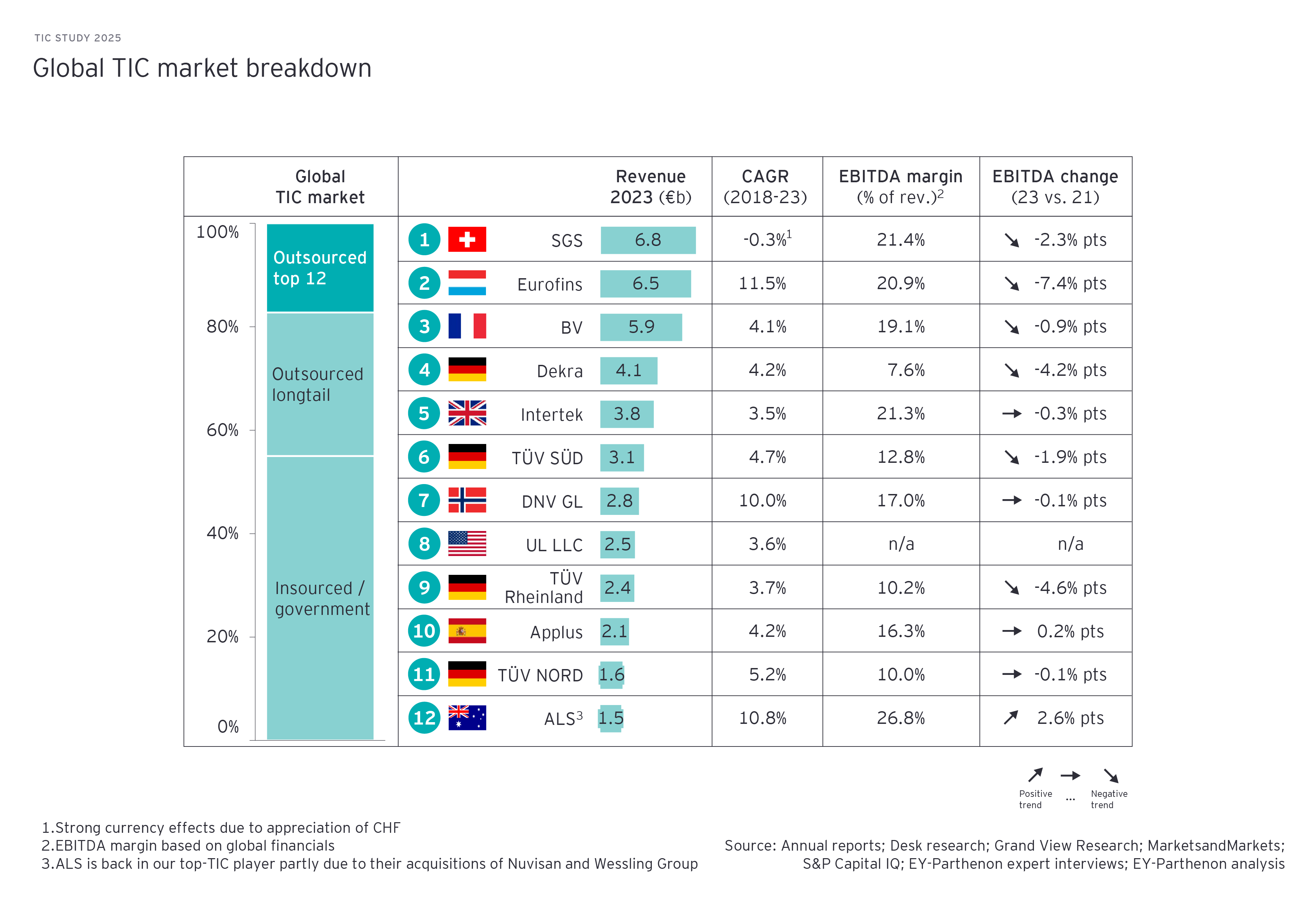
The global economic landscape remains tense, with inflation and supply chain disruptions posing significant challenges. While inflationary pressures have eased in Europe and the US, uncertainties persist due to geopolitical tensions, volatile energy prices, and cautious consumer spending. The TIC sector, however, has demonstrated structural resilience, with revenue growth and valuations showing cyclical patterns during crises. Major players have managed to pass on cost increases to customers, maintaining profitability despite inflationary effects.

Graphic 1

Amid ongoing global economic and geopolitical challenges, we expect the global TIC market to continue growing over the next few years at a rate of 4-5% p.a., overall consistent with historical growth rates. The market’s growth outlook is supported by five key drivers that will sustain growth despite broader macroeconomic uncertainties:

  1. Emerging digital advancements: Enhancements in technology (e.g., AI, IoT, automation) enable TIC providers to optimize their current service delivery and develop new service offerings.
  2. Rising regulatory obligations: The long-term trend of new regulations (e.g., EU AI Act) across various industries is driving demand for TIC services to ensure compliance with safety, quality, technological, and environmental standards.
  3. Ongoing sustainability efforts: While some countries are questioning the agreed-upon environmental sustainability and carbon reduction goals, these goals continue to drive demand for TIC services to ensure compliance with evolving standards.
  4. Even greater importance of data security: The rising use of digital systems is increasing demand for TIC services that ensure compliance with data protection regulations and safeguard sensitive information from cyber threats.5. Growing middle class and regional investments: In particular, a rising middle class in emerging markets is driving higher expectations for quality and safety, while increasing investments (e.g., infrastructure, industrial development) are further boosting demand for TIC services.
  5. Growing middle class and regional investments: In particular, a rising middle class in emerging markets is driving higher expectations for quality and safety, while increasing investments (e.g., infrastructure, industrial development) are further boosting demand for TIC services.

Necessary Steps for Future Growth and Resilience

To secure future growth and build resilience, TIC companies must adopt strategic responses, including:

  1. Investing in Technology and Innovation: Digital transformation and the adoption of technologies like AI are critical for enhancing operational efficiency and service offerings.
  2. Navigating Economic and Geopolitical Uncertainty: Strengthening risk management and diversifying operations can help mitigate external shocks.
  3. Strengthening Customer Understanding: Leveraging customer intelligence to adapt offerings and enhance experiences is vital in a fast-changing environment.
  4. Focusing on Cost Optimization: Improving efficiency and optimizing costs are essential to withstand financial pressures and safeguard profitability.

A Changing M&A Landscape

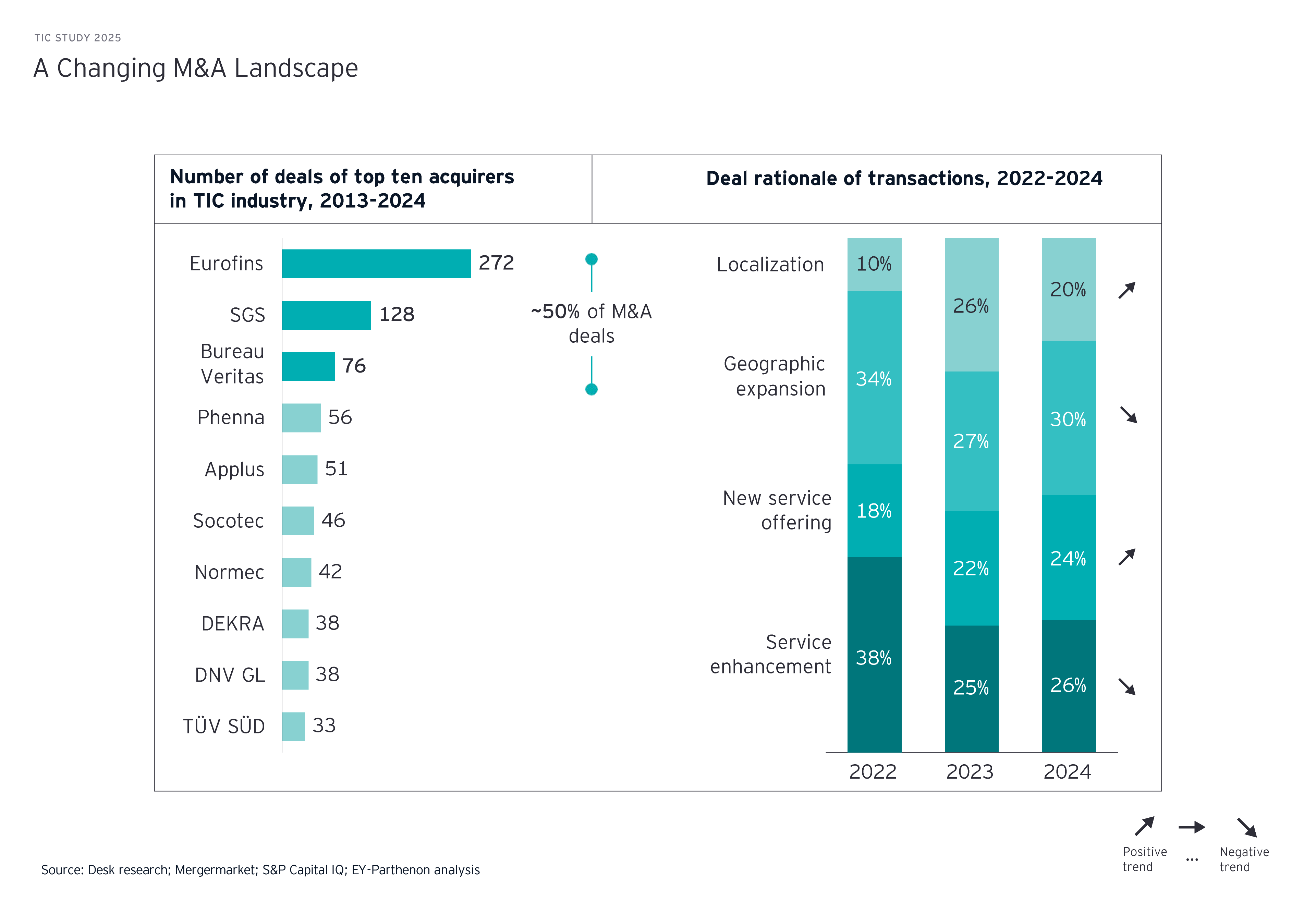
Mergers and acquisitions remain a key growth strategy for TIC players. Over the past 12 years, there have been almost 1,000 acquisitions in the global TIC market.

The strategic rationale for M&A has evolved over the past three years. While geographic expansion and service enhancement were previously the primary strategic drivers, TIC companies are now focusing on developing new service offerings (such as AI-driven solutions) and localization initiatives. Strengthening their presence in local markets – given that TIC incumbents are already well-established globally – and adapting to customer needs have become essential priorities for achieving mid- and long-term success.

Graphic 2

AI as a Strategic Imperative

AI has and will further become a critical necessity for TIC players, enabling them to enhance service delivery, improve indirect processes, and develop new AI-driven offerings. The EU AI Act, introduced in 2024, imposes substantial compliance requirements, including conformity assessments, risk management, and transparency standards. TIC companies must ensure continuous AI compliance to avoid significant penalties and maintain accountability.

Several (usually larger) TIC players have already started to develop offerings around these themes, e.g., AI system certification, conformity assessments, system testing, and data governance audits as well as training and development propositions. The growth opportunity is significant but requires considerable investment.

Adapt, Transform, Thrive

How TIC players can navigate and prosper in fast-paced, challenging times 2025

Summary 

To thrive in an increasingly dynamic landscape, TIC players must embrace innovation, recalibrate strategic priorities, and proactively address emerging challenges. By investing in technology, diversifying operations, and optimizing costs, they can position themselves for sustainable growth and higher margins.

Acknowledgment

We thank Maxime Vedrenne, Stephan Bindner, Rishi Shah who contributed to this article.

Related articles

Wie Sie sich im TIC-Sektor Wettbewerbsvorteile sichern

Lesen Sie hier, wie Sie als TIC-Player aktiv Ihre Resilienz stärken und sich Wettbewerbsvorteile sichern.

    About this article