Green leaves pattern background, Natural background and wallpaper. in Phuket Thailand.

Demystifying the voluntary carbon credit value chain for Swiss financial institutions


As carbon markets evolve, Swiss financial institutions face rising opportunities and risks. This analysis demystifies the voluntary carbon credit value chain, key intermediaries, and implications for financial institutions.


In brief

  • Carbon markets at a turning point: Regulatory pressures, global climate goals, and voluntary initiatives are driving demand for high-integrity carbon credits.
  • Navigating a complex value chain: Understanding the origination, trading, and retirement stages, as well as the intermediaries involved, is essential for managing risk, pricing, and due diligence.
  • From commodity to asset class: Standardization, legal clarity, and robust infrastructure will transform carbon credits into investable climate assets unlocking opportunities for institutional adoption and climate action leadership.

The evolving landscape of carbon markets

The voluntary carbon market (VCM) is gaining increasing relevance for financial institutions (FI) in Switzerland due to both regulatory and voluntary drivers.

The demand for credible climate action is being accelerated by several factors:

  • Disclosure requirements: New international standards from bodies such as the International Sustainability Standards Board (ISSB) and the Corporate Sustainability Reporting Directive (CSRD) are expanding corporate obligations to measure and report emissions.
  • Voluntary standards: Initiatives like the Science Based Targets initiative (SBTi) are pushing companies to set ambitious decarbonization goals. This drives the use of the VCM as a complementary tool to internal emission reduction efforts.

These factors are creating a push for financial institutions to engage with concrete climate actions, the VCM being one of them. The market, however, has an inherent complexity that needs to be addressed. At its core, a carbon credit is a tradable certificate that represents the reduction or removal of one metric ton of carbon dioxide equivalent (CO2e) from the atmosphere. The Integrity Council for the Voluntary Carbon Market (ICVCM) has established Core Carbon Principles (CCPs) to define high-quality credits, focusing on additionality, permanence, robust quantification and prevention of double counting. These fundamental elements are essential for building the integrity and credibility of the market.


This article is not a call to buy carbon credits. Indeed, the aim is to analyze the VCM, detailing the carbon credit value chain from origination to trading and retirement while identifying key stakeholders across each stage. Drawing on lessons from commodity markets, it examines pricing, market infrastructure and risk considerations, and highlights the dual identity of carbon credits as both financial instruments and environmental commodities.


The value chain of a carbon credit and relevant stakeholders

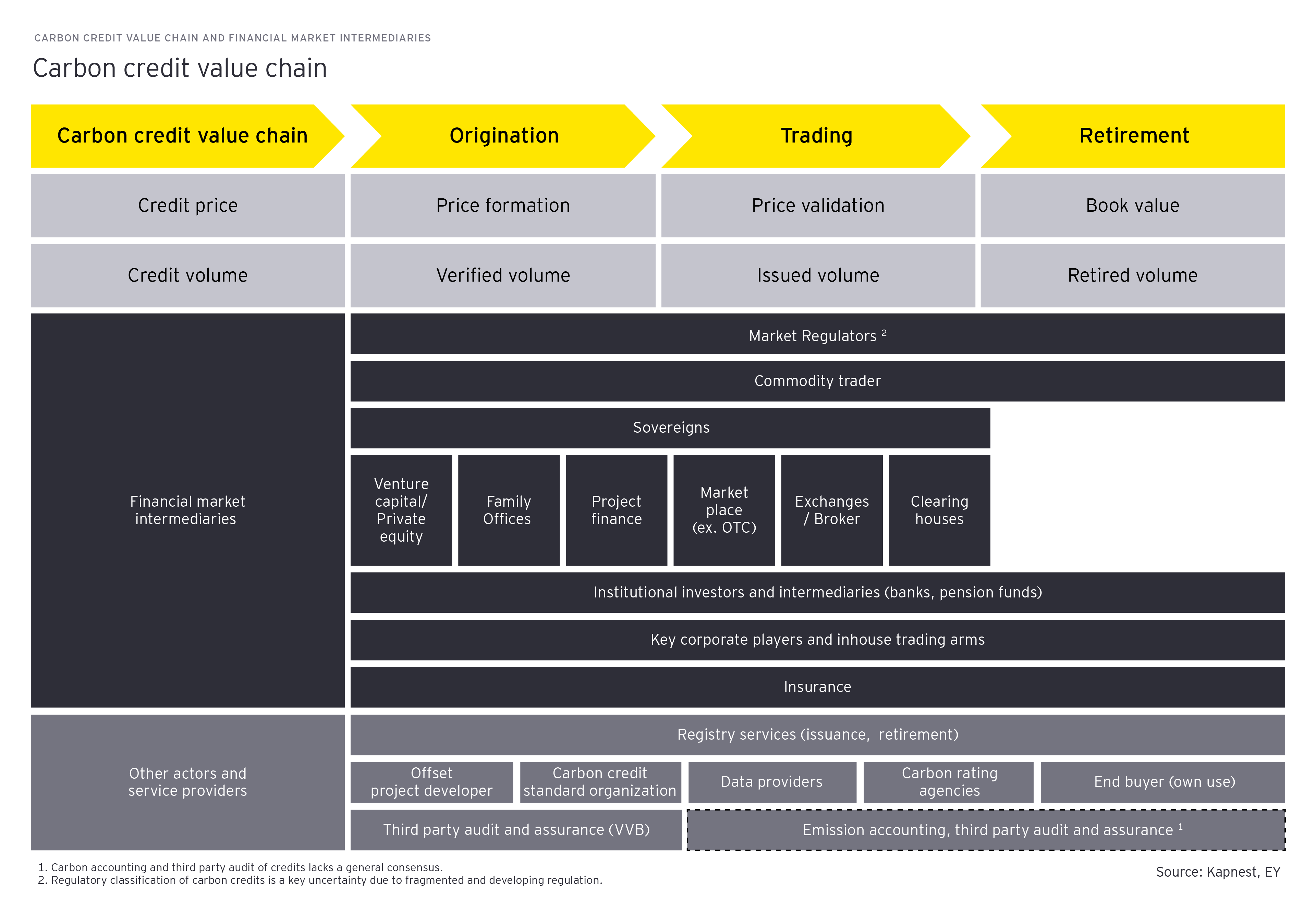
Carbon markets are best understood through the value chain of a carbon credit, which can be divided into three stages: origination, trading and retirement as shown in Figure 1. Each stage has unique market dynamics and is supported by a variety of specialized intermediaries. For financial institutions, understanding these roles is crucial for managing due diligence, risk and cost. Some market participants, like project developers, generate credits directly, while others, such as financial firms, profit from trading, intermediation or the appreciation of carbon assets.


Figure 1

1. Origination

Project developers design and implement activities that generate credits (e.g., reforestation, direct air capture, enhanced rock weathering). To qualify, projects undergo audit by accredited Validation and Verification Bodies (VVBs) against standards such as ISO 14064-3 or ISAE 3000.

If audits succeed, projects apply to registries such as Verra or Gold Standard for issuance. Registries record credits in digital ledgers to prevent double counting. While some registries are piloting or enabling tokenization (blockchain-based credits), many do not yet support this feature.

At this stage, pricing is typically negotiated. It's important to note that the type of trading varies by market segment. Similarly, the distinction between primary and secondary trading is market dependent.

2. Trading

After issuance, credits enter the trading cycle. Here, the market structure begins to resemble established financial markets. The primary market takes place at the point of issuance, when a project developer sells a newly issued credit for the first time. While secondary market trading and price discovery are growing, a significant share of VCM transactions, especially for new or high-quality credits, still occurs in the primary market directly from project developers.

Currently, most trading remains over-the-counter (OTC), but infrastructure for more standardized and liquid trading is emerging. Marketplaces, exchanges and clearing houses are gradually entering the trading space. For example, the Swiss exchange SIX is improving transparency and liquidity. The development of these mechanisms mirrors the maturation of other commodities and financial markets. Over time, a more institutionalized market structure is likely to reduce transaction costs and enable greater participation by traditional financial intermediaries.

A layer of due diligence is provided by carbon rating agencies, which are independent organizations that assess the quality of a carbon credit. Unlike an auditor who verifies the quantity of emissions reduced, a rating agency evaluates a credit's integrity and risks, such as additionality and permanence. Their ratings help buyers and investors navigate market complexities, reduce due diligence costs and drive capital to high-quality, high-impact climate projects.

A key uncertainty, however, is the regulatory classification of carbon credits. Whether and how credits will be formally recognized as financial instruments and therefore fall under securities and market supervision regimes is in development. This question has significant implications for how intermediaries will operate and how capital will flow into the market and is therefore a key consideration for financial institutions.

3. Retirement

The final stage of the value chain is retirement, when a carbon credit is used to offset emissions and is permanently removed from circulation. Retirement is recorded in the registry to ensure environmental integrity and prevent double counting.

A widely accepted standard for the reporting and accounting of carbon credits doesn't exist. Consequently, companies adopt diverse practices. Some businesses capitalize credits as intangible assets, treating them as long-term investments, while others expense them as sustainability costs when they are used. Both FASB and IFRS are developing new guidance, but, as of late 2025, diversity in practice remains. This lack of consensus is highlighted by the guidance from the International Swaps and Derivatives Association (ISDA) which shows the variety of accounting methods currently in use. The fundamental classification of a carbon credit, whether it's considered a financial instrument or a commodity, significantly influences how a firm manages its risk, compliance and investment strategies.

The lack of uniformity is reflected in the recent EY publication Carbon as an asset class (2025). The article gives a primer on accounting for carbon credits noting that entities must distinguish between credits held for trading and those for own use, potentially applying either IAS 2 (Inventory) or IAS 38 (Intangible Assets). This further emphasizes that market volatility, impairment considerations and the absence of consistent guidance require significant judgment and transparent disclosure by entities participating in the VCM.

It is worth mentioning that insurance offerings have already begun to cover risks from origination to retirement, further professionalizing the market and providing confidence to institutional buyers.

The carbon credit market is an evolving and maturing system

While each stage of the carbon credit value chain involves distinct stakeholders and challenges, the market's maturation depends on addressing key hurdles: building trusted infrastructure, establishing robust standards and clarifying the legal and accounting treatment of credits. These steps are crucial for the market to integrate more fully with the broader financial system and become an investable asset class.

For a deeper exploration of these foundational challenges and potential solutions, the EY white paper “Carbon Markets: Steps to Create a Recognisable Market and Asset Class” offers valuable insights. It outlines practical steps to strengthen market infrastructure, improve transparency and standardization, and align carbon credits with financial market expectations, key themes that support the market’s evolution into a credible and investable asset class.

Lessons from commodity price formation for carbon credits

The VCM is still in its formative stage and remains fragmented. However, it is gradually maturing as it develops stronger integrity, transparent and standardized contracts and trusted infrastructure. In the following section, we discuss lessons learned from established and younger commodities and discuss what common characteristics could be applied to carbon markets.


  • Carbon vs. crude oil: Oil is a highly liquid and mature market with continuous price discovery. It benefits from transparent reporting, deep financial derivatives and the ability to hedge both price and delivery risk.

    Key lesson: For the VCM to be credible, it requires trusted and frequent price and volume data, a visible track record and hedging instruments. The compliance market and the EU Emissions Trading System (EU ETS) already show how institutional-grade intermediaries like exchanges and investment banks can provide the reliable data and trading products essential for building market confidence.

Summary of implications for carbon credits

  • Build transparency: Like oil, carbon markets need clear, frequent price and volume data, establishing a track record to guide trust and liquidity.
  • Create benchmarks and robust infrastructure: Natural gas shows the value of regional hubs and strong trading platforms; carbon markets would benefit from replicating the same.
  • Strengthen integrity: Lithium and cobalt remind us that standards and verification are vital to managing risks and building credibility.
  • Standardize and scale: Gold shows that standardization attracts investors; carbon credits would benefit from standardization and scale.
  • Enable financial tools: Derivatives and hedging, common across commodities, can help carbon markets grow, improve clarity in the price discovery journey and attract institutional players.

The dual nature of carbon credits: financial instrument or commodity?

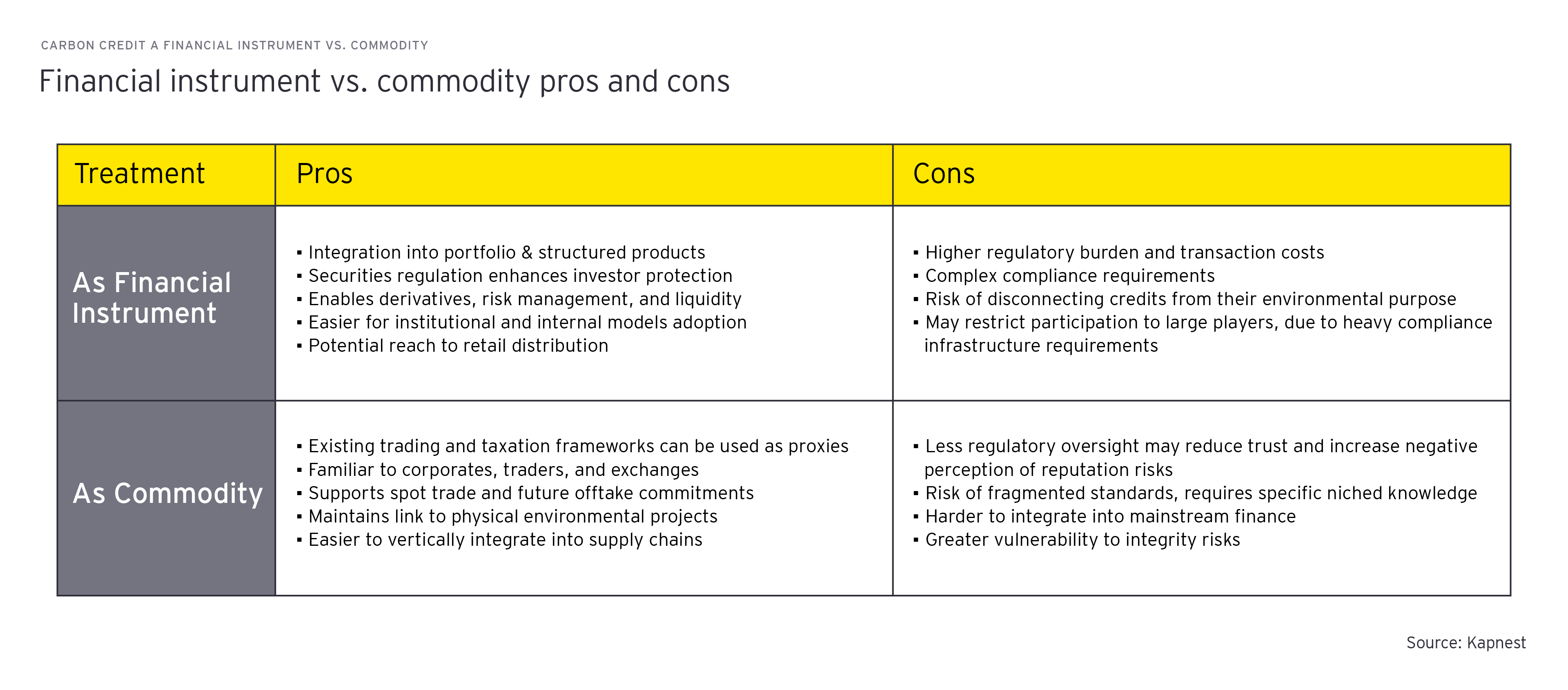
For Swiss financial institutions, a critical first step is understanding how carbon credits are classified. The question of whether they are a financial instrument or a commodity fundamentally shapes how they are integrated into a firm’s risk, compliance and investment frameworks. Figure 2 illustrates the implications of the two classifications.

Figure 2

Compliance markets (EU ETS) lean toward financial instruments, while VCM credits are often treated as commodities. Ongoing work by UNIDROIT and ISDA is crucial for clarifying the legal status of carbon credits and enabling cross-border recognition. For now, every financial institution must adapt its own approach to classifying credits based on available data, risk metrics, supply chain linkages and internal models. No standardized approach exists, and the debate itself is shaping how carbon markets continue to evolve.

The role of Swiss financial institutions in a net-zero transition

Switzerland has established itself as a front-runner in Paris Agreement Article 6.2 transactions, starting with its 2020 bilateral agreement with Peru and expanding to 15 agreements by mid-2025. These government-to-government arrangements allow Switzerland to count international mitigation outcomes toward its national climate targets. The 2025 agreement with Norway marked a milestone as the first Article 6.2 transaction involving durable carbon dioxide removal (CDR). Importantly, VCMs should be distinguished from compliance markets and Article 6 markets. Whilst Article 6 markets are primarily structured for government-to-government transfers, they are increasingly enabling private sector participation, both directly and indirectly, as frameworks mature.

While these initiatives are driven by the Swiss government, their impact on financial institutions is indirect: they set the framework for carbon markets to mature and for private actors to operate with greater confidence. Domestic policy, including integration of carbon removal into Switzerland’s national net-zero strategy and disclosure requirements aligned with international standards (e.g., ISSB), creates structured demand for credible carbon credits. This, in turn, influences how Swiss financial institutions engage with the VCM.

The long-term relevance of VCMs depends on robust infrastructure, standards and legal clarity. Until then, each institution must create its own strategy in line with policy signals and risk frameworks.

Practical steps for Swiss FIs to engage in carbon credit initiatives

  • Secure board-level commitment & ESG alignment.
  • Define a selection of investable carbon credit types, quality standards and risk appetite.
  • Build cross-functional carbon teams & train staff on a continuous basis.
  • Conduct rigorous due diligence: integrity, legal, financial, reputational risks.
  • Integrate accounting & reporting systems (IAS 2/38, ISSB/CSRD).
  • Leverage registries, exchanges and clearing houses for trading.
  • Engage regulators, shape standards and explore innovative carbon-linked products. Share best practices.

By doing so, Swiss finance can take a step in financing the net-zero transition.


Summary

Carbon markets are gaining strategic relevance for financial institutions navigating climate-related obligations and investment opportunities. As the market evolves, institutions must address structural gaps, assess risks, and define their role in shaping credible climate finance. Drawing on lessons from commodities and Switzerland’s leadership in international frameworks, firms can build informed strategies that align with sustainability goals. A proactive approach grounded in transparency, governance, and cross-sector collaboration will be key to unlocking the full potential of carbon credits as part of the transition to a low-carbon economy.

Acknowledgement

Adelina Toader, founder of Kapnest, provided expert insights on carbon market infrastructure, regulatory trends, Swiss market practices, and parallels with global commodities markets. Her input shaped the analysis and its practical implications for financial institutions. Connect: LinkedIn

FAQs


Explore how EY can help you with Sustainability

Sustainability is everybody’s business. Explore EY insights to see how your business can reframe sustainability to protect and create new sources of value.

Green leaves pattern natural background

About this article

Request for proposal (RFP) - exclusively for Switzerland

|

Submit your request now!