



EY refers to the global organization, and may refer to one or more, of the member firms of Ernst & Young Limited, each of which is a separate legal entity. Ernst & Young Limited is a Swiss company with registered seats in Switzerland providing services to clients in Switzerland.
Recent Searches

Disconnected data slows decisions. Integrated EPM connects planning and execution to give leaders a clear view and confidence to act.
In brief
- Fragmented data across finance, tax and operations slows decisions; integrated EPM creates one aligned view of performance.
- A life sciences use case shows how unified data turns manual inventory risk processes into scalable, real-time decision capabilities with measurable returns.
- Success starts with connecting data and breaking silos, enabling faster decisions, stronger compliance and future AI-driven insights.
Business leaders are expected to make fast, confident decisions, often without a complete or connected view of the business. When finance, tax and operations work from separate data sets and planning processes, no single function has a full view of all aspects of enterprise performance. Insights come late, reports don’t fully align and opportunities are missed.
The issue is less about access to data and more about alignment. In most organizations, planning, actuals and compliance still sit in different systems, driven by different assumptions. That disconnect slows decisions and limits the ability to respond when conditions change.
An integrated approach to enterprise performance management (EPM) addresses the core issue at its source. By connecting planning, execution and reporting on a shared data foundation, it gives leaders a clear, consistent and holistic view of performance and the confidence to act.
Integrated EPM doesn’t merely improve reporting – it helps leaders move from fragmented signals to enterprise-wide clarity, from delayed reactions to proactive steering and from isolated decisions to coordinated action. The value is not only greater efficiency, stronger compliance or measurable financial returns, but a more resilient and agile organization that can create value with confidence, adapt faster to change and build the foundation for the next generation of AI-enabled decision-making.
The core problem: too many versions of the truth
Most organizations have not designed their performance management processes for today’s complexity. Over time, systems have been added, functions have specialized and data volumes have grown rapidly.
The symptoms manifest in how work actually gets done. Finance teams build forecasts that aren’t fully connected to operations. Tax works on separate data sets and timelines, often in parallel rather than in sync. Controllers spend too much time reconciling numbers instead of analyzing them. Meanwhile, IT manages a patchwork of fragmented data pipelines just to keep everything running. Even when each function performs well on its own, the organization struggles to align as a whole.
The result is not simply inefficiency. It is an organization that reacts later than it should, commits leadership attention to reconciling competing views instead of shaping the future, and struggles to translate data into timely action. In a market where speed, resilience and intelligent decision-making increasingly define performance, this lack of alignment becomes a strategic constraint on value creation.
Functional alignment
79%
79%
of leaders prioritize functional alignment
Data and AI
86%
86%
of leaders emphasize data and AI as critical capabilities
Unsurprisingly, 79% of leaders now prioritize functional alignment and 86% emphasize data and AI as critical capabilities.1
Why traditional EPM no longer holds up
Traditional EPM systems were built to support financial planning and consolidation. They were not designed to integrate tax, operations, sustainability or real-time data. Instead, they focus on budgeting, forecasting and consolidation within structured environments, a model that breaks down under today’s conditions of rapid regulatory change, increased tax transparency and growing ESG reporting requirements.
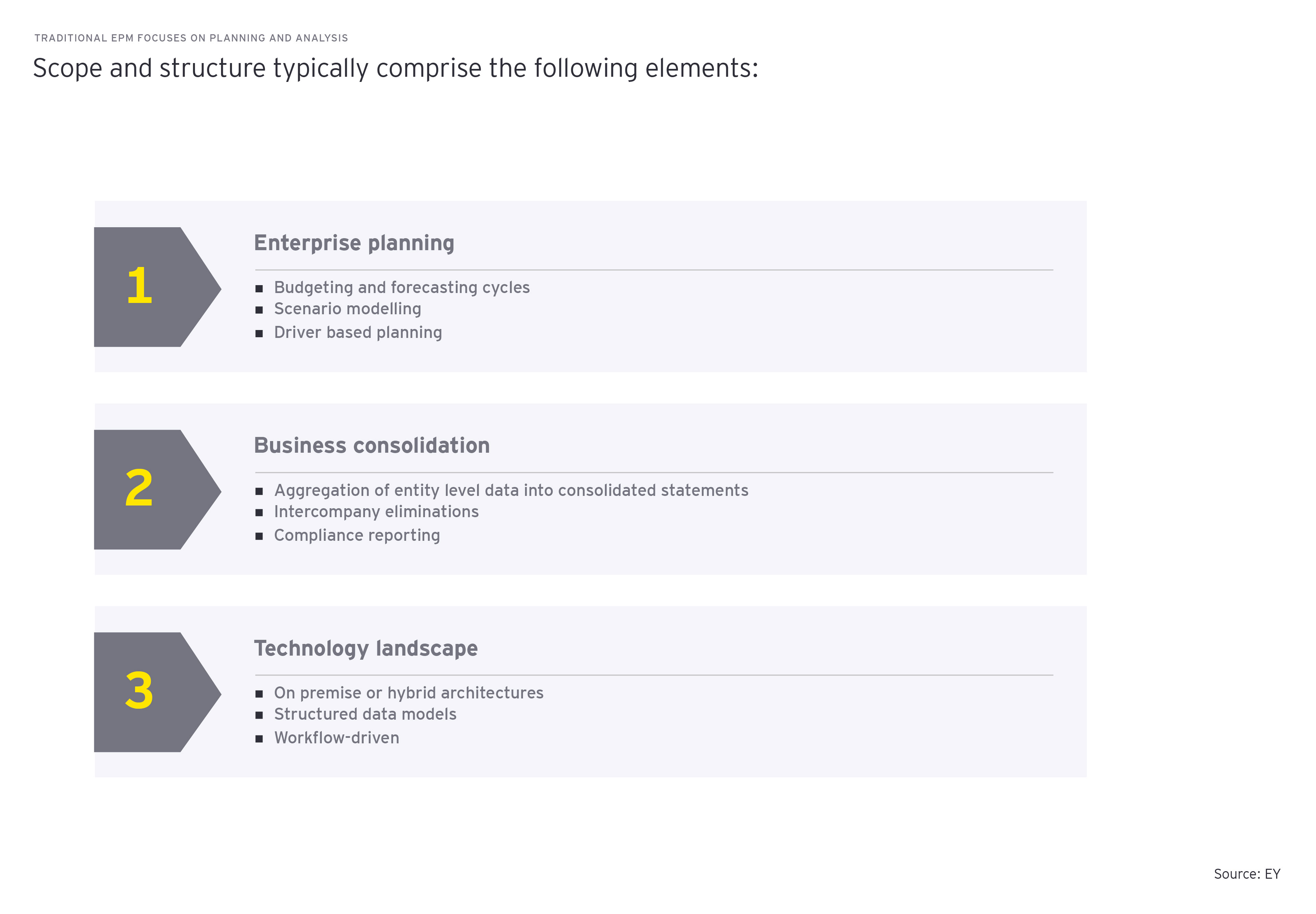
As a result, the scope of traditional EPM is too narrow. Finance sits at the center, while tax, sustainability and management reporting run on separate dashboards. Planning and actuals are stored in different systems, making reconciliation time-consuming and error-prone. Teams across IT, tax and accounting lack a shared platform, limiting collaboration and alignment.
At the same time, expectations have changed. Organizations now need real-time insight from large, complex data sets across global operations, not least to feed advanced analytics and AI-driven solutions. Traditional EPM cannot keep up, leaving businesses to manage performance through disconnected layers instead of a single, unified view.
Consequently, organizations are faced with not just operational friction, but a leadership challenge. When performance data is fragmented across functions and systems, organizations cannot steer with the speed, confidence or precision that today’s environment demands. Capacity is absorbed by reconciliation instead of transformation, opportunities are identified too late, and the business remains constrained by a model designed for control rather than enterprise value creation.
What integrated EPM actually changes
Integrated EPM is not about adding more tools. It is about connecting what already exists in a single model as illustrated below.
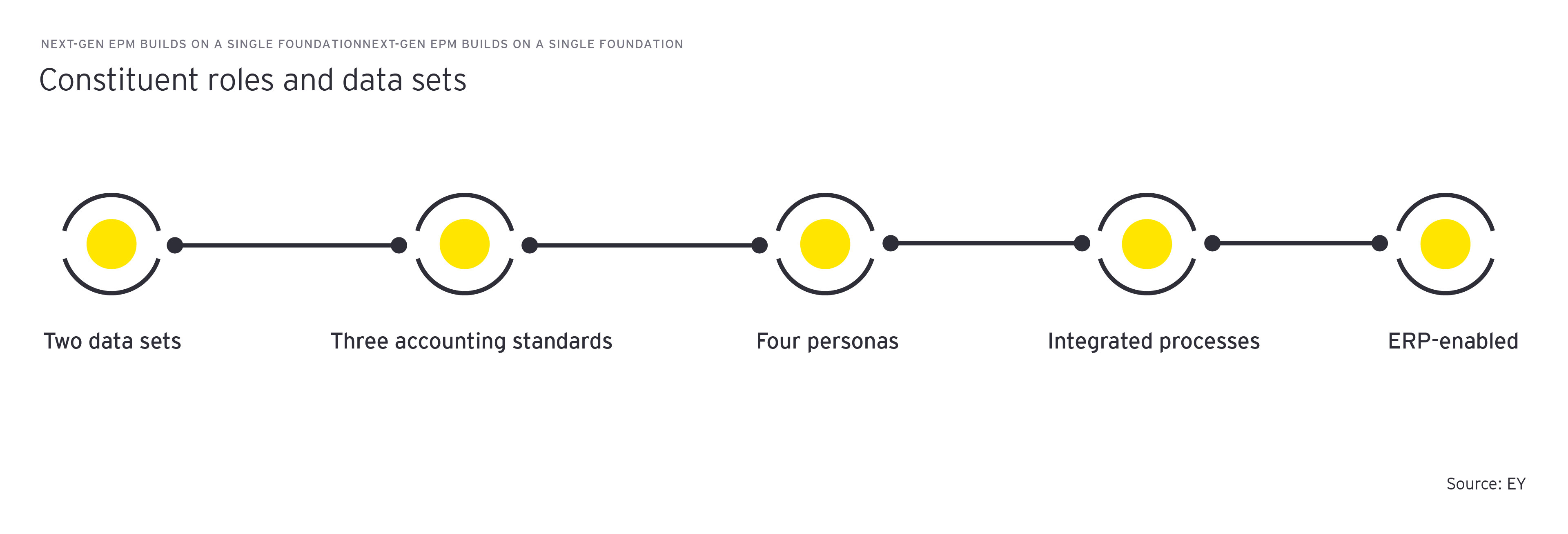
At its core, the model brings together multiple roles and data sets anchored in a common foundation:
- Two data sets – planning and actuals in one model
- Three accounting standards – IFRS, local statutory accounting and tax accounting
- Four functions (or personas) – with cross-functional workflows across IT, tax, accounting and controlling
- A process layer – comprising financial, tax and statutory perspectives, while supporting planning, consolidation, tax and management reporting
- A technology layer – complementing the process layer as a foundation for a future-ready EPM strategy
Backed by a reliable, highly capable foundation, performance management shifts from reporting on the past to actively steering the business in real time.
A real-world example: turning inventory risk into actionable insight
In our experience, the shift outlined in the previous section quickly delivers tangible results. A good example is Novartis, which faced a common but critical challenge: managing slow-moving and non-moving inventory across a complex, highly regulated supply chain.
Because of production constraints and the need to ensure uninterrupted patient supply, the Swiss pharmaceutical company’s inventory levels had to remain high. Yet the processes behind inventory provisioning were manual, fragmented and reactive. There was no reliable way to identify risks early or forecast potential write-offs.
As a result, the company struggled with time-consuming, error-prone calculations and limited visibility into inventory risk. In addition, the company faced challenges ensuring accurate financial statements and lacked consistent audit trails.
This is exactly the kind of disconnect integrated EPM is designed to address. The company implemented a unified solution that combined operational inventory data with financial and accounting logic. Built on a centralized data foundation and advanced calculation models, the system enabled the business to:
- Identify slow-moving inventory and products approaching expiration earlier and reduce the destruction of goods;
- Apply consistent provisioning logic across all entities and increase automation, allowing teams to concentrate on strategic priorities;
- Access real-time data through a shared interface and enhance compliance through comprehensive monthly analyses;
- Create a transparent and auditable process, including secure archiving of simulated scenarios for future audits.
Rapidly deployed across over 100 countries, the solution was capable of analyzing 150,000 stockkeeping units per month. The impact was immediate and measurable. Compliance improved, processes were standardized across countries, increasing transparency and consistency, and manual effort dropped significantly, leading to faster execution cycles. More importantly, the organization shifted from reacting to inventory risk to managing it proactively.
Potential inventory write-offs
US$ 300m
US$ 300m
Novartis implemented a solution to better manage hundreds of millions in write off avoidance across inventory worth US$ 5.2bn
This is what integrated EPM looks like in practice. Novartis’ solution now supports the management of US$ 5.2 billion in inventory while addressing well over US$ 300 million in potential annual write-offs. It also connects operational signals with financial outcomes and turns them into better decisions.
Moreover, backed by the unified data foundation, Novartis gained a key capability that unlocks future AI use cases. The result is a scalable approach that raises the bar for the industry.
A unified data foundation proved key to unlocking future AI use cases, raising the bar for the industry.
Sveinung Baumann-Larsen
EY Global Tax SAP Leader; EY EMEIA Tax Alliances and Ecosystems Leader
How Novartis turned inventory risk into actionable insight
See how Novartis improved transparency, compliance and operational performance at scale.
Technology enables scale – and integration makes it valuable
Modern platforms make integrated EPM possible at scale by bringing together planning and actuals on a unified data layer, supporting advanced analytics and predictive capabilities as well as providing role-based access across functions. They also enable seamless integration with ERP and external systems, creating the technical foundation needed to manage performance across the enterprise.
In the inventory example, technologies such as SAP Profitability and Performance Management made it possible to run complex calculations at scale while maintaining transparency and control. But technology alone did not solve the problem – it supported the solution. Alignment came from how data and processes were brought together.
This is also what makes AI effective. There is a direct link between integrated EPM and the ability to use AI in a meaningful way. In the inventory use case, the unified data foundation now supports future AI scenarios such as classification and trend analysis or predictive insights to enable further optimization of supply chain processes.
Without integration, AI relies on fragmented and inconsistent data, limiting its value. With integration, it can detect risks earlier, improve forecasting accuracy, automate complex processes and support better decisions.
As a result, technology moves beyond enablement and becomes a true source of enterprise value. With an integrated foundation, organizations can scale insight, apply AI with greater trust and relevance, and turn complexity into faster, more confident action. What emerges is not simply a more capable platform, but a stronger decision engine for resilience, performance and future growth.
Without integration, AI relies on fragmented and inconsistent data, limiting its value.
Urs Kennerknecht
Partner, Business Consulting Finance | EY Switzerland
Moving from insight to action
More than a system upgrade, the shift to integrated EPM is a fundamental change in how the organization operates. It means treating tax as a strategic function by aligning data early, breaking down silos across finance, operations and IT, and focusing on outcomes such as faster decisions and better accuracy. It also means building systems that can adapt as business and regulatory demands evolve.
The inventory example shows what this looks like in practice. A fragmented, manual process becomes a scalable, data-driven capability that improves both control and performance.
Most organizations already have the building blocks they need. The data exists. The systems exist. The expertise is there. What is missing is connection.
The way forward is to start where the impact is visible. Focus on one area where fragmentation slows decisions, whether that is inventory risk, tax provisioning or the financial close, and fix the data foundation behind it. This creates a blueprint for how the rest of the organization can operate.
Companies that move now will not just improve performance management. They will build the ability to act faster, with better information, every time a decision matters.
Summary
Organizations struggle to make fast, confident decisions when finance, tax and operations work from disconnected data, processes and assumptions. Integrated EPM addresses this challenge by creating a unified foundation that connects planning, execution and reporting across the enterprise. A life sciences inventory use case shows how integration can transform fragmented, manual activities into scalable, data-driven capabilities that reduce risk, improve transparency and deliver measurable returns. As a result, organizations can build a more agile, insight-led and AI-ready enterprise – one that responds faster to change, acts with greater confidence and creates more sustainable value over time.