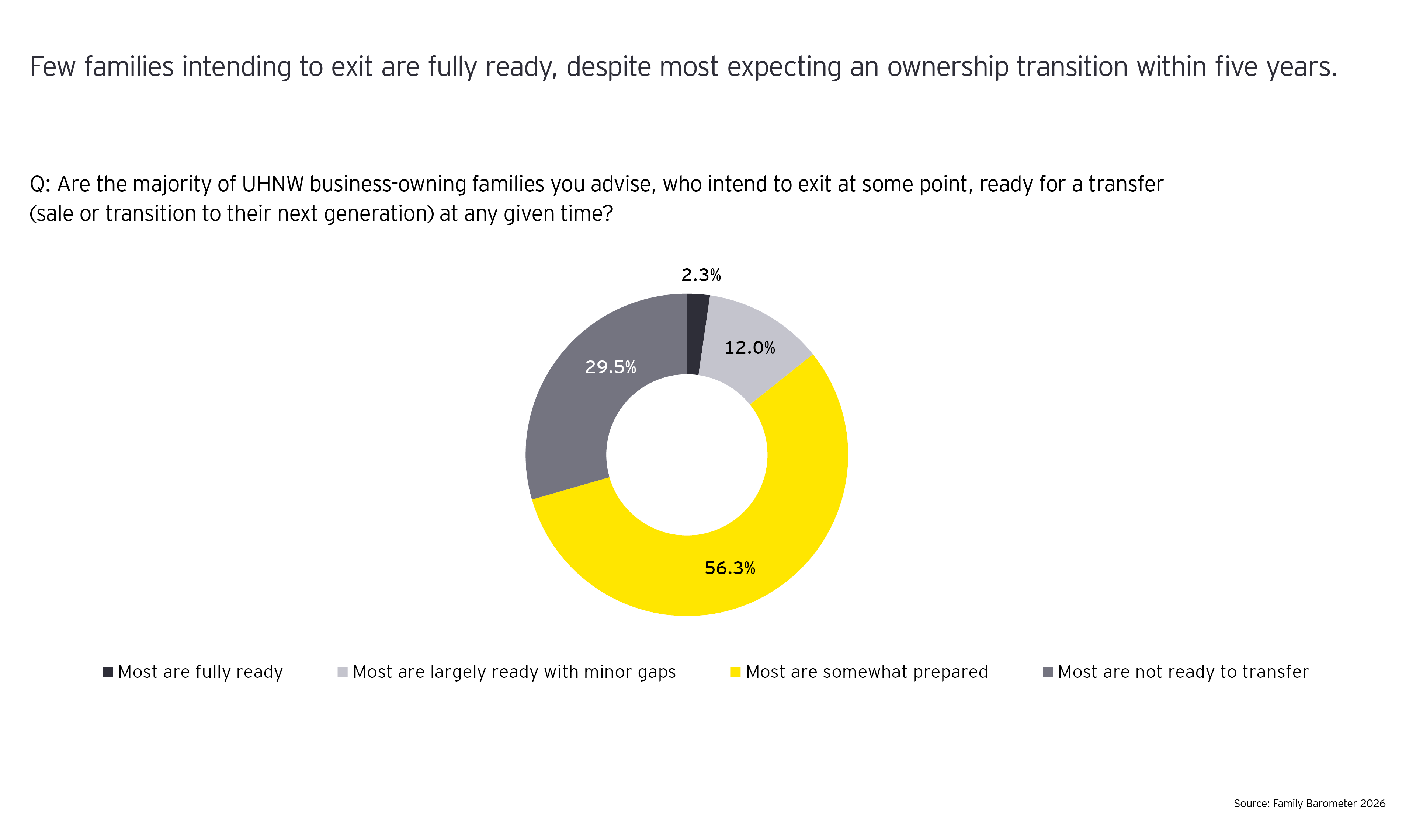
For a wealth manager, the implication is clear. The conversation cannot begin with the portfolio that will exist after the sale. It needs to begin with the family that will own it. What does each family member want from the exit? Is the business an asset, a legacy, an identity or all three? What constitutes a fair outcome across generations and family branches? Who has a voice, who has a vote and who ultimately decides? What would family members do after the company is sold? What should remain collectively owned? And what kind of purpose should replace the business?
These are not questions to be left until the transaction is underway. Unresolved differences can influence timing, negotiations and valuation precisely when the family needs to present a united position.
The wealth manager as alignment and orchestration partner
Once the family has begun to articulate what it wants from an exit, the transaction itself needs to be considered in that wider context.
A full sale, a partial sale, a succession transaction or a structure that leaves the family with continuing exposure to the business can produce very different starting points for the next phase of wealth ownership. The question is therefore not simply which structure maximizes value at closing. It is which transaction gives the family the right combination of liquidity, control, continuing exposure and flexibility for what comes next.
This is where wealth managers can play a role much earlier than they traditionally have.
Insights from the Family Barometer (“Selling at the right time” analysis) indicate that families should explore different ownership scenarios and establish what would justify a sale before an offer arrives. They also reveal that timing becomes easier to judge when the family is clear about what it wants to achieve once the proceeds have been received.
The wealth manager does not need to become the family’s M&A adviser. Nor does the client relationship manager need to become a family therapist. The opportunity is to provide a disciplined process and bring together the right specialists so that commercial, tax, legal, governance and wealth considerations inform one coherent decision.
That makes wealth managers an alignment and orchestration partner. They can help the family articulate individual and collective objectives, make tensions visible before they become transaction-critical, agree decision criteria in advance and involve the next generation appropriately. They can help compare continuation, partial-sale, full-sale and succession scenarios and connect the potential transaction with the family’s longer-term wealth architecture as well as involve external experts as needed for the chosen target state.
A business exit changes the investment priorities
When the transaction completes, the family’s most familiar asset can disappear almost overnight. For decades, capital may have been concentrated in an operating company that the family understood intimately and could influence directly. After the sale, a large proportion of that wealth may be sitting in cash or liquid financial assets. The family has exchanged concentration for diversification, but it has also exchanged control and familiarity for complexity.
The entrepreneur who has spent a lifetime building and managing a business, suddenly becomes responsible for managing capital across a much wider range of investment decisions. The resulting asset allocation and risk management problem is therefore more profound than simply constructing a diversified portfolio.
The first question is not “What should we invest in?”. It is “What is this wealth meant to achieve?”. The answers may include preserving family wealth, replacing the income previously generated by the business, funding future generations, maintaining financial independence or retaining capital for future entrepreneurial activity. Notably, the Family Barometer identifies capital preservation and long-term capital growth as the two leading post-exit investment priorities, followed by replacing income generated by the operating business.
Only once the objectives are clear does strategic asset allocation become meaningful. For some families, a useful answer may therefore be to separate pools of capital: a professionally managed core designed to preserve and grow family wealth alongside a defined pool that allows the founder or subsequent generations to continue investing entrepreneurially.
Governance needs to be adapted early and with foresight
The transition from operating business to financial wealth does not necessarily require a radical redesign of how a family governs itself. In many cases, the foundations are already there. The more important task is to anticipate how those arrangements will need to evolve once the operating company is no longer at the center of family decision-making and to put the necessary adjustments in place before the transaction.
This is another reason why business readiness and family readiness need to be considered separately (see the readiness gap above). A family may have well-established governance around the operating company, but the questions it will face as a diversified wealth owner will be different. Decision rights may need to be clarified, the role of different family branches may need to evolve and the next generation may need to become more involved. The family may also need to agree in advance what should remain collectively owned and which decisions can be delegated.
The objective is not to replace a functioning governance system with an entirely new one. It is to make sure that the system is capable of supporting the family through the transition and into its next phase of ownership. This is particularly important because the operating company often provides a natural framework for family decision-making. Boards, shareholder meetings, reporting processes and clearly defined roles create regular opportunities for family members to engage with one another and make decisions. As the business changes ownership, those mechanisms may change too. The family therefore needs to decide beforehand which functions should be retained, adapted or transferred into new structures.
The Family Barometer’s findings support this emphasis on preparation. Families that establish governance structures and engage in regular decision-making before a transaction are better positioned to make difficult choices when the time comes. As the study notes, governance works when it becomes part of the family’s ongoing decision-making rather than remaining an architecture that sits unused until a crisis occurs.
For wealth managers, this creates an important opportunity before the liquidity event. Rather than presenting governance as something that needs to be built once the business has been sold, they can help families test the extent to which their existing arrangements will remain fit for purpose. That may mean agreeing decision rights, involving the next generation, establishing an investment committee or adapting existing family governance arrangements to accommodate a more diversified pool of assets.
A pivotal role for wealth managers: Support families beyond the investment mandate
For wealth managers seeking to build lasting relationships with entrepreneurial families, the critical moment is much earlier than the liquidity event itself. When a family first raises the possibility of a sale, the most valuable question is not simply how much the business might be worth or how the proceeds could be invested. It is what the family wants its life, its relationships and its wealth to look like when the business is no longer at the center.
Answering that question requires more than investment expertise. It requires the ability to connect the family with the right specialists at the right time – from tax and legal advisers to corporate finance, governance, succession and investment specialists. The wealth manager’s role is not to replace these experts, but to orchestrate their perspectives around a coherent understanding of the family’s objectives.