Closeup of hands of young female pharmacist

Agentic AI Is Transforming Healthcare With Intelligent Collaboration

Agentic AI is redefining healthcare—enabling intelligent systems that collaborate, personalise care, and adapt in real time.


In brief

  • Agentic AI enables intelligent systems that reason, act, and collaborate across clinical, operational, and patient-facing healthcare domains.
  • Success depends on structured, interoperable data and open standards that allow agents to personalise care and support clinicians in real time.
  • Healthcare leaders must build the foundations now to benefit from agentic ecosystems—modular, adaptive, and designed for continuous collaboration.

Healthcare systems worldwide face two major challenges—workforce shortages and increasing patient demand. The World Health Organization projects a global shortfall of 11 million healthcare workers by 20304, with the greatest impact across low and lower-middle-class nations, worsening inequities in access to care.

Traditional approaches can’t keep up. For the last decade, we’ve deployed technology that quietly turned clinicians into data entry clerks. These solutions are failing to meet modern care demands and are actively contributing to the increasing workforce shortage. As health systems evolve to manage more complex, continuous, and connected care, digital tools must go beyond digitising old processes and enable clinicians to deliver higher quality care with less effort.

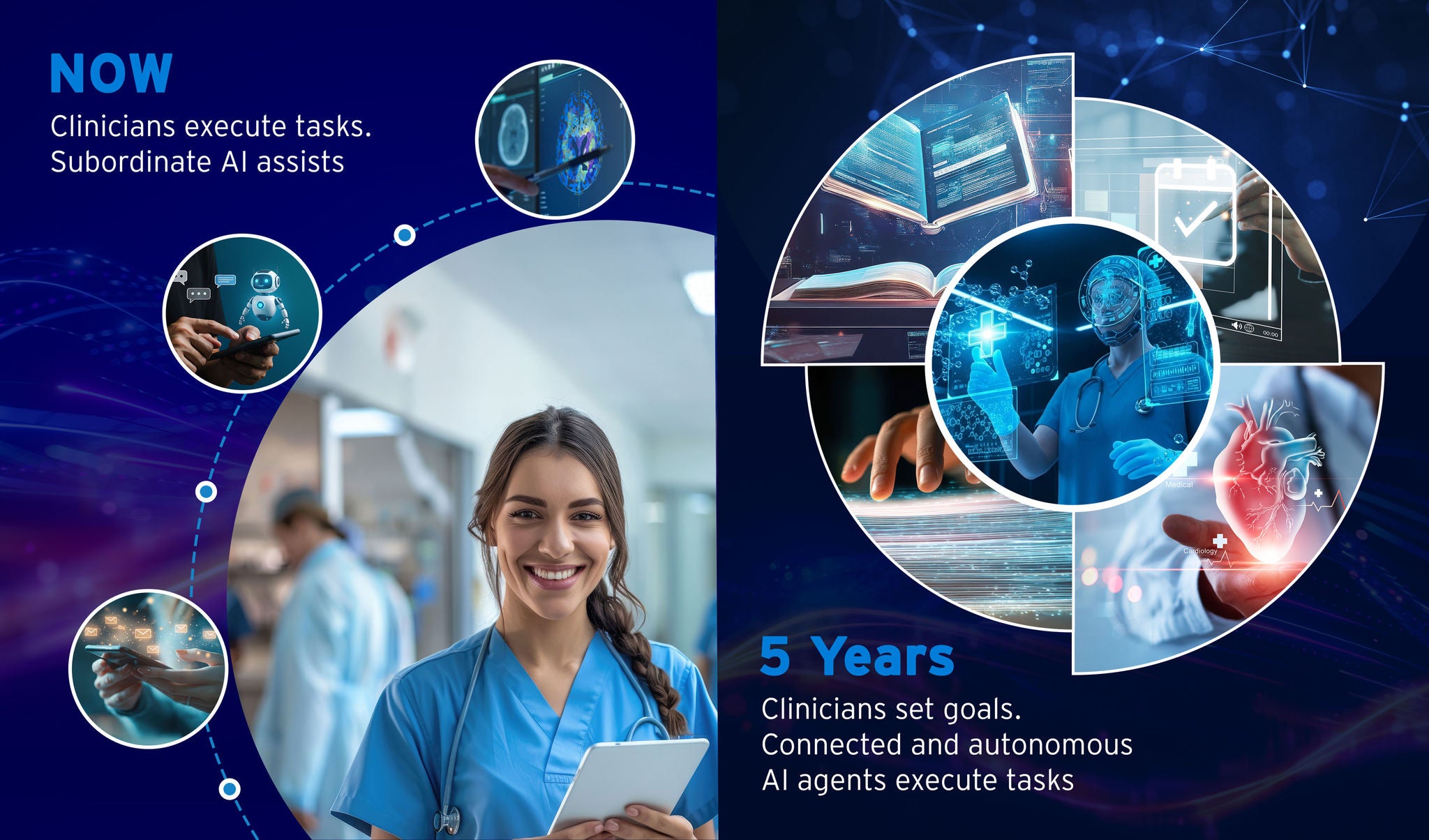
In five years’ time, if AI delivers on its promise, we’ll walk into hospitals that look and feel different — fewer keyboards, fewer screens, and systems that work quietly in the background so the clinical workforce can focus on patients again.

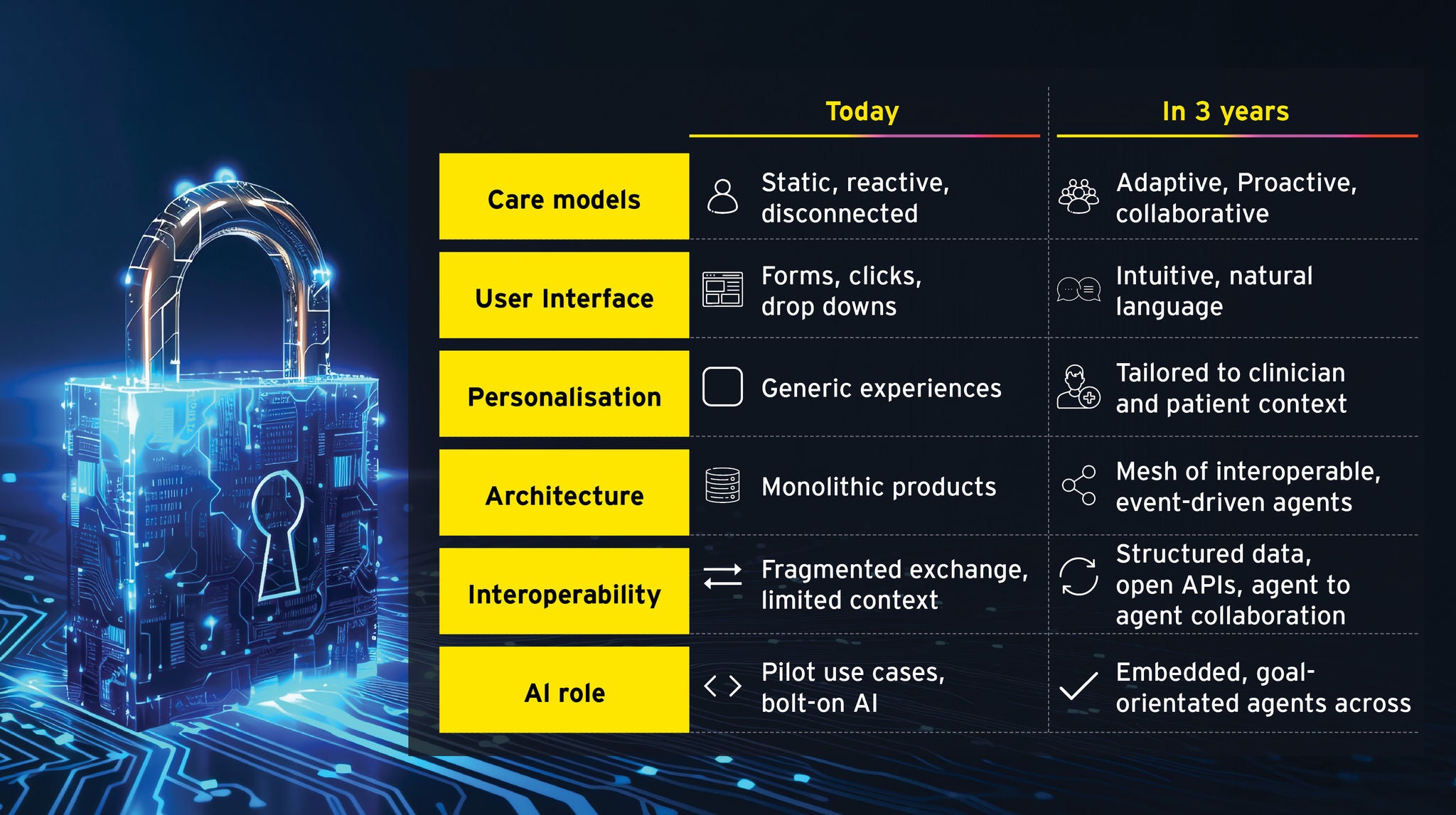
For this to happen, a paradigm shift is required — from the passive technology of today that is  built to store, report and route, to the pro-active systems of the future that can reason, act, and collaborate autonomously.

infographic 3

From passive systems to pro-active agents

Generative and agentic AI marks a new phase in artificial intelligence. Agentic AI operates with autonomy and initiative, supporting tasks proactively rather than waiting for instructions.


In healthcare Agentic AI is already showing potential:

  • Triage assistants: analyse symptoms and guide patients before a clinician is even involved.5
  • AI scribes: summarise complex patient histories and reduce clinician documentation time.6
  • Operational agents: dynamically adjust staffing or theatre schedules based on real-time demand forecasts.7
  • Patient-facing tools like digital health coaches and medication adherence apps use behavioural nudges to improve outcomes.8

These are early signals of what’s possible, but they remain isolated use cases, where the AI is predominately a subordinate assistant to the clinician. To realise their full potential, cohorts of autonomous, connected agents must be integrated into a smart, connected infrastructure that spans clinical systems, operational platforms, and patient pathways.

Why data is the starting point

Intelligent agents are only as good as the data they work with. And in healthcare, that data is often fragmented, inconsistent, and locked in formats that machines can’t easily interpret.

To enable clinical reasoning, automate workflows, or proactively guide patients, we need structured, semantically rich, and longitudinal data. Beyond diagnoses and timestamps, we need computable representations of clinical decisions, and outcomes.

This calls for a stronger data foundation that leads to:

  • Adopting open, standardised data models (like openEHR and FHIR)
  • Ensuring data is captured at the point of care in structured, machine-readable form
  • Embedding clinical context and intent so agents can reason, not just react

Without this foundation, agentic systems will remain brittle and shallow—able to mimic, but not to fully support or collaborate.

Agentic systems across the health landscape

Most digital tools in healthcare record, alert, and report, but don’t shape or support the delivery of care in real time. Agentic systems are different. They can actively collaborate with clinicians, anticipating needs, adapting to context, and coordinating complex journeys across fragmented services.

That’s the potential of agentic systems: intelligent, personalised digital collaborators that operate throughout the health system and across the patient pathway.

If they deliver on this promise, hospitals themselves will look and feel different. Fewer keyboards and fewer screens. More listening, observing, and reasoning in the background. Agents will work together quietly and continuously—monitoring clinical encounters, tracking patient progress, and awaiting new results—so the human workforce can focus on people rather than processes.

Potential includes:

  • Clinical agents: tailor support to individual clinician’s speciality, style, and workflow. A cardiologist sees different alerts than a GP; a junior doctor receives different prompts than a senior consultant.
  • Operational agents: learn from demand, local capacity, and clinician preferences to make context-sensitive decisions in real time. They can collaborate across organisational boundaries to align care plans, coordinate referrals, and reconcile information.
  • Patient-facing agents: personalise advice using clinical history, genetic profile, learning style, and even social circumstances—turning one-size-fits-none interventions into precision-guided support.
  • Population-level agents: draw on real-world evidence, predictive models, and public health data to drive targeted outreach and early interventions.

This level of personalisation sets agentic systems apart from the rules-based automation of the past. They can adjust their behaviour based on who they’re helping, what’s needed, and what’s known.

With this context, interventions become more relevant. Alerts are more meaningful. Care is more continuous. And both clinicians and patients experience a system that seems to understand them, not just process them.


How will this be delivered?

Several analysts1 predict that the most important AI will come from new companies, with traditional product vendors struggling with AI integration.  The reality will be a mixed landscape.

Transformative advances will come from AI-native entrants, unhindered by the constraints of legacy architectures 9.

But traditional players won’t sit still. Established vendors across health IT, diagnostics, scheduling, and clinical systems are already embedding AI into their platforms2,3. Some will evolve successfully. Others will struggle to adapt to a model that’s fundamentally different from software as we know it.

This won’t be a winner-takes-all scenario. What’s likely to emerge is an agentic mesh: a distributed ecosystem of interoperable agents operating across organisations, systems, and contexts. Each agent may perform a specific function—triaging symptoms, scheduling follow-ups, surfacing risks—but together they collaborate to solve complex, dynamic problems.

In this model:

  • The concept of a standalone “app” starts to fade.
  • Orchestration becomes more important than ownership.
  • Success depends less on the size of any single vendor application, and more on the ability of systems to interoperate, reason collectively, and act with context.

The role of healthcare leaders is to prepare their organisations to participate in, and benefit from, this emerging agentic ecosystem, as illustrated below:

Structured health data

Main challenges for agentic healthcare:

  • Agent Interoperability: agents must collaborate, share context and hand off tasks across different systems, this is more complicated than traditional data interoperability, especially in unpredictable environments.
  • Trust, Safety & Reliability: adaptive goal-driven agents require rigorous training, validation and ongoing oversight with secure frameworks for governance and assurance to manage risks.
  • Privacy, Identity & Access: security models must evolve to support autonomous agents with their own secure identities and permissions, moving beyond static, human-centric access controls to adaptive, policy-aware security.
  • Ethics, Bias & Transparency: Agents must act fairly and within boundaries. AI systems can inherit or amplify biases from data, design, or deployment environments. Systems need real-time monitoring, auditability, and human-in-the-loop controls. Transparency, coupled with clear escalation pathways, will be essential to maintain trust.

So, what does this mean for leaders

The agentic era will be shaped by the decisions leaders make today. Technology plays a role, but lasting impact will come from building strong foundations with structured high-quality data, open standards, modular architecture, responsible AI governance, and a workforce ready to engage with digital collaborators.

Beyond digital transformation, this marks a change in how care is designed, delivered, and experienced. The question for health leaders now is not if this will happen, but how soon they’ll be ready.

If this vision resonates with you—if you’re starting to think about how intelligent agents could support your clinicians, engage your patients, or streamline your operations—we’d welcome a conversation.

Whether it’s a strategic workshop, an early stage use case, or a readiness assessment, we’re already working with clients to explore what agentic systems could mean in practice.

We’d be happy to help you take the next step—wherever you are on the journey.

Summary

Agentic AI is emerging as a transformative force in healthcare, moving beyond passive systems to intelligent agents that collaborate, personalise, and adapt. These systems promise to ease workforce pressures, improve care quality, and enable real-time decision-making. This change is about building a connected ecosystem of agents that work together to deliver smarter, more responsive care.