





































EY refers to the global organization, and may refer to one or more, of the member firms of Ernst & Young Global Limited, each of which is a separate legal entity. Ernst & Young Global Limited, a UK company limited by guarantee, does not provide services to clients.
Recent Searches

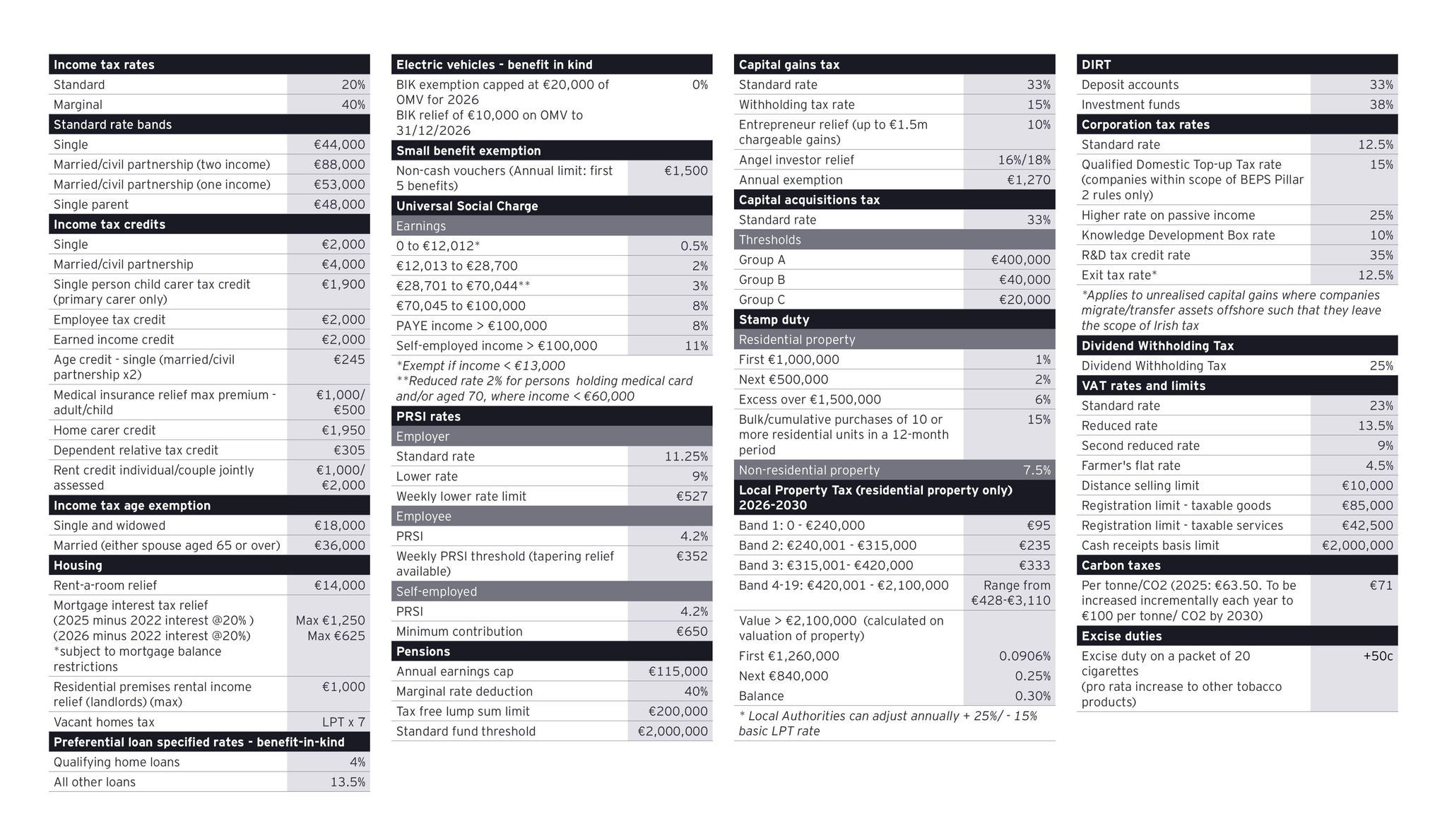
Minister for Finance Paschal Donohoe has announced the details of Budget 2026.
Budget 2026 sets out both the Government’s taxation and spending priorities for the year ahead and strategies to prepare for future challenges.
Find all the real-time insights and analysis here on what Budget 2026 means for Ireland, organisations and individuals. Our experts break down complex fiscal policies into actionable insights.
- Sector-Specific Impact: Understand how Budget 2026 will affect key industries and what it means for your organisation's future.
- Personalised Implications: Discover tailored advice on how the budget's measures could influence your personal and business finances.
To ensure you are equipped with the knowledge to make informed decisions we'll guide you through the implications of Budget 2026 with in-depth analysis from EY Ireland's thought leaders on what Budget 2026 signifies for Ireland's economic landscape.
On 16 October the Government published Finance Bill 2025 (as initiated). The Bill primarily seeks to implement the tax elements of Budget 2026 measures announced on 7 October. The Bill also contains previously unannounced measures.
Direct to your inbox
Get expert Budget 2026 insights as it unfolds.
Beyond Budget: The choices shaping Ireland’s future
Introducing the "Beyond Budget" content series, where we delve into the complexities and opportunities shaping Ireland's economic future. As we approach Budget 2026, we explore critical themes such as innovation, tax policy, and strategic resilience. This series aims to uncover the challenges we face, and the bold choices needed to enhance Ireland's competitiveness. Join us as we navigate the path forward, emphasising that our future is not guaranteed—it's a choice we must actively make.

Related articles
Unlocking capital: Strategies for Ireland's entrepreneurial growth
Unlocking private capital in Ireland's entrepreneurial ecosystem is crucial for growth. Explore strategies to enhance investment opportunities.
Accelerating infrastructure development: Ireland's path to growth
Investing €275 billion in Ireland's infrastructure by 2035, the NDP Review aims to enhance economic prosperity and improve citizens' lives.
Creating an economy where innovation thrives
Explore how Ireland can become Europe's innovation hub through strategic investments and policy reforms. A roadmap for a thriving economy.
Building Ireland’s Resilience: Securing our Future in a Volatile World
Explore Ireland's strategic imperative for resilience in energy, data, and services amid geopolitical shocks and evolving security threats.
Ireland’s R&D Tax Regime: A Make-or-Break Moment for Competitiveness
Explore how Ireland's R&D Tax Regime can drive innovation and competitiveness through strategic reforms and increased support for businesses.
Find all the real-time insights and analysis here on what Budget 2025 means for Ireland. Access our Income Tax Calculator 2025 to compare your salary.
AI to AI: Artificial Intelligence to Accelerate Infrastructure
As Ireland gears up for Budget 2025, the spotlight turns to Artificial Intelligence (AI) as a transformative force in accelerating infrastructure development.
How Budget 2025 Can Reinforce Ireland's Competitive Edge
Discover Ireland's Budget 2025 strategy for economic resilience amid global challenges. Find out how innovation & prudence shape the future.
Why the overdue increase in pension threshold is welcome
Finance Minister Jack Chambers has raised the pension threshold to €2.8M by 2026, aiming to improve talent retention and tax issues. Find out more.
Why we need imaginative action to bolster Ireland’s FDI proposition
Ireland's FDI future hinges on bold moves in cleantech and renewable energy, leveraging incentives and public finances to maintain its competitive edge.
Why Budget 2025 must tackle old and new challenges
Explore how Budget 2025 can shape the economy and environment with new tax strategies. Find out more about sustainable and competitive measures.
Why we can expect the expected on personal taxation
Upcoming budget set to deliver predictable tweaks to personal taxation, with a focus on inheritance tax relief for families and potential support for self-employed individuals through the abolition of an income surcharge.
Budget 2024 – The EY Perspective
Find all the real-time insights and analysis here on what this budget means for Ireland, organisations and individuals.
Budget 2023 – The EY Perspective
Minister for Finance, Paschal Donohoe and Minister for Public Expenditure and Reform, Michael McGrath announced the details of Ireland’s Budget 2023 on 27 September, setting out the Government’s taxation and spending plans.
How Budget 2023 can enhance Ireland’s global attractiveness
Ireland needs to retain its attractiveness as an FDI destination to remain competitive in international markets. Find out how Budget 2023 can help.
How Budget 2023 needs to calibrate Ireland’s taxing and spending measures
Over-reliance on Corporation Tax and a narrow income tax base make decisions on building future resilience that bit more difficult.
Our Tax Leaders