AI coding assistants promise speed, and developers are leaning in. The results often look good, until they don’t. A feature might work fine alone, then collapse in integration. A quick fix plugs one hole while opening security gaps. A service passes initial tests, but compliance asks about error handling and there’s nothing there. This is an unfortunate pattern of speed without structure, and it leaves teams with systems that fail under real-world demands.
Why ‘Vibe Coding’ fails at scale
‘Vibe coding’, treating AI like a code search engine, feels fast, but it’s fragile at scale. Enterprise systems carry regulatory demands and complex architectures, and when code only looks right, the cost of fixing what breaks later can drain budgets fast.
The Blueprint Gap
AI tools excel at pattern recognition and generation, but casual prompts aren’t enough. Without clear specifications, assumptions creep in, and risk multiplies. It’s like building without blueprints: skilled workers, great tools, but no plan for load-bearing points or compliance. Problems stay hidden until production, when the fixes cost far more.
Structured specifications bring order to AI-driven development. They’re dynamic guides that evolve with the build, making every change deliberate and traceable. Updates start in the spec, flow cleanly into code, and surface issues during CI/CD, not after launch. That discipline keeps complexity in check and prevents costly surprises.
Companies are investing heavily in AI-powered development tools such as Copilot, ChatGPT, and Claude. These tools promise 2–3x productivity gains. Demos impress. ROI projections look strong. Velocity jumps. But speed amplifies everything. With clear specifications, AI accelerates robust systems. Without them, technical debt compounds at scale. The lesson here is that the foundation matters.
The Cost of Skipping Specifications
Research from Microsoft and GitHub shows developers using AI assistants complete tasks over 50% faster. Stack Overflow reports 76% of developers are using or planning to use these tools, and IBM data confirms productivity gains of 30–40% in documentation and testing.
Yet studies also show that 60–70% of development time in low-maturity teams goes to rework, fixing problems that shouldn’t exist. Without specifications, AI accelerates this cycle by producing flawed solutions faster. The result is speed without stability, and the gap between disciplined teams and everyone else widens with every sprint.
Teams with specification-driven practices use AI to build from a solid base, turning speed into sustained advantage. Specifications remain the foundation for scale.
The Hidden Costs of Uncontrolled Vibe Coding
AI-powered development produces code at unprecedented speed; hundreds of lines in minutes, entire systems in days. When those outputs rely on undocumented decisions, technical debt grows exponentially. The Consortium for Information & Software Quality estimates this debt costs U.S. organisations $2.08 trillion annually. Without disciplined specifications, AI accelerates that burden to a scale few teams can manage.
Regulatory and Compliance Exposure
In regulated sectors such as finance, healthcare, government, the stakes are high. Compliance demands clear documentation, and “the AI suggested it” won’t stand in an audit. When code is generated without specifications covering security, data handling, and compliance controls, gaps appear that auditors will exploit. Every undocumented architectural choice is a risk. Every assumption about data flow is a liability.
Regulators are raising the bar: the EU AI Act requires documentation of AI-assisted systems, the SEC mandates detailed cybersecurity disclosures, and GDPR obligations continue to expand.
Spec Driven Development: The Control Layer for AI
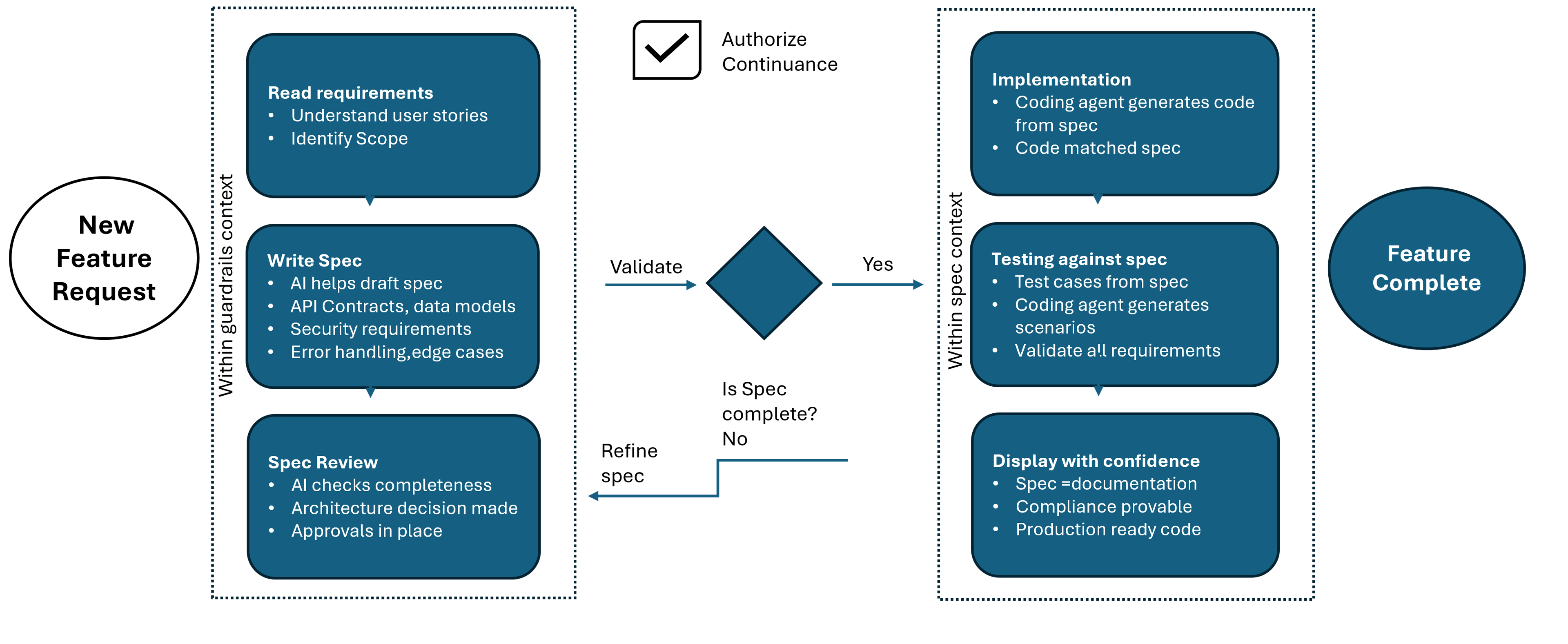
Spec-Driven Development (SDD) applies engineering discipline to AI-driven software by using living specifications as the foundation for speed and control. Unlike traditional documentation, these specifications evolve with the build and integrate directly into development workflows.
What Is Spec Driven Development?
SDD uses detailed, versioned specifications to guide design, coding, and maintenance. In AI contexts, specs provide three essential functions:
- Context for AI tools to generate accurate, compliant code
- Validation criteria for automated checks
- Organisational memory that preserves architectural decisions
The Four Pillars of Spec-Driven Development