




EY Megatrends

What falling frontiers mean for the global rush for resources

Temas relacionados

The Earth’s orbit, the Arctic and the deep sea and earth are becoming domains for new resource extraction, geopolitical competition and risk.

In brief

  • Technology, geopolitics and climate change are breaking down barriers to resources at Earth’s edges.
  • The resources at play are both tangible, such as critical minerals, and intangible, such as orbital slots and new shipping routes.
  • The course of resource development and competition in new frontier domains will have profound economic, sustainability and geopolitical impacts.

This article is part of the second set of insights in the new EY Megatrends series New frontiers: The resources of tomorrow

A frontier separates ambition from opportunity. Falling frontiers at Earth’s edges — once separated by boundaries of altitude, distance or depth – have opened three domains to new resource extraction and to commercial and geopolitical competition:

  • Earth orbit: the space 200km–36,000km above the Earth’s surface, ‘a limited natural resource’ which offers a platform for observation, communications, research and defense activities
  • The Arctic: home to strategic mineral, energy and biological resources but also commercially and strategically valuable sea routes
  • The deep sea and deep earth: sites of vast reserves of critical minerals which have significant supply gaps from existing sources

Governments, companies and resource users are rushing for both tangible and intangible resources with commercial strategic value in these domains. Tangible resources are the ones that might be expected – physical things like metals, petroleum and fish. Intangible resources, in contrast, can’t be touched – like the use of orbital satellite slots and access to shipping routes.

How competition and use in these domains unfold over the next decade will have profound implications for environmental and economic sustainability and geopolitical dynamics. 

Three powerful transformational forces open resourcing frontiers

Technology, geopolitics and climate change are causing resource frontiers to fall, creating demand that pushes against barriers to access while at the same time breaking them down.

First, broad digital transformation in business operations and personal lives — accelerated and deepened by the exponential uptake of technology and artificial intelligence (AI) — is finding physical manifestation in the buildout of data centers, related power infrastructure and with the manufacture of growing volumes of digital consumer devices, all of which drives demand for critical minerals which face supply gaps. At the same time, innovation and cost reductions make frontier regions easier and more cost-effective to access.

Second, as discussed in the EY 2026 Geostrategic Outlook, international relations now operate under new rules and norms characterized by state intervention and the geopolitics of resource scarcity. Governments are more willing to intervene in markets, accelerate access and provide more regulatory certainty as resource supply rises as a national security concern and strategic economic interest. Competition and strained multilateralism also tempt countries to exploit governance gaps and grey areas in frontier regions or ignore them entirely. And as geographic frontiers open, conflicts and competition from other arenas spill into them.

Third, the clean energy transition is another growing source of demand for critical minerals. Wind turbines, solar panels, batteries and electric vehicles all require rare earth minerals, while expanding the transmission networks needed to support the electrification of the global economy and will consume growing volumes of copper and aluminum. At the same time that the need to decarbonize propels the clean energy transition, climate change is opening the Arctic, which is heating four times faster than the rest of the world, to new exploration, extraction and use.

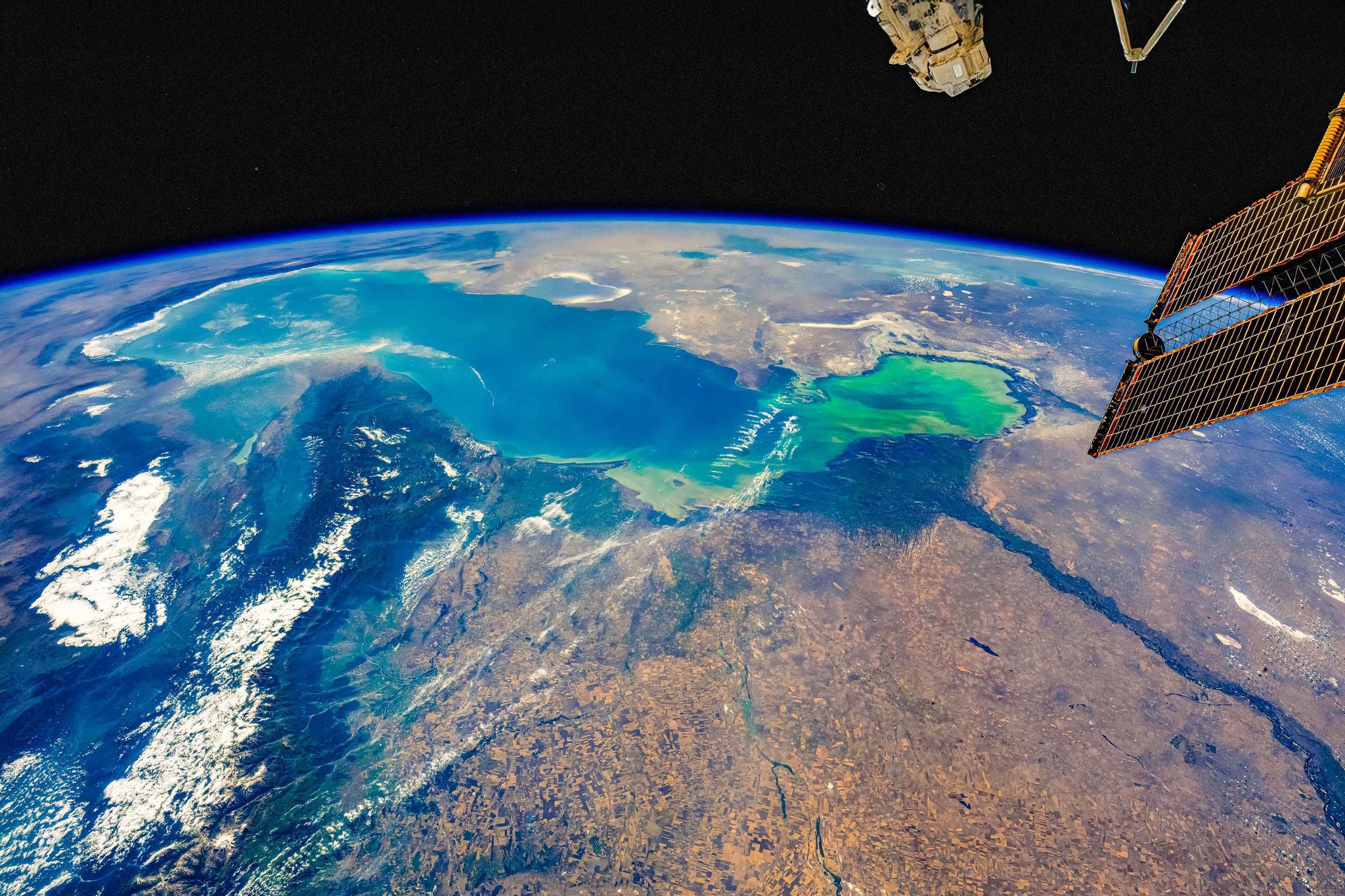
Caspian Sea, Planet Earth. Digital enhancement of an image by NASA. The artist has enhanced sharpness, the white and black point. In addition the artist has added texture, clarity, and dehaze. Colors has been corrected according the artist view of the scene.  Dust spots from the sensor have been removed. 

NASA's Media Usage Guidelines: https://www.nasa.gov/nasa-brand-center/images-and-media/

Original link to the image: https://eol.jsc.nasa.gov/SearchPhotos/photo.pl?mission=ISS073&roll=E&frame=511449
1

Chapter 1

Earth orbit: a limited resource with growing access, value and risk

Orbital resources are quickly becoming easier and cheaper to access, fueling a fast-growing space economy but also a tragedy of commons that threatens the terrestrial economy.

Scene from the future…It’s mid-morning and you’re the CEO of a global retail company. You receive a report that your point-of-sale system isn’t working. Then you’re told that you’ve lost contact with every asset in your just-in-time delivery network. The lights go out. Someone mentions something about a Kessler event.

The infrastructure in Earth orbit is fundamental but invisible

The constitution of the International Telecommunication Union (ITU) defines Earth orbits as “limited natural resources.” The direct space economy is largely based on exploiting these resources and includes verticals such as position, navigation and timing services, Earth observation and remote sensing, launch services, satellite manufacturing and space infrastructure. It is projected to grow from US$613b in 2024 to US$1t in 2032. Two-thirds of the value of the space economy comes from the private sector.1

“There’s a huge VC interest in investing in space,” notes Hemali Vyas, EY wavespace luminary, Chair of the AIAA New Space Economy Committee, and a space industry veteran with more than 35 years’ experience across NASA/JPL, TRW and SiRF Technologies. “Investors are looking for high-risk, high-reward opportunities over a 10-year horizon.” Venture capital investment in space tech funding rose from US$700m in 2016 to US$6.6b in 2024.2

The next phase of orbital investment includes private space stations (e.g., Axiom, Blue Origin’s Orbital Reef), which could open new markets in tourism, research, manufacturing and more.

But the broader value of global economic activity dependent on orbital assets is nearly incalculable and touches every sector. This includes the Global Positioning System (GPS), communications, data transmission, power grids, financial transactions, infrastructure and crop monitoring, weather prediction and modeling and disaster recovery, all of which rely on the continuous operation of satellites.

Yet, out of sight is out of mind. “One of the great successes of space is just how invisible it has become to end users,” says Prof. Alan Duffy, astronomer and Pro Vice Chancellor of Flagship Initiatives at Swinburne University of Technology.

Private access to Earth orbit leaps as financial and technical hurdles fall

Perhaps counterintuitively, Earth orbit (200km-36,000km above the surface) is the easiest frontier resource to access and is being exploited the fastest.

Private sector technical and operational innovations have pushed down the cost of building and launching a satellite dramatically. With greater efficiency, vehicle reusability and smaller, cheaper satellites, the total cost of putting a satellite in orbit dropped 65% in 10 years.3

As a result, the number of active satellites in Earth orbit surged from about 3,300 in 2020 to about 13,000 in 2024.4 Commercial launches make up 90% of payloads; of these, Starlink accounts for nearly 80%.5

These numbers are set to spike further: As many as 70,000 Low Earth Orbit (LEO) satellites are expected to be launched in large constellations over the next five years.6

“Space seemed remote until we got low-cost launch capabilities. Now it is close - and getting ever closer. Earth orbit is now the most valuable real estate on the planet that’s not on the planet,” says Paul Saffo, a leading futurist and an EY wavespace luminary.

With so much junk accumulating up there, a runaway Kessler syndrome could be just another collision away, like the snowflake that causes the avalanche. The stakes just keep getting bigger.

Heading toward a tragedy of the orbital commons

The Outer Space Treaty of 1967 declares space to be the “province of all mankind,” while Article 44 of the ITU Constitution admonishes its member states to bear in mind the limited nature of the Earth orbit resource. In practice, open access to limited orbits is creating a tragedy of the commons, a situation where the pursuit of individual interests impairs or destroys the value of a shared resource.

“We’ve been exploiting orbits — which are categorized as natural resources in outer space — since the Sputnik days, and, as indicated by the huge numbers of debris now threatening future space activities, we’ve not paid sufficient attention to issues of the sustainability of the space environment,” observes Steven Freeland of Western Sydney and Bond Universities, who is also the Chair, Working Group on Legal Aspects of Space Resource Activities, United Nations Committee on the Peaceful Uses of Outer Space. Some 15,000 objects have been put in orbit since the Sputnik era, which has led to an estimated 140 million pieces of orbital debris, only a fraction of which are trackable.

As a result, we face the risk of a Kessler Syndrome event – a fission-like runaway cascade of collisions in space – which only grows as the number of satellites increases exponentially, driven by the placement of tens of thousands of satellites in mega-constellations.

“A runaway cascade of collisions would have devastating economic impacts and could create a debris field making orbits unusable for centuries, potentially limiting our ability to leave the Earth. There have already been a few catastrophic satellite collisions, but so far with limited consequences. With so much junk accumulating up there, a runaway Kessler syndrome could be just another collision away, like the snowflake that causes the avalanche. The stakes just keep getting bigger as we put ever more objects and value in space,” says Duffy.

Other factors contribute to the risk of a Kessler event:

  • Lack of international policy on anti-satellite tests
  • No central “traffic control” in orbit: Operators must negotiate collision avoidance among themselves.
  • Lack of effective debris removal: Technology like lasers, harpoons and nets to deorbit debris are being explored, but remain largely unproven, with policy and incentives lagging.

1. Weaknesses in the US “five-year rule”7 for deorbiting satellites: Many satellites cannot be controlled at end-of-life and atmospheric re-entry can have significant environmental impacts.

  • Climate change: By trapping heat, greenhouse gases cause the upper atmosphere to cool and contract. This reduces the drag on old satellites and debris, slowing the rate at which they fall and burn up.8

Space debris causes problems even short of a Kessler event. Astronauts on China’s recent Shenzhou-20 mission delayed their return to Earth after their spacecraft was struck by a small piece of debris.

The crowding of Earth orbit has other sustainability impacts. The ITU also defines radio frequencies as a limited natural resource, one that we are running out of as they are assigned to the growing constellation of satellites along with terrestrial uses. Without an available radio frequency, a satellite cannot communicate.

“The sustainability of frequency spectrum is fundamental because we use it for everything from communications to navigation and climate monitoring. We must leverage this resource without impairing the next generation of people or countries who wish to access space,” says Roser Almenar, member of the ITU Secretary-General’s Youth Advisory Board.

Vast satellite constellations also impose scientific and cultural costs:

  • Light pollution: Satellite reflections interfere with taxpayer-funded ground-based astronomy by creating visible streaks in imaging.
  • Radio interference: Satellite communications increasingly overwhelm reception of faint signals by radio telescopes. “It’s like we’re listening to the symphony of the heavens and our neighbor has the worst drum and bass playing,” says Duffy.
  • Cultural loss: The loss of dark skies affects not only science but also cultural and spiritual practices, especially for Indigenous communities.

Geopolitical stakes: a strategic but potentially destabilizing platform in space

National actors are unconstrained in Earth orbit; at the same time the infrastructure in orbit is as vulnerable as it is essential and extremely valuable.

At least 20 countries have spy or military satellites. The big three – US, China and Russia – have about 500 between them. As terrestrial tensions and competition spill up into space, those assets become potential targets. So do the commercial and civil society satellites that provide critical infrastructures services.

The United States, Russia, China and India all have conducted debris-creating kinetic anti-satellite tests. Australia, France, Japan, Iran, Israel, North Korea, South Korea and the UK are also developing counter space technologies.9

The proposed US Golden Dome anti-ballistic missile defense system would up the ante with a space component involving a large constellation of satellites functioning as both sensors for tracking and, potentially, as missile interceptors. If it were deployed, several countries would likely feel compelled to develop counter capabilities.

The overlap of the growing risk of accidental fragmentation event and of an intentional event threatens to be geopolitically destabilizing. The cause of a debris event that knocks out GPS, communications or observations would likely be difficult to attribute quickly and authoritatively, opening the door to strategic miscalculations influenced by the geopolitical situation on the ground.

Governance: multilateralism needed in a time of multipolarity

When the foundational international space treaties were drafted and signed in the sixties and seventies, their framers couldn’t have foreseen the explosion in the commercial uses of Earth orbit and the private sector’s dominance in the space industry.

Space is governed by the principle that everyone can access it, but this open access is increasingly problematic as congestion and debris risks grow. The US Federal Communications Commission, other national regulators and the International Telecommunication Union control access, but national and commercial interests often override collective responsibility and no court or effective global mechanism exists to police orbital behavior.

With over 100 countries planning to enter space, collaboration and systematic regulation are increasingly important. In addition, there is a growing push for equitable sharing of benefits from space activities, championed by developing countries and the Group of 77.

Current approaches to orbital resource management are unsustainable. “Most solutions are individual and problem-based, lacking a holistic, system-level approach. We need integrated thinking that considers all stakeholders, including governments, private companies, academia and international bodies,” says Vyas.

“We will need to further strengthen a global ‘overview’ approach to the governance of space. This will require that regulators look beyond their traditional national roles to address cause and effect and balance in space. It’s hard to convince countries to broaden the perspectives of their respective national regulators and take a precautionary pause, because space capability development is still primarily thought of in terms of comparative advantage. It’s a major change in thinking but it won’t voluntarily be done by the major space-faring countries without a strong voice from other countries, because they would currently perceive it as not being in their national interest. We have to translate this into a global issue,” says Freeland.

Actions for business and government

  • Companies launching or relying on space assets should consider orbital sustainability, debris mitigation and the broader consequences of their activities. Regulatory frameworks are evolving, but businesses should not wait for law to catch up given the stakes – best practices and responsible innovation are needed now.
  • Make dependencies visible: Many industries rely on space assets without realizing their potential vulnerability to space-based disruption. Companies should build space into their risk management frameworks to assess their exposure and build resilience, including understanding supply chain dependencies on space-based services.
  • Include space in strategic foresight: Companies should conduct scenario analysis and future-back planning to anticipate how space developments could affect their industries over the next five, 10 or 25 years. This includes considering R&D investments and product innovation for future space markets.
  • Governments should consider how they can progress multilateral processes to promote the sustainability of Earth orbit even as geopolitical competition heats up. Given the massive potential upsides and downsides, collective action on Earth orbit aligns with the pursuit of self-interest.
Canada, Nunavut Territory, Arctic
2

Chapter 2

Arctic: Multi-polar competition heats up as old orders melt away

As the Arctic sea continues to recede over the next decade, the region will become a nexus of commercial and geopolitical competition.

Scene from the future…A line of ships runs nose to tail across the pristine waters of the Arctic. It is summer, so global shipping traffic has shifted from the Suez Canal to the open waters of the Northern Sea Route. Container ships, LNG carriers and cruise lines are only some of the vessels; the frigates and cutters from a dozen navies also ply the waters, protecting their national interests.

Arctic resources exploitation is not new, but changing

Habitation and resource exploitation in the vast Arctic are nothing new. Indigenous peoples have made their home in the Arctic for thousands of years and commercial resource extraction — such as fishing, mining and timbering — has been under way for centuries. The value of the economy in the circumpolar region reached US$666 billion in 2022 with a population of only 10 million people.10

The region hosts significant terrestrial mineral reserves, including deposits of gold, nickel and cobalt that are among the world’s largest. Greenland and Norway have substantial rare earth resources. Russia is the largest producer of palladium.11 Norway’s Arctic seabed mineral resources suggest there could be significant opportunities in the Arctic Ocean, but actual reserves are unknown.

Russia, the US and Norway extract large amounts of oil and natural gas from the region. In addition, the Arctic holds an estimated 13% of the world’s undiscovered conventional oil resources and 30% of its undiscovered conventional natural gas resources, mainly in offshore basins under the frozen Arctic Ocean.12

Fisheries are a multibillion-dollar Arctic industry. The stocks under the pristine, frozen Central Arctic Ocean have yet to be defined but are assumed to be substantial.

A new intangible resource is coming into play as Arctic Ocean summer sea ice recedes: access to the Northwest Passage, the shortest route between Asia and east coast of North America, and the Northern Sea Route, the most direct route between Asia and Europe. A Chinese container ship recently cut the travel time from China to Europe by half, using this northern route instead of the Suez Canal.

Declining sea ice will likely expose resources gradually, then suddenly

The expanse of September sea ice on the Arctic Ocean, the annual benchmark, is declining 12.2% per decade as the region warms four times faster than the rest of the planet. Ice-free summers, defined as less than 1 million km2, could arrive in the 2030s.13


Global warming and receding sea ice will likely open access to material resources in a gradually-then-suddenly scenario:

  • Minerals: While global warming is unlikely to reveal new terrestrial resources, longer ice-free periods will make shipping in mining supplies and shipping out ore easier. It could also become easier to build energy infrastructure, including renewables, permanent roads and ports. Receding ice would, however, make it much easier to discover and harvest seabed resources in territorial and international waters. Obtaining a license for seabed mining would likely be difficult in light of environmental concerns.
  • Energy: Although most undiscovered resources are offshore, diminishing ice and warming temperatures are predicted to have little immediate impact because offshore conditions are still harsh and uneconomical. But production could be significant by 2100, depending on the transition scenario and depletion of more southerly reserves.14
  • Fisheries: The Central Arctic Ocean Fisheries Agreement (CAOFA), signed by the eight Arctic countries and China, Japan, South Korea and the European Union in 2021, protects these waters from fishing until 2037 while research on stocks is undertaken. Economic interests could prevail over conservation after 2037. “CAOFA is a good example of how Arctic governance can work in the commons with these new Arctic actors at the table. Whether it will last as the ice retreats is another question,” says Mia Bennett, associate professor in the Department of Geography at the University of Washington and author of Unfrozen: The Fight for the Future of the Arctic.

Access to the intangible resource of transarctic shipping lanes and open international waters will come more quickly as summer ice disappears. Arctic shipping has been on the rise for a decade. Nautical miles in Arctic waters increased 108% from 2013 to 2024 while the number of unique vessels built to transit those waters rose 37%. Growing terrestrial extraction activities and related infrastructure build-out is a driver. So is the increasing use of Arctic waters for bulk shipping.15


Access to Arctic waters will also be increasingly available for other uses, such as global logistics, tourism, research and military activities. Growing use of this intangible resource comes with a strategic overlay: Commercial interests beget national interests.

We could lose the Arctic before we know what we have

The Arctic is a vast carbon store, climate regulator and reserve of biodiversity. Permafrost holds two and a half times more carbon than is in the atmosphere, more even than the world’s forests, by some estimates. The region’s ice and snow help cool the planet by reflecting solar back into space. Due to its inaccessibility, the Arctic is also less studied and less understood than other biologically or climatically important regions, whether the Amazon and other tropical regions, temperate grasslands or boreal forests.

Shipping increases sustainability risks. Increased shipping during the summer months concentrated in defined lanes could impact traditional uses by Indigenous communities as well as wildlife. Particulates from shipping exhaust could darken ice and snow, causing them to melt faster and reducing the Arctic’s reflective effect, accelerating global warming and ice loss. In addition, due to the cold, the Arctic recovers more slowly from oil and fuel spills that might result from increased shipping traffic.

The Arctic’s intersection with national security concerns could result in sustainability impacts being discounted for strategic infrastructure buildout and resource extraction, such as the roadbuilding and exploration initiated in the US Arctic National Wildlife Refuge. Even so, obtaining mine licensing is incredibly difficult even in stable and simple environments (e.g., 29 years for approvals in the US) and approvals in region like the Arctic would be substantially more complex.

Potential sustainability impacts include the effects on Indigenous and traditional communities, both positive and negative. Arctic development can provide desired economic opportunities and infrastructure; it can also threaten food sources and cultural practices tied to the environment. “Arctic Indigenous peoples have come a long way in terms of securing rights and recognition from national governments. But some of that might be compromised by defense activities,” says Bennett.

An intensifying nexus of direct competition

The Arctic has been governed through multilateral, consensus-based cooperation orchestrated by the Arctic Council for 30 years. Recent event and global trends — the war in Ukraine and climate change increasing polar accessibility and the breakdown of multilateralism — are making the Arctic a nexus of direct multipolar competition.
 

Russia remains the dominant regional power but has been isolated politically and constrained economically by Ukraine-related sanctions. In response, it has increased regional collaboration with China, which has become the main customer for its sanctioned natural gas. Continued development of military infrastructure along its Arctic coastline emphasizes the strategic value Russia assigns to the region.
 

China positions itself as a “near Arctic” nation and argues for treating the Arctic as a “new global commons” as part of a broader initiative to shape global ocean governance. It aims to establish a “Polar Silk Road” through investments in Arctic resources and has undertaken a number of initiatives to establish a solid presence in the region, from research in the Arctic Ocean to a joint patrol of the Northern Sea Route with Russia.16
 

The US views Chinese regional inroads as a threat and is playing catch-up in the region – for example, Finland has more icebreakers than the US. The US Arctic strategy focuses on enhancing military capability in the region, collaborating with allies and enhancing and exercising its presence in the region, independently and with allies. This is part of what is driving US interest in Greenland. Arctic installations figure prominently in US Golden Dome plans.
 

Canada has recognized a need to protect its sovereignty and interests in the region. It too is building its capabilities in the Arctic and seeks to deepen collaboration with allies, such as the US and Nordic countries. Many non-Arctic nations, including the UK, France, South Korea, Japan and India, are pursuing Arctic strategies to maintain presence and influence.

Canada, Russia, the US and Denmark are pursuing overlapping claims to the extended continental shelf (ECS) under the Arctic Ocean with the UN Convention on the Law of the Sea (UNCLOS) to position themselves to control mineral resources. Canada is also defending its claim to the Northwest Passage as internal waters, while the US views it an international strait.18

All eight Arctic countries are building commercial and industrial infrastructure — roads, ports, communication systems, settlements — which can double as strategic infrastructure.

This “geopolitical warming” in the Arctic suggests a future in which countries seek to fill the strategic space opened by melting ice, bringing military and commercial competitors into proximity in new ways in the region.

A precautionary principle is needed

Multiple overlapping governance frameworks are at play in the Arctic, whether the agreements under the Arctic Council, CAOFA, the International Maritime Organization’s Polar Code for ships operating in the Arctic or UNCLOS.

The Arctic Council, which has served as the forum for consensus-based governance, faces challenges as the economic and security stakes rise, external conflicts spill over into the region and multilateralism breaks down more broadly.

Yet this moment of transition, before positions harden and frictions increase, may be the best opportunity to redirect the trajectory of the Arctic and establish overarching governance based on the precautionary principle to ensure that Arctic resources are accessed and used sustainably. The tragedy of the commons in Earth orbit should provide a motivating cautionary tale.

Actions for business and government

  • Businesses across a range of industries should assess emerging opportunities while taking geopolitical risk and sustainability into account as the region plays a larger role in global supply chains and national competition.
  • Shipping companies should consider the implications of having seasonal Arctic routes available that could complement or provide faster alternatives to the Suez Canal or Panama Canal. The Arctic routes could provide a hedge against geopolitical disruptions to Suez access or problems with the Panama passage due to climate-driven water issues.
  • Defense and shipbuilding companies should look to opportunities to supply Arctic capabilities in support of national strategies. Given security considerations, governments will prioritize domestic companies and then ones in allied or aligned countries.
  • Consider the partnership or alliances that might be necessary to pursue Arctic opportunities, along with the tax and structuring implications related to entering the region.
  • Governments and companies should consider how they can continue to engage with each other and with Arctic stakeholders to advance regional sustainability at this critical moment, including robust consultation with local communities who could be affected both positively and negatively.
Mining drilling machine in tunnel of sylvinite salt quarry. Equipment for mineral ore digging in pit. Organic materials for fertilizers
3

Chapter 3

Deep seabed and deep earth mining: Innovation enables transformations

Existing mining sources can’t provide all the critical minerals we’ll need over the next decade. The imperative to go deeper will grow.

Scene from the future…The delegates at COP50 celebrate the success of the energy transition accelerated by access to abundant critical minerals — the worst impacts of climate change have been avoided. However, a coalition of Pacific Ocean countries demands a fund for seabed loss and damage.

The minerals that enable digital transformation and energy transition are in short supply

The two fundamental transformations of our time – digital and the clean energy transition — depend on critical minerals that face supply gaps.

The buildout of data centers and related infrastructure, fueled by exponential AI uptake and the growing demand for digital consumer products, requires mountainous volumes of critical minerals. The material requirements of wind turbines, solar panels, batteries and electric vehicles and the transmission networks needed to support the electrification of the global economy add more altitude to critical mineral demand, which outstrips supply. Significant gaps are expected by 2040 without new sources of supply.


One potential source is deep seabed mining, an old idea that has come to the fore again.

The expedition of the HMS Challenger discovered polymetallic nodules on the seabed floor on an expedition in 1873.19 Polymetallic nodules are mineral concretions that contain iron, manganese, nickel, copper, cobalt and rare earth elements.

We are running out of near-surface resources that you can mine by open pit, and it’s cheaper to extend.

Since then, there has been steady interest in exploiting these resources, with a surge of interest in the 1960s. Today, the US Geological Survey estimates that 21.1 billion dry tons of polymetallic nodules exist in the Pacific Ocean’s Clarion-Clipperton Zone — containing more critical metals than the world’s terrestrial reserves. The value of these seabed reserves is estimated to be in the trillions of dollars.

A more immediate source of critical minerals is going deeper (3–4 km) on land. Many major mines confront limits to what can be extracted using existing open pit methods and depths. Given resistance to opening new mines, or even expanding existing ones and the value of infrastructure in place, sometimes the only economical option is to go deeper: deep earth mining. “It’s economics in the end. We are running out of near-surface resources that you can mine by open pit, and it’s cheaper to extend,” says Prof. Ernesto Villaescusa, Chair of Rock Mechanics at the Western Australian School of Mines.


Technology is overcoming the barriers of the deep

Polymetallic nodules – the main focus of seabed mining – lie on sea plains at depths of 4,000m-6,500m. “One of the big pluses is that the concentrations of the nodules are tremendous so you need lower volumes of ore,” says Kalev Ruberg, CEO of Karu Advisory Ltd. “They have pure metals in them, but also rare earths, so they will be increasingly sought out.”
 

Several companies are testing harvesting technologies that integrate AI, computer vision, robotics and autonomous vehicles to overcome the challenges of bringing nodules up from those depths to ships. They have not yet proven the viability of long-term commercial scale production, however.
 

“Another hurdle is the ability to process the nodules,” says Ruberg. “China and South Korea are the main two countries with the electric arc furnaces needed to smelt them.” Processing capability is also being developed in Japan.
 

Deep mines can extend into similar depths into the earth. The Laronde mine in Canada, for example, plunges 3.3km in pursuit of gold, copper, silver and zinc. Shifting to deep earth mines will require taking humans out of the process as much as possible.
 

“Deep mining raises a lot of issues around the need for automation, robotics and other technologies that can make mining better. The highest risk is to human beings, so removing human beings from harm’s way is essential,” observes Chamirai Nyabeze, Executive Vice President of Business Development at the Centre for Excellence in Mining Innovation and Network Director for the Mining Innovation Commercialization Accelerator Network.
 

Going deep also entails understanding how the whole mine system behaves in response to human interventions so that the seismic risks that increase with depth can be identified and addressed effectiviely.
 

To these ends, a number of technologies are being developed and deployed, including autonomous drilling and haulage, remote-controlled machinery, digital modeling of the mine system and electrified equipment to avoid emissions. 

The impacts are likely to be high, but will they be worth it?

The sustainability risks related to seabed mining are substantial. Harvesting nodules would impact thousands of square kilometers by scraping or effectively vacuuming the sea floor at each site. At these depths, the sea floor is rich in life but slow to recover from disruption.
 

The grounds of an early test bed in the Clarion-Clipperton Zone have not recovered fully decades after harvesting with early technology.20 A report by the European DEEP REST project presented to the International Seabed Authority (ISA) found that the seabed ecosystems don’t recover in the short term and that the effectiveness of restoration measures must be evaluated over a period of many decades.21
 

There could also be broader ecosystem disruption, including damaging fish stocks and impairing the ability of ocean waters to act as a carbon sink. Onshore processing and shipment would have further impacts.
 

Seabed mining companies are piloting a variety of technologies to minimize impacts from harvesting. For example, one technology in development could harvest nodules selectively, plucking them individually with robotic arms. Some companies are also undertaking significant independent research to understand the deep-sea environment and the sustainability implications of their operations.
 

Deep earth extraction presents some sustainability challenges beyond the ones typically associated with mining. Ore grades tend to decline with depth, requiring more energy and water per unit of metal. Reclamation can be more difficult, often requiring innovative backfilling and water management strategies. Deep mining amplifies dynamic geological risks, such as rock bursts and water inrushes, which endanger workers and complicate environmental protection and disaster prevention.
 

Compared to seabed mining, however, deep earth has the important sustainability advantages of a much smaller geographic footprint and mine sites that can be restored effectively.

Another field of competition for the US and China

Seabed critical minerals (manganese, copper, nickel, cobalt) are increasingly viewed as strategic resources, especially in the context of US-China competition. The Trump administration issued an executive order to encourage and enable seabed mining in both US and international waters shortly after his election.

Despite the order, the approach to actual exploitation has been cautious and much of the rhetoric centers on strategic leverage rather than immediate resource extraction. China holds five exploration contracts from the International Seabed Authority (ISA) but has not aggressively pushed for exploitation, preferring to wait for economic viability.

“For quite a few of these countries, they see the seabed as real estate. They don’t necessarily harbor strong intentions to start mining activities, but for them, it’s important to say that we have rights over this area. Despite what it seems, it goes beyond the desire to extract mineral resources tomorrow. It’s like real estate for the future,” says Pradeep Singh, Senior Project Manager at Oceano Azul Foundation.

Critical minerals from deep earth mining – mainly copper and zinc, rather than rare earths which are found mainly at the surface – are also part of the context of strategic competition but less fraught because they are extracted from within national terrestrial borders.

Countries could be tempted to go it alone

The ISA under the UNCLOS is mandated to organize and control all mineral-related activities in international waters for the “benefit of humankind as a whole” while ensuring the effective protection of the marine environment. 

While the ISA has approved numerous exploration contracts, which are 15-year plans allowing entities to conduct exploration in specific areas, it hasn’t issued permits for commercial mining. It began negotiations among its 170 member countries on the rules for permitting in 2019 but has not yet achieved consensus.

Many countries, including Brazil, Canada, France, Germany, Mexico and the UK, have called for a precautionary pause or moratorium until key issues can be addressed, such as: 

  • Sufficient understanding of costs, benefits and potential consequences from scientific, economic and social perspectives
  • The ability to monitor pre-commercial demonstration phases for environmental impacts
  • Insurance and financial guarantees from mining companies for potential damages
  • Legal “kill switches” to halt operations in case of unacceptable harm, without contractor recourse against ISA
  • Royalties and compensation for affected ecosystem services and fisheries

The impasse threatens the multilateral approach as some pro-mining countries, such as the United States, Japan, India and beneficiary states like Tonga and Nauru, become impatient and tempted to take independent actions. China, ​though pro-mining, has ​supported ​and worked closely with the ISA to ​develop a multilateral approach to regulate and determine conditions for approvals.

The US has ​never joined ​the UNCLOS and is ​willing to bypass ​the ISA as a ​non-member. ​It ​appears poised ​to provide permits for mining — as ​opposed to solely exploration — based ​on ​national regulations put in place in the ​1980s.

Governance of deep earth mining, in contrast, is much simpler because it is controlled by national jurisdictions.

Actions for business and government

  • Seabed mining is at a nascent stage but could be transformative for the supply of critical minerals if the industry can demonstrate long-term cost-competitive and sustainable production. It is a space to watch at this point.
  • Businesses should consider the innovation opportunity related to enabling deep earth mining with AI, automation and clean energy to help bridge critical mineral supply gaps.
  • Both businesses and governments should consider the overall costs and benefits of different critical mineral sources and the opportunities to bridge supply gaps through circular initiatives or innovations that reduce material requirements.

Resources, sustainability and strategic interests are becoming increasingly intertwined as falling frontiers open new arenas for competition. Business and government leaders will have to give new and unaccustomed attention to the edges – Earth orbit, the Arctic and the deep sea and deep earth – and the opportunities and risks that they raise.


The authors would like to thank Dr. Thomas Graham, Senior Consultant, Oceania Assurance AI, Ernst & Young Services Pty Limited; Angie Beifus, Lead Metals & Mining Analyst, Ernst & Young Services Pty Limited; and Bhavya Agarwal, Senior Mining & Metals Analyst, Ernst & Young LLP, for their contributions to this article.

About the Authors


Summary

Across frontiers, the question of how to govern Earth orbit, the Arctic, deep sea and deep earth sustainably comes to the fore. We will need innovative approaches to address governance gaps even as multilateralism declines. Despite the shift to a more multipolar, competitive geopolitical landscape, national governments will have an essential role in driving collective action that also serves self-interest. The private sector will also have an important role to play in filling governance gaps by advocating for – or creating – economically and environmentally sustainable outcomes.

Related articles

    Acerca de este artículo

    Autores