





A person stands on a gravel road under a starry night sky with a faint glow on the horizon.

Why 2035 is the climate target that counts: Eight keys to achieve net zero

A new EY Net Zero Centre report shows most emissions cuts needed by 2035 can reduce costs. Now is the time for business to lead.


In brief:

  • Australia will set a new emissions reduction target in 2025. A 65-75% cut by 2035 is both feasible and in the national interest.
  • EY analysis shows the lion’s share of this target can be achieved through cost-saving actions across buildings, transport and industry.
  • The 2035 horizon demands a near-term business strategy: invest now, reduce costs and build future advantage.

In 2025, Australia will submit its next major climate commitment under the Paris Agreement: a 2035 emissions target. This will set the pace, and scope, for government and business climate action in the decisive decade ahead.

The EY Net Zero Centre's latest report, Charting Australia’s path to 2035 and beyond: Eight keys to unlock lower costs, improve security and deliver net zero emissions, finds that a national target to cut emissions 65–75% by 2035 is both proportionate and practical.

Deploying known, commercially-available technologies across buildings, transport, industry and agriculture can deliver around 80% of the required emissions reductions to 2035 – while cutting costs today.

Most of the action needed will deliver cost savings through electrification, electric vehicles and more efficient road transport.

The future of climate change, and the role of Australian business in the global transition, is not yet written. Leaders who lean in to engage, explore and imagine the possible will be best placed to create the future.

Four keys for cost-effective action

The benefit–cost ratio of climate action has improved significantly in the last decade. Technology costs have fallen rapidly, while the benefits of avoided climate impacts are more immediate and material. As a result, the economic case for ambitious action is now stronger than ever.


The EY Net Zero Centre identifies eight practical ‘keys’ to lower costs, strengthen energy security and progress net zero ambition. These can deliver the lion’s share of emissions reductions to 2035 – while unlocking new value for industries and consumers:


1. Electrify buildings and assets as they reach end of life. Switching to electric systems powered by renewables delivers immediate long-term savings – estimated at more than $6,000 per household over a decade.


2. Expand electric vehicle (EV) uptake and transport efficiency. EVs offer total cost of ownership savings of up to $1,200 per year over conventional vehicles. For fleets, the opportunity is even greater. Realising these benefits requires charging infrastructure, electricity supply and upfront cost barriers to be addressed.


3. Improve the resilience and energy performance of homes and infrastructure. Future-ready buildings and settlements are safer, more comfortable and cheaper to run. For instance, a $2 billion investment in resilience could avoid $19 billion in future costs by 2050, while energy-efficient buildings can save households over $945 annually.


4. Scale land sector removals and high-integrity carbon credits. With the right frameworks, land-based carbon removal projects could generate $50 billion in national value by 2050 – while also helping to offset emissions from hard-to-abate sectors.


Four more keys to prepare for what’s next

The remaining four keys prepare the ground for a more dynamic and prosperous low-carbon economy beyond 2035:


5. Co-develop competitive low-carbon industries and technologies. Australia can lead in green iron, critical minerals, chemicals and data centres. A modest shift to export green iron (alongside iron ore), when combined with favourable policy and carbon credits, could lift national income by $89 billion by 2050.


6. Negotiate low-carbon growth strategies for agricultural exports. With limited abatement options, agricultural emissions could account for almost half of gross Australian emissions by 2050. Livestock exporters will need to rely on offsets, and pass the value of these on to consumers. Supporting informed consumer choice in destination markets will be essential.


7. Maintain incentives for reducing emissions in heavy industry and transport. Using Australian Carbon Credit Units halves costs to 2035 versus scenarios without carbon credits. More coverage and motivation are needed beyond current policy settings.


8. Provide a coherent long-term framework for fossil fuel exports. In 2024, 99% of Australian energy exports (and 94% of all goods exports) went to countries with net zero commitments. Aligning export policy with global decarbonisation goals – such as ensuring exports only go to countries with credible net zero targets – would help protect Australia’s long-term national interest.

The world is not on track to avoid dangerous climate change. But momentum is building – and businesses that move first are positioned to gain the most.
2035-strategy-and-sectoral-pathways-chart-for-web

2035 is the new 2050

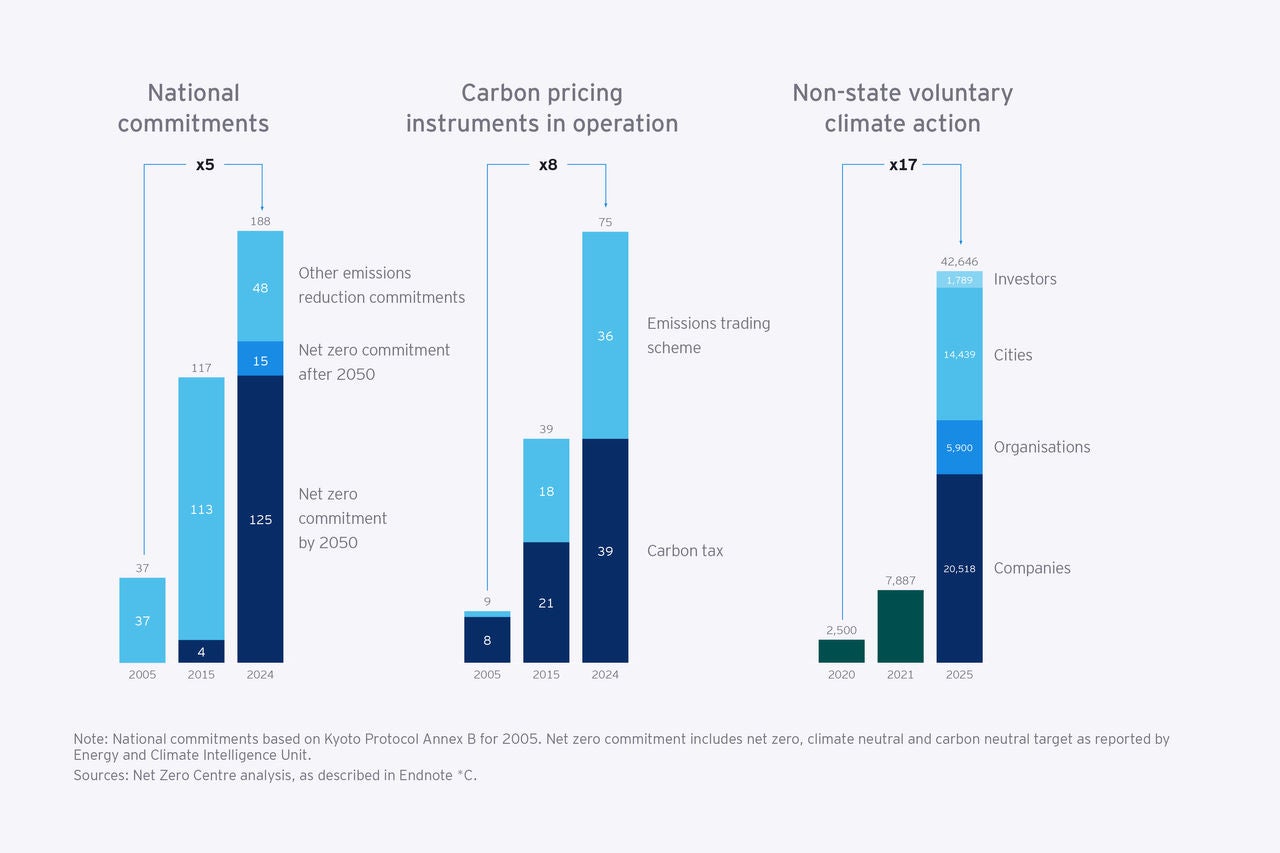
For years, 2050 has been the horizon for global climate ambition – the year by which most governments and companies have pledged to reach net zero. But the EY Net Zero Centre report argues that climate and commercial strategy must now focus on what can be achieved in the next decade.

The Climate Change Authority is assessing an emissions reduction target in the range of 65-75% below 2005 levels by 2035 – consistent with a 1.5°C global pathway. Science-based guidance suggests companies in advanced economies aim for a 75–100% reduction in fossil fuel emissions by 2035.

Government and businesses must work together. Investment cycles, infrastructure timelines and policy frameworks demand clarity today. Businesses that act early can:

  • Avoid locking in high-emissions infrastructure and technology.
  • Position for green capital flows and procurement standards.
  • Meet rising stakeholder expectations around climate risk and resilience.

Every business will need to identify its own best path, shaped by its emissions profile, industry context and strategic opportunities.

Government can pull a range of levers, including grants, tax incentives, mandatory standards, labelling and disclosure. But businesses are in the driver’s seat – and eight keys are in their hands.

Summary

The forces driving climate action will only intensify — shaped by unpredictable events that will have profound impacts on countries, communities and companies. Some will strike fast. And those without a plan will be caught off guard.

The good news? Many of the keys to unlocking resilience and returns are already within reach. 

About this article

Authors

Contact us
Get in touch with our team.

Related articles

Why hard choices in 2025 will define your sustainability journey

Discover six challenges shaping climate strategy in 2025 and how to turn compliance pressure into commercial advantage.

Emma Herd + 1

Global voluntary carbon market outlook 2024

As the costs of carbon credits rise, business leaders need clear decarbonisation strategies, with carbon credits supporting a smooth transition to net zero.

Energy Infrastructure Executive Briefing Series

Exploring how we can help drive the net zero / clean energy transition and create new value for consumers, businesses and our nation.