






Smiling man running in mid-air

Has AI enthusiasm peaked?

Related topics

In this three-part series we explore user sentiment toward AI, starting with thesis 1: People are growing tired of AI-generated content.


In brief:

  • As businesses compete for attention in a noisy media space, AI-generated content is increasingly failing to resonate with the target audiences. 
  • Yet well-crafted AI content can match and often outperform human writing in readability and relevance, not to mention productivity. 
  • In research, editing or quality assurance, AI can enhance human creativity, allowing authors to focus on their ideas while keeping content sharp and engaging.

The recent launch of generative AI systems triggered a wave of excitement, with bold predictions – and fears – about a new era of AI that would bring dramatic changes in many areas of life. Since then, an array of useful tools have made their way into our daily work. But we have yet to see the total takeover by bots and algorithms endowed with superpowers that many had predicted or feared was imminent. In fact, some experts say they are observing growing user fatigue with the current generation of AI and its true capabilities. Moreover, there is mounting concern that uniquely human skills are being neglected. In this three-part series, we take a step back to look at where we really are and where things might be headed.

Thesis 1: People are growing tired of AI-generated content

Social media platforms like LinkedIn are filled with professionally written thought leadership and news articles competing for attention. However, after several years of authors drawing on large language models to increase their productivity, there is a danger of content becoming increasingly hackneyed and dull. “In today’s fast-paced environment...” or “It’s important to note...” are just two of the tediously common phrases ChatGPT obsessively uses in its far from engaging renditions. Is that merely a temporary bug that will get better over time or an early sign of a slippery downward spiral?

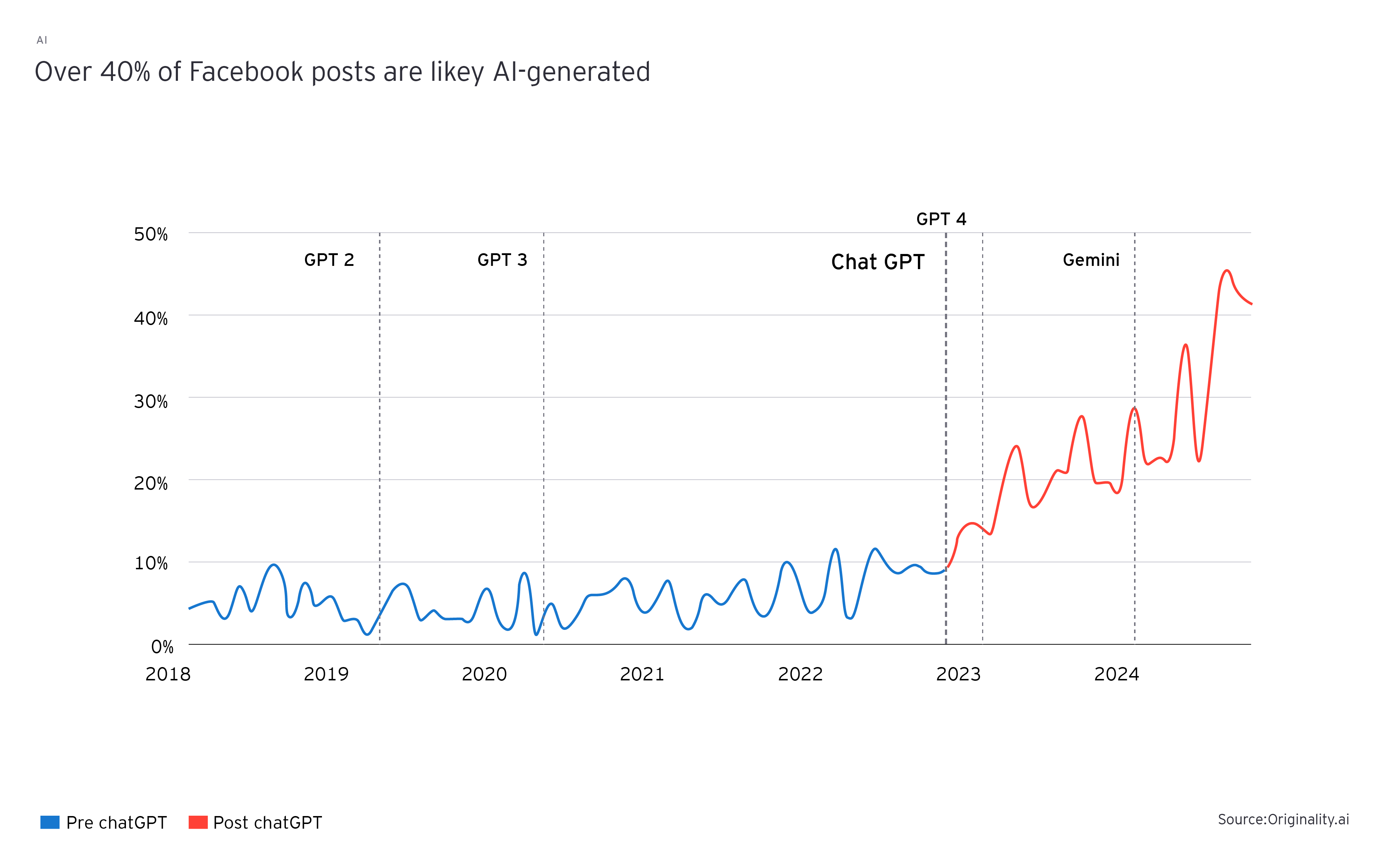
Within organizations, both external and internal communications teams are automating their output – from business emails to status updates on social media. Plagiarism and fact checker Originality.ai estimates that over 40% of current Facebook long-form posts are produced by AI, a figure gone up dramatically since the introduction of ChatGPT in late 2022. 

Today, AI agents scan news, generate social media posts, create YouTube videos with AI-generated clips and voiceovers and even interact with other users – all with minimal human input. These AI bots can be programmed to repackage information on specific news topics, and sprinkle in additional thoughts, and then publish the lot en masse as proprietary insights. A novelty only a few years ago, the Christmas greeting from our line manager containing a verse quickly composed using ChatGPT today seems rather stale and unoriginal. This raises a crucial question: To what extent are we actually achieving our communication goals in the flood of automated content?
 

The challenge: Growing signs of AI content fatigue

Businesses are fighting for attention in an ever more crowded social media space. The digital landscape is showing noticeable signs of content fatigue. Readers are increasingly quick to spot AI-generated content at first sight by its predictable patterns and overly polished tone. Having come to realize that most of it recycles known facts without adding much new insight, many ignore it without reading any further.
 

Moreover, companies relying on AI to produce thought leadership often default to safe, corporate language and avoid controversy. What they end up with is content that feels sterile and disconnected from real human experience. Granted, AI can post 24/7 and often sounds more refined than many human writers broadcasting digital content – but what’s missing is authenticity. Audiences want to understand the human thoughts and reasoning behind the opinions, and that requires a human voice.
 

As AI-generated content floods the internet, truly original ideas are getting harder to find. In response, people are turning to formats that allow them to feel a deeper connection, among them podcasts and long-form interviews, and some are even returning to traditional media. In a world of artificial polish, the flawed but genuine human perspective has become a valued quality.

The counterargument: The value of AI-generated content

Proponents of AI-generated content rightly point out that clickbait headlines, shallow articles and recycled information are nothing new and have certainly been around since well before the GenAI era, even if AI has admittedly made it easier to scale such content. By the same token, the challenge of finding valuable information isn’t new either. But, done right, AI systems can be trained to develop distinct voices and offer fresh perspectives – as if they were individuals with their own opinions. Often, the issue lies not with the technology itself, but with poorly configured AI agents and the sheer volume of low-quality bots.

Recent blind tests show that well-crafted AI content can be indistinguishable from human writing –and sometimes even outperforms it in readability and relevance. Used wisely – as a research assistant, editor or quality assurance tool – AI can support and indeed enhance human creativity. We already have effective methods today for stripping away generic AI tone and jargon, allowing authors to focus on their original ideas while keeping content sharp and engaging.

The outlook: Humans and AI working in partnership

In many ways, the development of artificial intelligence (AI) is reminiscent of the early days of processed food, when the emphasis was on convenience and mass production. At first, the abundance of ready-made products seemed like progress. But over time, the downsides became clear, prompting a shift back to local, high-quality and transparent food sources.

A similar pattern is emerging with AI-generated content. After the initial excitement over its capabilities, people are starting to reconsider how they evaluate information. In what is sometimes referred to as the “dead internet theory”, some fear a future in which bots – indistinguishable from humans – overrun the internet and social media platforms and forums by interacting with each other and reinforcing their own content.

But this view overlooks the positive role AI can play when used responsibly. Today, AI tools are already helping media professionals and writers enhance the clarity, structure and quality of their work. Companies that preserve the human touch in their communication – while taking advantage of AI to sharpen focus and support their message – will be better positioned to earn the trust of their target audience and sustain engagement. A growing field of study, human-AI interaction (HAX) is exploring how we can build on this nexus and find smart, ethical ways forward.

Whether content is created with AI or more traditional human-centric methods, one constant is likely to remain: the human role in creating genuine, meaningful connections. It’s not about producing more content faster – but rather about creating the content that matters, resonates and adds value to the conversation.

Summary

The initial excitement around AI tools like ChatGPT has given way to growing fatigue, as automated content floods digital platforms with predictable, polished, but uninspired writing. Businesses and individuals are automating communications at scale, but audiences are seeking authenticity and human nuance. While AI can support creativity and efficiency, overreliance risks dulling originality and trust. AI proponents argue that the issue lies more in poor use than in the tech itself, as well-designed AI can still produce high-quality content. The future lies in combining AI’s strengths with human insight to create content that connects, informs and truly adds value.

Explore how EY can help you with AI

Explore our insights that look at how you can build confidence in AI, drive exponential value throughout your organization and deliver positive human impact.

Brazil town from sky

Related articles

Is AGI the inevitable next step for businesses?

Is human-level AI feasible in a business context? Find out how it measures up in a corporate environment in terms of its potential, cost and risks.

Next-gen AI – the answer to cost and energy concerns?

Slim and efficient, or large and powerful – which AI model will prevail going forward? Join us in the discussion of where AI development is headed.

    About this article

    Request for proposal (RFP) - exclusively for Switzerland

    |

    Submit your request now!