





EY refers to the global organization, and may refer to one or more, of the member firms of Ernst & Young Limited, each of which is a separate legal entity. Ernst & Young Limited is a Swiss company with registered seats in Switzerland providing services to clients in Switzerland.
Recent Searches
Trending
-
How Swiss firms should prepare for post-quantum cryptography
05 Aug 2026 Cybersecurity -
New Swiss AML and Transparency framework: how it impacts businesses, company owners and advisers
27 Jul 2026 Financial services -
Global IPO highlights in Q2 2026 and insights for future IPO candidates
08 Jul 2026 IPO

Discover how Bowie Bonds turned music royalties into tradable securities, reshaping finance and creativity.
In brief
- Bowie Bonds transformed music royalties into investable securities.
- Streaming revived IP-backed finance, attracting institutional investors.
- Corporates face both opportunities and risks in creative securitization.
Music isn’t just art – It’s capital
“There is so much capital in the world, an enormous amount, and that capital is asset-seeking.”1 This observation explains why Bowie Bonds, securities backed by future royalties on Bowie’s song catalog, have become such an obvious investment vehicle. In a market with liquidity yet chronically short on yield, institutional investors are switching to unconventional assets, exclusively decorrelated from standard financial market in order to generate stable returns.
What began in 1997 with David Bowie’s groundbreaking decision to securitize his music has evolved into a mainstream financial phenomenon. Over the course of 2025, investment giant funds such as Blackstone, Carlyle and Michigan’s state pension fund have already raised a record USD 4.4 billion (as of September 2025) in music-backed debt. With major rating agencies now assessing these deals, streaming’s transformation of music economics, a prolonged low-interest-rate environment and returns outpacing comparable corporate bonds, Bowie Bonds have moved from niche experiment to legitimate asset class, and stand as a striking example of how finance continues to transform creativity into investable value.2
Bowie Bonds emergence
When David Bowie realized in the 1970s that he did not fully own the rights to his own music, with his manager at the time, Tony DeFries, holding up to 50%, necessity became the mother of invention. Together with investment banker David Pullman, Bowie conceived a groundbreaking idea that would forever change both the music and finance worlds: transforming non-tradeable assets like copyrights, music recording and publishing rights into tradeable securities. In 1997, the first Bowie Bonds were issued, the first major example of what would later be known as Pullman Bonds, creating a model for intellectual property-backed securities.
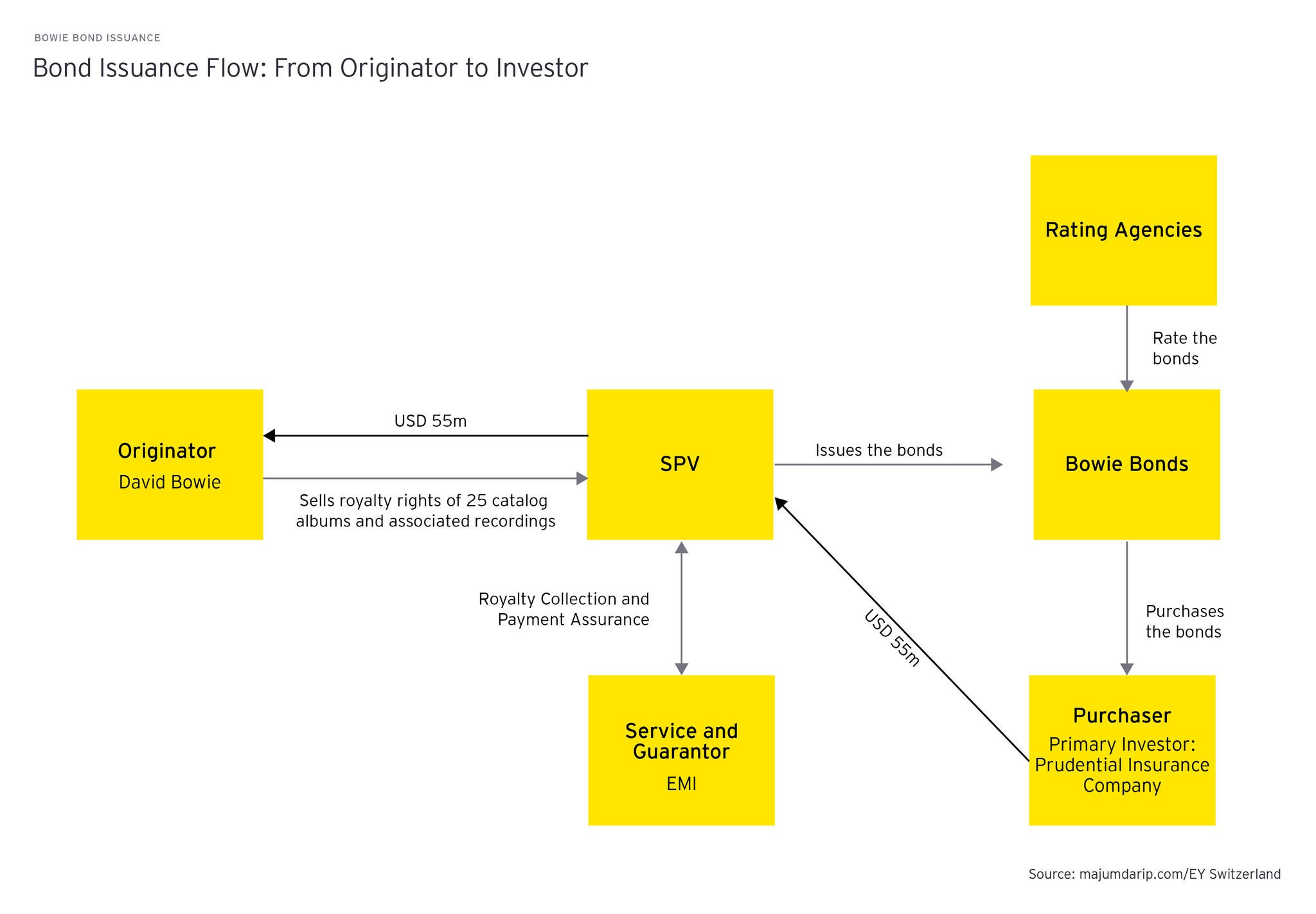
The issuance, underwritten by Prudential Insurance Company of America, raised USD 55 million immediate cash to David Bowie. This allowed him to buy back the rights for his music catalog from his former manager, reclaiming control over his creative legacy. The bonds were backed by the future royalties of 287 songs from 25 albums recorded before 1990, including classics like Heroes and Ziggy Stardust.3
The concept didn’t just benefit David Bowie – it also offered an attractive opportunity for investors. The Bowie Bonds, with a face value of USD 1,000 and a 10-year maturity, paid an interest rate of 7.9%, notably higher than the 6.37% yield on a 10-year U.S. Treasury note at the time. Rated A3 by Moody’s (equivalent to A– by Fitch and S&P), the investment-grade bonds provided investors with a steady, long-term return and, symbolically, the chance to own a piece of their favorite rock star’s legacy. The bond structure also transferred the financial risk of Bowie’s catalog to investors, who were arguably better equipped than the artist to evaluate whether the music would continue generating revenue over time.4
The structure was straightforward yet innovative: music royalties were pooled and transferred to a Special Purpose Vehicle (SPV), guaranteed by EMI Records, Bowie’s label. The SPV acted as the issuer of the Bowie Bonds, basing the securities on revenue streams backed by the rights in the intellectual property assigned to it and using the proceeds from the issuance to pay Bowie for that assignment. The bonds were self-liquidating, meaning the principal declined each year as royalties were paid out — a new concept at the time, particularly because it was one of the first instances where intellectual property served as collateral. Investors received royalty payments over a ten-year period, while Bowie gained immediate liquidity without losing ownership of his work. Importantly, the US Tax Office (IRS) classified the arrangement as a loan, meaning Bowie avoided tax liabilities on the proceeds, since future royalties were recharacterized as interest and principal payments under the bond agreement.
Evolution and Modern Relevance
Shortly after their launch, Bowie Bonds faced significant challenges. Their value depended on physical album sales, which collapsed in the early 2000s as MP3 sharing and piracy surged during the Napster era. Streaming was emerging, but far from being monetized, thus sharply reducing royalty income. Moody’s downgraded the bonds from A3 to Baa3, investor confidence eroded, and refinancing became difficult. Despite legal disputes, the bonds liquidated as planned in 2007, avoiding default and reverting rights to Bowie.
The decline marked a temporary collapse in music royalty securitization. For nearly two decades, the concept lay dormant, until streaming transformed the economics of music. Today, Pullman Bonds have emerged as the modern blueprint for IP-backed securities, offering investors access to predictable, data-driven royalty streams. With platforms like Spotify, Apple Music and YouTube generating recurring revenues, music rights have become investable assets once again.
Since 2020, the market has revived strongly. Landmark deals include Concord’s USD 1.8 billion A+ rated transaction and Hipgnosis’ 1.47 billion securitization backed by 45,000 songs. Improved data transparency, new monetization channels (TikTok, fitness apps, global streaming growth) and active catalog management have all strengthened the asset class.5
Music is now perceived much like infrastructure: it delivers predictable cash flows with low correlation to economic cycles. Its global and repetitive consumption patterns make it inherently noncyclical. Consumers stream music regardless of market conditions. What began as Bowie’s experimental financial innovation has matured into a mainstream investment strategy. Pullman Bonds illustrate how art and finance can harmonize, turning creativity into a durable, income-producing asset class.
Relevance for corporates
As IP-backed securitizations gain traction and become a more established asset class, their growing acceptance among institutional investors naturally raises the question of their relevance for corporates. From a return perspective, the idea of monetizing intellectual property, whether through music royalties, patents or trademarks, offers an innovative way to unlock hidden value and diversify funding sources. The rise of streaming and better data transparency have made cash flows from certain IP assets more predictable, while rating agency frameworks and standardized deal structures have helped to increase credibility. In theory, such developments could make IP-backed securities attractive for corporates looking for alternative, asset-based financing options.
However, despite their appeal, music securitizations come with notable risks. The rise of AI-generated music brings both opportunities and challenges, as questions around copyright and data use remain unresolved. Shifts in consumer behavior, such as changing listening habits, shorter song formats and adjustments in platform payout models, can make royalty income less predictable, while revenues are often concentrated around a few top artists. In addition, streaming platforms hold significant power over visibility and monetization, meaning changes to algorithms or licensing agreements could quickly affect expected returns.6
Alongside these industry-specific risks, there are also financial ones: difficulty in determining value, asset volatility as well as legal and regulatory challenges. For most corporates, this level of volatility conflicts with treasury objectives focused on security, liquidity and predictability. Nevertheless, within a diversified investment portfolio and with an appropriate risk appetite, a smaller allocation to such assets could be considered, particularly for companies seeking innovative, yield-enhancing opportunities or exposure to the growing creative economy.7
Looking ahead, it will be fascinating to observe how this market continues to evolve, how music asset-backed securities mature over time, and whether new, creative financing approaches for corporates could eventually emerge. While the asset class may not yet qualify as a traditional, risk-adjusted investment instrument for corporates, it can still serve as a strategic, brand-aligned gesture – a way to demonstrate innovation, support creative industries and strengthen corporate identity, rather than purely a pursuit of financial return.
Summary
Bowie Bonds marked a turning point in 1997, when David Bowie and the banker, David Pullman, transformed music royalties into tradable securities. The deal raised USD 55 million, secured by royalties from 25 albums, and offered investors a steady 7.9% yield. This innovation not only gave Bowie liquidity but also introduced a new asset class that bridged creativity and finance. Today, streaming has made royalty flows more predictable, fueling investor appetite for decorrelated returns.
Acknowledgement
Many thanks to Gaetan Lefevre, Mascha Steenblock, Noel Bader, Xavier Nijhof for their valuable contribution to this article.
FAQs
Related articles
How can treasurers transform to realize new value in a world of uncertainty?
The EY DNA of the Treasurer Survey provides insights for treasurers and senior finance leaders looking to drive success. Learn more.
Finance in the Age of Web3: On the field or sideline?
In the world of Web3, the finance function – and treasury in particular – plays a vital role in navigating new revenue streams.
How can optimizing bank fees fuel corporate success?
Explore successful company growth through bank fee analysis. Uncover indispensable elements of beneficial with banking relationship management.