




Young man working online using laptop and enjoying mountains view

Strengthen your GBS while boosting value delivery for your customers


Building your centers of excellence within global business services extends the reach of specialist resources in fields like D&A and ESG.


In brief

  • Bundling talent, special skills, capabilities, resources and technology, global business services (GBS) is the ideal home for setting up a center of excellence (CoE)
  • In the specialist field of data and analytics, a CoE drives efficiency, quality and tech adoption within the organization
  • Incorporating ESG into GBS or CoE enhances data management, boosts efficiency, unifies practices and allows focus on sustainability

Global business services (GBS) is well established as a cost-efficient way to support an organization’s business success by consolidating and standardizing processes across regions and business areas. Bundling of resources, greater agility and enhanced flexibility allow companies to quickly adapt to changing market conditions and scale their operations globally. It means the business can focus on core activities while effectively managing non-core functions in a centralized and streamlined approach.

In times of scarce resources and challenges to acquire special skills, we believe centers of excellence (CoEs) could be the solution for organizations to leverage and expand the talent, skillsets, expertise and technology already used within their GBS organization. A CoE – pulling together these resources to support a specific aim – can serve as a gateway to excellence, innovation and collaboration within GBS and beyond.

In this article, we explore how to set up a CoE within GBS and illustrate the benefits for two use cases: data & analytics and ESG.


How do you set up a CoE within GBS?

GBS organizations provide the ideal platform for most types of CoE. While both CoE and GBS enhance organizational capabilities, the differentiation mainly lies in their focus: a CoE emphasizes deep subject matter expertise to innovate and drive best practices while GBS emphasizes streamlined, cost-effective service delivery. Activities involving routine, high-volume procedures should be bundled in GBS for efficiency while complex, specialized tasks that require unique knowledge and improvement should be housed in a CoE for expertise-driven solutions. Combining both in a GBS organization yields a synergistic effect— enabling seamless integration of standardized best practices, tools and methodologies across the organization.


With a focus on a specific field – such as data and analytics (D&A) or ESG, as we explore later on – the CoE can support various units or regions ensuring that the whole organization benefits from the same high-quality specialized services regardless of where individual units or functions are located. In addition, the central position of a CoE fosters cross-functional collaboration between different business functions and units, which sparks innovation, enhances knowledge-sharing and improves problem-solving by leveraging diverse expertise.


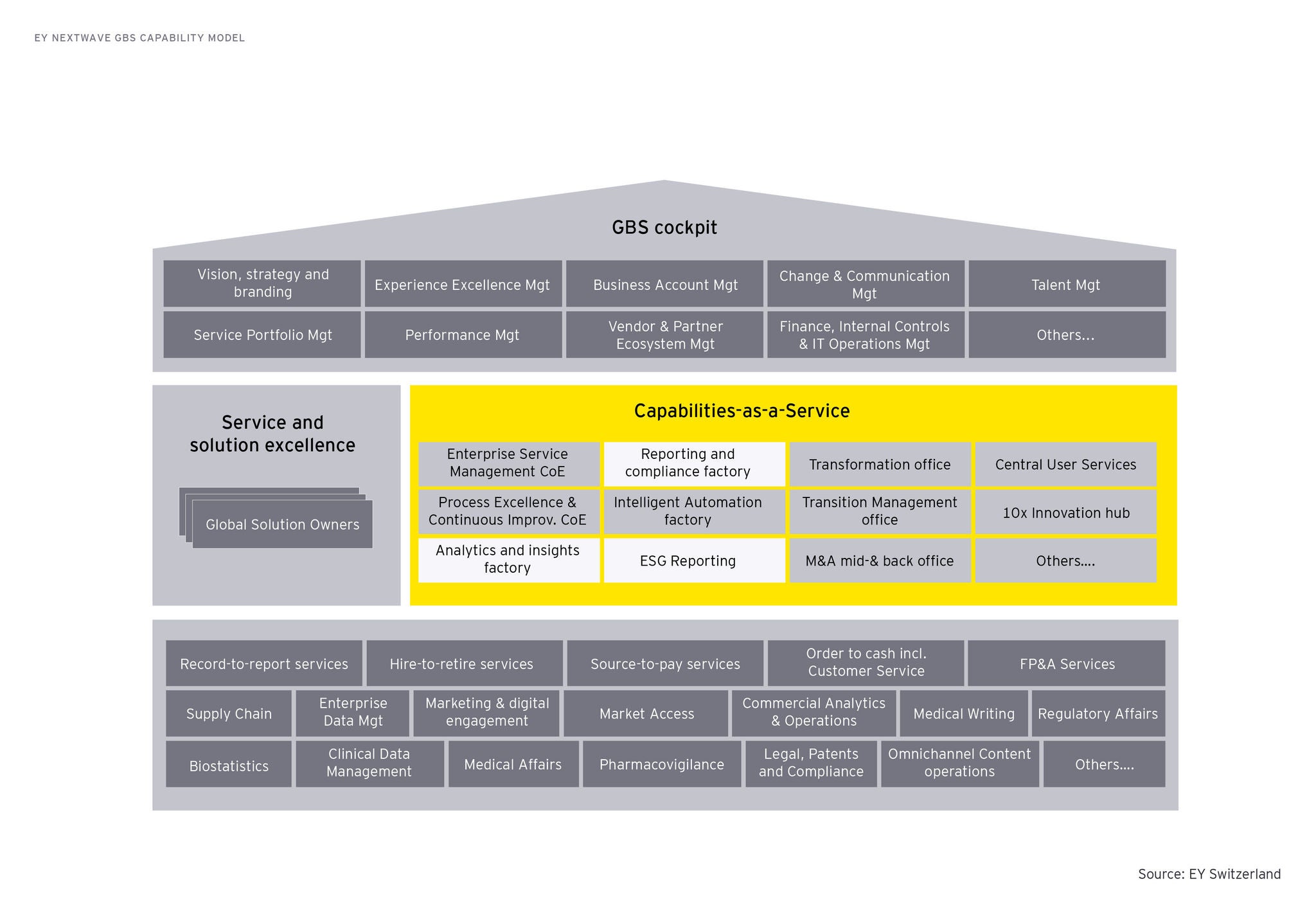
Another benefit of utilizing the GBS organization for establishing a CoE is the ability to scale specialized expertise and resources or “capabilities-as-a-service” to meet evolving organizational needs. This flexible scalability contributes to cost savings by right-sourcing resources and avoiding duplication and waste . We will focus hereafter on analytics and insights factory, reporting and compliance factory (D&A) as well as ESG reporting CoEs.

ey.com-graphic-template 11

Deep dive: D&A

D&A capabilities are in high demand across organizations as these capabilities are empowering organizations to improve decision-making, operational efficiency, creating a more personalized customer experience, etc. To scale up these capabilities efficiently, we would advise organizations to consider building these capabilities in their GBS.

A well-structured D&A CoE emerges as a key enabler of efficiency, quality and agility in the rapidly evolving landscape of data-driven decision-making. For example, a reporting hub ensures that reports across all business units and geographies follow standardized taxonomies and are structurally coherent and compliant with the group reporting template. Additionally, this hub manages the data model and guarantees data hierarchy and correctness, enabling consistent comparison of KPIs across business units and countries while also facilitating adherence to regulatory requirements, streamlined audit processes and enhanced decision-making through accurate and timely data.

It takes appetite for innovation, application of modern technology and continuous improvement to be “fit-for-future” and able to expand capabilities such as data science and AI across all functions. Taking the example of AI, there is a vast range of applications which can be consolidated into a CoE. For instance, in revenue forecasting, the usage of advanced AI-based driver trees enables hierarchical decomposition, simulation and adjustments and enhances capabilities in scenario modeling and variance analysis. Another example is the use of machine learning for a 100% data-driven statistical trajectory of P&L line items, combining internal data with market intelligence to extract insights from historic events for robust mid- and long-term financial forecasting.

The global CoE serves as an anchor for consistent application of digital technology so the organization can capitalize on automation opportunities and assume a leading position at the forefront of technological advancements. Integral to its success is the implementation of automated workflows wherever feasible, coupled with a strong self-service culture. This dual strategy enhances operational efficiency and elevates user experience as well as the overall quality of data and analytics outputs.

We have identified the three stages of a data-driven transformation journey, combining the best of analytics and automation:

Centralized steering and ownership within the CoE foster consistency, innovation and efficiency while at the same time the functional and market capabilities remain required to allow for responses to specific and dynamic market conditions. The CoE becomes a catalyst for internal best practice sharing and active knowledge management, creating a collaborative environment that accelerates learning and innovation across the organization.

Deep dive: Sustainability & ESG

For a business to become sustainable and remain competitive, environmental, social and governance (ESG) metrics need to be considered. Indeed, robust, reliable and real-time information is an important prerequisite for meeting growing demands from investors, regulators and society.

The overall ESG topic is complex and evolves amid new, extended and further standardized policies, becoming a formalized business imperative for all. This can make it harder for organizations to navigate sustainability and position themselves against competitors and market best practices. Benchmarking, ESG-related ratings and KPIs contribute to simplifying the sustainability landscape for organizations and for their stakeholders.

In this context, companies seek to comply with an extended volume of sustainability regulations (e.g., sustainability disclosure requirements, responsible supply chain, due diligence duties, DE&I, etc.) bringing complexity into their processes (large range of cross-functional topics with a lack of organization around these at organization level). As some ESG topics are already managed within CoEs (e.g., people management processes, compliance and business ethics, etc.), we believe that extending the scope of an ESG CoE within the GBS platform can help efficiently manage the sustainability of a company’s ESG data in the most coherent way and address some of the ESG challenges in four key ways:

  • Leverage synergies of different GBS functions to enable an enterprise-wide strategy focusing on managing performance instead of focusing on reporting and data only
  • Benefit from enterprise-wide data and data infrastructure to improve analytics and insights as well as to drive insights to value
  • Ensure consistent ESG interpretation across multinational entities through adherence to clear E2E processes, centralization of regulations and jurisdictional variations
  • Capitalize on the transformational skills of a GBS center

Within a mature GBS setup, a dedicated CoE takes charge of extracting and processing data to produce internal and external reports, monitoring ongoing further evolving regulation across the entire organization and multiple jurisdiction exposure as well as ensuring adherence to reporting standards. Beyond reporting, ESG information also flows into controlling processes (for instance to ensure sustainability commitments and regulations are met) and influences management decisions. It also actively supports compliance monitoring and ESG audits to make sure the organization remains aligned with its ESG policies and effectively manages associated risks.

An ESG CoE integrates sustainability within the organization, focusing on efficiency gains, accelerating availability of decision-relevant data and leading ESG programs across business units and geographies, prioritizing performance over data management and reporting processes.

The CoE plays a pivotal role in defining ESG data governance for the entire organization, offering smart analytics, management decision support (to achieve hard-wired commitments, ensure C-level liability and decide on investments) and ESG-induced business performance steering. This includes implementing analytical tools like ESG opportunity cost, cost of compliance versus non-compliance, true earnings diagrams or scenario modeling, resulting in a comprehensive view of the organization’s operational sustainability transparency, enabling improvements to be identified and actions defined and everything being managed in exactly the same way as any other business-relevant process such as Finance is.


Summary

GBS serves as the ideal starting point for a CoE thus maximizing the reach of specialist resources. Communication channels and platforms can be used to share expertise, insights and updates with a wider audience across the organization, globally impacting the organization across multiple regions and units and contributing to a unified approach to expertise and innovation.


Related articles

Banking Barometer 2025 - Balance

EY Banking 2025 report indicates Swiss banks may see lower profits ahead but remain confident in their long-term business model.


    Explore how EY can help you with Finance

    Our Finance offerings enable innovation by freeing up scarce resources to focus on important questions and solve difficult problems.

    Young man working online using laptop and enjoying mountains view

    About this article

    Request for proposal (RFP) - exclusively for Switzerland

    |

    Submit your request now!