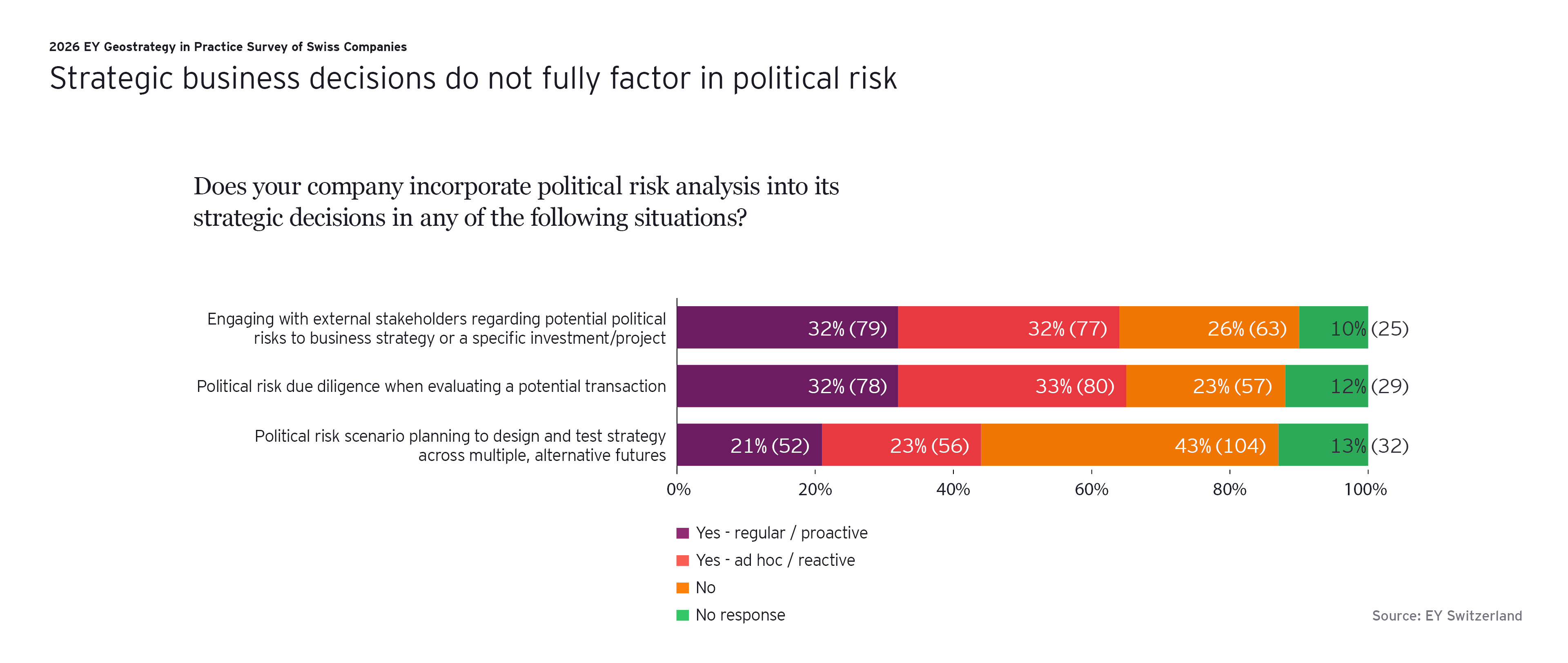
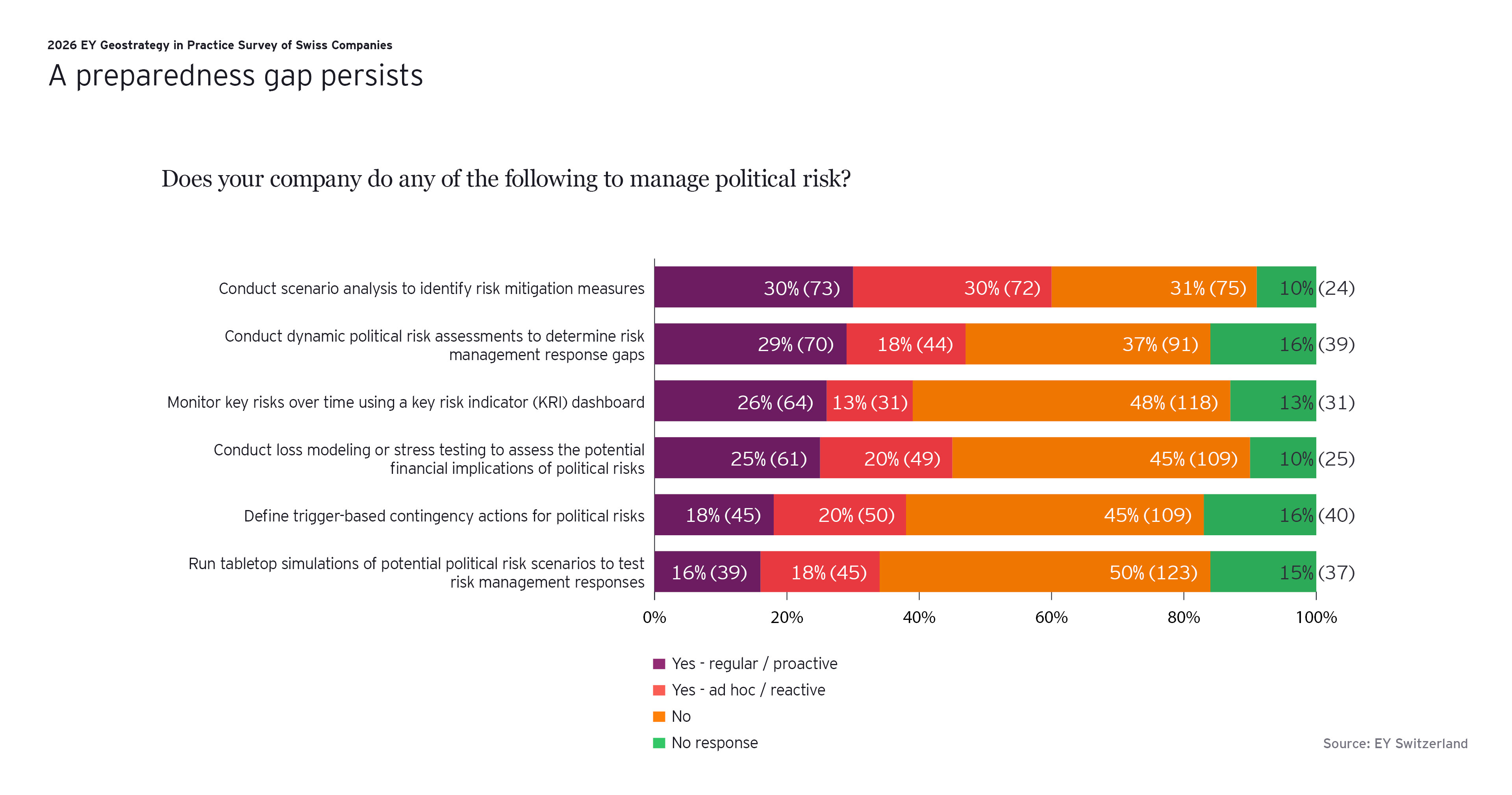
The 2026 EY Geostrategy in Practice Survey of Swiss Companies provides a useful indication of the gap: only 18% of respondents say their organizations regularly and proactively define trigger-based contingency actions and a mere 16% regularly and proactively run tabletop simulations for political risks.
A contingency plan is valuable only if it can be activated. A trigger has little meaning if nobody has the authority to act on it. And a simulation has limited value if it ends when the workshop ends. The purpose of testing is therefore not simply to improve the plan. It is to test the organization itself.
Who notices the signal? Who determines whether it matters? Who brings the relevant functions together? Who decides whether the threshold for action has been reached? And what can be decided immediately rather than escalated through several layers of management? These are governance questions as much as risk questions.
Why do contingency measures depend on governance?
Governance is crucial because a response cannot be activated by analysis alone. Someone needs to own the trigger, convene the right people and have sufficient authority to move from assessment to action.
Preparedness needs to be designed around actionable analysis and decisions: The organization should know not only what could happen, but what it would do, who would do it and under which conditions.
Ownership is the missing link
Why is clear ownership the most actionable gap?
Because ownership connects geopolitical awareness with organizational action. Without an accountable owner, monitoring, scenario planning and contingency measures can remain fragmented across functions without producing a coherent response.
Geopolitical risk does not belong naturally to one corporate function. Strategy may assess implications for the business portfolio. Risk may monitor exposures. Legal and compliance may track sanctions or regulations. Supply chain and procurement teams may manage dependencies. Government affairs may understand political developments. Technology teams may address data and infrastructure implications.
All of these perspectives are necessary. But without clear accountability and orchestration, the organization can end up with a collection of informed functions rather than a coherent response capability.
Our survey findings confirm precisely this problem. Only 22% of respondents say their organizations systematically and proactively assign responsibility for geostrategy to a particular person, function or cross-functional team. This makes ownership one of the most actionable preparedness gaps identified by the survey.
Does clear ownership mean creating a new geopolitical risk function?
Not necessarily – more importantly, it means establishing explicit accountability and decision rights, whether those sit with an executive, an existing function or a cross-functional team.
A clear owner does not mean that one executive must become the company’s geopolitical expert or that a new department must be created. It means that someone has an explicit mandate to connect geopolitical intelligence with business decisions.
That mandate should include bringing together the necessary expertise, coordinating scenario work, establishing decision processes and ensuring that agreed actions are implemented. In a cross-functional environment, ownership is what prevents geopolitical risk from becoming everyone’s responsibility in theory and nobody’s responsibility in practice.
From reactive response to institutional capability
What should leadership teams do now?
They should focus on building the organizational mechanisms that turn intelligence into decisions. The broader challenge is to move from treating geopolitical risk as something the organization monitors to treating preparedness as an organizational capability.
In an environment where developments can move quickly and outcomes are difficult to predict, the advantage comes from reducing the time between recognizing a meaningful signal and taking an informed decision. Organizations can influence that time.
How can organizations turn awareness into readiness?