







Businesswoman working on project on digital tablet in office

The Sustainable Product Edge: Strategic Advantage and Future Resilience for Swiss Financial Institutions (FIs)


Swiss FIs can unlock growth and resilience by embedding sustainability into products, lending and due diligence.


In brief

  • The financial sector is challenged to integrate sustainability into its core offerings, driven by dynamic regulatory landscape, increasing sustainability risks and evolving client demands.
  • Many FIs recognize this, but often face unique challenges with implementation, greenwashing risk and performing robust due diligence across investments and lending portfolios.
  • This article outlines a strategic approach, structured across three chapters to navigate this shift:
    Chapter 1: Identifying high potential areas for sustainable innovation in both product development and lending practices
    Chapter 2: Integrating rigorous sustainability due diligence for all financial activities
    Chapter 3: Optimizing processes for continuous improvement and market leadership

In an increasingly sustainability-conscious world, the Swiss financial sector stands at a pivotal juncture. Evolving client demands, the inherent financial risks and opportunities associated with sustainability as well as regulatory shifts such as the AMAS self-regulation framework 2.2 are reshaping the landscape. Looking ahead, adjacent regimes will also shape Swiss cross-border activities. In the UK, the FCA’s Sustainability Disclosure Requirements (SDR) are phasing in. An anti-greenwashing rule has been in effect since May 31, 2024, and with the four optional investment labels available, new naming and marketing rules took effect with temporary flexibility to comply and further decisions still to come. Across the EU, the Commission has started a formal review of the Sustainable Finance Disclosure Regulation (SFDR) to put clearer product categories in place, with a legislative proposal targeted for Q4 2025. For Swiss FIs with EU/UK distribution, designing products and disclosure that can map to SDR labels and emerging SFDR categories will minimize rework as these regimes solidify. Embracing sustainable finance and crafting or integrating third-party compelling sustainable solutions across their entire business – from investment products to corporate lending, trade finance and treasury activities – is no longer merely a “nice-to-have”, but a strategic imperative for long-term value creation and enduring market relevance. 

This article explores how FIs can effectively integrate sustainability across their operations, from identifying impactful entry points for new sustainable product offerings and lending solutions to optimizing due diligence processes and deep-dive analysis of existing portfolios, ultimately building credible and resilient sustainable finance solutions for an increasing demand and future challenges that might not be fully accounted for yet. Despite the remaining challenges, there is an existing growing market, particularly in the private segment where retail investors lead the way.

in sustainable investments has been recorded by the private segment in Switzerland in 2024, topping CHF 618 billion, showcasing a continued increase by retail investors compared to only 10% increase by institutional investors.

Beautiful landscape with old compass on traveler's hand. Traveling concept.
1

Chapter 1

Unlocking Sustainable Value: Strategic Entry Points

  • Key Idea: FIs must strategically identify key areas within their existing product offerings, portfolio analysis frameworks and client relationships, where integrating sustainability creates long-term value and market fit.
     
  • Background: Many corporations recognize the importance of sustainable finance, but are challenged to identify the most impactful entry points for new sustainable products and fitting implementable actions. Without a clear strategy, efforts can be fragmented, leading to inefficient resource allocation and difficulty in demonstrating tangible benefits or meeting evolving client preferences for genuinely sustainable solutions. Identifying client segments, product lines and processes within the organization with the highest potential for sustainable value creation is crucial.
     
  • Challenge: The challenge is to move beyond surface-level sustainability claims towards a firm-wide data-driven discipline that demonstrably enhances value, reduces risk and meets the needs of distinct client segments. It must be an objective embedded in culture and operating models, reflected in governance and accountability, incentives and remunerations, product design and risk management, data architecture and reporting, and in how front office teams originate and service relationships rather than a siloed initiatives driven approach. Firms need a systematic view of broader sustainability dynamics. Nature and biodiversity dependencies, water stress and resource security, human capital, supply chain resilience, demographic shifts and geopolitics. Along with macro trends and potential tipping points that can rapidly reprice assets or disrupt sectors. A robust internal assessment should map current capabilities against these drivers, identify the highest impact entry points for new products and lending solutions. Done well, this positions the institution to capture growing asset flows while optimizing and future-proofing the existing product set.

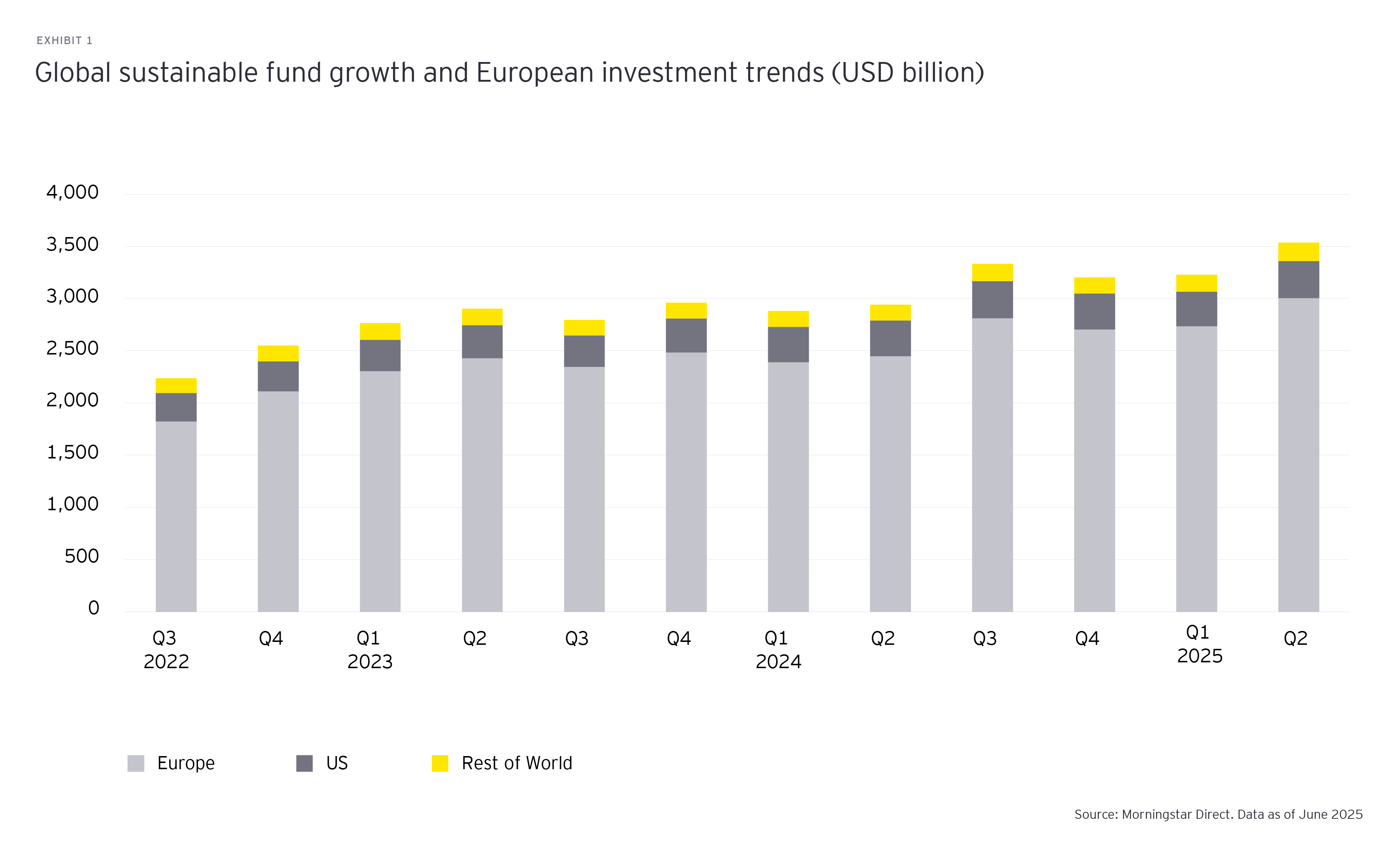
As proof of the market and the business opportunity, it is worth noting that sustainable fund assets continue to grow with the biggest contributor being Europe as the anchor of the sustainable fund market as seen in exhibit 1.

As of June 2025, global sustainable fund assets climbed to USD 3.5 trillion, with Europe making up 85%. For all market participants, the message is clear. Accelerate today or expect a weaker competitive position in the future. Globally there is potential for upside as sustainable funds currently make up mid-single digit % of the overall fund market, with a deep regional skew with 19% of assets in Europe but only 1% in the US.

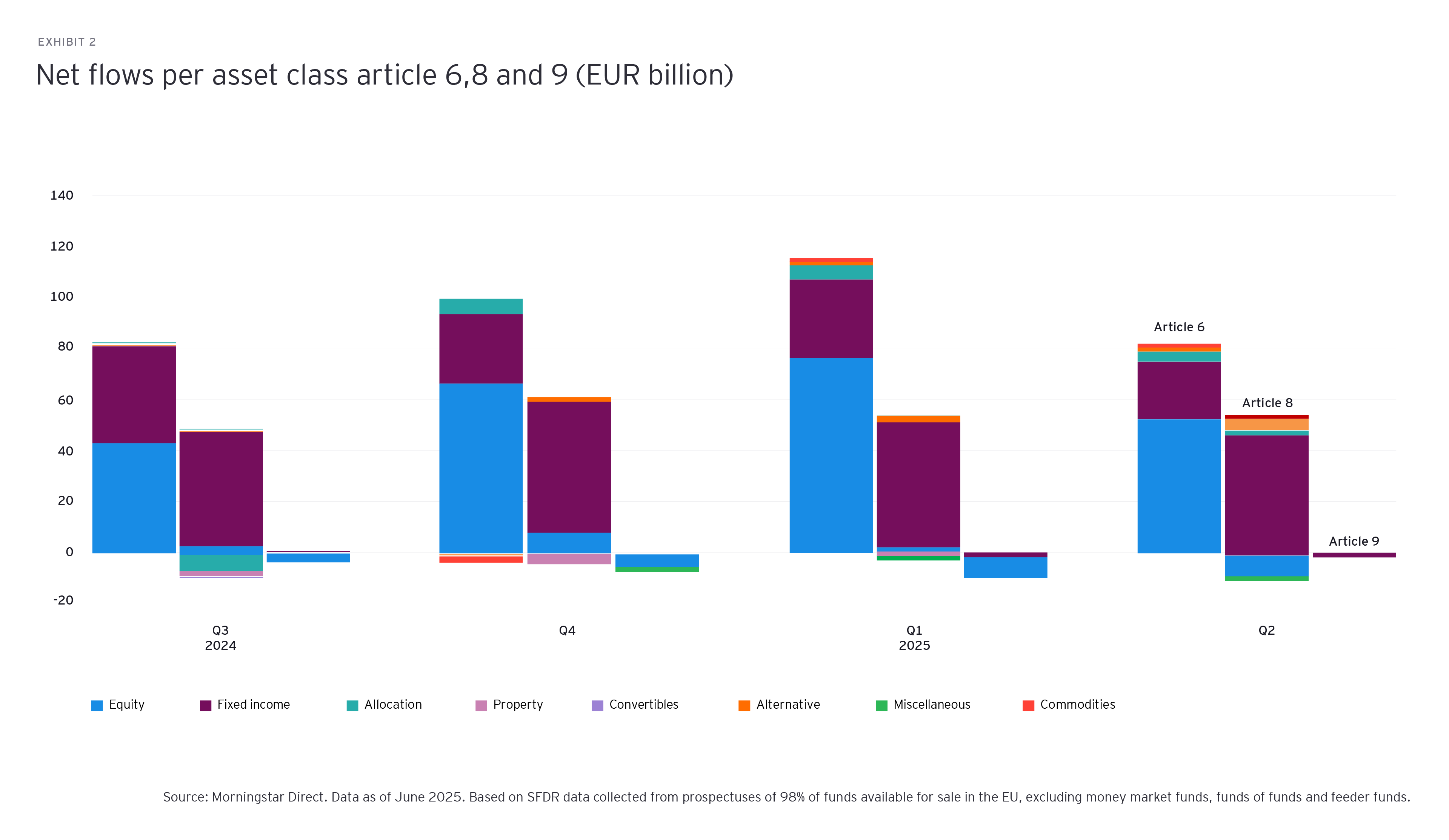
Among the European assets, exhibit 2 shows where money moved under SFDR. The defining trades in recent quarters were a rotation into bonds within Article 8 ahead of Article 6 bonds, with a focus on diversified bond funds and investment grade credit, a classic “defensive with carry” stance. Equities showcase the opposite picture. Sustainability-titled bonds are the comfort zone, while unconstrained equities are still being bought outside SFDR-labelled strategies.

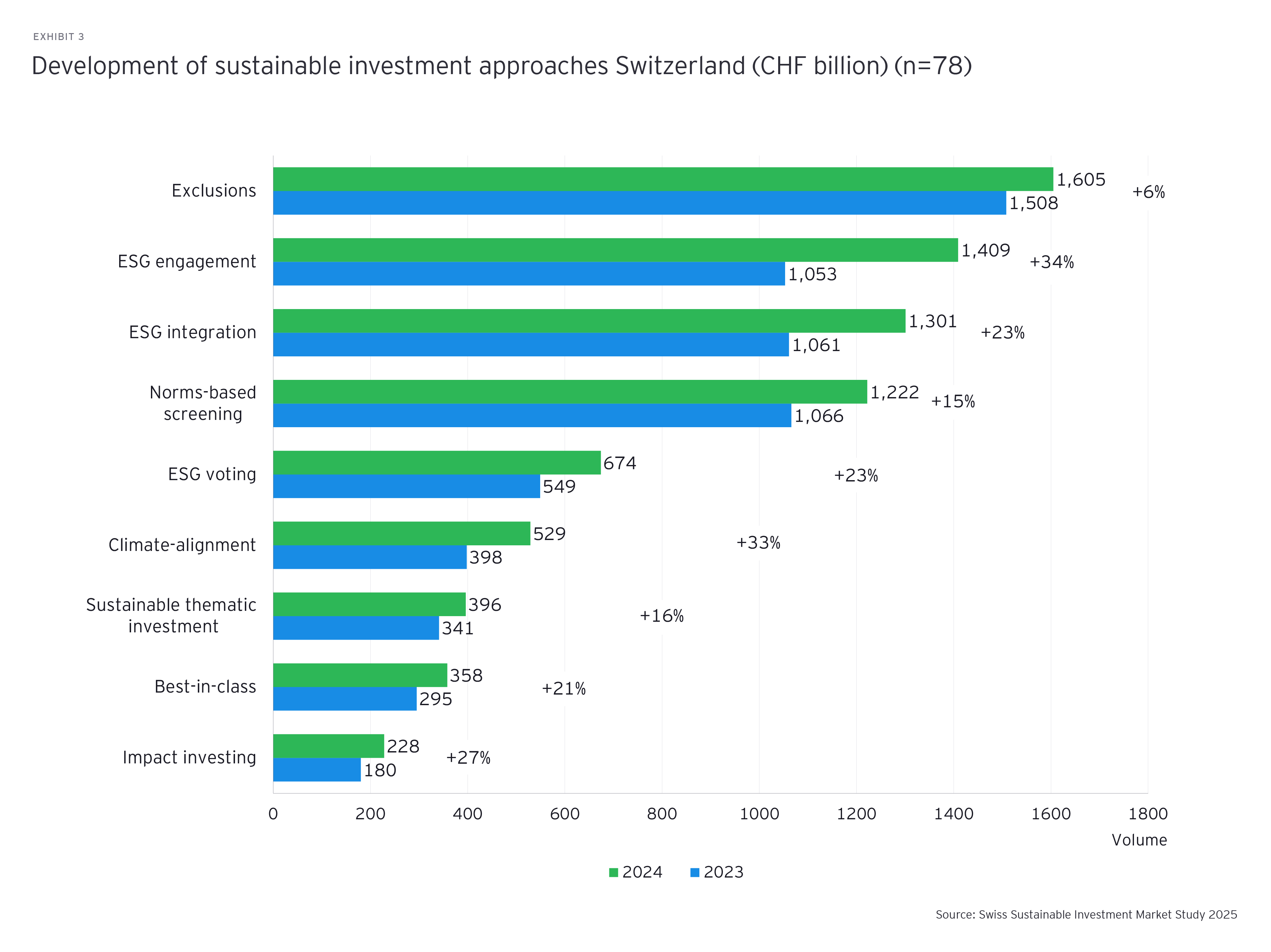
The Swiss market still skews toward screening-led approaches: exclusions are applied to the bulk of sustainability related assets, with stewardship, norms based screening and broad ESG integration close behind. On the contrary, outcome-oriented strategies and other more ambitious and niche approaches remain smaller in share but are expanding at double digit rates year on year. In short, today’s shelves largely implement the “avoid” and “engage” mechanism, but clients now want a more sophisticated product offering: strategies that deliver measurable real-economy outcomes and credible additionality.

  • EY Perspective: FIs that are approaching sustainability not as a separate initiative but as an intrinsic part of their core business strategy, considering sustainability within their products and capable of aligning to new regulations and product expectations set by their clients in the market, are gaining competitive advantages to access the growing demand of investors’ appetite for sustainable investment products. Insights from past engagements highlight how such organizations have approached those initiatives.
    • Conduct a Product Assessment: After a sustainability strategy has been defined and embedded within an organization, identifying the most significant sustainability risks and opportunities relevant to their specific product universe, client base and geographic footprint can be an extension diving deeper into the realm of optimal product setup. This often includes considerations of climate transition risks, biodiversity impacts as well as robustness of assets and performance, particularly given Switzerland’s commitment to net zero by 2050 and adherence to frameworks like TCFD and self-regulations (SBA, AMAS and SIA). Real estate accounts for 26% of total CO2 emissions in Switzerland, which will require massive investments to achieve net zero by 2050. Chronic risks such as long-term changes in average temperature and increased frequency of extreme heat bear another challenge for existing portfolios, with additional financial impact on renovation costs.
    • Segment Client Preferences and Prioritize Value Creation: Capture and analyze the nuanced sustainability preferences of institutional, professional and private clients regarding sustainable investing. The Swiss Bankers Association’s (SBA) guidelines, for example, mandate that financial service providers inquire about and document clients’ sustainability preferences, creating a clear opportunity to tailor offerings. Having a clear understanding of market demand helps match preference to actual potential implementation actions.
    • Benchmark Against Market Trends: Leverage insights from reports like the Swiss Sustainable Investment Market Study by Swiss Sustainable Finance (SSF), Morningstar and other sources which provide developments and analytics in sustainability-related investments, particularly in thematic, climate-aligned and impact investments. This helps align with current and future market demand, but also with portfolio challenges. At the same time, financial institutions should articulate a differentiated sustainable value proposition that goes beyond regulatory compliance, emphasizing tangible benefits for clients, such as risk mitigation, resilient long-term returns and measurable positive societal impact, supported by a clear roadmap and milestones.

This initial phase is critical. Rushing into product development or optimization without a solid strategic foundation can lead to misaligned offerings, “greenwashing” accusations and a failure to capture market share and performance effectively.

Helping you navigate change

  • Strategic & Market Opportunity Analysis: We help you identify the most impactful entry points for sustainable finance by conducting a data-driven analysis of your existing product universe, client base, and the broader market landscape. This includes benchmarking your offerings against industry trends to pinpoint areas of highest potential. At EY, multiple tools address our clients' challenges in this field and are driven by continuous improvements based on market appetite and insights which accelerate and can help with product driven and regulatory analytics to set direction and tangible implementations custom to your business and existing working environment.
  • Product Portfolio Screening: We provide expert analysis to help you screen your current portfolio for key sustainability risks and opportunities, aligning with critical frameworks such as TCFD and AMAS. This includes identifying existing "sustainable" product strengths that can be leveraged, rather than starting from scratch. Beyond regulation, at EY we leverage big data offering both climate and nature risk assessments on your assets under management guiding on achieving your strategic sustainability targets and building a more resilient portfolio for the future. For more information on our tools, please refer to the Appendix or contact us directly to discuss the best integration for your portfolio.
  • Client Segmentation & Preference Mapping: We assist with in-depth client profiling and market research to help you understand the specific sustainability demands of your clients' segments. This ensures your strategic entry points are client-centric and aligned with regulatory requirements, such as those from the Swiss Bankers Association AMAS SBTi and many more.
Rear view of a woman walking towards Westerheversand lighthouse in summer
2

Chapter 2

Fortifying Trust: Integrating Robust Sustainability Due Diligence

  • Key Idea: FIs must build a robust and operationally efficient due diligence framework to integrate sustainability into products, processes and transactions, to enable more resilient returns, ensuring credibility and mitigating various risks like physical, transition and greenwashing risks.
     
  • Background: Today, most Swiss financial institutions have started to integrate sustainability into their processes, often guided by international frameworks (e.g., SFDR, TCFD) and domestic initiatives such as the Swiss Climate Scores. While progress has been made in setting policies and offering sustainability-labelled products, practices remain fragmented. Approaches to due diligence differ widely between institutions, as data sources are inconsistent and many processes are still manual and resource intensive. This uneven maturity means that while some FIs have embedded sustainability into their risk and product frameworks, others are still at an early stage, missing out on the opportunity.
     
  • Challenge: The evolving regulatory landscape (e.g., EU SFDR, Swiss Climate Scores, FINMA requirements, AMAS SR 2.2, etc.) and the increasing scrutiny on sustainability claims necessitate robust and verifiable due diligence processes. Ensuring data quality, harmonizing methodologies and building internal capabilities are significant hurdles if success beyond mere compliance is the goal. Integrating and leveraging sustainability to form more robust competitive portfolios and a stronger product universe becomes indispensable.
     
  • EY Perspective: Integrating sustainability due diligence into established workflows is complex. Our experience indicates that FIs must focus on building a framework that is both comprehensive and operationally efficient by:
     
    • Developing Tailored Sustainability Frameworks: Customizing due diligence frameworks that align with the specific risk appetite, product types and regulatory obligations is the foundation. This includes defining clear criteria for identifying, assessing and monitoring risks and opportunities related to product integration, adjustments and transactions. Leveraging a set process and generating dedicated reports that can be easily integrated and embedded in the department’s investment office is key for lean integration.
    • Leveraging Technology and Data Analytics: Implementing solutions that can aggregate, analyze and report on sustainability data leveraging large global dataset sources can be used to easily go from an existing portfolio to learning more about each asset that can guide allocation shifts to achieve your net-zero goals and more resilient returns. This can involve using AI and machine learning to sift through vast amounts of information, enabling more efficient and accurate assessments of assets. Existing tools can be leveraged for a swift integration, which we see increasingly adopted in real estate and lending, to better plan how long-term assets are expected to change in value.
  • Risk Integration: Sustainability due diligence must address not only reputational risks but also physical risks (e.g., extreme weather, chronic heat shifts) and transition risks (e.g., policy changes, carbon pricing, technological disruption). Using scenario analysis and stress testing, FIs can quantify exposures, identify vulnerable sectors and reallocate capital toward more resilient assets. Embedding these tools into portfolio management strengthens risk-adjusted returns, aligns with FINMA and AMAS expectations and builds client trust in the robustness of sustainability-labelled products.
     

Helping you navigate change

  • Tailored Framework Development: We help you design and implement customized due diligence frameworks that align with your specific product offerings and regulatory obligations. Our approach includes defining clear criteria for identifying, assessing, and monitoring sustainability parameters, ensuring a streamlined and integrated process for your specific investment offices.
  • Technology and Data Integration: We offer designated big data-driven sustainability tech tools that enable enhanced portfolio analytics. Our solutions streamline sustainability data collection, analysis, and reporting, providing you with actionable insights from initial screening to ongoing monitoring. This allows for more efficient and accurate assessments of assets, helping you guide allocation shifts and achieve more resilient returns.
  • Greenwashing Risk Mitigation: We assist in developing clear internal policies and controls to prevent unsubstantiated claims. Our services include rigorous verification processes for "green" labels, impact claims, and alignment with recognized standards, helping you to mitigate reputational and regulatory risks.
  • Comprehensive Due Diligence and Specialized Expertise: Beyond traditional portfolio analytics, our services and tools include multi risk and opportunity assessments under different scenarios and decarbonization plans for implementation, including due diligence of carbon offsetting products and implementation thereof. We provide comprehensive product due diligence reports that can be easily integrated into your workflows, enabling you to leverage all available tools to plan and achieve your sustainability goals.
     

Proper due diligence underpinned by a thorough product due diligence report and specialized expertise in areas like carbon and biodiversity credits and implementation, is the bedrock of credible sustainable finance products. Without it, FIs expose themselves to significant reputational, regulatory and financial risks.

is achieved by companies that integrate climate data into their processes, according to CDP.

On average when acting on climate data. CDP drew data from 25,000 corporate disclosures in which companies reported a median of  USD 33.1 million in potential opportunities from environmental action, compared to  USD 4.6 million in cost to realize them. We see that opportunities are already realized. In 2024 alone, 12% reported unlocked opportunities of  USD 4.4 trillion in environmental value. Hence integrating sustainability data provides potential upside and resilience to your business by enabling unclaimed gains, but it also lowers your risk by considering climate and the volatile scenarios driven by nature.

Rear view of a woman walking towards Westerheversand lighthouse in summer
3

Chapter 3

The Agile Advantage: Navigating the Future of Sustainable Finance

  • Key Idea: To maintain a competitive edge and ensure long-term credibility, Swiss FIs must treat sustainability as an ongoing, dynamic process. This requires continuous optimization of due diligence frameworks, proactive adaptation to regulatory shifts and a commitment to measuring and enhancing real-world impact.
     
  • Storyline: Once sustainability is integrated, the new challenge is to maintain agility in a fast-changing environment. With regulations constantly evolving and market expectations on impact and transparency increasing, institutions need to build a muscle for continuous improvement. This includes leveraging new technologies to enhance reporting, evolving their frameworks to capture new risks (like biodiversity) and ensuring their offerings remain credible and competitive against a backdrop of increasing scrutiny.
     
  • Challenge: The primary challenge for FIs that have already established a sustainability framework is avoiding stagnation. The sustainable finance landscape is a moving target: new regulations (e.g., the potential for a Swiss Green Taxonomy), technological innovations and shifts in scientific understanding of ESG risks demand constant vigilance. Failing to adapt leads to a gradual erosion of credibility, increased exposure to unforeseen risks and a loss of market leadership to more agile competitors.

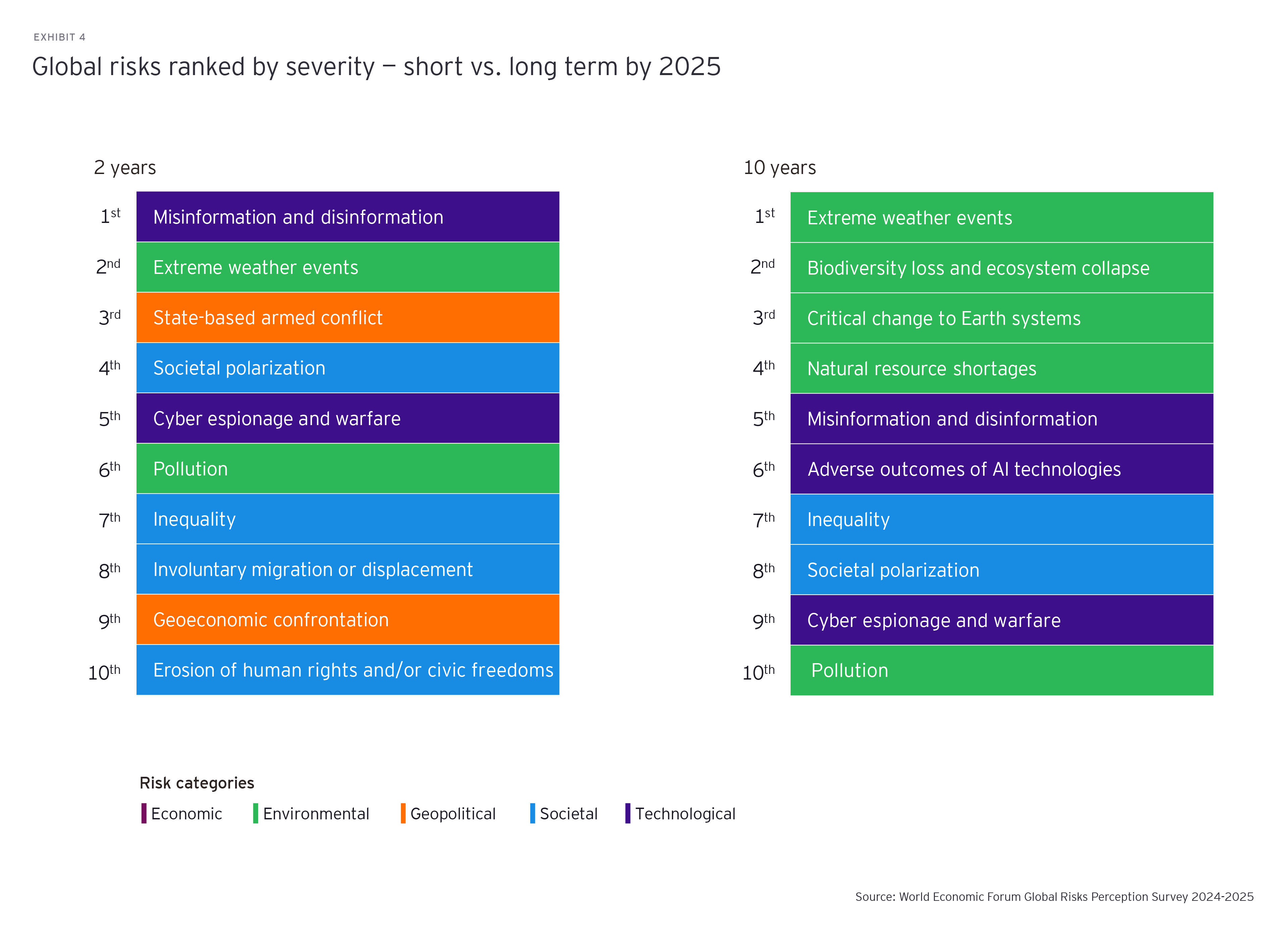
As the WEF 2025 risk map shows, perceived risk intensifies over time: the near term is dominated by socio political and digital shocks, while the 10-year view is led by environmental risks. Because financial effects often lag the environmental impact, the time to invest in resilient, future proof business models, and to embed long-term decision frameworks is now. Otherwise, we replay the “tragedy of the horizon”; a damaging inaction of risk management that shall be addressed by timely pricing in the externalities and governing the untamed and soaring risks.

For Swiss FIs, this dual horizon argues for an agile sustainability setup that manages two clocks at once, strengthening portfolios against acute shocks today while steadily reallocating toward climate and nature positive assets and transition ready issuers. Integrating this horizon view into product governance, stress testing, scenario analysis, and stewardship targets turns the chart into concrete allocation tilts, product design choices, and engagement milestones.

  • EY Perspective: It is increasingly important in this field of play to focus on long-term value and towards competitive advantage. Moving from a static, compliance-driven view and acknowledging the dynamic landscape as an opportunity, not solely as a burden:
    • Agile Frameworks Outperform Static Ones: The industry is learning that a “set it and forget it” sustainability framework is a liability. Agile institutions are building mechanisms for continuous feedback and improvement. They conduct regular “health checks” on their ESG methodologies and data, allowing them to swiftly integrate new market opportunity, regulatory requirements and emerging scientific consensus. This proactive approach prevents the need for costly, reactive overhauls down the line.
    • Data and Technology as a Strategic Asset: We see a clear move from viewing sustainability data as a regulatory chore to a strategic tool. Sophisticated firms are leveraging technology not just for reporting, but for predictive analytics. They are modeling the long-term impact of climate change on real estate portfolios, stress-testing loan books against transition and other risks and opportunities when considering new investment and existing investment opportunities. This data-driven approach is key to generating resilient long-term returns. Investments in advanced tech solutions and their implementation not only lead to streamlined optimized due diligence but also enables a more sophisticated impact and portfolio reporting as well as the achievement of set transition plans.
    • Diversifying the Sustainability Toolkit: The definition of what constitutes a “sustainable tool” is expanding. Leading FIs are now moving beyond traditional ESG scores and actively exploring new instruments. This includes the strategic integration of carbon and biodiversity credits as a complementary tool for managing transition risk and demonstrating impact. These credits are being used to offset hard-to-abate emissions and invest in nature-based solutions, creating a more holistic and credible sustainability strategy for both the institution and its clients.

Helping you navigate change

Our global network and experience with leading FIs enable us to implement practical solutions for optimizing sustainable finance processes. We can provide use cases and best practices for scaling your sustainability efforts and to support long-term compliance and market leadership.

  • Challenge status quo: In a fast moving market, we help you go beyond a compliance approach. We analyze and challenge sustainability strategies by providing benchmarking against industry leaders, leveraging tools, data and automation to optimize and establish an agile framework with you for continuous adaptation.
  • Developing Agile Frameworks: Our framework and development services help design and implement bespoke frameworks that are not only compliant but also built for continuous adaptation. This includes setting up automated monitoring protocols and establishing regular review cycles to ensure your strategy remains cutting-edge.
  • Harnessing Technology for Strategic Advantage: Our team can help you identify and integrate advanced technological solutions, from AI-powered data analytics for climate risk modeling to turning sustainability data from a reporting burden into a source of strategic insight.
  • Expanding Your Sustainability Toolkit: We provide expert guidance on how to evaluate and strategically integrate new instruments, such as carbon and biodiversity credits, into your portfolio to enhance your impact claims and manage transition risk effectively.

Ultimately, the agile advantage is what will separate market leaders from followers. FIs that embrace the continuous evolution of sustainable finance, moving beyond compliance to proactively innovate, will not only mitigate future risks but also be best positioned to unlock new opportunities and thrive in a dynamic financial landscape.

Summary

The potential to leverage sustainability across product offerings for FIs is now. The path begins with strategic foresight, is solidified through operational excellence, and is ultimately sustained by continuous innovation and agility. By embracing this journey, FIs can transform sustainability from a compliance requirement into a source of enduring value and market leadership.

How to get started:

For banks, insurances and sole asset managers looking to navigate this evolving landscape and enhance their sustainable finance capabilities, we offer a comprehensive suite of services. Our team of professionals combines deep financial industry knowledge with specialized sustainability expertise, ready to support you at every stage of your sustainable finance journey.

We invite you to:

  • Discuss your specific challenges: We offer initial consultations to understand your unique needs and tailor a bespoke solution that can incorporate strategy setup, product and framework development, product assessment and greenwashing prevention services, specialized carbon and biodiversity credit advisory as well as targeted capacity and capability building.
  • Get guidance: Explore how our specialized expertise in sustainability strategy, due diligence and regulatory compliance can augment your existing internal capabilities and accelerate your sustainable finance initiatives. We can bring insights from successful and ongoing implementations, leveraging our global exposure to clients and challenges, helping you navigate and better understand.
  • Innovate with us: Partner with us to explore cutting-edge, end-to-end solutions, automation leveraging sustainability to your best advantage and forming a unique long-term resilient setup and base for continuous adaptation and improvement.

Explore how EY can help you with Sustainable Finance

EY sustainable finance teams help financial services companies define sustainability goals that create value and make a measurable difference.

A car moving along a road in the forest

Summary

The potential to leverage sustainability across product offerings for FIs is now. The path begins with strategic foresight, is solidified through operational excellence, and is ultimately sustained by continuous innovation and agility. By embracing this journey, FIs can transform sustainability from a compliance requirement into a source of enduring value and market leadership.

FAQs


About this article

Request for proposal (RFP) - exclusively for Switzerland

|

Submit your request now!