Key financing documents typically include:
- Secured term loans for properties
- Development or construction loans for projects requiring upgrades or new construction
- Assignment of claims agreements where rental income or receivables are pledged to the lender
The buyer’s counsel must coordinate closely with the lender’s counsel and with the notary to prepare these documents, negotiate lien waivers and ensure regulatory compliance.
Buyers and sellers negotiate who bears notary, land register and bank fees. Usage differs across cantons: in the majority, the buyer typically covers all expenses associated with the acquisition, including notary fees. However, in some cantons, the parties may agree on a proportional sharing of these costs. Notary fees and charges associated with the registration of the deed (registry fees) are generally determined by cantonal regulations. In most cantons, a transfer tax is levied (calculated on the purchase price, sometimes also taking into account the cost of a work contract if such contract is closely linked to the real estate transfer).
Because Swiss financing law interacts closely with cantonal regulations and the federal land register system, foreign investors in particular should work with experienced local counsel to avoid missteps.
Anti-money laundering
Switzerland maintains a straightforward anti-money laundering (AML) framework, reflecting both domestic priorities and international obligations. The two core legal instruments are the Swiss Criminal Code (SCC), which prohibits money laundering, and the Anti-Money Laundering Act (AMLA), which imposes due diligence obligations on financial intermediaries such as banks, asset managers and insurance companies. Under AMLA, financial intermediaries must verify the identity of clients and beneficial owners, clarify the economic background of transactions that appear unusual or complex and report any suspicion of money laundering or terrorist financing without delay. They must also maintain records for at least ten years.
Under the SCC, any person who conceals the criminal origin of assets can face fines of up to CHF 1.5 million and up to five years of imprisonment. Serious cases involve organized crime, large sums or professional laundering.
One of the main implications of anti-money laundering rules for real estate transactions is the requirement to review the origin of funds used for the transaction. Large cash payments, in particular, may face scrutiny and have become increasingly rare.
The Swiss Parliament voted for a proposed revision to the AMLA in September 2025. It significantly expands the current scope of the AMLA by introducing the concept of “advisors.” These include individuals and entities that professionally assist third parties in financial transactions related to legal operations such as buying or selling real estate, creating or managing non-operational legal entities and providing domiciliation services. Advisors will be subject to due diligence obligations similar to financial intermediaries, including client identity verification, beneficial ownership identification and documentation retention. Exceptions apply for low-risk transactions, such as family-related transfers, residential purchases for personal use and property deals under CHF 5 million processed exclusively through regulated financial institutions.
The revision, which aims to reduce misuse of real estate for money laundering and tax evasion, especially through shell companies or complex ownership structures, may still be subject to a referendum, which could lead to a popular vote on the matter. If adopted, this amendment would tighten compliance requirements for professionals involved in real estate transactions, such as notaries, advisors, fiduciaries and possibly brokers. Overall, the real estate sector would face stricter scrutiny, aligning Switzerland with international AML standards.
The transaction process
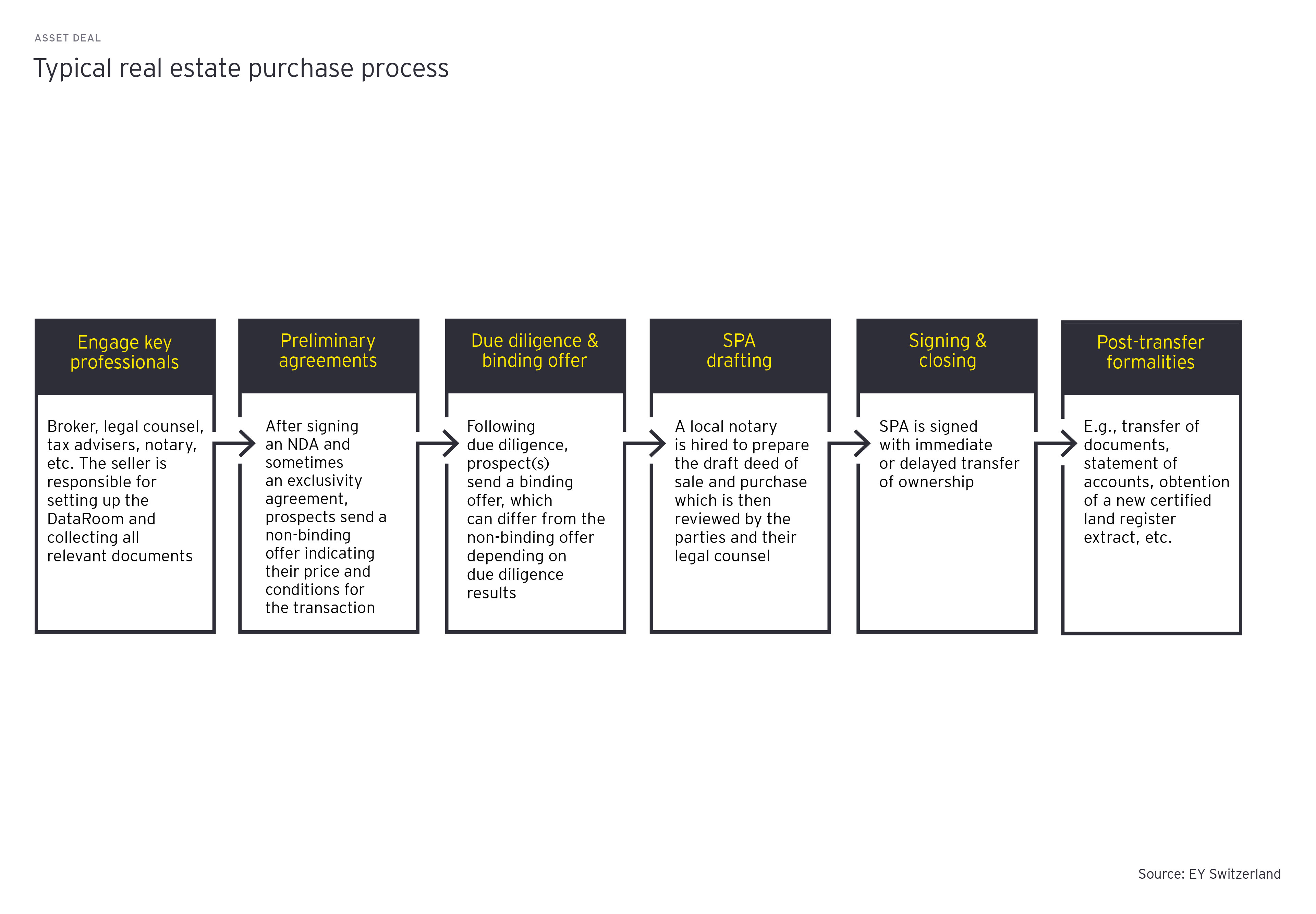
Buying and selling commercial real estate in Switzerland through an asset deal follows a structured workflow designed to ensure legal certainty. Each stage involves external professionals whose expertise is indispensable.