


EY refers to the global organization, and may refer to one or more, of the member firms of Ernst & Young Global Limited, each of which is a separate legal entity. Ernst & Young Global Limited, a UK company limited by guarantee, does not provide services to clients.
Recent Searches
Cost matters more than ever—but so do trust, value, health, and sustainability. Irish consumers are shopping with sharper intent.
In brief
- Price dictates decisions – Consumers are putting cost first across categories, forcing brands to prove their value.
- Sustainability must earn its place – Eco-friendly claims only matter if products are competitively priced and genuinely deliver.
- Trust drives loyalty – In a market of shrinking budgets and rising expectations, brands that build credibility will keep customers coming back.

1
Chapter 1
A new consumer reality
Why understanding sentiment matters now more than ever
The sharp rise in the cost of living in recent years has reshaped how Irish consumers think, shop, and spend. With global economic uncertainty set to persist, these behavioural shifts are unlikely to be temporary. Instead, they signal a lasting reset in consumer priorities and Irish businesses must act now to understand and respond.
To explore these changes, EY conducted a survey of 20,000 global consumers, including participants from Ireland. The research explores shifts in spending habits, channel preferences, attitudes towards private label products, and perceptions of AI in retail. The findings paint a picture of a population deeply cost-conscious yet cautiously optimistic and open to change when brands meet them on their terms.

2
Chapter 2
Price over quality
How consumer behaviour is shaped by cost consciousness
Price has emerged as the primary driver of consumer purchase criteria across a range of categories. On average, 53% of Irish consumers cite price as a key purchase driver across everyday categories. For 58%, it ranks as the top priority when purchasing clothing and footwear—well ahead of quality (44%). Even in fresh food, 46% of consumers place price above quality (32%), underscoring the extent to which affordability is influencing buying decisions.
This price sensitivity has prompted a shift in shopping habits. For example, 42% of consumers are now opting for less expensive alternatives in home and household care, and 37% are doing the same for fresh food, snacks, and confectionery.
How Consumers Are Adjusting Their Spending by Category
Meanwhile, 47% are turning to discount stores to stretch their budgets, while 45% are waiting for sales or joining loyalty programs to secure better value.
However, the dynamics at play, coupled with the continued strength of private labels, are more intricate than a straightforward price-for-value trade-off. Consumers are becoming increasingly aware of shrinkflation, where products are reduced in size while prices stay the same. This has led to scepticism towards promotions that appear overly generous, with nearly half (48%) believing that product improvements are often the result of cost-cutting rather than genuine enhancements for the customer.
With cost being the top consideration for the majority of consumers at present, the temptation to engage in price wars is understandable. Retailers need to ensure they are price competitive for key brands and commodity items whilst appealing to consumers on other characteristics such as quality, health benefits, and sustainability aspects.
Colette Devey
EY Ireland Partner Risk Consulting, Chief Risk Officer
Next steps for businesses:
Instead of discounting prices, focus on enhancing product value. Highlight qualities that justify the price—whether that’s sustainability, health benefits, or craftsmanship. Loyalty and simplicity in offers will win over savvy, price-sensitive consumers.

3
Chapter 3
Cost of living
What’s fuelling consumer caution
Financial matters dominate the Irish consumer mindset. In a clear signal of strain, 96% of consumers say they are either extremely or moderately concerned about the cost of living. The worry is personal —with 45% describing themselves as extremely worried about their own finances and another 47% moderately so. But it is broad too, with 93% uneasy about the state of the economy.
Top Financial Concerns Among Consumers
Yet amid the anxiety, there is some optimism. Over half (54%) of consumers believe they’ll be better off in 12 months, compared to just 19% who expect their financial situation to be worse off. This sentiment reveals a complex mindset—concerned but not resigned.
These pressures are directly impacting how people respond to increases in the price of things they regularly purchase. Some shoppers are cutting back on non-essentials like clothing, cosmetics, and alcohol. Others are leaning harder into value, shifting their spending to discount retailers and embracing private label options. There’s also a noticeable pullback in spending on indulgences like dining out and takeaways.
External headwinds may temper Irish consumer sentiment somewhat in the period ahead. Global trade tensions have increased since our survey was carried out, making for a more uncertain outlook here and elsewhere. Tariffs are a particular worry for households as they tend to push up prices, though it remains to be seen where the US and the EU ultimately land on these.
Next steps for businesses:
Avoid a race to the bottom. Instead, double down on clearly articulating the benefits—performance, prestige, provenance that justify your price point. For mid-tier brands, now’s the time to rethink product architecture and consider value-tier extensions that don’t dilute core brand equity. Be proactive in assessing the impact of tariffs and building price resilience into supply chain and pricing strategies.

4
Chapter 4
Sustainability vs. affordability
Can Irish consumers have both?
While price is the dominant force in purchase decisions, sustainability isn’t being sidelined completely. Irish consumers remain deeply concerned about the environmental impact of their consumption, with 89% recycling as much as they can, 91% consciously avoiding food waste, and 82% thinking twice before making purchases. However, these attitudes may also reflect a financial incentive to curb unnecessary spending, not just an ethical one.
Yet, there’s a clear contradiction. While sustainability is valued, nearly three-quarters (72%) of respondents want healthier, more sustainable products to be more affordable. And 83% believe brands should shoulder the responsibility of making their products more sustainable, without passing on additional costs to consumers.
Interestingly, only in fresh food do sustainability considerations rank higher than price, with 53% of consumers prioritising sustainability over cost. For processed foods, price is the decisive factor for 60% of consumers, and even higher for snacks (68%) and home care (63%).
When Choosing Alternatives, Price Still Trumps Sustainability
Consumers are not rejecting sustainability; they are demanding its accessibility. Our data shows that while people care about their environmental impact, they expect brands to take responsibility in a way that aligns with consumer expectations. For instance, extended producer responsibility regulations in Europe have held producers accountable for recycling targets, and while costs may be passed on to consumers, this can be a part of a sustainable business model.
With the EU Omnibus Package signalling a shift toward simplified, more pragmatic sustainability reporting, there’s a real opportunity for businesses to reset and focus on the true environmental and social impact that their businesses are having. This isn’t about pulling back, it’s about building sustainability into everyday decisions in a way that’s transparent, affordable and scalable.
Derarca Dennis
EY Ireland Assurance Partner and Sustainability Services Lead
Next steps for businesses:
Consumers are increasingly looking for sustainable options but are hesitant to pay more for them. Brands should explore opportunities to embrace sustainable packaging and circular products that could lead to decreased waste management costs, more efficient logistics, improved stakeholder perception and ultimately margin growth, not decline. Focus on improving your product’s green credentials while maintaining competitive pricing.

5
Chapter 5
Private labels gain ground
The rise of value alternatives
Once the second choice on the shelf, private label products have undergone a striking transformation. Today, 78% of consumers believe these products match or even surpass the quality of branded counterparts—and just as many say they meet their needs just as well. With 77% saying private labels help them save money, it’s no surprise they’re gaining serious traction.
That confidence spans generations. Gen Z (78%), Millennials (79%), and Gen X (87%) all agree private label and store brands satisfy their needs just as well as branded options. Yet the story doesn’t end there. When consumers switch back to branded products, one factor stands out across all age groups: superior taste, quality, and performance.
Product preferences also vary by generation. Gen Z leads with private label snacks and confectionery, while Millennials and Gen X are more focused on fresh food. Meanwhile, branded goods still hold their ground in categories like beauty and alcohol—where image, experience, and indulgence continue to matter.
This evolving dynamic spells both challenge and opportunity. For brands, the old playbook of competing on price or presumed quality no longer holds. As consumer perceptions shift, so too must brand strategies.
The perception of private label has changed dramatically. But what’s even more important is how this shift reveals the growing complexity of the Irish consumer. Brands and retailers now need to go far beyond surface-level insights. By leveraging first-party data and smart segmentation, businesses can build a far richer picture of the people they serve—understanding not just what they’re buying, but why. That’s where true value differentiation begins - not just a premium promise.
Richard Hepworth
EY Ireland Consulting Partner
Next steps for businesses:
Brands must respond with more than reactive pricing. Real differentiation will come from innovation, premium experiences, and meaningful value propositions—things private labels can’t easily mimic. Strategic use of loyalty programmes and partnerships can also help tip the scales. For retailers, the path forward lies in understanding the nuances of your customer base and activating insights that drive both value and loyalty.

6
Chapter 6
The resilience of physical retail
Why the local shop still matters
Reports of the demise of bricks-and-mortar retailing have been greatly exaggerated. Across Ireland, physical retail continues to hold strong—not just out of convenience or habit, but because of the real emotional and practical value it offers. A large majority of Irish consumers still prefer in-person shopping for essentials: 83% favour physical stores for fresh food, while 74% prefer them for personal care items. In fact, seven in ten (70%) prefer physical stores across everyday categories, underscoring the resilience of bricks-and-mortar retail and its enduring role in the consumer journey.
Physical Stores Remain the Dominant Channel Across Categories
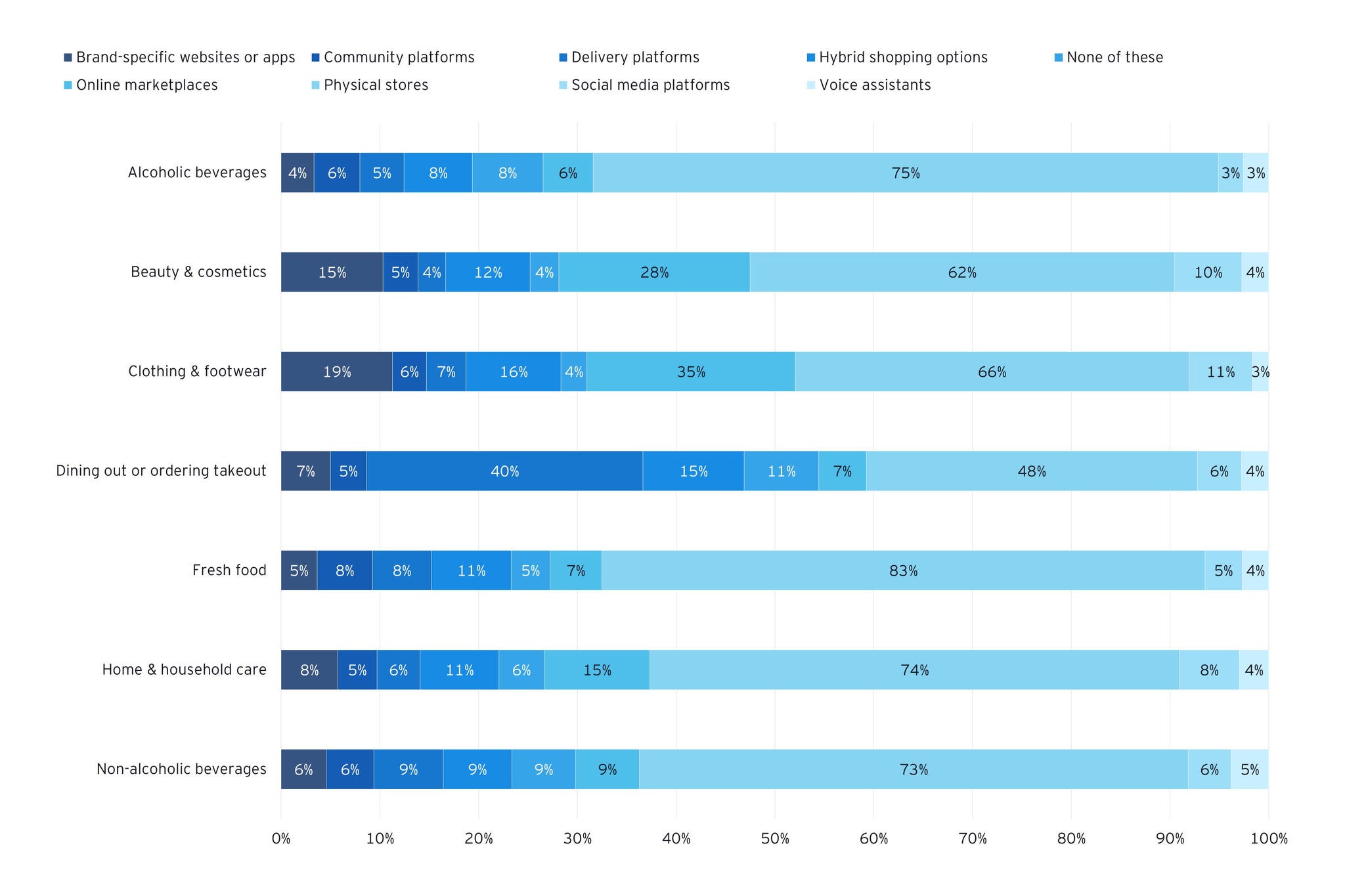
Part of this preference is rooted in the sensory nature of shopping—touching, smelling, tasting—which online channels struggle to replicate. But in Ireland, the appeal goes deeper. In rural and regional communities, the ‘local shop’ remains a cornerstone of daily life: a place for trusted advice, social interaction, and connection to community.
Whether it’s a family-run grocer or a village pharmacy, these businesses often serve as more than just retail outlets—they’re trusted institutions. In smaller towns and rural areas, they offer immediacy, familiarity, and a sense of reliability that digital-only players can’t match.
This physical-first mindset is more pronounced in Europe than in Asia, where higher digital trust and platform penetration have driven consumers online in categories like beauty and electronics. In contrast, Irish consumers still value the human, experiential side of retail.
The integration of digital experiences with physical retail outlets will become an increasing point of differentiation for national and local retailers. Brands and retailers will be able to integrate consumer insight from across all touch points of the omnichannel, building a richer picture of consumer behaviour with which to enable personalised promotions and targeted loyalty schemes.
Richard Hepworth
EY Ireland Consulting Partner
Next steps for businesses:
Retailers should continue investing in store experience, particularly in regional and rural locations where the ‘local shop’ is a key part of community life. Think local product ranges, community events, and staff empowered to create personal connections. Omnichannel strategies should support, not replace physical channels.

7
Chapter 7
AI in retail
A pathway to engagement and trust
While consumer enthusiasm for AI may not fully match that of investment markets, there is a willingness to engage with it. Nearly three-quarters (74%) of survey respondents claim to understand AI, yet 61% remain cautious about its capabilities, particularly regarding AI-generated content.
Still, 63% find AI-driven product recommendations useful, and 66% express moderate or complete trust in tailored promotions and deals. Tools like wish list alerts (69% interest) and saved shopping carts are also viewed positively.
However, trust is situational. Only 31% are willing to share publicly attributed data, and there’s far less confidence in AI’s role in financial advice or healthcare decisions.
AI can supercharge the retail experience – enabling more connected, personalised and responsive customer experiences across every touchpoint – online, in-store and everywhere in between. From tailored product recommendations to real-time inventory optimisation and seamless customer service, the opportunities are vast. However, as retailers harness the power of AI, building and maintaining customer trust must remain a top priority. Responsible use of data, transparency in how AI is deployed, and robust ethical governance are vital for cultivating and sustaining customer loyalty. The real advantage lies not only in what AI can do, though in how ethically and strategically it is applied to create meaningful value for the customer.
Bronagh Riordan
EY Ireland AI & Data Partner
Next steps for businesses:
Consumers are open to AI—if it improves their experience. Ensure that applications are transparent, customer-first, and genuinely valuable. Prioritise quality assurance and clear communication to build trust.

8
Chapter 8
Wellbeing wins
But only on practical terms
Health remains high on the agenda for Irish consumers. A significant 81% say they are moderately or extremely concerned about their mental wellbeing, while an even greater 88% express concern for their physical health. This anxiety is driving action: over the past two years, 60% say they’ve made healthier food choices, 61% have exercised more, and 49% have prioritised sleep.
But these ambitions come with practical conditions. When asked what would encourage them to make healthier choices, the top factor was affordability (72%), followed by improved quality (50%) and better taste (45%). While price pressures remain, consumers are showing a clear willingness to prioritise wellness—particularly in fresh food (68%), processed food (53%), and beauty and cosmetics (52%).
What Would Encourage Consumers to Make Healthier Choices?
Irish consumers are sending a clear message - they’re ready to invest in their wellbeing, but only if brands meet them halfway. It’s not enough to offer healthier options; they must be accessible, appealing, and affordable. The brands that win will be those that make health a part of everyday value—not just a premium promise.
Ronan Glynn
EY Ireland Partner and Health Sector Leader
Next steps for businesses:
Make healthier choices the easy choices. Irish consumers are actively seeking ways to improve their wellbeing—but they expect brands to meet them with solutions that are affordable, appealing, and accessible. That means offering health-first products that don’t compromise on taste, price, or convenience.
In categories like food and beauty, healthier alternatives should be clearly priced, well-communicated, and prominently positioned to drive uptake. And it’s not just about the physical—mental wellbeing matters, too. Businesses have an opportunity to support holistic health through thoughtful services, environments, and experiences that promote balance, calm, and care.
The message is clear: make health part of everyday value, and consumers will respond.
Conclusions: There Is No One Consumer
The 2025 Future Consumer Index confirms that the Irish consumer cannot be painted with a single brush. They are price-sensitive, but many will pay more for health or sustainability. They prefer local, but they’re open to digital. They’re cautious but not resigned.
For businesses, the message is clear: avoid generalisations. Instead of trying to reach all consumers, focus on deeply understanding the personas that matter most based on lifestyle, location, needs, and values. Whether it’s the health-conscious urban shopper, the rural loyalist, or the digitally curious value hunter, each requires a tailored approach.
Success will come to those who listen first and build second.
Summary
This article examines the transformation of Irish consumer behaviour driven by rising costs. Price sensitivity has become paramount, influencing purchasing decisions across categories. Despite this focus on affordability, consumers still value sustainability, creating a complex dynamic for brands. To succeed, businesses must enhance product value and tailor their strategies to meet the diverse needs of price-conscious shoppers while fostering trust and loyalty.