





Curved-pedestrian-bridge-with-angled-arches-over-water-at-sunset

A time for clarity and confidence: Australian carbon market outlook 2026

Australia’s carbon market has sound fundamentals – but policy clarity, investor confidence and sharper incentives will decide how far and fast it can go.


In brief:

  • Gross emissions from 220 facilities covered under Australia’s reformed Safeguard Mechanism (SGM) fell by 2% in a year, largely through low-cost measures.
  • But SGM and Australian Carbon Credit Unit (ACCU) policies are not yet motivating investors to commit capital to higher-cost abatement.

A time for clarity and confidence, the 2026 edition of the EY Net Zero Centre’s Australian carbon market outlook builds on previous carbon market analysis. This report provides fresh insights into current market dynamics and the potential impact of further refinements to the Safeguard Mechanism (SGM) and Australian Carbon Credit Unit (ACCU) policy settings.

Australia has set an ambitious 62-70% emissions reduction target for 2035. Achieving it will depend on:

  • Refining SGM and ACCU policies to boost investment confidence and activate deeper emissions reductions.
  • Motivating broader abatement across sectors currently lacking clear incentives, particularly transport and other industry.

The 2023 reforms to the SGM and ACCU system provide a “light on the hill” for efficient, coherent economy-wide decarbonisation. Success now depends on policy momentum, investor confidence, and alignment between incentives, transparency and outcomes.

Integrity is the currency of Australia’s carbon market. Clarity of policy and confidence of the market will decide its value.

Solid foundations, uncertain signals

Australia’s Safeguard Mechanism (SGM) now covers around 220 large facilities, accounting for roughly 30% of national emissions. Early data shows measurable progress: gross emissions from covered facilities fell 2% in the first year of the reformed SGM, much achieved through low-cost measures. More than two-thirds of internal SGM abatement for the first five years can be achieved at costs under AU$25/tCO₂e.

Australia’s integration of high-integrity ACCUs into a mandatory mechanism is globally distinctive. It enables more ambitious obligations while reducing total system-wide abatement costs by over 60%.

Yet, SGM and ACCU policy settings are not yet motivating investors to commit capital to higher-cost abatement from SGM facilities or new ACCU supply. New ACCU supply is also constrained by slow progress on available methods – just one new ACCU method has been approved in the last three years.

Forthcoming SGM and ACCU reviews are expected to explore options to improve investment confidence, strengthen abatement incentives and enhance co-benefits. But the immediate impact of these reviews is to create uncertainty, which risks delaying investment until policy detail is decided and announced.

Clarity delayed, confidence deferred

Markets move with policy certainty – and for now, ACCU prices suggest investors are adopting a “wait-and-see” approach.

EY Net Zero Centre’s updated outlook reflects downgrades to new SGM activity projections and higher-than-expected cost of capital. This translates into lower projected ACCU demand growth and prices, relative to EY Net Zero Centre’s 2023 central scenario.

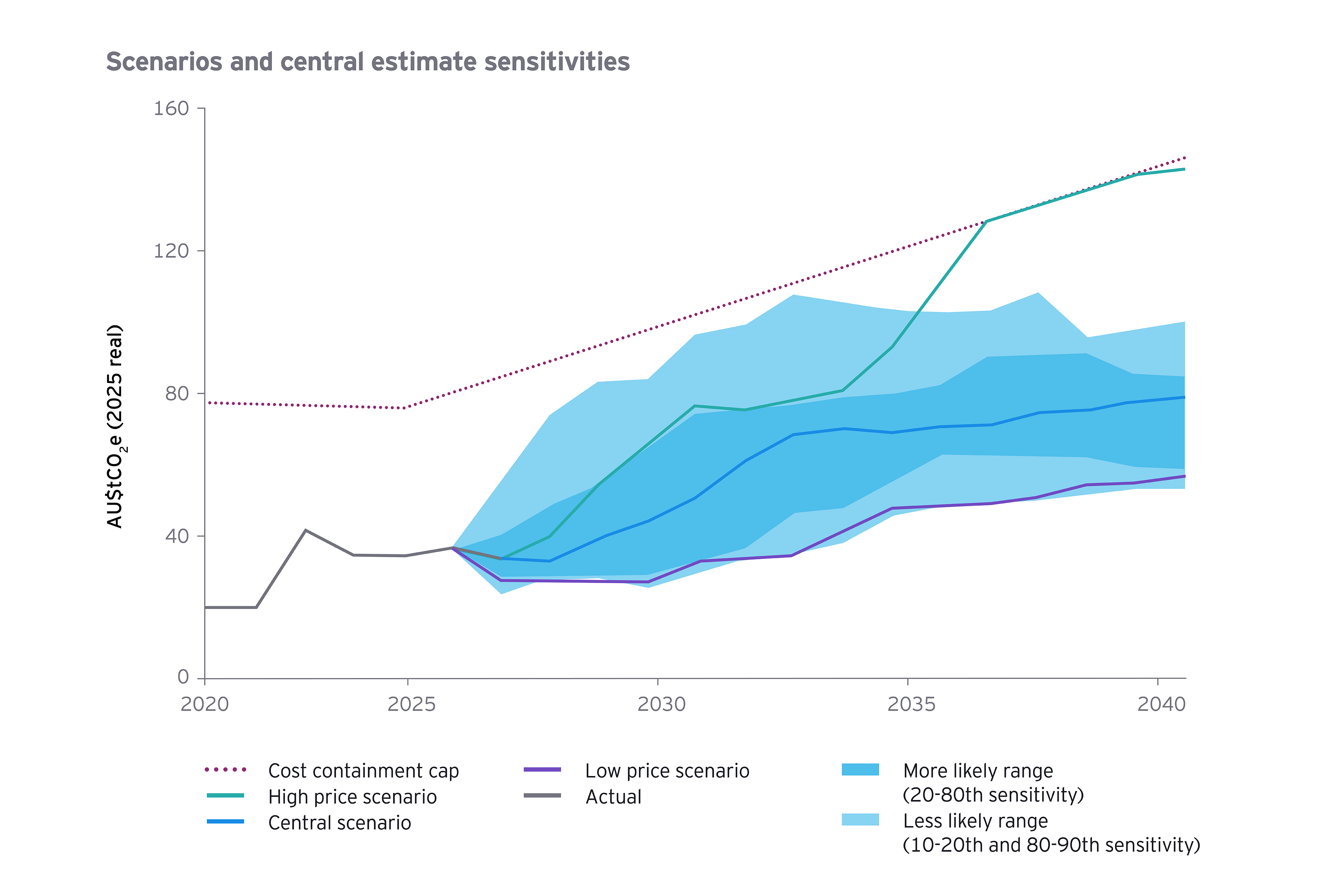
The updated outlook projects a flat or falling market-clearing ACCU price of around AU$30-35/tCO2e for the next two-to-three years, followed by gradual growth to around AU$70 by 2035.


Australian Carbon Credit Unit prices

AU$30-35/tCO₂e

over the next 2 to 3 years

AU$70/tCO₂e

gradual growth in prices to 2035.


This near-term outlook is materially lower than our 2023 central projection, shaving off around AU$25/tCO2e. After 2035, the price converges with our previous longer-term projection.

But prices to 2040 could plausibly be around AU$14 higher or lower than our central estimate. While higher prices are more likely over the medium- to long-term, sustained low ACCU prices cannot be ruled out.

Chart 1

Sharpening incentives, building confidence

Achieving the 2035 target will require sharper abatement incentives and greater confidence in forward ACCU prices. Aligning the SGM and ACCU reviews to report by late 2026 would support coordinated policy and timely action.

EY analysis shows:

  • Lowering the SGM threshold could more than double the number of covered facilities, expanding emissions coverage by around 10% and raising prices by up to AU$5 to 2040.
  • Including transport fuels in the SGM could increase ACCU demand by 7.6 Mt per year to 2040 and lift average prices by roughly AU$12.
  • Public investment targeted at trade-exposed industries could unlock more than 20 Mt of abatement by 2040 without harming competitiveness.
  • Aligning carbon incentives with nature repair could restore priority habitats at scale without government expenditure – avoiding an estimated AU$7.3 billion per year for 30 years – but may add upward pressure on ACCU prices.

Overall, the ACCU market provides a visible carbon price that could serve as a benchmark ‘carbon incentive value’ to guide policy development, and wider public and private investment in abatement.

Successfully navigating the net zero transition will increasingly be seen as an investment, rather than a cost, that is essential to Australia’s future economic security and success.

From challenge to change: What leaders should do now

Decarbonisation is becoming a defining element of industrial competitiveness. Every organisation has a role to play in turning clarity into confidence and confidence into action.

  • Safeguard Mechanism participants: Model compliance costs under different price scenarios and declining baselines. Accelerate efficiency and abatement projects, and shift strategy from least-cost compliance to long-term competitiveness.
  • Directors and boards: Treat carbon pricing and policy reform as strategic signals. Integrate policy, pricing and transition risk into governance and disclosure frameworks to demonstrate that risks and opportunities are understood and managed.
  • Investors and finance leaders: Engage early with SGM and ACCU reviews. Stress-test portfolios against multiple carbon price pathways, and identify sectors and assets positioned to benefit from stronger incentives and rising demand for low-carbon products.
  • Transport and logistics operators: Prepare for reform. Carbon charges or SGM coverage of transport fuels could reshape cost structures. Analyse exposure and invest in sustainable fuels, fleet electrification and logistics optimisation.
  • Government and policymakers: Maintain market confidence through clear, coordinated reform. Bring forward SGM and ACCU reviews, extend incentives to drive cost-effective economy-wide action, and link carbon credit policy with nature repair and regional investment.
  • Carbon credit suppliers and developers: Plan for growth. Focus on scalable, high-integrity projects aligned with emerging demand. Strengthen transparency and verification to meet expanding markets.
  • All businesses: Even with modest exposure, monitor evolving policy and investor expectations. Carbon advantage today can erode quickly as standards tighten. Clarity, confidence and early action remain the best defence.

Summary

Australia’s task ahead is to translate sound design into confident delivery – turning policy clarity into real investment and lasting emissions reduction.

About this article

Authors

Contributors

Related articles

2035 climate target: Eight keys to achieve net zero

EY Net Zero Centre’s latest report shows most emissions cuts to 2035 can reduce costs. Learn why this target matters – and what business and government can do now to stay ahead.

Global voluntary carbon market outlook 2024

As the costs of carbon credits rise, business leaders need clear decarbonisation strategies, with carbon credits supporting a smooth transition to net zero.

Australia’s carbon market is changing gears. Are you ready?

Your business doesn’t need to be captured by reforms to the Safeguard Mechanism (SGM) to need a carbon credits strategy.