







Aerial satellite view of a thunderstorm with dramatic cloud patterns and active lightning, highlighting the storm's intensity

From targets to transition: Why Oceania’s next climate move must be the doing

Companies across Australia and New Zealand have set net zero targets. Now they must deliver the credible transition plans, capital and momentum to turn ambition into action.


In brief:

  • The structures for climate reporting are largely in place, but credible transition planning is patchy.
  • Targets are common; delivery pathways are not. The gap between those with ambition and the capital committed to act is growing.
  • New disclosure standards, transition plan guidance and Safeguard Mechanism reforms are pushing boards and executives to show real progress.

Over the past two years, most Australian and New Zealand companies have been very busy preparing for mandatory climate-related disclosures. They’ve built governance frameworks, undertaken risk assessments and set emissions targets.

The assessing and planning should now be done. What’s left is the doing.

Net zero targets are not enough

This year’s EY Global Climate Action Barometer analysed 857 companies across 50 countries and 13 sectors, including 40 in Australia and nine in New Zealand.

Nearly two-thirds of companies globally have set net zero targets – a strong signal of ambition and elevated awareness of what a 1.5°C pathway demands. Across all regions, disclosure of emissions targets is high for scope 1 and 2; although scope 3 targets and the transition plans that rely on them are far thinner.

On paper, many companies say they’re preparing for transition. But when we scrutinise the substance, only a small minority have plans that could withstand investor or auditor review. That gap – between claimed plans and credible ones – is the defining issue for Australia and New Zealand.

Net zero and emissions-target disclosures

of global companies have set net zero targets
of global and Oceania companies model scope 1 and 2 scenarios
of Oceania companies have set net zero targets
of global companies have set scope 3 targets
of Oceania companies have set scope 3 targets

From claims to credibility

Most companies selected for this year’s research were chosen because they either had a transition plan in place or intended to disclose one in 2024. Globally, 64% of companies self-report having such a plan; in Oceania, the figure is 67%.

A credible transition plan – as defined in the EY Global Climate Action Barometer – is a time-bound, science-aligned pathway showing how an organisation will reshape its assets, operations and business model to decarbonise in line with a 1.5°C trajectory, manage climate risks and opportunities, and contribute to the wider economy’s shift to net zero.

The distinction between a plan and a credible plan is significant—only credible plans drive real progress

While around two-thirds of companies claim to have a transition plan, many show little or no progress against their earlier commitments, and some are moving backwards. Regulatory and political uncertainty, the cost and effort required to produce a transition plan, and reassessment of previous bold commitments all contribute to this stagnation.


When we apply a more rigorous test – looking for plans that are actionable, costed, governed and tied to milestones – only 22% of global companies within our sample meet this higher threshold. In Australia, just 13% do. In New Zealand, none do. It is a striking mismatch: ambition widely declared, substance narrowly delivered.


Some organisations have published strategies without building the machinery to implement them. Others are revisiting early commitments in light of rising costs, volatile policy signals or a clearer understanding of what genuine decarbonisation entails.


For investors, regulators and communities, this matters. Transition plans will influence capital flows, insurance exposure, audit scrutiny and the credibility of forward earnings. In other words: the difference between a claimed plan and a credible one is financial.

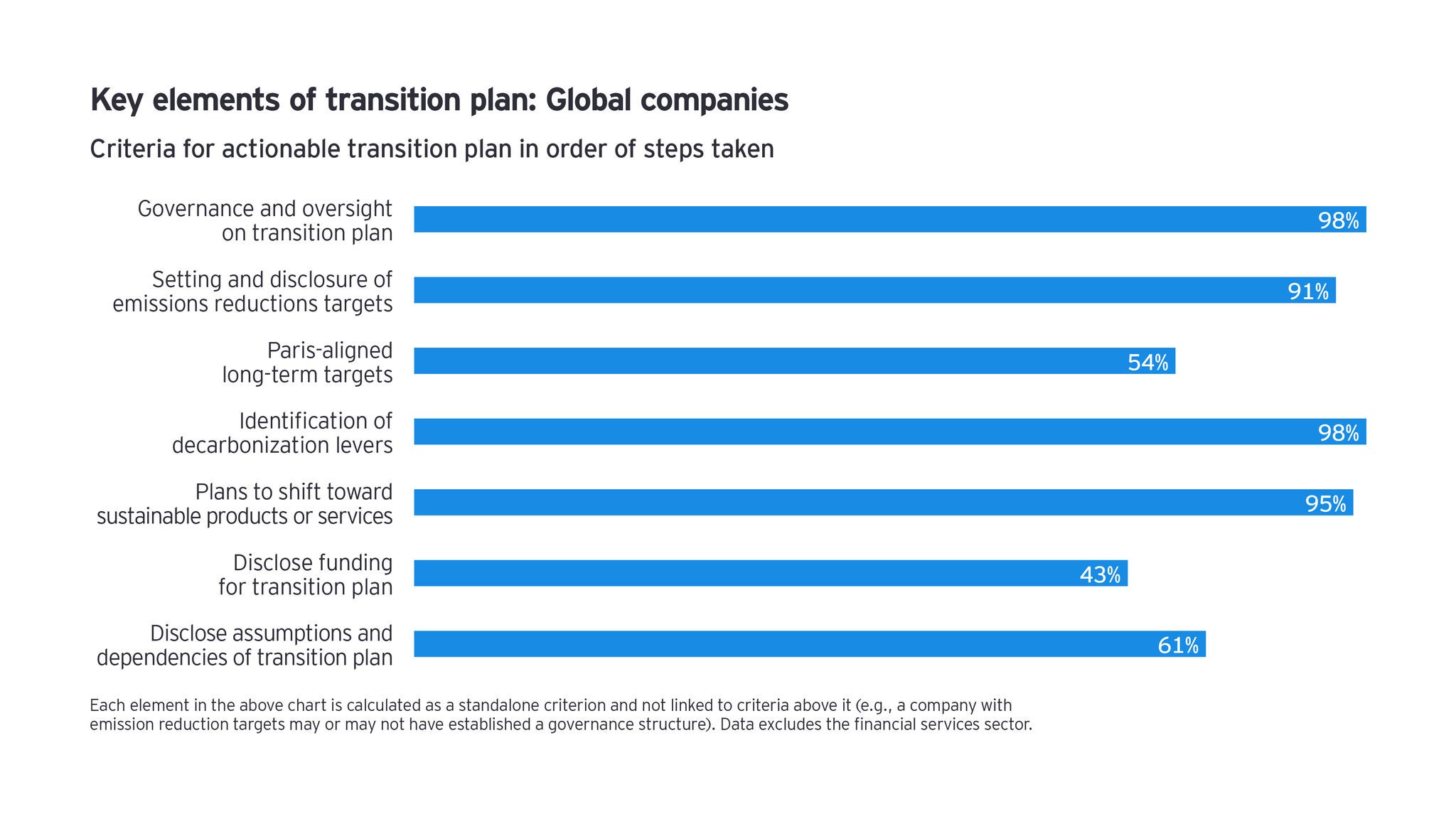
Chart

From frameworks to follow-through

Companies have spent the past two years preparing to disclose, not preparing to do.

Most large organisations in Australia and New Zealand have strong governance oversight of climate risk. Eighty-four percent of Oceania companies disclose board-level responsibility, significantly higher than the global average of 72%. Risk assessments are largely complete, baselines measured and decarbonisation levers identified.

Frameworks themselves do not cut emissions; they simply describe how an organisation might act. The next step – implementing the operational shifts that change footprints, supply chains and capital flows – is, for many companies, still a large stride.

One number illustrates the gap: only 4% of Oceania boards oversee climate-related capital allocation. Boards understand the risk, but the spending has not yet followed.

The policy pivot

What will close the gap? Three developments converged in 2025 that will continue to play out in 2026:

  1. AASB S2 and NZ CS climate disclosures: From 1 January 2025, large entities in Australia must disclose the financial effects of climate-related risks and opportunities. In New Zealand this requirement will now commence from FY27. Companies need to quantify the expected impacts on cashflow, asset values and investment plans. Read more on the EY Sustainability Disclosure Hub.
  2. Australian Treasury’s transition plan guidance: This will outline what credible transition planning looks like in practice: key assumptions, capital dependencies, governance, scenario alignment and progress metrics. Currently in draft consultation, the guidance will raise expectations and provide a reference point for investors looking to differentiate ambition from execution.
  3. Safeguard Mechanism begins to bite: For Australia’s 215 heaviest emitters, carbon now shows up as a line item in financial performance. Baselines decline by 4.9% each year to 2030. Companies that delay decarbonisation face rising costs. Those that invest early can reduce exposure and improve predictability. EY modelling has found reforms to the Safeguard Mechanism won’t just impact the entities that account for 28% of Australia’s emissions – they will reverberate through Australia’s economy.

Overall, these three developments make it harder for companies to rely on high-level commitments or distant targets. They also make it easier for markets to reward progress and to penalise stagnation.

The financial stakes are rising

The EY Global Climate Action Barometer estimates that the global cost of inaction averages 15% of annual revenue. Across Oceania, the financial effects are already visible in flood-damaged assets, supply chain disruptions, insurance volatility and investor scrutiny of high-emissions portfolios.

Yet only 17% of global companies disclose the financial impact of climate risks. In Oceania, the figure falls to 8%, and to just 5% in Australia.

This lack of disclosure does not mean the risks are low or absent. It means they are not yet fully understood or quantified. For investors assessing long-term value, opacity creates uncertainty. For boards, it creates vulnerability, as risk cannot be governed if it is not priced.

2025 EY Global Climate Action Barometer

To better understand why businesses need to shift from a commitment to an action mindset, take a look at the full report.

Summary

Australia and New Zealand have the ingredients for a rapid acceleration: a decarbonising grid, strong governance foundations, maturing investor expectations and policy settings that reward early action. The transition is no longer a future exercise in scenario planning, but a present-day exercise in execution.

For boards, this means establishing clear accountability, setting shorter-term milestones and linking remuneration to delivery. For executives, it means budgeting for decarbonisation in the same way they budget for growth. And for markets, it means looking beyond targets to the quality of the plan and the credibility of the pathway.

About this article

Related articles

2035 climate target: Eight keys to achieve net zero

EY Net Zero Centre’s latest report shows most emissions cuts to 2035 can reduce costs. Learn why this target matters – and what business and government can do now to stay ahead.

Why hard choices in 2025 will define your sustainability journey

Discover six challenges shaping climate strategy in 2025 and how to turn compliance pressure into commercial advantage.

Emma Herd + 1

Mandatory Scope 3 Emissions Reporting

For many Australian organisations, the reporting of scope 3 emissions is about to move from being ‘on the radar’ to front of mind.