








Aerial satellite view of a thunderstorm with dramatic cloud patterns and active lightning, highlighting the storm's intensity

What makes today’s climate leaders tomorrow’s business leaders?

Local contacts:
Thibaut Millet, EY Canada Climate Change and Sustainability Leader
Stephanie Hamilton, EY Canada Climate Change and Sustainability Services Lead; Partner, CCaSS, Ernst & Young LLP

The 2025 EY Global Climate Action Barometer shows how proactive climate action can present a valuable strategic opportunity for companies.


In brief

  • The 2025 Barometer focuses on companies demonstrating leadership in climate ambition and risk management, as well as disclosure quality based on 2024 research.
  • Most climate leaders claim to have a transition plan, and they are assessing both the physical and transition risks associated with climate change.
  • Companies that manage risks, seize opportunities and adapt their business models may be better able to achieve their climate goals and thrive in the future.

As extreme weather events grow more frequent and severe, the urgency for corporate climate action has never been greater. Progress, though evident, remains inconsistent: some regions are making headway with climate disclosures and transition strategies, while others encounter political resistance and regulatory setbacks. In this context, transparency emerges as a cornerstone for both individual and collective climate action, enabling companies to share how they are managing risks and supporting wider systemic change. Open reporting not only fosters industry-wide collaboration but also strengthens accountability and drives meaningful progress across sectors.

In a context shaped by global volatility — including changes in regulatory developments such as the EU Omnibus Package, the Corporate Sustainability Reporting Directive (CSRD), the European Sustainability Reporting Standards (ESRS), the Sustainable Finance Disclosure Regulation (SFDR), and the Corporate Sustainability Due Diligence Directive (CSDDD), alongside mounting geopolitical tensions — the selection criteria for the Global Climate Action Barometer study have been recalibrated to better reflect the shifting dynamics of corporate climate action.

Building on the urgency underscored in previous reports, the 2025 EY Global Climate Action Barometer (pdf) (the Barometer) focuses on over 850 companies classed as climate leaders in the 2024 Barometer report (pdf) (CAB24): companies that had committed to transition plans, or pledged to disclose one, as well as those demonstrating strong climate risk management. This refined approach enables us to spotlight top performers — those translating high-quality disclosures into concrete actions — and look at what we can learn from these leading companies and the robustness of their claims.

Strong, actionable transition plans are vital for a company’s resilience and long-term preparedness. They show how businesses can anticipate risks, adapt strategies and remain sustainable in a rapidly evolving low-carbon economy. Businesses have a significant opportunity to enhance their long-term resilience by putting in place a practical transition plan that will help them adapt to climate change challenges.

Curvy Mountain grassland scenery in Xinjiang
1

Part 1

Companies are making limited progress on climate action

Despite progress in climate planning, many companies are lagging in transparency, target-setting and the financial evaluation of climate actions, especially regarding Scope 3 emissions and governance.

The Barometer shows that companies are not progressing with their climate reporting substantially. Despite 64% of companies having a transition plan, most of them either show no progress or have moved backward regarding their previous commitments. Climate inaction can be costly to businesses, with future inaction estimated to cost 15% of their annualized revenue on average, according to the Barometer. Yet, less than one in three companies (31%) assess the financial impact of both the cost of action and the long-term cost of inaction in relation to climate-related risks, whether those are physical or transition risks.
 

Twenty-five percent of companies are not disclosing or planning to disclose transition plans in 2024. They may be hesitating to do so for several reasons:

  • Political uncertainty
  • The costs and efforts associated with developing such plans
  • Lack of any transition plan at all
  • Lack of robustness or credibility needed for public sharing
  • Reluctance to disclose commercially sensitive information to competitors, such as details about their exposure to significant physical and transition risks

When companies see peers withholding climate risk disclosures, they may follow suit — undermining collective action and systemic progress.


This lack of transparency extends beyond disclosure. While 92% of companies analyzed assess the qualitative or quantitative impact of physical risks, or both, just 44% say they have adaptation measures in place. Without adaptation measures, companies risk far-reaching disruption to their business models — which may be a major concern to investors and other stakeholders.

Sixty-eight percent of companies claim to have undertaken quantitative risk assessments for both physical and transition risks, yet only 17% disclose the financial impact of these risks. This is possibly due to the short time horizons of financial statements and the complexity involved with making the calculations.

Decarbonization levers and the challenge of Scope 3 emissions

The research found that nearly four out of five companies (78%) have disclosed the adoption of decarbonization levers across all three scopes, with almost all (96%) having implemented decarbonization levers for Scopes 1 and 2. Expectedly, Scope 3 emissions continue to pose a significant challenge for companies, with the majority (60% to 90%) reporting only upstream emissions and only 10% to 40% reporting downstream emissions.3

Nearly all nonfinancial companies (98%) have adopted decarbonization levers across at least one scope, and 91% have set emissions reduction targets. Targets are important because they help companies to determine the extent to which emissions need to be reduced, the impact of specific decarbonization levers and which additional measures must be taken to drive emissions reduction.


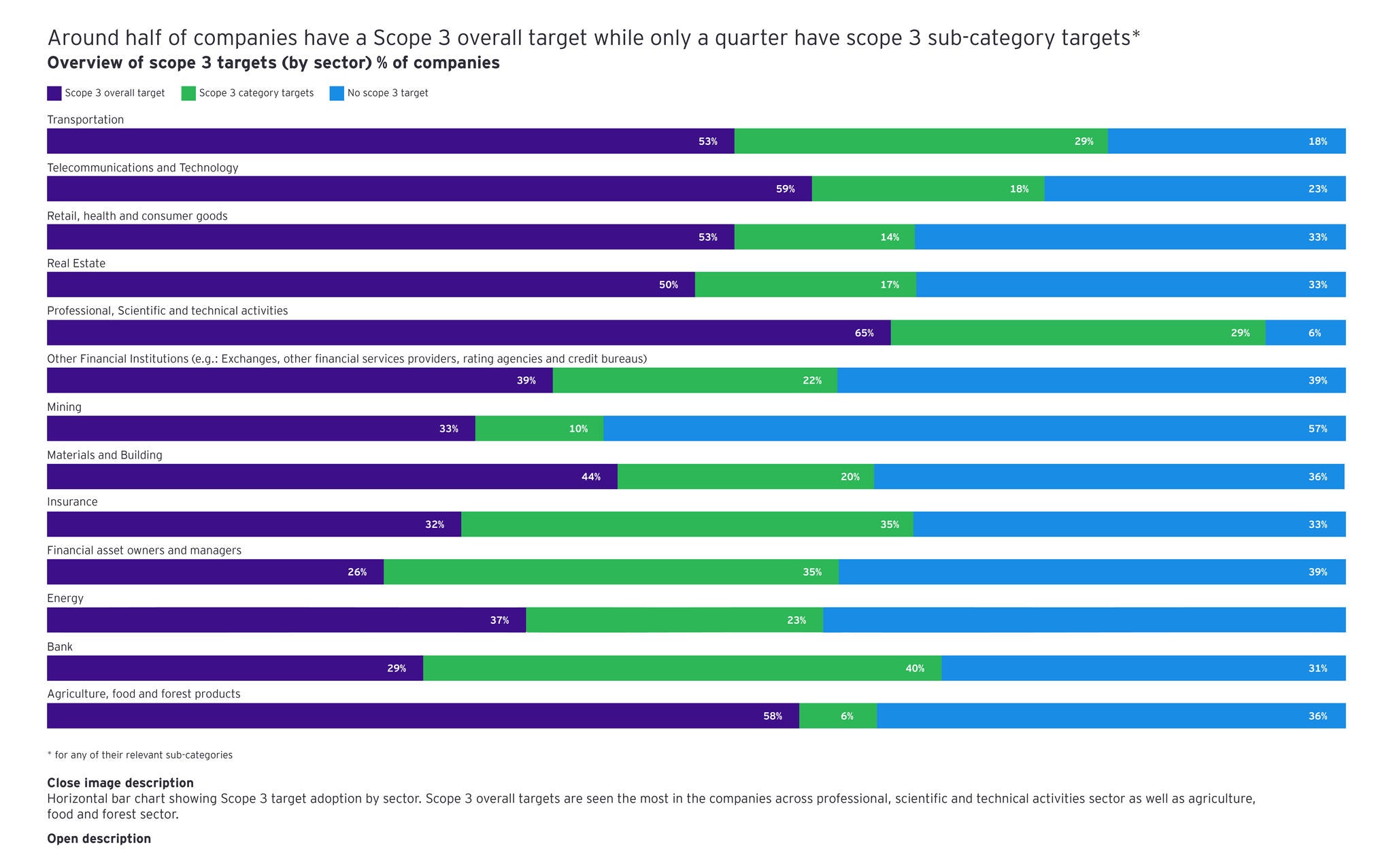
While most companies report their Scope 3 emissions, at least to some degree, only around half (53%) have an overall Scope 3 target. A delay in setting and achieving Scope 3 emissions reduction targets can hinder companies’ overall progress on climate goals.

Governance

EY analysis found that many companies are accelerating decarbonization efforts, not waiting for formal governance frameworks or clearly defined emission targets. Only 8% of companies disclose capital allocation, 21% target-setting and 41% progress monitoring.

Executive incentive plans are a vital part of the governance process to push for successful climate strategies. The research shows that climate leaders indeed recognize this link, with 82% of the companies analyzed having an incentive plan that features environmental metrics, such as reduction in absolute emissions and their intensity as well as performance against net-zero targets.

Overall, however, the findings suggest governance needs to be improved if companies are to accelerate action on climate change. Nevertheless, it may be the case that boards are more involved with climate strategy than companies are currently disclosing. It is therefore critical that companies improve their disclosure in this area to show that they are being held accountable for their progress. A recent EY study — How can boards bridge the gap between sustainability ambition and action? — revealed key lessons for cross-functional collaboration and essential interdependent traits for board and management that drive sustainable business outcomes.

Curvy Mountain grassland scenery in Xinjiang
2

Part 2

How to truly lead on climate action

More decisive action is needed from both policymakers and businesses to accelerate decarbonization and effectively address climate risks.

The disclosures analyzed for this year’s Barometer show that climate leaders are setting targets, monitoring emissions reduction and assessing their climate-related risks. Nevertheless, even these forward-thinking companies should aim to take the more ambitious action needed to accelerate decarbonization, transform their business models and address the threats they face.

So, what can policymakers, regulators and businesses do to drive more action on climate? Here are some top recommendations from the research.

Top three actions for policymakers and regulators:

  1. Lead by example. Governments should promote accountability and transparency on the climate agenda by setting metrics and targets, as well as disclosing their progress against these targets in their reporting. They should also be open about the climate risks and opportunities facing their national economies.

  2. Mandate all large companies to disclose sector-specific transition plans, including information on the amount of capital expenditures and operating expenses they have committed to transition. Transparency around transition planning will increase if companies know their peers and competitors are also publishing transition plans. Accounting frameworks could also be reviewed so that companies are required to specifically quantify the potential impact of their climate risks over the long term.

  3. Develop a clear and consistent regulatory framework that contains the right mix of incentives and penalties to drive ambitious action. Companies can be incentivized to take action on climate through approaches such as grants and tax credits. Those companies that do not take appropriate action should be penalized through fines or loss of market access.

Top five actions for companies:

  1. Start with a comprehensive approach. Companies should integrate climate goals into their core strategy by setting ambitious yet attainable targets and directing capital toward essential climate-related investments. This includes preparing for evolving scientific insights and the increasing impact of nature on business models. Strong governance is crucial, with board-level oversight on goal setting, progress tracking and investment decisions, potentially supported by appointing a board member with specialized climate expertise to uphold high standards.

  2. Create and disclose an actionable transition plan. Companies should develop and publicly disclose a comprehensive, actionable transition plan that includes governance structures, emissions reduction targets aligned with the Paris Agreement, decarbonization strategies, shifts toward sustainable products and services, and transparent funding mechanisms, along with the assumptions and dependencies underlying the plan. By doing so, they commit to their climate goals and allow stakeholders to hold them accountable. The plan should also incorporate different future scenarios, assessing associated risks, opportunities and financial impacts, while outlining strategies to mitigate identified risks across different potential outcomes.

  3. Reduce reliance on carbon credits. Companies should minimize reliance on carbon credits and instead focus on internal carbon pricing (ICP)5 as a strategic tool to drive genuine emissions reductions. While carbon credits can support short-term progress by addressing residual emissions, they have to be paired with credible and measurable decarbonization efforts and not used as substitutes for actual reductions. Realistic ICP helps companies prepare for a future where high carbon footprints are financially unsustainable, encouraging long-term planning and investment in low-carbon solutions.

  4. Engage with your value chain and foster collaboration. To address the significant challenge of Scope 3 emissions and beyond, companies should actively engage with their value chains by encouraging suppliers to set net-zero targets and develop transition plans, thereby promoting climate action throughout the supply chain. Additionally, collaboration between the public and private sectors is essential for successful transitions, as public-private partnerships leverage private sector expertise and resources to accelerate the development of sustainable infrastructure and services.

  5. Embrace artificial intelligence (AI) responsibly. AI tools present both significant risks and opportunities in the transition to net zero, as their high energy consumption can increase emissions, but they also offer powerful capabilities to support climate action. AI can optimize renewable energy operations, model future climate scenarios, plan low-emission transport routes, and enhance resource efficiency in sectors such as agriculture and manufacturing. When used strategically and responsibly, AI can be a transformative asset for companies aiming to accelerate their climate action goals.

2025 EY Global Climate Action Barometer

For further insight into why it's important for today's leaders to keep reporting on climate risk management, you can read the full report.


Summary

Today’s climate leaders could be tomorrow’s business leaders. As extreme weather events become more frequent, businesses face mounting pressure to act on climate change, yet progress remains inconsistent. The 2025 EY Global Climate Action Barometer finds that while many leading companies have set net-zero targets and disclosed transition plans, they need to ramp up reporting on their climate risk management to ensure collective industry progress.

Related articles

How a climate transition plan can strengthen your business model

Climate transition plans are necessary for companies aiming to achieve ambitious climate targets. Read why.

    About this article