


EY refers to the global organization, and may refer to one or more, of the member firms of Ernst & Young Global Limited, each of which is a separate legal entity. Ernst & Young Global Limited, a UK company limited by guarantee, does not provide services to clients.
Recent Searches
Trending
-
Advancing Canada’s defence innovation
09 Apr 2026 -
Canadian Insurance Outlook 2026: navigating uncertainty, unlocking opportunity
13 Mar 2026 Financial services -
From bottleneck to accelerator: the strategic role of digital identity controls for industrials and energy companies
18 Feb 2026 Energy and resources

Contributors
Cormac Leddy, Senior Manager, Technology Consulting, EY Canada
Eric Guay, Senior, Technology Consulting, EY Canada
Krista Broughton, Director of Product, Open Banking, Mastercard
Unlock insights on how security and trust drive Canadian consumers' choices in open banking and reshape financial service experiences.
In brief:
- Canadian consumers prioritize security, data control, and trust when sharing financial data, significantly impacting open banking adoption.
- Effective measures addressing consumer concerns can enhance willingness to share data, leading to improved relationships with financial service providers.
- Simplification and personalization of financial products are crucial for attracting consumers and small-to-medium-sized businesses in the evolving open banking landscape.
Consumer-driven banking. Connected finance. Open banking. Three distinct terms for one common concept: Canadians’ ability to securely share financial data with accredited third parties — all in the spirit of accessing new and improved financial experiences.
This capability is already changing the way people and businesses interact with financial services providers. And therein lies a significant opportunity. Service providers that level up simplicity and personalization can now strengthen customer relationships, generate loyalty, build brand and grow results.
To succeed, providers must strike the right balance between reducing perceived barriers and providing the right value driver to the right consumer at the right time. That starts by seeking to understand — and address — the underlying factors that hold consumers back from, or motivate them to, share personal data.
In its fourth iteration, this year’s EY Canada Open Banking Survey conducted in partnership with Mastercard and TrueChoice Solutions surfaces insights into data-sharing preferences among personal banking and small-to-medium-sized business (SMB) consumers. Our 2025 report is the most detailed yet, digging deep into why respondents who use a wide range of financial service providers share their data, or don’t, which value drivers stand the greatest chance of influencing decisions and what kinds of financial products interest Canadians now.
What did we learn? Three key findings stand out.
1. Security, data control and trust matter most to Canadian consumers.
Protecting identity and account information is crucial. Consumers want to know security measures are in place to protect their privacy. That includes ensuring data is only used for its intended purpose and protecting it through adherence to technical standards. These security measures make up the greatest barriers to open banking adoption.
In addition to security measures, consumers are also concerned about data consent and control. Consumers want the ability to revoke access to their data and prevent it from being repurposed without their consent.
This comes down to building trust. Our survey shows that trust varies across demographic groups. Factors like age and income affected how consumers perceive data sharing and whether they adopt new financial services. Trust is the foundation of these decisions.
Put simply: financial services providers that fail to create security measures, data consent and control guardrails and build trust run the risk of losing out on open banking’s potential.
By the numbers, Canadian consumers say:
Security, data control and trust combined are
27%
27%
more important than simplifying banking processes to be easier and more efficient.
Similarly, security, data control and trust combined are
18%
18%
more important than personalized banking services to meet individualized consumer needs.
Trust also matters a great deal to SMBs. For this group, barriers such as additional security measures and data control become less important when financial services providers successfully establish trust and demonstrate brand recognition.
Specifically:
Of the SMBs that rank identity and account protection as their most important factors,
57%
57%
showcase an overall increase in barriers, specifically in data control.
Of the SMBs that rank the service provider receiving or transmitting their data as a brand they trust,
27%
27%
put less importance on other data control and security barriers.
Effectively addressing consumer barriers can significantly improve consumer willingness to share data in the near term.
When service providers implement effective security and data control measures, they can build the kind of trust that moves consumers beyond these barriers — and make value drivers much more enticing. This can help accelerate data sharing specifically, and open banking adoption overall.
Among Canadian consumers considering data sharing:
68%
68%
say protecting themselves against identity theft is their primary concern.
72%
72%
emphasize that data should only be used for its intended purpose.
Products that include identity theft protection measures and only use data for its intended purpose are
2.1x
2.1x
more valuable to survey respondents.
Which other factors impact the importance of a given barrier to an individual consumer?
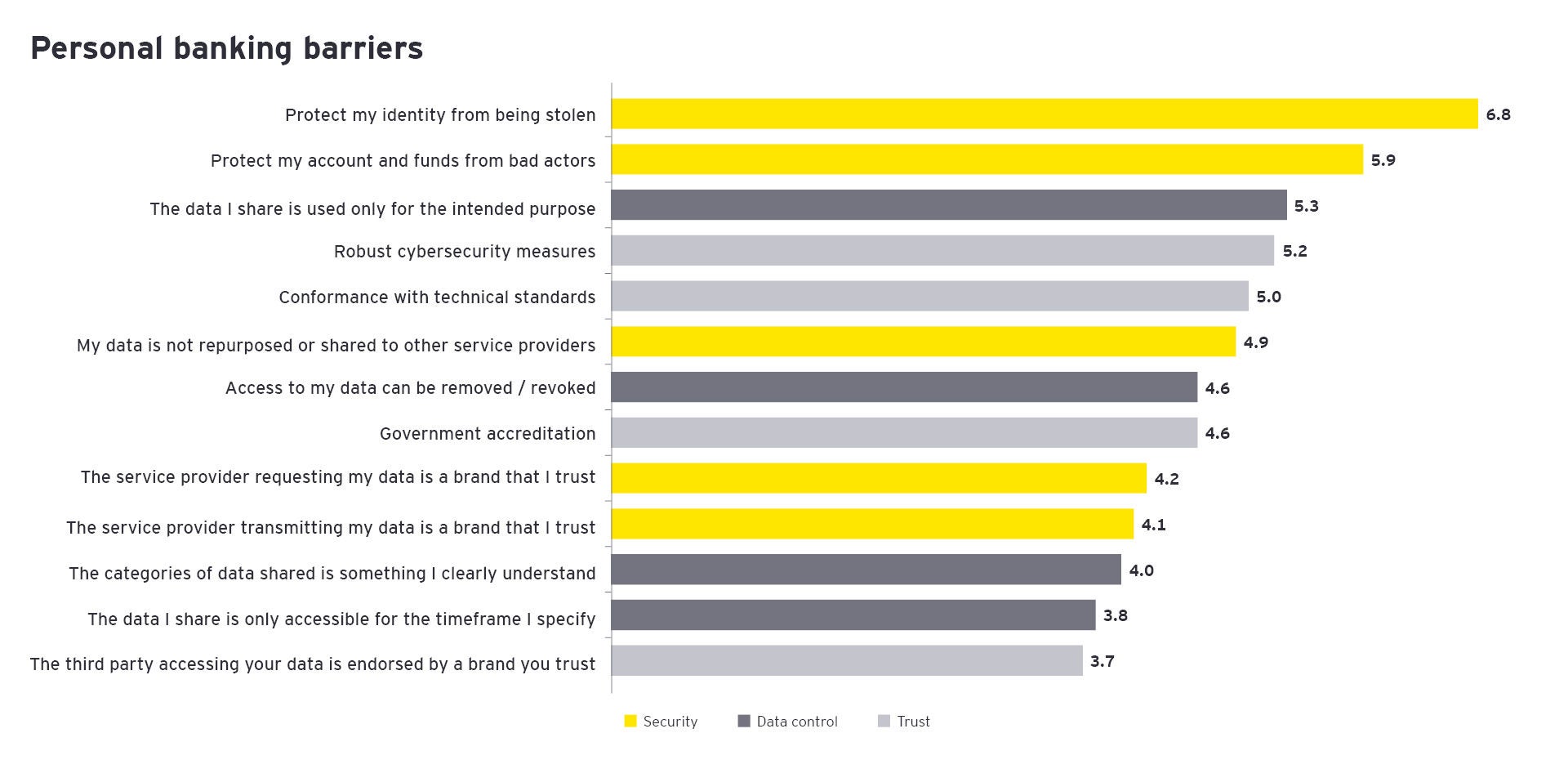
That said, building trust is a dynamic process. Different barriers will matter in different ways across demographic groups, with age emerging as a standout influencer around data sharing and adoption of new financial services.
Expanding that lens shows that Canadian SMBs have similar views of perceived barriers:
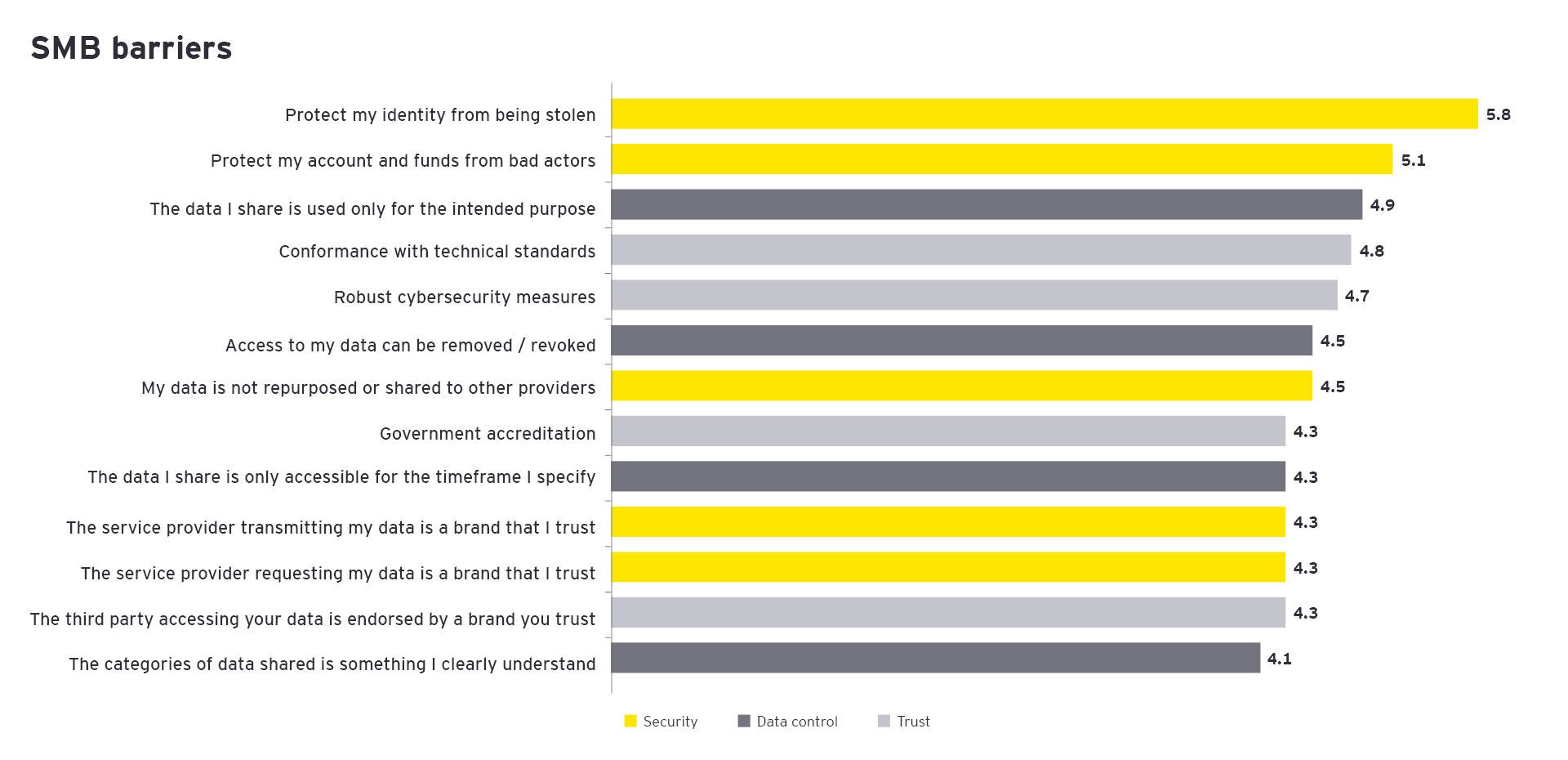
Taken together, this insight reinforces the need to adapt barrier mitigation strategies, both across demographic groups and within consumer and SMB audiences.
2. Differentiating through simplification and personalization are pivotal to open banking adoption.
Overcoming barriers is a must. Financial services providers that effectively address consumer concerns around security, data control and trust can create a meaningful springboard to progress. With those factors mitigated, these providers and institutions can turn their focus to maximizing value for personal banking and SMB customers. As they do, product or service simplification and personalization merit top focus.
How so?
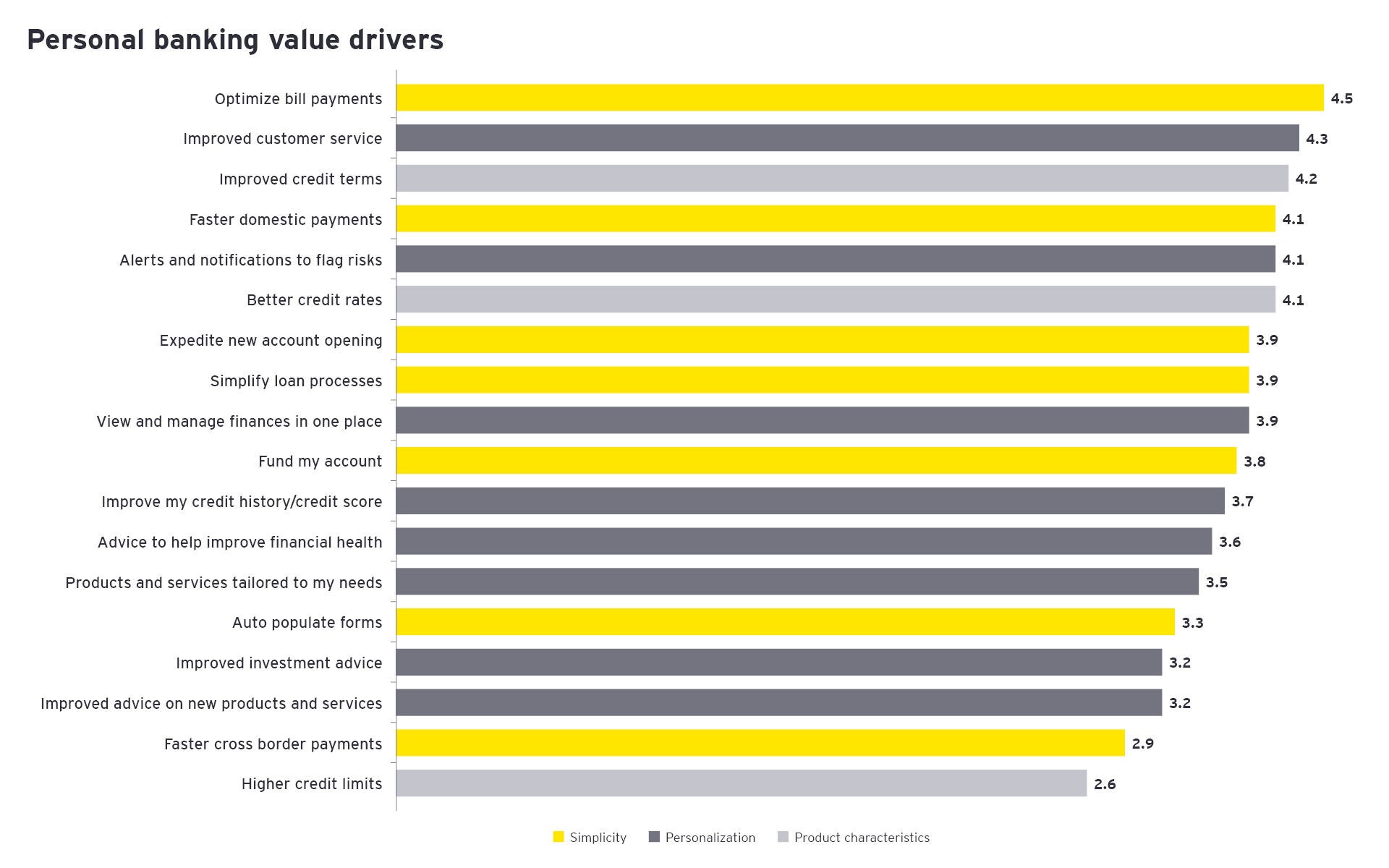
Personal banking consumers value product enhancements that simplify their finances — like optimized bill payments or the ability to move money within Canada more quickly and easily — above all other potential value drivers.
In fact, among Canadian consumers comparing two offers:
Offerings that include the ability to move money more quickly and easily within Canada are considered
1.5x
1.5x
more valuable than those that do not.
Offerings that include optimized bill payments are considered
1.6x
1.6x
more valuable than those that do not.
Offerings that combine both these features become
3.8x
3.8x
more valuable.
What other enhancements rank highly among Canadian consumers? Customer service improvements and more personalized communication, such as alerts and notifications to flag risks, are seen as highly attractive.
When comparing two product offerings with all else being equal, consumers prefer an offering with improved customer service 1.6 times more than one with improved investment advice — both of which are attributes of personalization improvements.
Overall, simplification and personalization offer financial services providers many different ways to set themselves apart with Canadian consumers:
In the SMB context, decision-makers are equally likely to embrace simplification and personalization features once barriers have been addressed.
With security, data control and trust mitigated, SMBs are open to a host of enhancements. Top among them: in Canada, SMBs place the greatest value on optimizing bill payments, moving money within Canada more seamlessly and improved customer experience. Account funding is also high on the priority list.
Among SMBs surveyed:
Offers that include expedited funding of a new account are considered
1.3x
1.3x
more valuable than offerings that do not.
Offers that expedite funding of a new account and optimize bill payments improve open banking adoption rates by more than
4x
4x
Combining product characteristics such as improved credit terms with enhanced access to capital drives a
33%
33%
jump in adoption rates among medium-sized businesses (compared to smaller businesses).
More broadly, what other value drivers influence SMBs to adopt open banking?
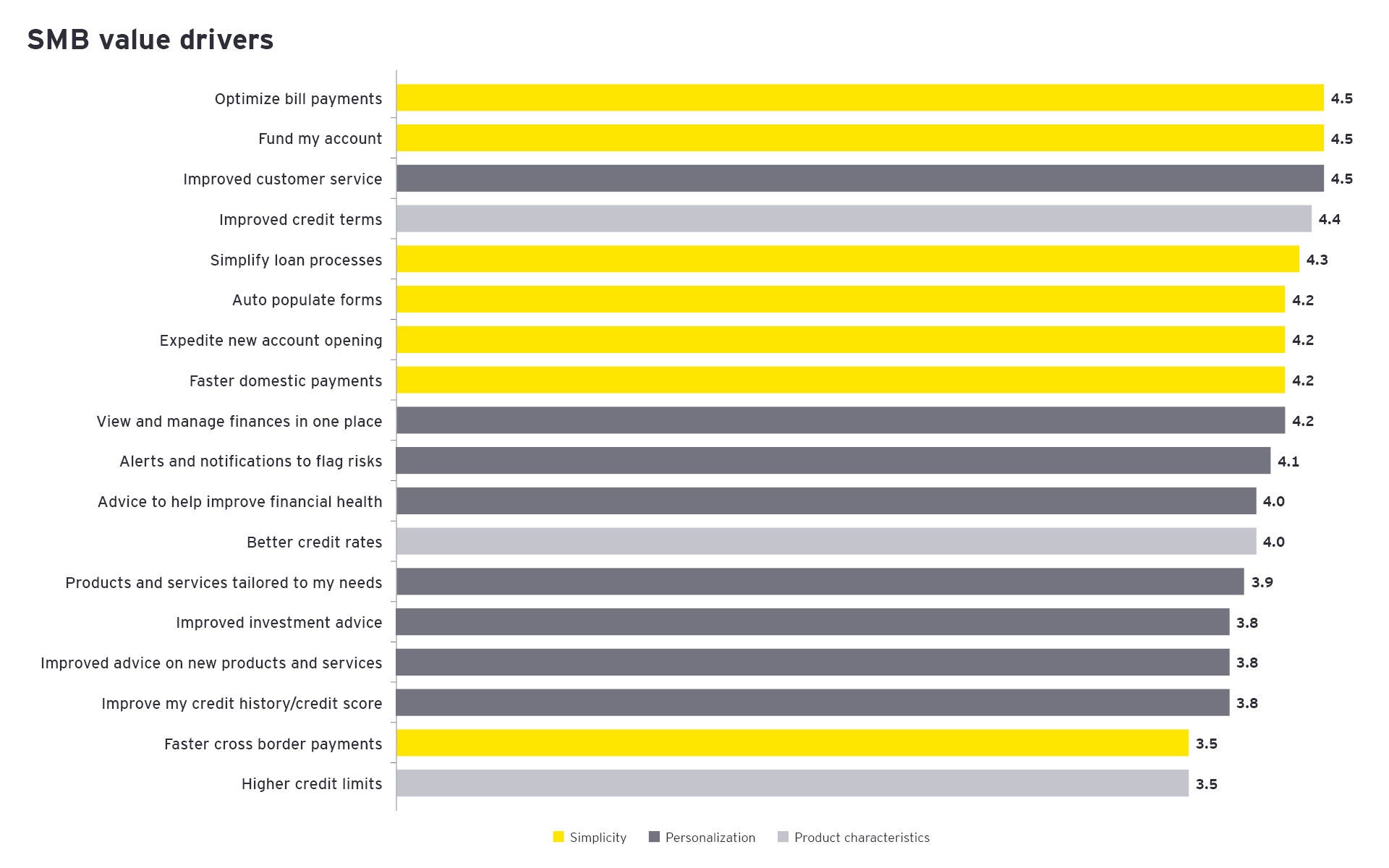
Among SMBs, we see a smaller gap between barriers — security, trust and data control — and value drivers — personalization and simplicity — compared to personal banking consumers.
SMBs also place slightly lower importance on top-ranked attributes such as security, data control and trust compared to personal banking consumers.
Reducing SMBs’ barriers could thus lead to a quicker uptick in open banking adoption.
How can financial service providers make the most of this insight?
- Financial service providers can capitalize on these insights to develop targeted strategies that address specific consumer concerns while highlighting value propositions.
- By comprehensively addressing security, data control and trust, financial service providers can foster greater adoption of open banking in Canada, ultimately transforming the way Canadians interact with financial services and beyond.
Our methodology
The ability to share customer-permissioned data across providers is a powerful capability that can be extended beyond financial services through open finance and open data, where there is a need to share sensitive data securely.1,2
As the market matures, important enablers of open banking include regulation around common standards and rules, technology and participation across ecosystem players. The ecosystem has placed emphasis on building towards a strong regulatory environment. Once the emphasis on foundational efforts subsides, consumer preferences will become the main driver of open banking adoption.
Expanding and deepening this year’s study in collaboration with Mastercard, we have combined our collective perspectives to examine Canadians’ preferences and attitudes towards open banking and the factors influencing adoption, including value drivers and barriers to adoption.
We asked 1,000 personal banking and 500 small to medium-sized business respondents across Canada who use a wide variety of financial services providers about their data-sharing preferences across various attributes such as types of data they’re willing to share, value drivers including simplicity and personalization, barriers such as security, trust and data control, and financial products of interest3.
This report provides a snapshot of our findings based on consumers’ data-sharing preferences and perceived value. Through valuation of use cases, the study’s patented approach measures in real time how consumers make decisions — using tradeoff analysis to identify potential barriers to adoption and the relative importance of value drivers within each use case. Robust individual-level profiles of consumer preferences and perceived value are captured to enable predictive insights for offer optimization, personalization and identification of key decision drivers that inform buyer values and behaviours4.
Summary
The EY Canada Open Banking Survey reveals that Canadian consumers prioritize security, data control, and trust when sharing financial data. These factors significantly influence open banking adoption, with effective measures enhancing consumer willingness to share information. Additionally, simplifying and personalizing financial products are vital for attracting both personal banking customers and small-to-medium-sized businesses. By addressing consumer concerns and focusing on value drivers, financial service providers can strengthen relationships and drive growth in the evolving open banking landscape.