




EY refers to the global organization, and may refer to one or more, of the member firms of Ernst & Young Global Limited, each of which is a separate legal entity. Ernst & Young Global Limited, a UK company limited by guarantee, does not provide services to clients.
Recent Searches

Authored by: Sharath Peddada, EY Canada Energy Industry Data and AI Leader
Unlock operational efficiency in Oil & Gas and Chemicals with Master Data Management. Discover how data governance boosts compliance, productivity and smarter decisions.
In brief
- Canada’s energy and resource companies generate and rely on huge amounts of data.
- Strengthening asset management data can help these businesses improve operations, productivity, decisions and compliance in a market where agility is a competitive advantage.
- One of the most important steps to unleashing that potential is a sound business case that brings internal stakeholders on board for Master Data Management (MDM) program implementation.
Master Data Management (MDM) holds significant potential for Canada’s energy and resource companies. By enabling the business with reliable data to make informed decisions, MDM can improve operations, efficiency and compliance. But stakeholders must understand the big picture to see those upsides and embrace MDM’s potential. Leaders looking to generate MDM buy-in should start by tailoring the business case to the organization’s specific challenges and opportunities.
How can MDM help energy organizations thrive?
MDM empowers organizations to improve vast and varied data sources. That’s particularly relevant for energy and resource organizations. By virtue of their multinational operations and many business lines, energy companies generate and process massive amounts of data every day. Without an effective platform capable of streamlining that process, that data can become siloed across departments, difficult to analyze and hard to rely on.
By contrast, building out the right MDM solution — either implemented on its own or as part of a broader transformation program — establishes centralized rules for data validation and standardized master data updates. This significantly improves the business’s data quality by making the data across the organization:
- Consistent
- Accurate
- Updated
This kind of robust data integrity reduces errors, improves efficiency, supports decision-making and creates a competitive edge for the business overall, especially in the face of market volatility and an evolving trade and tariff environment.
Build the business case for MDM through concrete examples
Every effective transformation program starts with a compelling business case. For solutions as far-reaching as MDM, it can be difficult to qualify and quantify the value they ultimately bring to the organization. That’s due in part to MDM’s varied potential. For example, it might be hard for energy companies to quantify the potential return on investment of reduced data errors, enhanced operational efficiency and improved decision-making across the breadth and depth of the entire organization. The potential is huge, but often tough to illustrate.
Drawing on case studies to illustrate that potential can help stakeholders understand the full impact of possibilities here: for example, focusing on a clear use case and using real data and facts to sketch out the potential.
At EY, we recently mapped out possibilities for a midstream oil & gas and chemicals organization by illustrating insights from the maintenance function’s work order lifecycle. This allowed us to highlight the challenges the organization faced without an MDM system. By analyzing maintenance processes, the team identified operational metrics directly linked to MDM capabilities. This approach helped develop a successful MDM business case that the organization’s stakeholders could understand and relate to in the context of its actual operations.
So, what makes a good business case great?
1. Get clear on challenges.
Stakeholders must see the real pain points before considering how MDM might address them. In our recent case, we started by identifying operational improvements related to work order priority service level agreements (SLAs).
Analysis showed that only about 40% of work orders followed these defined SLAs. Meanwhile, noncompliant work orders resulted in longer throughput times, increased work order management costs and additional rescheduling efforts. We also revealed that work order noncompliance was linked to data gaps in the work order management process.
For example:
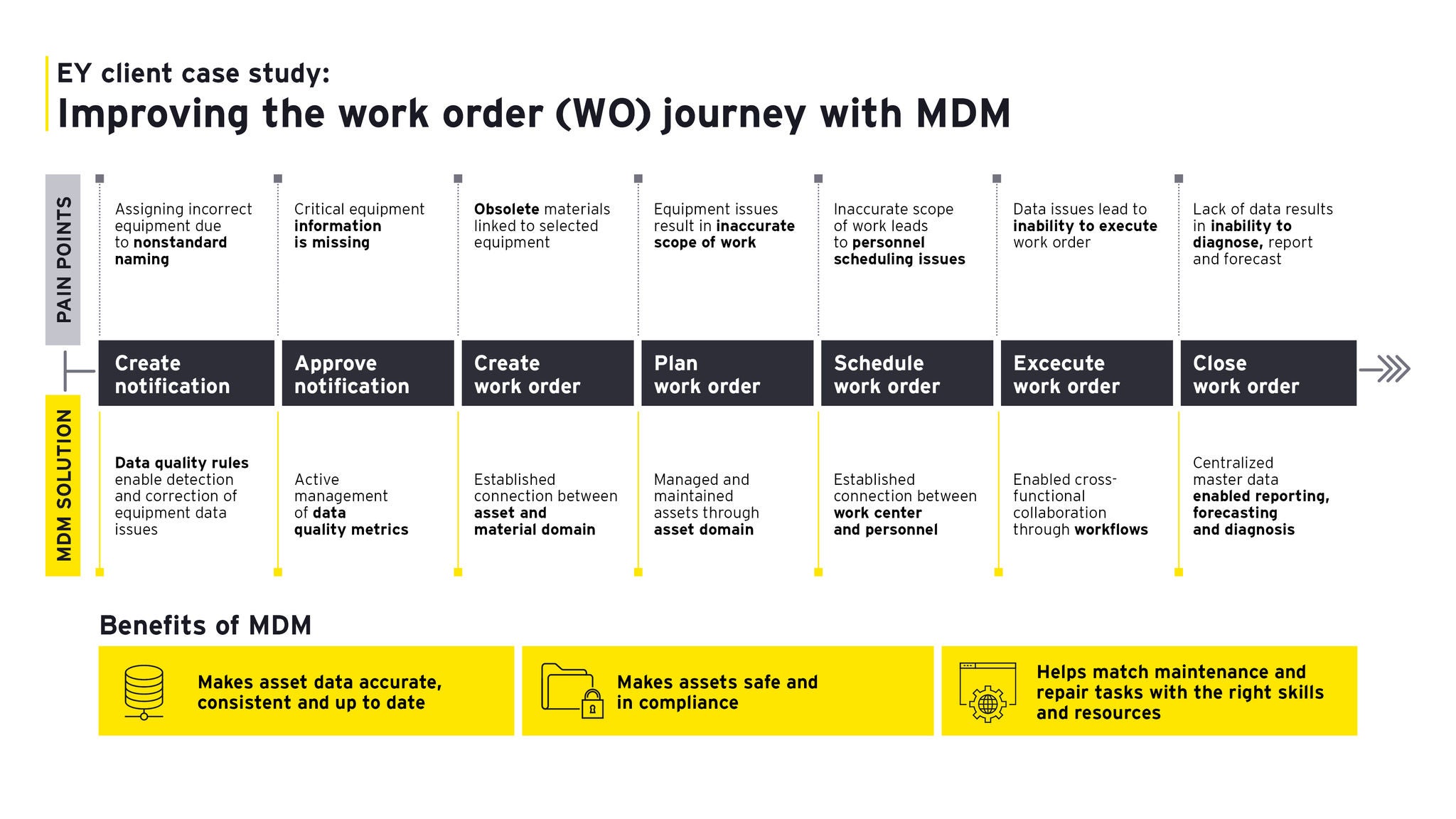
- Nonstandard naming or decommissioned data was leading to inaccurate prioritization.
- Critical equipment information was missing, causing approval delays.
- Materials linked to the selected equipment were also obsolete, resulting in procurement challenges and slowdowns.
- Equipment data issues led to inaccurate work scope, mismatched maintenance plans, incorrect resource allocation — and, as a knock-on effect, inaccurate planning.
The first step in helping stakeholders understand the value of MDM is clearly demonstrating how a lack of integrity creates challenges like these, prevents work orders from being executed and slows down execution timelines.
2. Provide specific examples.
Mapping out how an MDM solution will address specific business challenges is critical to helping stakeholders engage in the process. In the work order management example, analysis revealed that MDM concepts could effectively address procedural and tool challenges. We walked the team through an end-to-end work order management process to demonstrate how MDM would play a key role in closing those gaps.
For instance: a well-designed MDM program establishes data quality rules to notify the data steward of data issues linked to equipment. This allowed the data steward to resolve records right away, with updates in data sent back to the asset management tool. This would mitigate the risk of nonstandard equipment naming — reducing inconsistencies in asset assignment and allowing work to be done effectively the first time around.
Further, a well-integrated MDM program enables relationships across various data domains such as asset and material domains, which mitigates procurement and inventory challenges. These relationships can be extended to work centre and personnel data for effective work order planning. Contextualizing MDM in this way, by applying its proposed use against the business’s actual challenges, can generate stakeholder engagement.
3. Focus on outcomes.
People across business units must understand MDM’s ultimate objectives to support implementation. Whether consolidating data from multiple sources, standardizing work order templates, establishing hierarchical structures for data or providing ongoing data validation to achieve data accuracy and completeness, MDM systems integrate within the company’s existing ways of working to make operations smoother. Bring people on board for this transformation by explaining MDM’s actual impact.
For example, in our work order case, the MDM system ultimately streamlined the entire work order process:
- MDM enabled the organization to govern and maintain critical data to high standards.
- Accurate and reliable work order data moving through the MDM system enabled the company to generate real-time reports, track performance metrics and analyze trends quickly.
- By establishing the relationship between asset and material domains, MDM enabled dependencies between master objects.
- The system effectively created relationships between work centre and personnel so that people who had capacity were assigned to work orders based on availability and access to the locations.
All of this improved collaboration, communication, productivity, compliance and audit readiness. That said, helping folks across the business understand concrete potential outcomes empowers them to support MDM implementation with confidence, knowing the very specific benefits it could generate for their functional group and the organization at scale.
Summary
Investing in MDM helps tackle immediate operational challenges, but also provides long-term strategic advantages. By achieving leading-class metrics such as reduced cycle time and average rework, organizations can enhance operational efficiency, improve productivity and position themselves for sustained success in today’s competitive landscape. Unleashing that potential begins by building a clear business case that stakeholders can both understand and stand behind.
Related articles
CFO Role Evolution: Data and AI in Energy
Transforming CFOs into CVOs: Data & AI are key for Canada's energy leaders to unlock value & future-proof their companies.
The DNA of the Chief Data Officer
While balancing data enablement and control, CDOs must ultimately view data as an asset and need to understand how it can be effectively used.