



EY refers to the global organization, and may refer to one or more, of the member firms of Ernst & Young Global Limited, each of which is a separate legal entity. Ernst & Young Global Limited, a UK company limited by guarantee, does not provide services to clients.
Recent Searches
Trending
-
Advancing Canada’s defence innovation
09 Apr 2026 -
Canadian Insurance Outlook 2026: navigating uncertainty, unlocking opportunity
13 Mar 2026 Financial services -
From bottleneck to accelerator: the strategic role of digital identity controls for industrials and energy companies
18 Feb 2026 Energy and resources

Hiring or subcontracting: does the SR&ED tax credit program influence your strategy? We can help.
Innovation is, by definition, a risky activity for a business. The risk grows even larger when the steps toward innovation require technological advancement. Achieving technological advancement often depends on the skill and experience of the specialists assigned to innovative projects.
Therefore, two of the keys to success are effective recruitment and adequate cash flow.
This article will not broach recruitment, an extremely complex topic, given the current state of Québec’s job market. But we will tell you about a tax measure that can reduce the financial risk of your innovative project by influencing your recruitment strategy.
First question: Should I hire an employee or a sub-contractor to work on a project?
The non-specific duration of an innovative project and the technical specialization required to achieve technological advancement can influence your recruitment strategy. That being said, you might consider hiring a sub-contractor to work on your project.
Second question: So, which measures can influence my strategy?
First, it’s important to understand that both levels of government are interested in creating permanent jobs. So, they’re more generous when it comes to the expense of a hire than taking on a sub-contractor. For example, the Scientific Research and Experimental Development (SR&ED) tax credit program targets both employees and sub-contractors.
Below is a simulation table, based on the following assumptions:
- The nature of the expense (also known as the activity) meets the SR&ED program eligibility criteria.
- Your business qualifies for the maximum tax credit rate.
The simulation is based on an assumption in which a $50,000 salary qualifies for the program. Two scenarios are presented, for both a sub-contractor and an employee. The final cost to the business, after the tax credit, does not account for the cost of employee benefits.
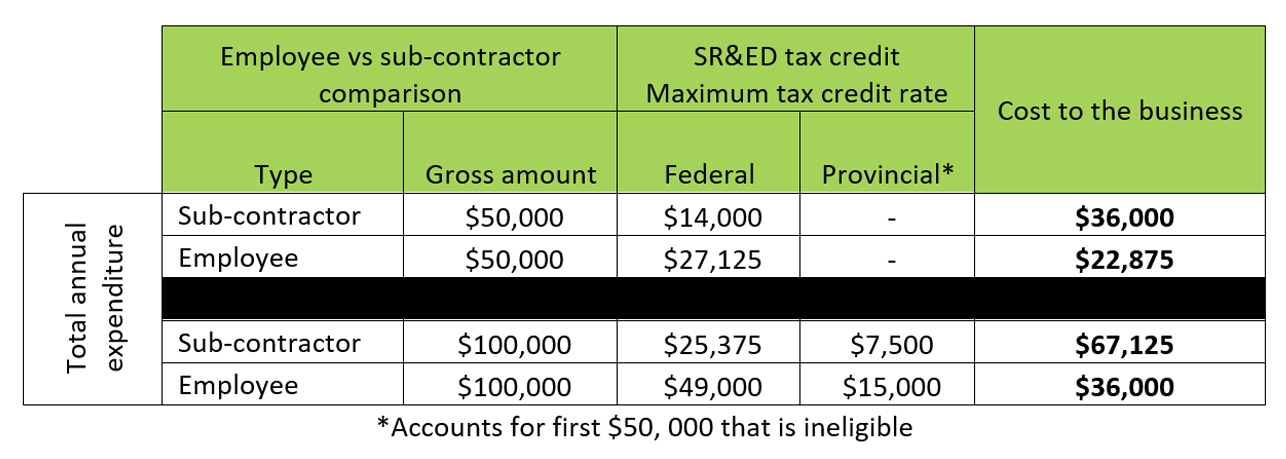
This simulation clearly shows the financial advantage of hiring an employee to work on your innovative project.
Caution: financial benefit should not be the only criterion for your recruitment strategy. A candidate’s skill, experience and ability to integrate into an existing team are also fundamental criteria. Would you like to discuss your options for your own project? Contact us.
Summary
In the context of claiming a tax credit for scientific research and experimental development, it is more profitable to hire an employee than a subcontractor to carry out an innovative project?