The hidden risk behind rapid adoption
The rapid spread of AI tools also introduces a new set of risks that many organizations are only beginning to confront.
One particularly noteworthy finding is that 29% of respondents say employees are allowed to use private AI accounts such as ChatGPT within their companies. For 8%, these personal accounts represent the only available means of accessing AI tools at work.
While this approach may accelerate experimentation and innovation, it also raises important questions about governance, security and control. When employees use personal AI accounts, organizations often have limited visibility into how company information is processed, stored or shared. Sensitive business data may inadvertently leave controlled corporate environments and enter external systems that are beyond the organization’s direct oversight.
This challenge illustrates why cybersecurity and data governance can no longer be treated as separate discussions from AI adoption. As AI systems become more deeply embedded in business processes, they increasingly interact with sensitive intellectual property, customer information, financial records and strategic data. Every AI interaction potentially creates a new point of exposure. The benefits of AI are significant, but so are the consequences of inadequate safeguards.
For Switzerland, whose economy is built on trust, precision and reliability, this issue is particularly important. Industries such as banking, insurance, pharmaceuticals, healthcare and advanced manufacturing depend on strict confidentiality and strong security controls. The country’s reputation as a secure place to do business has been cultivated over decades. Maintaining that reputation in the AI era will require equally strong digital safeguards.
Digital sovereignty has become a strategic business issue
Perhaps the clearest message emerging from the survey concerns digital sovereignty.
More than half of respondents say it is business-critical that AI systems comply with Swiss or European data protection requirements and that data processing takes place within Switzerland or the European Union. Respondents assigned an average importance rating of 8.7 out of 10 to local data processing and adherence to regional data protection standards.
This is not merely a matter of compliance with regulations. It is a strategic business concern. As organizations increasingly rely on global technology platforms, questions surrounding data location, data ownership and control over information flows become more significant. Companies want assurance that their data remains subject to predictable legal frameworks and that they retain visibility into how information is used.
For Swiss businesses, digital sovereignty represents a competitive advantage. Clients, partners and investors often choose Switzerland because of its strong legal framework, political stability and commitment to privacy. Extending these strengths into the digital economy offers an opportunity to differentiate Switzerland from competing business locations.
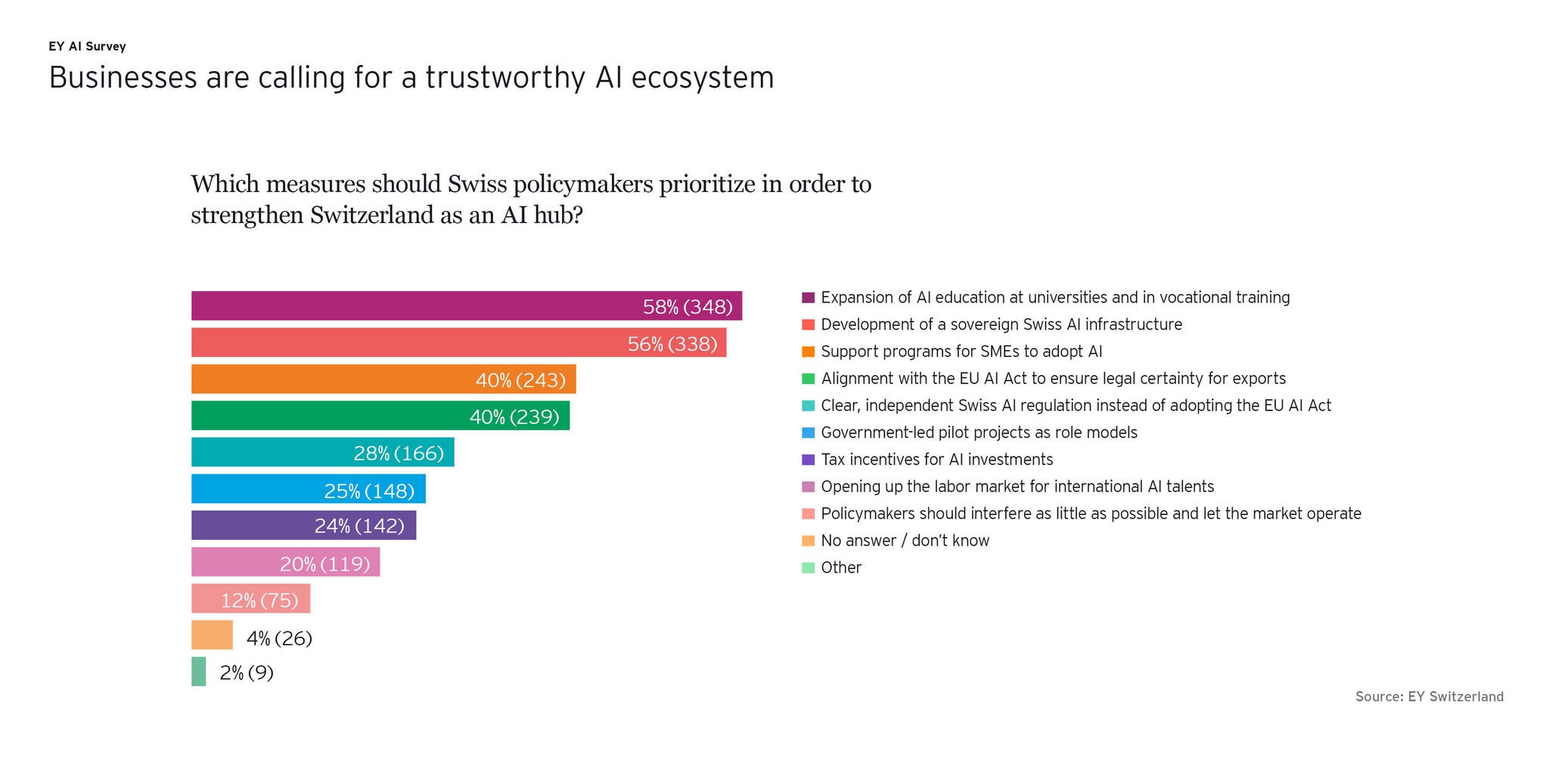
The survey findings suggest that businesses recognize this opportunity. A large majority of 56% support investments in sovereign Swiss AI infrastructure, including domestic cloud and computing capabilities. This level of support reflects a growing understanding that digital infrastructure is becoming as strategically important as physical infrastructure.
In the AI era, access to secure computing resources and trusted data environments may prove just as important as transportation networks, financial systems or energy grids.