


Electric car charging with wind turbines and solar panel

How smart charging and V2G solutions can drive Ireland’s renewable future

The energy system in Ireland is undergoing a fundamental transformation driven by decarbonisation.


In brief

  • Smart charging and vehicle-to-grid can reduce costs, support grid stability, and store up to 10% of Europe’s power by 2040.
  • Policies, incentives, technology solutions, and customer trust are vital to scale EV flexibility and meet climate goals.
  • Ireland targets 20% – 30% system flexibility by 2030 to manage renewable variability and rising demand.

On the supply side, the shift is already well underway; renewable sources now account for an average of 39% of electricity generation. On the demand side, the electrification of heating and transport remains a central priority. In 2025, electric vehicles (EVs) and heat pumps contribute just 4% to total demand, but this is expected to rise significantly to 18% by 2034, driving a projected 45% increase in overall demand relative to 2023.

The need for flexibility

Meeting this surge in demand while managing renewable variability presents a dual challenge. As dispatchable sources are replaced by intermittent wind and solar, system flexibility becomes critical. Ireland’s Climate Action Plan (CAP) 2024 set an ambitious target of between 20% and 30% flexibility by 2030 to support the renewable transition.

The potential for EV flexibility

Transport electrification is not only reshaping demand, it also holds untapped potential for system flexibility. With approximately 148,000 EVs on Irish roads, and CAP targets calling for 845,000 private and 82,000 commercial EVs by 2030, the scale of this transformation is significant. Research published this year by EY and Eurelectric has explored how EVs can provide grid balancing solutions, accelerate renewable energy adoption as well as reduce the total cost of ownership for consumers.

Unlocking EV flexibility

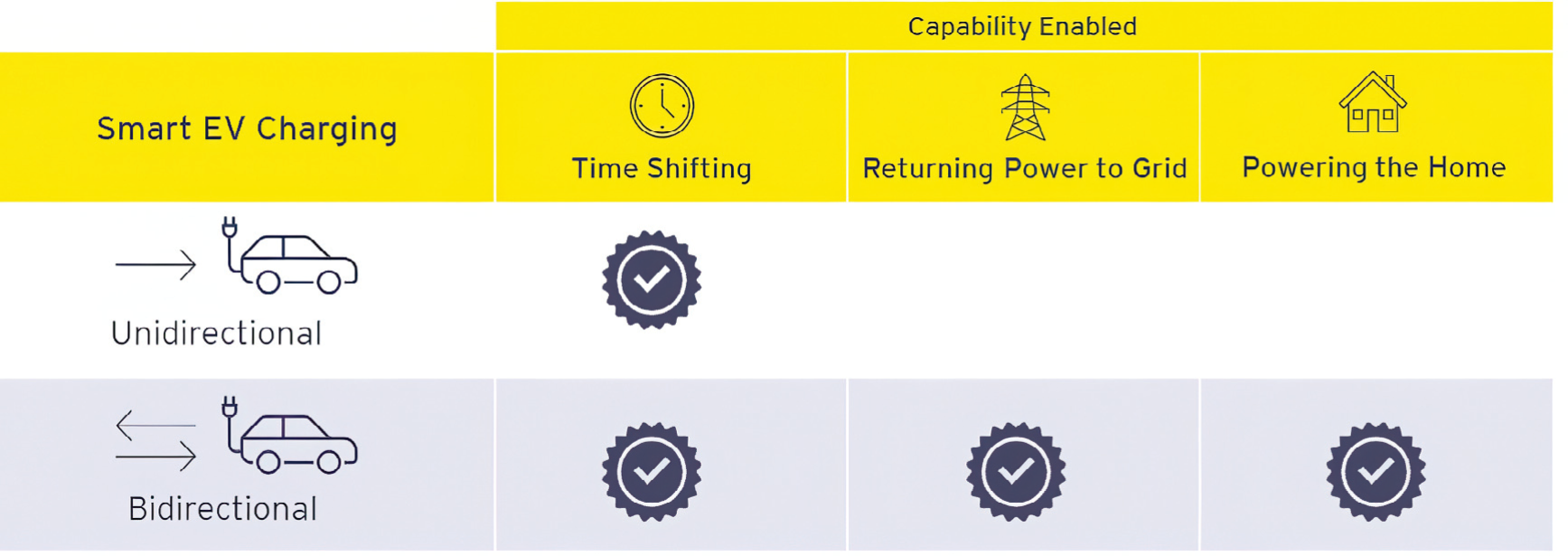
The technologies enabling this flexibility fall under two main categories – unidirectional smart charging and bi-directional vehicle-to-grid (V2G).


Unidirectional (V1G): Smart charging optimises the time of charging through smart algorithms, moving it away from peaks to lower demand periods overnight – and times of high renewable generation in its most optimised state. Customers benefit from lower prices via time-of-use (ToU) tariffs that reward off-peak usage. As ToU tariffs become more dynamic to network conditions, savings from optimised smart charging has the potential to grow.


Bidirectional: Bidirectional charging goes further, enabling V2G and vehicle-to-home (V2H) capabilities. V2G technology transforms EVs from passive consumers of energy into decentralised energy storage units and active participants in the grid by facilitating the flow of power between the vehicle and the grid. V2H capabilities provide network resilience, acting as on-site back-up generation to customers in the event of outages, and enable the optimisation of self-generation when integrated with microgeneration such as rooftop solar PV.

Smart EV charging

Benefits of unidirectional and bidirectional technologies

V1G and V2G present a clear win-win scenario for both system operators and customers. Here are some interesting findings from the EY-Eurelectric report outlines some interesting findings.

For system operators, V1G and V2G can contribute to peak demand shaving, reduction in renewable curtailment, and deferral/avoidance of network reinforcement. EY estimates that by 2030, the total EV battery capacity in Europe could be sufficient to power 30 million homes each year. Furthermore, by 2040, V2G technology could enable these batteries to store and reinject 10% of Europe’s power.

For customers, these technologies can help overcome the upfront cost barriers associated with EVs and incentivising ownership. Through aggregation services, individual customers may provide flexibility services to system operators. EY estimates that by switching to an equivalent EV, customers could achieve annual savings of €885 for compact segment cars, €1,229 for family cars vehicles and €1,760 for SUVs by charging during off-peak hours and selling energy back to the grid (based on the UK market).

Next steps

Unlocking EV flexibility will require making the most of existing V1G capabilities and laying the groundwork for the future V2G potential. Critical actions include:

  • Policy and market alignment: Implementing policies that facilitate uptake and flexibility participation, aligned to EU directives (including the Electric Market Directive and Regulation).
  • Frameworks and incentives: Translating regulations into effective frameworks with the right incentives to encourage participation (e.g., avoiding the double taxation of energy storage);
  • Technology solutions: Smart technology, reliable infrastructure, and standardised data sharing unlock new possibilities in energy. Paired with AI-driven insights, these solutions put households and businesses in control of their energy future.
  • Engagement: Education and advocacy efforts empower customers – both households and businesses – to actively participate in driving the energy transition and maximising the use of existing V1G and promoting the uptake of V2G technologies to provide flexibility.
  • Trust: Customer trust is critical to underpin EV flexibility participation. The use of customer data to enable AI applications that will facilitate flexibility will need to be leveraged in a transparent manner.

The article was first published in 2025/2026 Energy Ireland Annual Renewable Energy Magazine.

Summary

Renewable energy already accounts for 39% of Ireland’s electricity supply, but electrification of heating and transport will drive demand up by 45% by 2034. Flexibility is crucial as intermittent renewables replace dispatchable sources. EVs offer significant potential through smart charging (V1G) and vehicle-to-grid technologies, enabling grid balancing, cost savings, and resilience. Policy alignment, incentives, technology, and customer engagement are essential to unlock this flexibility and accelerate Ireland’s renewable transition.

Related content

Adapting to Change: How Providers can meet the new Energy demands of Irish Businesses

Energy providers need to adapt to rising business energy demand in Ireland. EY research shows how they can support growth and sustainability for companies.

Critical Minerals Shortage Threatens EU Energy Transition

Europe’s energy transition hinges on critical minerals—yet supply gaps threaten clean power goals and recycling remains a major challenge.

    About this article

    Contributors