





ey-com-banner

Can Australia move from raw materials to real advantage?

Australia’s critical minerals future depends less on geology, and more on building distributed partnerships for processing and refining capability to support supply chain resilience.


In brief:

  • Demand for critical minerals is rising rapidly across clean energy and artificial intelligence, placing pressure on highly-concentrated supply chains.
  • Australia holds vast mineral reserves, but converting raw ore into usable industrial inputs depends on targeted investment and new coalitions.
  • For Australia, capturing the opportunity demands early, deliberate decisions and a willingness to pay for reliability.

The clean energy transition is converging with the rapid expansion of artificial intelligence(AI), driving a step-change in demand for critical materials. Demand is expected to quadruple by 2040.

The technologies underpinning both – and shaping the next phase of Australia’s economic growth – draw on the same concentrated set of minerals and metals. Batteries, renewable energy systems, electric vehicles, transmission networks, semiconductors, data centres and AI infrastructure all rely on a shared material base, often sourced through highly-concentrated supply chains.

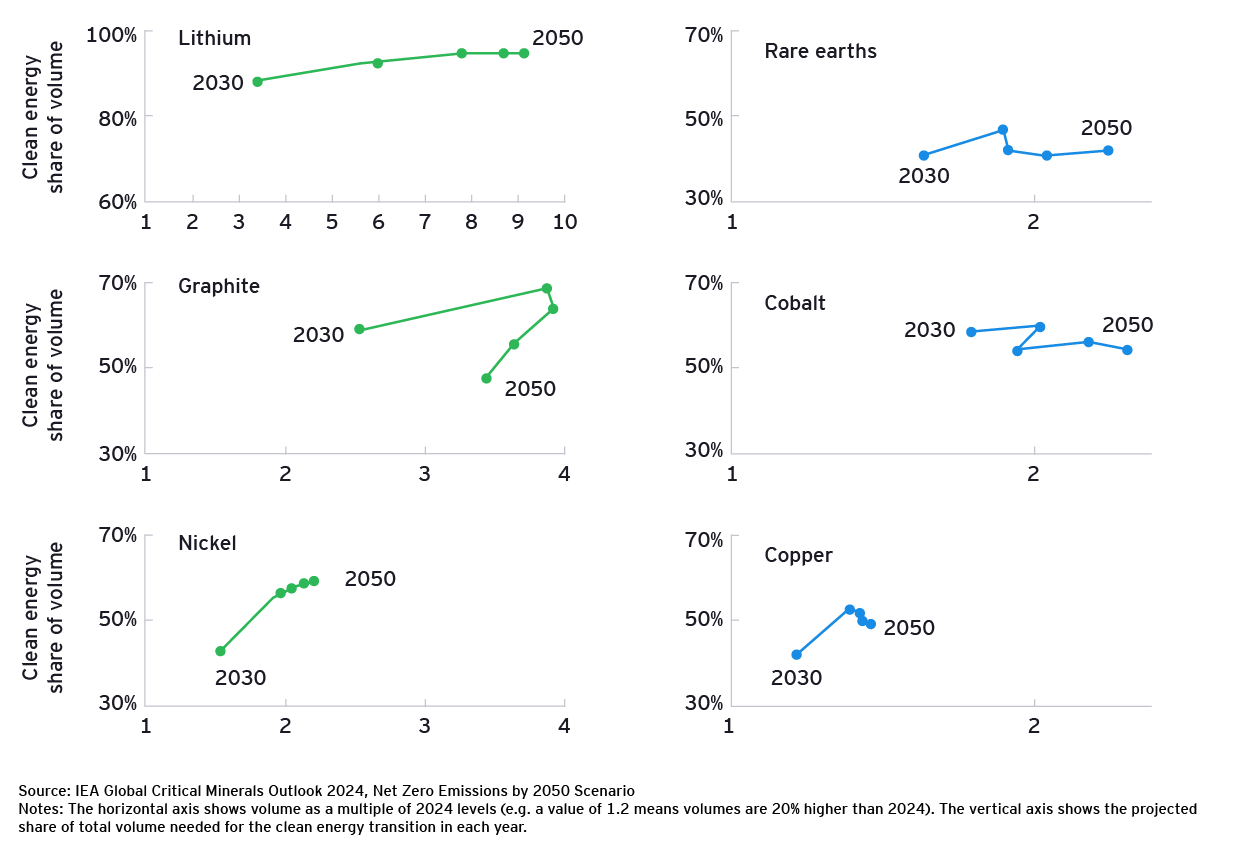
Minerals on the move

Minerals on the move
Projected growth in transition mineral demand to 2050 and the share of global supply consumed by clean energy technologies.

At the same time, geopolitical fragmentation is making critical material supply chains less predictable.

Governments and businesses are being challenged to think deeper about our resources. Cost alone is no longer the only deciding factor. Reliability, processing capability and strategic alignment now matter just as much.

These dynamics are explored in the EY Net Zero Centre’s latest report, Risk and Resilience: Rethinking Australia’s critical materials advantage in a disorderly world.

Supply gaps ahead
30-40%
30-40%
Projected supply shortfall for copper and lithium by 2035

Demand pressures from two directions

Clean energy technologies require up to seven times more mineral inputs than fossil-fuel alternatives. Electrification, battery storage and grid expansion all depend on large volumes of copper, lithium, nickel, cobalt and rare earths.

Capital investment in data centres by major technology companies exceeded US$400 billion  in 2025, and is now larger than global investment in oil and gas production.1 Data centres require extensive electrical infrastructure, cooling systems, semiconductors and network upgrades, all requiring inputs of critical materials.

Risk no longer resides in the performance or economics of clean energy technologies themselves. It sits in the systems that supply the materials required to build them.

Advantages beyond the resource

Australia enters this moment with significant advantages. We hold 26% of global lithium reserves, 22% of nickel, 18% of cobalt and manganese, 11% of copper, and 28% of iron ore, alongside strong institutions, deep mining capability, and abundant renewable energy potential.

But geology alone does not guarantee resilience or competitive advantage. Supply chains remain vulnerable even when raw materials are abundant. Disruption occurs beyond raw material shortages. Export controls, licensing restrictions, pricing pressure and processing bottlenecks can still delay downstream industries. This creates a new form of supply chain exposure.

The most important leverage points in today’s critical material supply chains sit in processing and refining – the stages that convert raw ore into usable industrial inputs. Mining is relatively geographically dispersed. Processing is not.

China is currently the dominant global refiner for most strategically important transition materials, including rare earths, graphite and lithium chemicals. This concentration has intensified, even as mining has diversified globally.

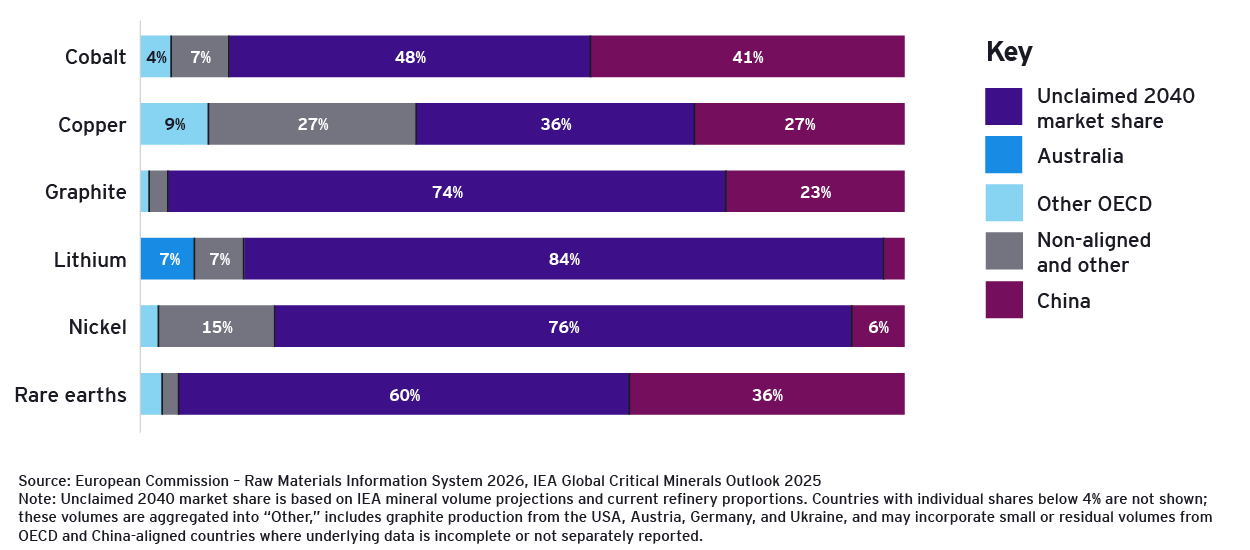
Critical minerals, concentrated control

Chart showing projected 2040 supply gaps and regional shares for key critical minerals globally
Current concentration of processing by nation or group, versus projected global demand by 2040

The scale and speed of demand growth is not just a pressure point. It is a huge opportunity for processing. To meet projected demand will require significant expansion of processing capacity, far beyond what most markets prospectively encounter. This creates a rare window to reconfigure the processing landscape, as significant new capacity must be built rather than expanded incrementally.

Critically, Australia and other middle powers should seek to ensure this expansion is used to dilute the current global concentration of processing. New capacity should be increasingly distributed and structured around trusted partnerships. In this context, demand-driven investment becomes a primary mechanism to rebalance global processing and reduce supply chain risks.

Advantage accrues not only to countries with resources in the ground, but to those positioned at key nodes in the supply chain.

From least cost to secure access

Traditional supply chain models were designed around efficiency and cost optimisation. But highly-concentrated systems create different risks, particularly when geopolitical relationships become more uncertain and industrial policy becomes more interventionist.

The number of trade-related interventions globally has risen sharply in recent years, reflecting a broader shift away from assumptions of frictionless globalisation. Critical materials are increasingly being treated as strategic assets rather than purely commercial commodities.

Slow to supply
16 years
16 years
Average time for new mines to move from discovery to production

Security, redundancy, traceability and trusted partnerships now carry economic value of their own. The opportunity is shifting from least cost to best value – including the value of resilience itself.

That does not mean abandoning global trade or attempting full self-sufficiency. No middle power can secure critical material supply chains alone. Instead, resilience is more likely to emerge through coalitions of countries and businesses that link complementary strengths across extraction, processing, manufacturing and end-use demand.

For Australia, this creates both an opportunity and a strategic choice.

Competing where it counts

Capturing this opportunity will require discipline and selectivity.
 

Rather than attempting to compete across every part of the value chain, Australia is likely to achieve greater impact by focusing on three to five priority areas where it can build globally competitive capability in partnership with like-minded nations.
 

This could include developing common-user processing precincts that reduce infrastructure costs and improve coordination between mining, refining and manufacturing activities. It may involve coalition-linked offtake arrangements that connect strategically important projects with long-term trusted demand.
 

Recent policy developments, including Australia’s Critical Minerals Strategic Reserve, reflect the broader shift underway. Governments are increasingly recognising that supply chain resilience may require targeted intervention to manage volatility, support investment and reduce system-level exposure.
 

Business leaders can also step up by capitalising on leverage points and building the missing system architecture that forms a resilient network.


Summary

Risk and Resilience argues that Australia’s next competitive advantage will not be defined by what it digs up, but by how it builds capability, develops collaborations and positions within global supply chains.

Understanding leverage points withing supply chains and moving early can help Australia capture advantage and enhance security for ourselves and our supply chain partners.

Durable competitive advantage can be achieved when governments and businesses work together to build a resilient system for all Australians, despite the disorderly world.

About this article

Authors

Contributors

Related articles

A time for clarity and confidence: Australian carbon market outlook 2026

Australia’s carbon market fundamentals are sound, but investor confidence will define its next phase. Read EY Net Zero Centre’s 2026 outlook to learn more.

What falling frontiers mean for the global rush for resources

Explore how new frontiers are reshaping the global resource race. Uncover risks, opportunities and what leaders must do next. Discover more.

2035 climate target: Eight keys to achieve net zero

EY Net Zero Centre’s latest report shows most emissions cuts to 2035 can reduce costs. Learn why this target matters – and what business and government can do now to stay ahead.