
EY refers to the global organization, and may refer to one or more, of the member firms of Ernst & Young Global Limited, each of which is a separate legal entity. Ernst & Young Global Limited, a UK company limited by guarantee, does not provide services to clients.

EU packaging rules are changing the game, challenging businesses to ensure resource efficiency, compliance and long-term resilience.
In brief:
- The Packaging and Packaging Waste Regulation (PPWR) signals a major shift toward sustainable packaging through reduction, reuse systems, and improved recyclability.
- Companies must rethink packaging across their full lifecycle to meet compliance and unlock innovation.
- By staying on top of regulations and continuing to innovate toward future-proof packaging, businesses can cut costs and stay ahead in an evolving landscape.
In a time of increasing environmental pressures and higher consumer expectations, the Packaging and Packaging Waste Regulation (PPWR) marks a turning point for all companies that are dealing with packaging on European territory. Building on the Extended Producer Responsibility (EPR) concept already implemented since the 1990s, the PPWR introduces directly applicable EU-wide rules that push companies to use packaging that is resource-efficient, recyclable or re-usable and, in the end, future-proof.
How is PPWR shaping the packaging of the future?
The PPWR came into force on 11 February 2025, with its first binding obligations taking effect on 12 August 2026. The regulation aims to significantly reduce the environmental impact and volume of packaging across the EU, focusing on three main eco-design levers, the 3Rs: Reduce, Reuse, and Recycle.
Reduce
Reduction is a top priority according to the Waste Hierarchy principle and the PPWR. Packaging plays a vital role in protecting product quality, ensuring food safety and shelf life, and facilitating communication and transportation. However, it also contributes to the environmental impact of the product: packaging alone represents on average 5% to 10%, and up to 20%, of a product’s environmental footprint. Reducing materials used as much as possible, without compromising the key roles of packaging, involves lightweighting, right-sizing, and eliminating unnecessary components, thereby reducing both resource consumption and waste generation.
Reuse
The PPWR promotes the implementation of reusable packaging systems, encouraging a shift from single-use solutions toward refillable containers or deposit-return schemes. These circular approaches extend the lifecycle of packaging and can reduce emissions and pollution, and improve resource efficiency.
Recycle
When reduction and reuse are not an option, packaging must be designed for effective sorting and recycling as much as possible. By 2030, packaging will have to be 70% recyclable to be allowed in the EU market and plastic packaging will have to contain recycled content.
As a reminder, some key targets outlined in the PPWR:
|
Target |
Deadline |
|
|---|---|---|
|
Transport & sales packaging |
40% reusable |
2030 |
|
Transport & sales packaging |
70% reusable |
2040 |
|
Recycled content |
30% recycled content (PET & other plastics) |
2030 |
|
Recycled content |
50-65% recycled content (PET & other plastics, depending on material) |
2040 |
|
Recyclability |
All packaging must be recyclable by design |
2030 |
|
Packaging waste reduction |
-5% vs. 2018 |
2030 |
|
Packaging waste reduction |
-10% vs. 2018 |
2035 |
|
Packaging waste reduction |
-15% vs. 2019 |
2040 |
The PPWR establishes the overarching framework for packaging and packaging waste, but it does not set out all the technical details yet required for its application. These will be developed through both implementing and delegated acts, which serve to translate the regulation’s provisions into concrete, practical, and enforceable measures across the EU:
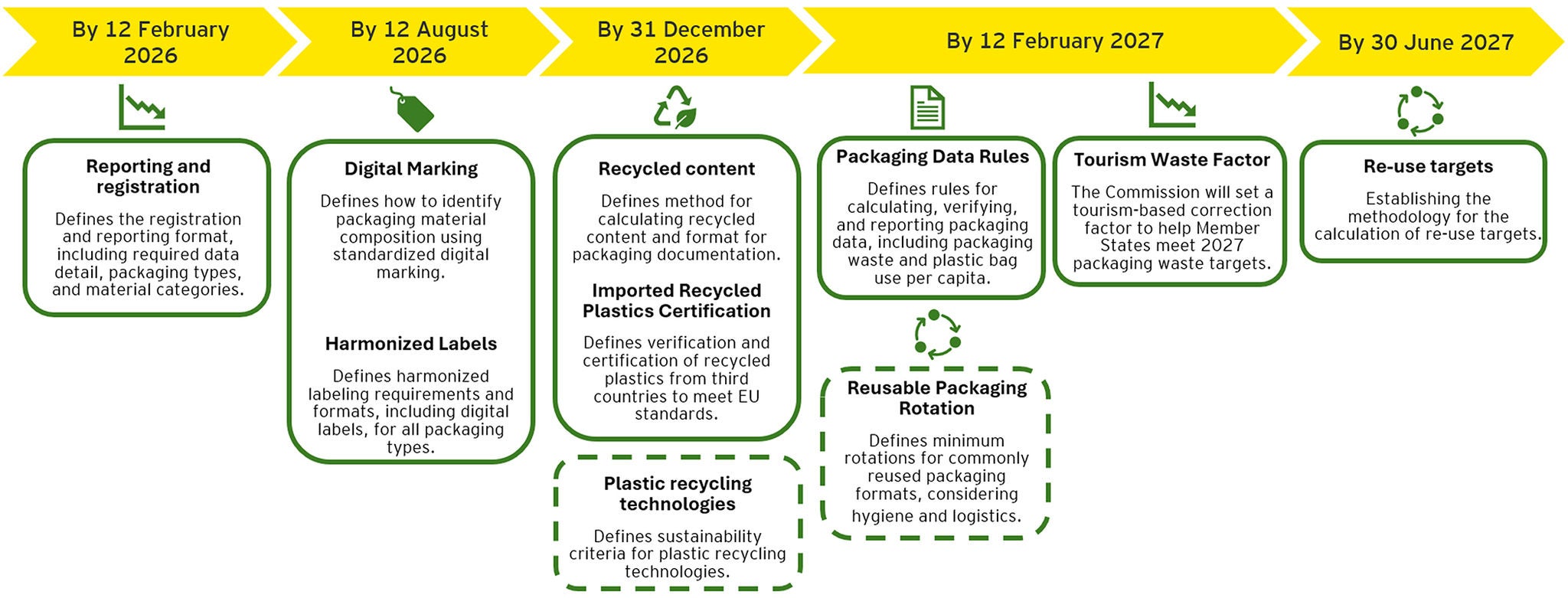
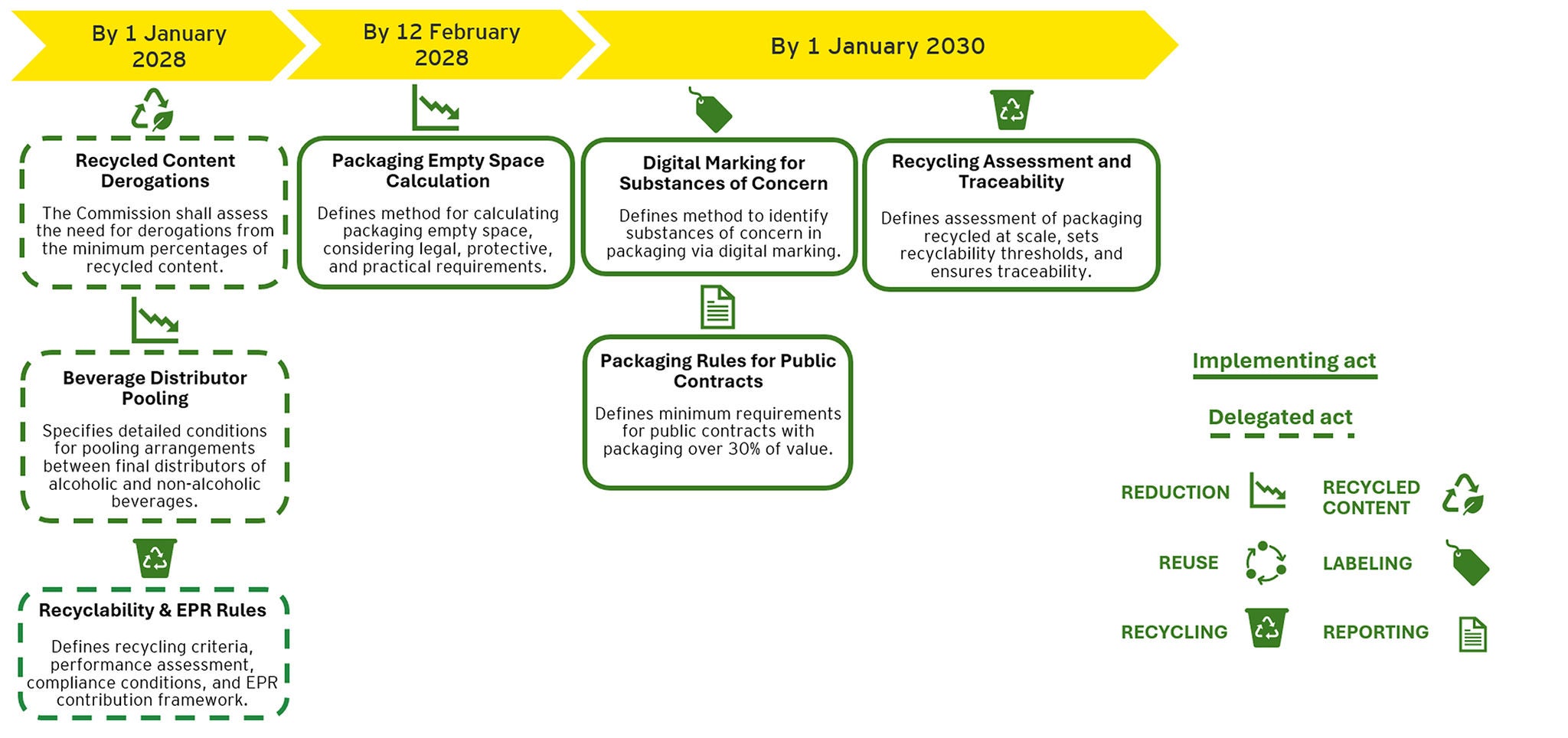
Businesses should actively monitor regulatory updates, set targets accordingly, adapt and design their packaging, considering resource procurement, consumer expectations, sourcing practices, and waste management. Compliance will also require accurate, detailed data on packaging, yet many businesses lack systems to capture and report this information across supply chains: a global packaging survey reported that 73% of companies still rely on manual spreadsheets for sustainability data, leaving most unprepared for detailed reporting under new EPR and PPWR rules. Strong data management is essential, not only for meeting regulatory requirements but also for driving efficiency, transparency, and innovation.
How to navigate through challenges and seize opportunities?
In light of the PPWR, companies have to rethink their approach to packaging. It starts with compliance but also goes far beyond: future-proof packaging is about creating solutions that are sustainable across the entire lifecycle, from producing and sourcing materials to end-of-life, through recycling and reuse.
This shift presents companies with a powerful opportunity to identify alternatives to traditional packaging, explore resilient materials and design packaging that minimizes virgin resource use while extending product lifespan.
By embracing these trends, companies can innovate in ways that differentiate their products in the market, unlock efficiency gains, and reduce fees, all while staying ahead of regulatory requirements. In short, the move toward sustainable packaging is not just a challenge to navigate; it is a strategic opportunity to enhance brand value, drive innovation, and secure long-term competitive advantage.
Where to start today?
8 key actions that will remain valid under the more detailed delegated acts of the PPWR:
- Start with data
Structure your packaging data so you can redesign faster, report confidently, and stop overpaying EPR fees.
- Right‑size and simplify
Remove excess space, thickness and unnecessary components; reduce individual portions when possible. This aligns with PPWR minimization and prepares you for recyclability grading.
- Design for real recycling
Design packaging in simple, mono-material formats that can be easily sorted and recycled. Avoid inks, coatings, decorative laminates or colors that disrupt recycling streams. Target PPWR recyclability grades A (≥95%) or B (≥80%) now to stay ahead of future restrictions as the EU finalizes Design-for-Recyclability criteria and ”recyclable at scale” requirements.
- Shrink your EPR bill
Reducing packaging and improving recyclability can deliver significant fee reductions at portfolio level. Make use of your country’s eco-modulation system and follow the most advanced rules. Use these as a proxy for future EU harmonization to guide portfolio redesign.
- Pilot reuse
Consider innovative packaging and reuse pilots initiatives in a targeted test market. Validate demand and further seek for challenges at risk of being overlooked, while keeping the consumer well-informed. Think outside the box and follow evolutions in the market of reusable packaging
- Choose lifecycle assessments (LCA) wisely
LCAs bring value when applied to a specific, concrete context. Generic or “one-size-fits-all” LCAs can highlight differences between two packaging options but they are highly sensitive to assumptions (functional unit, system boundaries, data quality), which can also mislead decisions if interpreted in isolation.
- Build the internal coalition
Situate your sustainability team right in the business structure. Engage procurement, R&D, marketing, and suppliers early to overcome cost and performance barriers.
- Make your consumer part of the solution
When you change packaging, explain why. Use clear, honest messaging and numbers.
As the regulatory landscape continues to evolve, organizations will need a clear view of their packaging portfolios and the agility to adapt. EY’s sustainability and packaging specialists help companies translate these shifts into practical action, from analyzing EPR data and reporting to developing circular, future-proof design strategies. Our EY Belgium team is recognized as a Center of Excellence for Circular Economy within the EY global network.
How EY can help
Service Leader
-
Sophie Chirez
EY Belgium Climate Change and Sustainability Partner
EY Belgium newsletter
Subscribe to our monthly newsletter and stay updated on our latest insights.
Summary
Future-proof packaging is no longer about simply meeting regulations: it's about shaping a vision for eco-design through resource efficiency, reuse and recyclability. Those who invest in adaptive, forward-thinking packaging solutions today will not only participate in a more circular value chain but also prosper in the evolving landscape, turning compliance into innovation, cost savings, and a long-term competitive advantage.