EY refers to the global organization, and may refer to one or more, of the member firms of Ernst & Young Global Limited, each of which is a separate legal entity. Ernst & Young Global Limited, a UK company limited by guarantee, does not provide services to clients.


Since January 1, 2022, a new tax regime has been introduced for inbound taxpayers and researchers. This regime allows for certain costs to be reimbursed to employees without incurring tax or social security charges. To qualify for this status, however, specific strict conditions must be met. Three years after the implementation of the new regime, a substantial decrease in beneficiaries compared to the previous expat regime has been observed. In this regard, the government recognized the necessity to amend these conditions and published a draft Law on July 3, 2025.
Revised eligibility criteria
Inbound taxpayers that want to benefit from the Belgian tax regime for inbound taxpayers may not have had a connection with Belgium in a 60-month period prior to their start date. This implies that the expat may:
- not have been taxed as a resident in Belgium
- not have been taxed in Belgium as a non-resident on professional income
- not have been living closer than 150 KM from the Belgian geographical border
In 2022, a significant salary threshold condition was established for inbound taxpayers. Expats arriving in Belgium were required to have a gross annual salary exceeding EUR 75,000. However, with the introduction of this draft law, this salary condition will be reduced (retroactively effective from January 1, 2025) to EUR 70,000. This adjustment aims to broaden the number of employees eligible for the Belgian tax regime for inbound taxpayers in an attempt to attract more foreign talent to Belgium.
Improved financial advantages
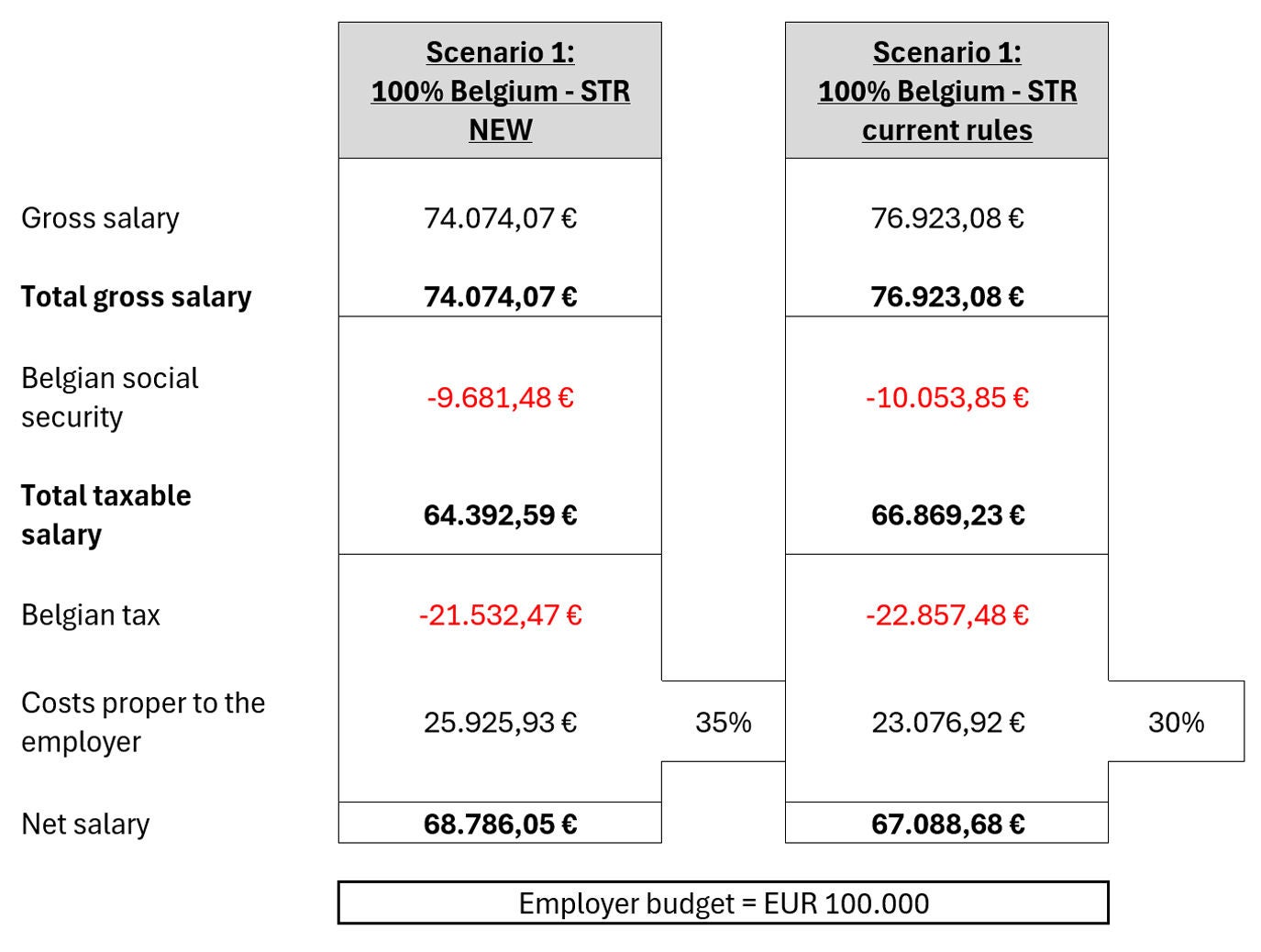
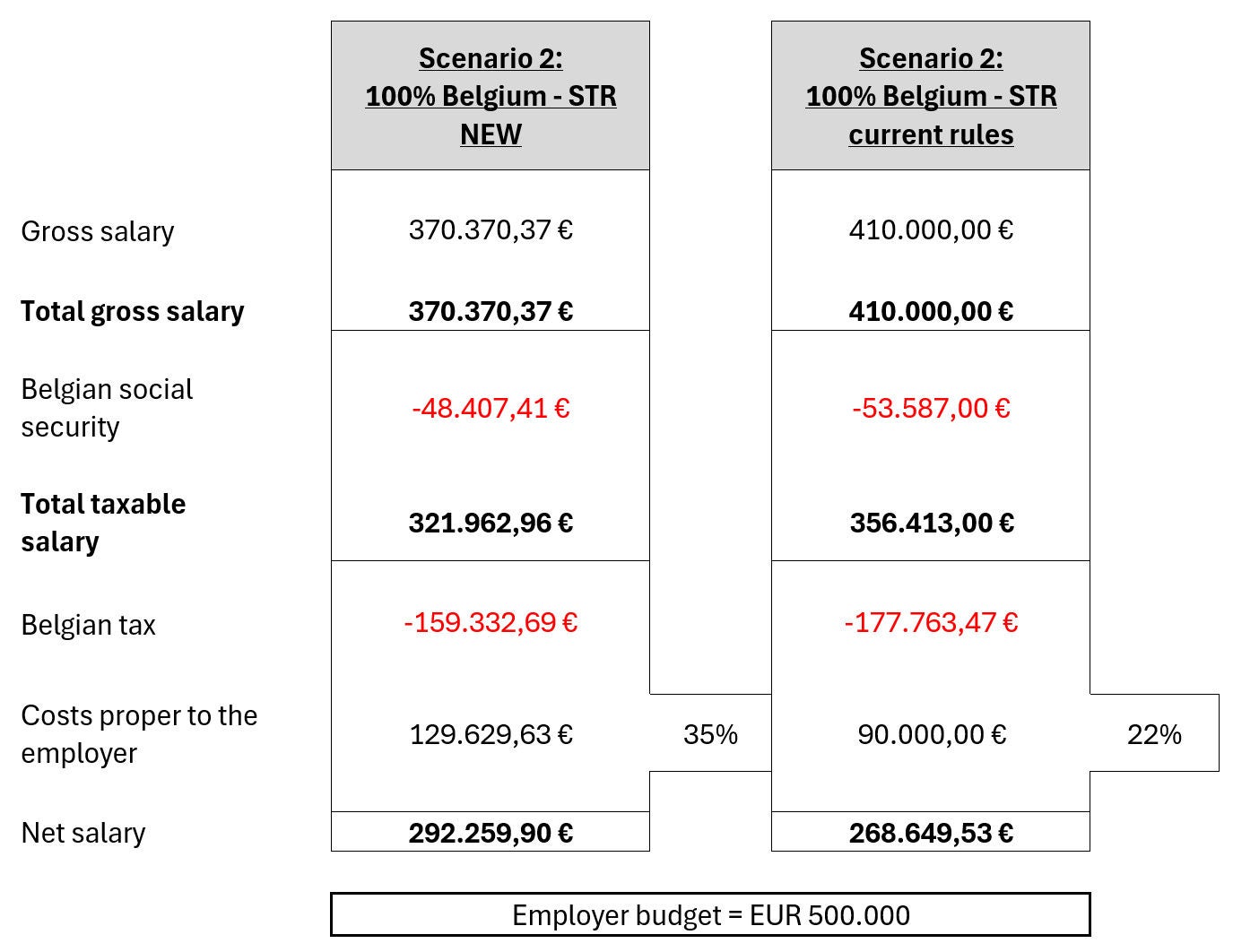
Not only will the entry conditions of the regime be revised, but the authorities are also taking steps to enhance the attractiveness of this status by increasing the financial benefits. Until now, recurring additional expenses incurred due to employment in Belgium were classified as costs proper to the employer, capped at 30% on top of the gross remuneration. This percentage will now rise to 35%, and the existing ceiling of EUR 90,000 on these recurring expenses will be abolished.
What will it mean in numbers?
To provide a clear understanding of the implications of the changed terms and conditions, we made some simulations based on two different employer budgets. First, we will consider an employer budget of EUR 100,000. By comparing the current benefits with the new ones, the net difference can be illustrated as follows:
Secondly, we will illustrate the potential impact of abolishing the EUR 90,000 cap for senior executives:
A more widely embraced regime for inbound taxpayers?
It remains to be seen whether the new conditions and enhanced benefits will lead to an increase in applications for the Belgian tax regime for inbound taxpayers. Important to note is that employees currently benefitting from the special expat status will also be eligible for the new, more attractive, rules, which will apply to remunerations paid or attributed as from 1 January 2025. In this respect, it is important to screen your current expat population and double check if the more favorable rules can apply to their situation as well.
If you have any questions or need further information, please feel free to reach out to EY. We are more than happy to assist you.