


EY refers to the global organization, and may refer to one or more, of the member firms of Ernst & Young Global Limited, each of which is a separate legal entity. Ernst & Young Global Limited, a UK company limited by guarantee, does not provide services to clients.
Recent Searches
Trending
-
Advancing Canada’s defence innovation
09 Apr 2026 -
Canadian Insurance Outlook 2026: navigating uncertainty, unlocking opportunity
13 Mar 2026 Financial services -
From bottleneck to accelerator: the strategic role of digital identity controls for industrials and energy companies
18 Feb 2026 Energy and resources

Use design thinking to develop, test and improve apps quickly in a market that’s always changing.
In brief
- Design thinking is a way of working that’s based around deep discovery, understanding and knowledge.
- By eliminating assumptions and surfacing facts, design thinking empowers developers to be more creative and effective when solving problems and building solutions.
What is the design thinking process?
The most important thing to remember when you’re creating an app, whether it’s your first or 500th, is to design a product that’s user focused. Companies often think they have the perfect solution for their clients and want to jump into the development process before stopping to ask the question: is this something my customer/user actually wants?
Design thinking is a process of creative problem-solving, and key to the way EY Design Studio Canada begins each new project. Design thinking stops everyone from starting with an assumption and building a product around it before testing its validity. Rather, it encourages the team to take a step back and focus on the people we’re creating for, which ultimately leads to better and more useful apps.
So, what is design thinking, and how does it keep teams focused on people? Design thinking is a process by which users research, gather facts, identify personas, consult subject matter professionals and brainstorm to generate a great number of ideas. From these ideas, the best are turned into prototypes and rapidly tested to see which works best with your users and how better to refine them.
The six stages of the design thinking process
There are six stages of the design thinking process:
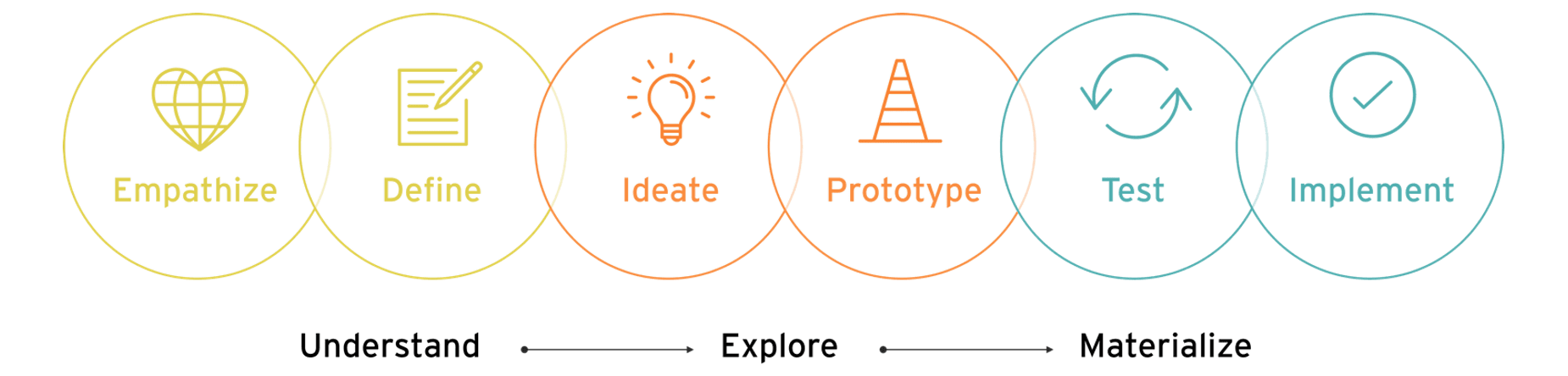
This is the design thinking process according to the Stanford d. School.
Note that creating a prototype is a relatively late-stage step in the process, which some people find surprising. Many people and companies come to the table thinking they know exactly what they want to make. This can be dangerous, because they may be going off of the wrong information or making the wrong assumptions about their products’ or services’ users.
For example, do you need an app that sells your products because you think the client is looking for a way to buy your product on their mobile phone, or because you think it might be another revenue stream for your company? As you can see, one is taking what a user wants into consideration, while another is merely concerned with the business. With design thinking, the user always comes first. In this case, there are a few things to do before you begin to develop an app. It may be that mobile purchases are an important feature to consider. But with design thinking, you need to talk to your users first. Start by asking questions to find out who the users are and what needs they have and the motivations behind them. How many, for example, shop using mobile devices? And what type of mobile devices do they use? You might also want to consult outside data or professionals. Are people buying your particular product on mobile, or do they prefer an in-person purchase — and if so, why? Answers to these questions will dictate everything from what platform to build on to what features the app needs to serve a user’s requirements.
When do I use them?
User stories are written throughout the agile project. However, the business analyst assigned to the project should produce user stories in the discovery phase. After the discovery phase, everyone on the team will then participate to create a product backlog of user stories. This backlog will fully describe the functionality to be added over the course of the project. In an agile project, new stories can be written and added to the product backlog at any time, by anyone.
Here’s why design thinking is important
"Think of design thinking as a sort of scientific method. It helps teams get around biases to focus on root problems by creating a structure i to systematically approach customer feedback and problem-solving."
Design thinking helps to focus problem-solving by creating a set of processes that can help locate pain points, then work through to the leading-class solutions in time-efficient ways. Think of design thinking as a sort of scientific method. It helps teams get around biases to focus on root problems by creating a structure to systematically approach customer feedback and problem-solving. The output of these processes can also provide user research artifacts to which your entire team can refer to help answer questions that arise throughout design and development.
Design thinking helps with the design process and is important for many reasons:
- It helps keep a human element at the centre of the process.
- It takes the guesswork out of what your client’s needs are.
- It allows you to prioritize solutions.
- It generates revolutionary ideas by creating a “yes, and…” mentality during brainstorming.
- It helps teams learn quickly by allowing the team to fail faster and build out ideas more effectively.
- It’s flexible, allowing you to move forward and backward through the process to prototype and iterate faster.
But design thinking is also important from the business perspective:
- It nurtures a customer-first approach to problem-solving.
- Reveals gaps in business intelligence about your users.
- It reveals pain points experienced by the client and, if these are removed effectively, helps businesses ease friction from actions (like purchasing).
- It saves time and money by informing what not to do.
Why design thinking is so useful in tech
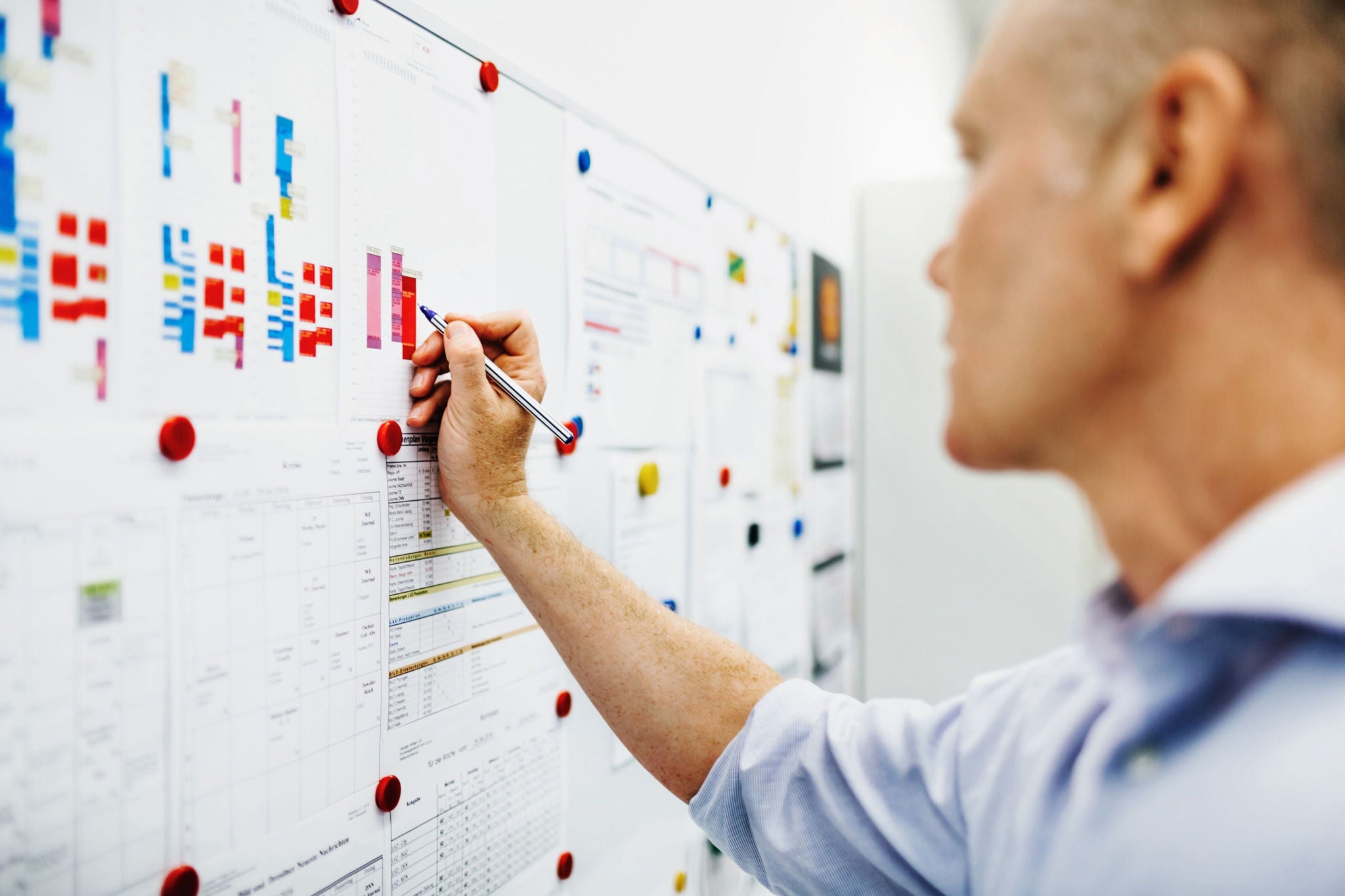
When building an app, many people get excited about all the potential bells and whistles that can be added to really “wow” a customer. But more often than not, simpler is better. How do you pare down an idea to its essence to address your user intuitively knows how to use the app? It starts with understanding your client/user and how they might use the tech itself. That’s why it’s so important to get their input early on in the process. An augmented reality (AR) buying environment may seem super cool in theory, but what if your customer prefers a simple one-click shopping experience?
Keeping things structured
Although design is often considered the realm of creatives who — we’ve been led to believe — prefer an overall lack of structure, design thinking is very much a structured exercise. This purposefully structured systemic approach to creative problem-solving is important for a few reasons. It instills confidence in the team, who can move through things step by step. Each step has a clear output that the next activity relies on, so going in order and moving through the process remains integral.
You also don’t have to know how to code an app or work Photoshop to jump into a design thinking framework. It’s meant for diverse teams to be able to have input in the process and the steps all along the way.
That’s one of the reasons design thinking works so well for EY Design Studio and the clients. As we prefer to have a collaborator-developer relationship with companies, design thinking allows us to pull our collaborators into the process. They can help shape questions to customers, share insights, source experts, and build user personas around the collected data. They are also part of the ideation phase where we begin to source solutions. Mockups, prototypes and iterations are all collaborative efforts, which helps maintain transparency in the overall process, and our client-collaborators can participate in the process largely due to the design thinking framework.
The importance of waiting to prototype
Design thinking reduces risk and uncertainty in innovation. It does this by engaging with customers/users at every step of the process to refine concepts, test assumptions and prototype solutions. Design thinkers rely on user insights, not historical data or research. That’s why prototyping comes a bit later in the process. First, the user must be understood. Then, solutions can be sourced that will fit their needs.
Fast failing
Once the leading-class approaches have been revealed, it’s time to mock up, test and iterate. Design thinking allows teams to fail fast and test theories relatively inexpensively and quickly. You’ll be able to see what works and what doesn’t, understand why, figure out how to fix it, and then craft simple solutions based directly on user feedback.
Here’s why that’s good:
Prototyping allows for the design thinking process to remain non-linear. This means you can test assumptions through prototypes and learn from the prototypes to form new, sometimes better, ideas. You can test, return to the ideate phase and prototype again. The end result is a stronger product that’s already been through the fire on multiple occasions. Weak spots are ironed out and processes are streamlined to create something that’s both useful and intuitive. But the end product only comes from multiple passes of iteration.
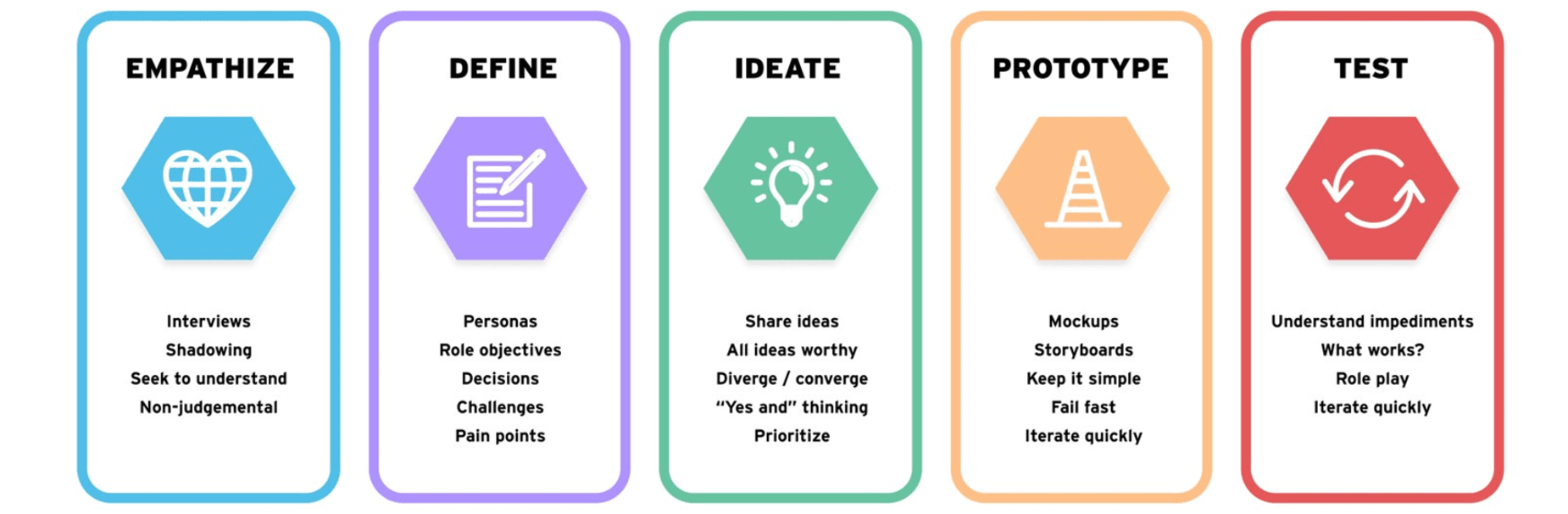
Fast failing is important in tech, as it’s a way to save time and resources while working towards a solution. Instead of working backward — building something that a user rejects and then figuring out how to make the user respond to the end product — design thinking allows us to take smaller bites, by finding what works and discarding what doesn’t.
Creating the perfect app in the first go just isn’t going to happen. But what design thinking allows for is for the best ideas to rise to the top and be tested for strength of concept. It allows for iterations and simple refinements that make the best ideas even better. And it allows you to go back and try again — whether that means prototyping a new design or redefining the problem.
This may seem like a lot of work – and it is. But it also means that we’re going to end up developing the best end product possible. Also, because we’ve kept the user at the centre of the process, it means your customers are much more likely to use your solutions. We’ve listened to them, gathered feedback and designed an app that addresses their pain points and meets their needs. Ultimately, the due diligence performed during the design thinking process is aimed at creating a robust and useful app that will complement your business and delight your customers. And the best part? You’ve probably gained some pretty powerful insights on your customers that will reverberate into other areas of your business going forward.
Are you ready to build your own app and curious about our process? Reach out and say hi! We’re here to answer your questions concerning how we build strong client relationships and intuitive apps.
Summary
Assumptions hold solutions back. Design thinking moves development forward. How? By enabling teams with an agile a process for researching users, gathering facts, establishing personas, consulting experts and brainstorming ideas – fast.